Why Choose Board Service and What Makes a CAAP Board Different
What does it really mean to serve on a Community Action board?
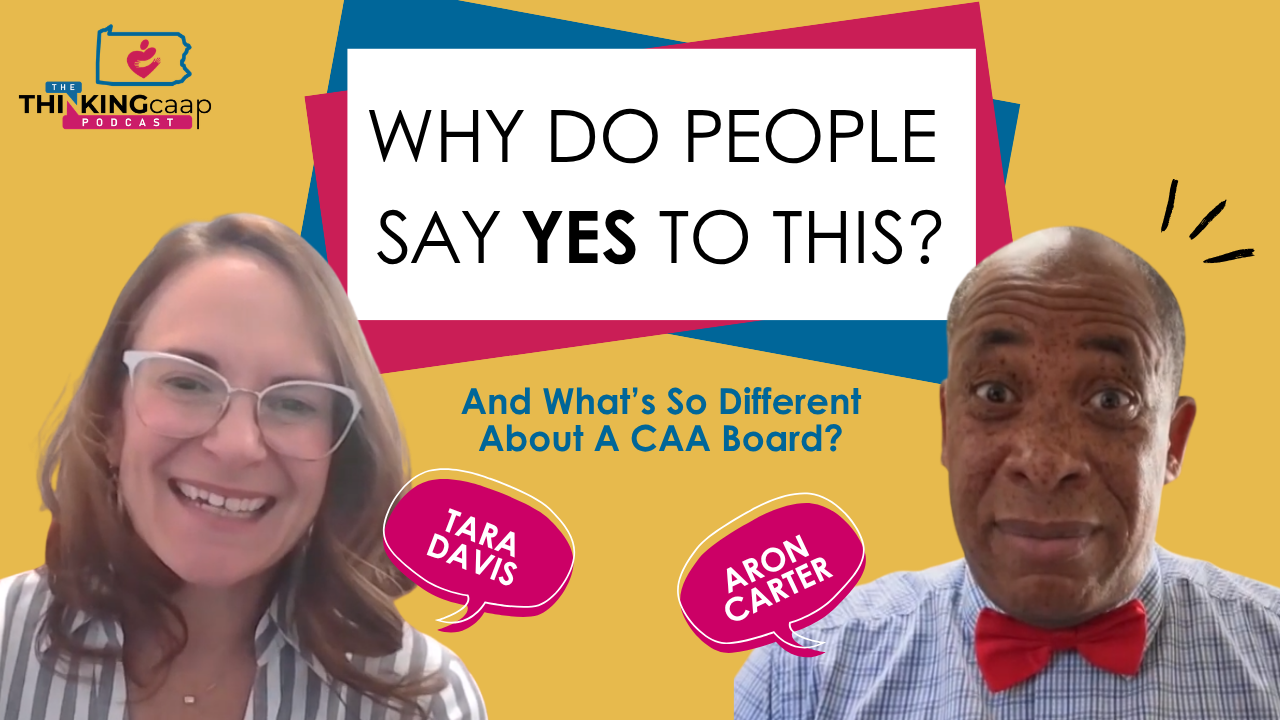
In this episode of Thinking CAAP, Beck Moore explores that question through two separate conversations with board members who bring very different experiences and a shared commitment to community.
In the first half of the episode, Beck talks with Aron Carter, who reflects on his journey from being a Head Start graduate to serving on the board of STEP, Inc. Aron shares why vulnerability matters in board service, why nonprofit work is often far more complex than people realize, and why meaningful board recruitment starts with relationship and trust.
In the second half, Beck is joined by Tara Davis, who brings more than 20 years of nonprofit experience to the conversation. Tara discusses what makes Community Action unique, the importance of including lived experience in leadership spaces in authentic ways, and why breaking stigma around poverty starts with telling the real stories of the people Community Action serves.
Together, these conversations offer a thoughtful look at what strong board service can look like — from governance and accountability to empathy, lived experience, and the responsibility to listen well.
If you’ve ever wondered how Community Action boards function, why their structure matters, or what real leadership looks like in service to a community, this episode is for you.
Thinking CAAP Episode 34 Highlights
[0:00] Introduction to Board Service in Community Action
Beck Moore introduces the episode as a conversation about what it means to serve on a Community Action board.
He explains the unique structure of Community Action boards, which include public sector leaders, private sector professionals, and individuals with lived experience.
Beck previews the episode as two conversations with two different board members from the Community Action Network in Pennsylvania.
[1:47] Aron Carter’s Background and Connection to Head Start
Aron Carter introduces himself as a banker located in Central Pennsylvania.
He shares that he graduated from Head Start in 1976 and later joined the STEP board in Williamsport, Pennsylvania.
Aron also mentions doing tax work for another agency, CSO.
[3:26] Why Aron Said Yes to Board Service
Aron shares that after moving into the Williamsport area, he heard someone talking about STEP and Head Start, which immediately got his attention.
He first joined the Head Start Policy Council and was later invited to join the board because of his banking background.
Aron says he joined around 2014 or early 2015 and has enjoyed it ever since.
[4:34] Vulnerability, Learning, and Perspective in Board Service
Aron reflects on how board service creates opportunities to learn from others.
He explains that vulnerability allows people to see things through the eyes of others rather than staying trapped in assumptions.
Aron emphasizes the importance of being open to learning from others rather than assuming you already know.
[6:17] Distinctives of Community Action Board Service
Beck asks Aron about the differences between serving on the STEP board and serving on other boards.
Aron’s experience on the North Central Sight Services board provides contrast and context.
The conversation begins to explore how the Community Action board service differs from other nonprofit boards.
[8:02] Why Community Action Work Is More Complex Than People Think
Beck notes that many people underestimate how complicated nonprofit and Community Action work really is.
Aron explains that Head Start and similar programs carry significant financial reporting, audit, and compliance demands.
He emphasizes that losing funding could shut an organization’s doors, which makes the work especially serious and complex.
[11:23] Change Takes Time, but Action Matters
Aron reflects on how change in people’s lives may take six months, a year, or even decades.
He stresses that if you do not start somewhere and do something, nothing will ever change.
Aron describes Community Action as offering a step or hand up so people can navigate life and eventually bless someone else.
[13:08] Board Recruitment, Relationships, and Hidden Stories
Aron says people often do not know one another’s full stories.
He suggests that board recruitment can begin by simply talking with others and learning more about their background.
Beck thanks Aron for joining the conversation and reflecting on his experience.
[14:45] Tara Davis’s Nonprofit Background and Path to Tri-County
Tara Davis shares that she has more than 20 years of nonprofit experience, beginning with volunteer work in college.
She started at the YWCA, later moved to the Central PA Food Bank, and eventually joined the Tri-County Community Action board.
Tara describes that opportunity as a gift she did not realize she was receiving at the time.
[17:22] Learning the Complexity of Community Action
Tara admits that when she joined the board, she did not fully understand Community Action.
She recalls feeling like her mind was blown by the complexity of the work.
Beck describes Community Action as the complicated best-kept secret of human services.
[18:47] Funding Complexity and Leadership Growth
Tara says one of the biggest learning curves was understanding the complicated funding structure within Community Action.
She also shares a deeply personal reflection about Jen Wintermeyer’s leadership and support.
Tara explains that this support helped create a more confident version of herself.
[21:37] The Value of Tripartite Board Structure
Tara reflects on the value of having nonprofit, public, and private perspectives represented on a board.
She says these different sectors create stronger discussions and add value to strategic planning.
Beck adds that this structure was intentionally designed and depends on strong onboarding and expectation-setting.
[24:56] Lived Experience, Voice, and Tokenism
Tara emphasizes the importance of giving people with lived experience a real voice.
She says these perspectives help shape programming while also creating meaningful opportunities for the people involved.
Tara warns that organizations must be careful not to tokenize people with lived experience.
[27:32] Why Community Action Boards Feel Different
Tara says having people with lived experience on the board allows programming to keep evolving.
Beck asks her to describe how serving on a Community Action board differs from serving on other nonprofit boards.
Tara points to the complexity of Community Action’s structure and funding as one of the biggest differences.
[30:06] The Challenge of Umbrella Services and Funding Streams
Beck explains that Community Action agencies often operate under umbrella service models with many different funding streams.
Each funding source comes with its own rules, standards, and layers of regulation.
He emphasizes that weaving these services together is necessary to address whole family and whole health needs.
[31:09] State Budget Impasse and Community Misunderstanding
Beck reflects on how many people do not understand why a state budget impasse creates hardship for agencies.
He explains that this becomes even more complicated when combined with a federal shutdown.
The conversation highlights how broader systems decisions directly affect Community Action operations.
[32:34] Stigma, Story, and Humanizing Poverty
Tara says that every person’s story is their own and should be respected.
She encourages people to examine their own biases and question what really brought someone to where they are.
Tara says one of her proudest experiences is hearing how one person’s life has been changed through this work.
[34:28] Barriers, Blessing, and Empathy
Tara says many people do not understand the barriers that prevent others from getting out of difficult situations.
She reflects on how out of touch some people can be with those realities.
Tara hopes that deeper understanding will help people become more empathetic and compassionate with the human race.
[36:10] Closing and Invitation to Engage
Beck closes the episode and thanks listeners for joining the conversation.
The outro invites listeners to check the show notes, subscribe, and follow the podcast.
Listeners are invited to send questions about Community Action to info@thecaap.org with the subject line Thinking CAAP
Episode 33 Transcript
00:00:00
What's up everybody? Welcome back to Think CAAP. I'm Beck Moore, CEO of the Community Action Association of Pennsylvania. Today we're talking about board service, so specifically what it means to serve on a Community Action board. If you listen to Thinking CAAP before, you've heard us talk about the unique structure of the Community action agencies.
Our boards are made up of people from different parts of the community, public sector leaders, private sector professionals, individuals with lived experience, and that structure really, as we've talked about before, creates something really special, but it also means the people who serve on these boards play a critical role in shaping how Community Action responds to local needs.
00:00:31
And the truth is, you know, a lot of people don't really fully realize what board service actually looks like. It's not just about showing up to a meeting a few times a year. It's really about, right, the best board members bring curiosity, compassion, and a real connection to the mission. So for this episode we wanted to do something a little bit different. Instead of just one conversation, you're gonna hear two perspectives from two incredible board members who serve within the Community Action Network here in Pennsylvania.
00:01:00
So first we're joined by Aron Carter who spent years serving on the board at STEP in North Central Pennsylvania. Aron brings a power. Whole full circle story. He's someone whose life was touched by Head Start as a child and who later found himself serving the very mission that helped shape his early life.
And in the second half of the episode, we'll talk with Tara Davis, who is the chief programs officer at the Central Pennsylvania Food Bank and the board president at Tri-County Community Action. Tara shares a different perspective as someone who works inside the nonprofit sector and also helps guide a Community Action agency through board leadership.
00:01:34
Together, these conversations give us a really thoughtful look at what board service looks like from why people say yes to what they've learned along the way. And to why these roles matter so much for the communities that we serve. So whether you've served on a nonprofit board for years or you've ever wondered what it's like to get involved in Community Action leadership, really this episodes for you. So let's jump in and start a conversation with Aron Carter.
00:02:01
My name is Aron Carter. I'm a banker located in Central Pennsylvania. I've got to Pennsylvania via Florida, where I was born and raised. I grew up communally in Florida the 1st 5 years of my life. And. I'm a 1976 graduate of Head Start, which kind of led me to the board up in Williamsport, Pennsylvania, SEP Board, which administers the Head Start program there, and I was there for 10 years, but, I also do some tax work for another agency, CSO.
I do income taxes for low, low-income and elderly folks during the tax season as a volunteer there. And last board that I'm on that I'm also rolling off of that's in Williamsport is called North Central Site Services. It provides services including employment for blind and visually impaired people. And I'm the board chair there and I've been on that board probably 7 or 8 years.
00:02:54
Yeah, well, thank you for your support of Community Action and long history and love to see kind of the full circle experience within Community Action through the context of our board service. And we have a lot of folks who find themselves in positions of employment or positions on boards as a deep personal connection of Community Action. So I love when that kind of full circle comes, comes around, for sure. So thank you for everything that you do. And what I heard there too was longevity. You've been on a board for a minute. A little bit. What initially drew you to the board service and, and why did you say, say yes?
00:03:30
All right, so in 2013, I had taken a position with the bank in the Williamsport area and someone at the bank, you know, we were befriended each other and we just talking like going to lunch or just talking, they talked about this step forward and Head Start and all that and I kind of, I kind of perked up and I said, you know, I graduated from Head Start in 1976. And somehow the individual reached out to folks at SE and. I had lunch with one of the, two of the folks, I think the president CEO at that time and one of the board members, and then I kind of agreed to go on to Head Start Policy council first.
00:04:19
And then a couple of months after that, you know, someone said, hey, you're a banker, you'll be good for the board. We can help financial person on the board. So I got on the board, probably in 2014, later in 2014, I believe. And 2014, maybe early 2015, it's just don't remember and I've just enjoyed it ever since.
00:04:42
Yeah, I love that. And so for our listeners, I think the other key part here is that not all of our agencies are, are Head Start grantees, Head Start providers, but many of them are, I think in the state of Pennsylvania. I want to say we have 13, don't quote me on that, but I think that's roughly right. and so really close connections, Head Start and Community Action were created. Right around the same time with the War on Poverty Economic Opportunity Act. So our roots come from the, the same place, so very closely aligned with the work that we do.
00:05:10
I'm also on a board and I'm so curious, Aron, what do you think, what do you think makes a good board member? How, how do we show up as a great board member?
being a good board member means make yourself vulnerable. You know, I think too many times we don't want to be embarrassed. We don't. We don't want to not know the information, but being able to raise your hand and say I just don't know that, but hopefully someone can teach me that. And it could be someone can teach me to have more compassion, to be more empathetic, because then once you're vulnerable, then you can see things through the through the eyes of others.
00:05:53
Hm. If you're not vulnerable, then you just make the assumption that you know what it is and all of that and you're gonna go in with this mindset and not really open up yourself to be vulnerable, to learn from others. I think. As you. Look at the, the overall board. Do you see any, I'm gonna go back to this question a little bit. Do you see any distinct differences between your experience serving on the step board versus the other boards that you've stepped, you've served on? Is there anything in particular that you can point to? You're like, you know what, this is a very different experience.
00:06:27
I, I would say with step because it's involved with children. It tends to have a little bit more compassion. And also not only just children but with elderly cause we do Office for Aging that's facilitated for Lycoming in Clinton County through STEP. I think there's a little bit more compassion, there for the ultimate, constituencies for the services that are received. Now, again, I'm on another board called North Central Site Services. It's not a Community Action agency, but it It provides services for blind and visually impaired people, and there's a lot of compassionate folks on our board for those people because just imagine, you know, not having sight.
00:07:15
You know, and, and you know, we and our that organization. You know, when someone's born with the sight. You know, we have compassion for them, but what's even harder is, let's say I've lived my entire life with psych. And then at 60 years old, I lose my sight. Can you imagine that because you know what it is to see. Right. And now you can't see. It's very it's, it's hard to kind of put it into context if I didn't serve on the North Central Site Services Board.
00:07:51
So I'm. Curious about a couple, a couple of things. So one of which is that, you know, I happen to know a lot of bankers in my life, a lot of close personal friends. I don't know if that's, that's a good or bad thing, Aron. I'll let you answer that question. But I know that financial expertise is something that, you know, on the boards that I serve on is, is, is a hard thing to find, particularly right now.
00:08:15
and I think one of the things that we hear sometimes is that you know, nonprofit isn't that complicated, or people sort of have this false sense of the complicated nature of the work that nonprofits do. I've worked in nonprofit for over 22 years at this point, and I'll be the first person to tell you that that's not true, that, and, you know, some good friends of mine will say, you know, nonprofit is a tax code, not a business model. But what would you say to those folks sort of in the business world, maybe fellow bankers, maybe other folks in the professional world that say like, oh, you know, nonprofit, it's just not, can't possibly be that difficult.
00:08:54
It's an idiotic comment. I appreciate that. I appreciate that direct statement. Cut print. Take it to tape. It's an idiotic comment because they don't know and they don't understand. You gotta understand, a lot of nonprofits, funding providers are either public entities or could be private foundations. There's significant financial reporting requirements to those, organizations.
00:09:20
Now just imagine, you know, Head Start is a federal program. The amount of reporting that needs to be done, the audits that are done of them, surprise, even surprise visits. It's a lot of, it's a lot of work. It's a lot of work. More than a typical financial comp a company that's a, a for-profit. Because of who funding providers are. Whether they be public or whether they be foundations, endowments, things of that nature, you know, it's a significant amount of reporting and I can tell you with SEP and the other organizations I've been tied to have some very, very dedicated folks able to do that reporting because again, if you lose funding.
00:10:04
That could shut your door down. Absolutely. Just imagine the pressure that you have in reporting the information appropriately, timely, and it, and it better be accurate. Well, and on top of that, then you're also, you know, not for nothing, but we're also trying to change kids' lives, right? And shape, shape, shape, shape young minds. So you're working with, what, you know, 3 to 5 year olds and trying to work through the developmental challenges and differences from one kid to the next.
00:10:32
And that's, you know, that's difficult in itself. And then you add on the complications of then managing all the requirements and the pieces. So yeah, it's one of the, I asked the question, you know, I was hoping he would respond that way, but I think it's, it's, it's one of the, it's one of the hardest parts about when people are like, oh, what do you really do? And you're like, imagine managing a business when, you know, you're in no real control of your revenue to a degree, and, you know, your outcomes are not, you're not making a widget, right?
00:11:04
You're doing, you're trying to change people's lives and trying to scrape together the money to do it at the same time. It's, it's not an easy task, right, and that's a good point that you make because again, the result may not occur right away when you're selling a widget, you sell the widget, you get money back that occurs right away. So that change in lives may take. 6 months. A year. 15 years, 20 years.
00:11:33
It may take that long in order to get that return, but if you don't, if you don't start somewhere and do something. Then nothing will ever change, yeah. And then you're leaving behind people who need that. Step or hand up. In order to navigate life and then to be a blessing to someone else once they've achieved their goals. Yeah, absolutely.
00:12:00
And so for organizations who are looking to recruit folks who come from the financial world, right, financial institutions, what's something really important to you? I know, again, you know, friends, friends of many bankers. Is there anything in particular advice that you would give to someone who is thinking about, I'm gonna, you know, approach this particular person who is a, a banker specifically, it's really important to understand and evaluate about your agency before they Before they potentially ask the question, like what's what's important to get the yes from the person who is your counterpart?
00:12:36
Well, I would say that. You can't just go directly, say, hey, come be on our board. There's gonna be some type of relationship, some type of connection, right? Cause once you have some type of relationship or connection with someone, it makes it a little bit easier. It may take some time to talk them into it or what have you. And I think what people don't realize is they don't realize that. Maybe they're the answer, and it's not finding someone else, maybe it's.
00:13:08
You, maybe it's your spouse, maybe it's your neighbor. And again. You know, we don't know people's stories, we just assume like, yes, I'm a banker. I could have a neighbor that's retired that I don't know, know anything about that's a whiz with financials, but I never sit back and I talked to him about it. Or someone. I think we don't know people's story and, and making connections.
00:13:32
So, I want to say thank you, you know, on behalf of the Thinking CAAP for joining us for a little conversation today. I enjoyed it. Thank you for your continued service at CSO with the Vita program. Thank you. Aron, thank you so much for sharing your story and your perspective. Conversations like this remind us that board service is about people who care deeply about their communities and are willing to step up to make a difference.
00:14:03
Aron's story is such a powerful example of how Community Action comes full circle in people's lives from being supported by programs like Head Start to then later giving back through leadership and service. And that idea of service showing up in different ways is exactly why we wanted to bring you more than one perspective in this particular episode. And so in the next part of our conversation, we're joined by Tara Davis, who again is the board president at Tri-County Community Action and also serves in a nonprofit role as the chief programs officer at the Central Pennsylvania Food Bank.
00:14:27
Tara brings another important viewpoint to this discussion and, and someone who works inside the nonprofit world every day while also serving on a, a Community Action board. And so Tara shares what it was like stepping into board leadership, what surprised her about Community Action and why having people with different perspectives around the board table is so important. So, put on your thinking cap again or keep it on and let's continue the conversation here. Tara's experience serving on a Community Action board.
00:14:54
Beck, thanks so much for having me. I'm thrilled to be able to chat with you today and just talk a little bit about my experiences with the Community Action world. So, in my 20+ years of nonprofit experience, I have, it's more than 20 years actually because I've been at the food bank for 18. I've just been a nonprofit world for as long as I can remember, really actually started volunteering in college, during college, which I went locally. so a lot of my volunteer work was done in Allison Hill. so then that kind of brought me into the work that I did. I knew I wanted to do nonprofit, started out with the YWCA up on the hill, and transitioned over eventually here to the Central PA Food Bank.
00:15:36
doing special events was really where I started. marketing communications is my background, and, and about 7 years in, I wanted to take a leap into the program side. And so, I was, I had the pleasure of being able to start our Snap Outreach program. and now here I am, the chief Programs officer at Central Pennsylvania Food Bank. I oversee a staff of about 36 employees and we cover 27 counties, 1100 partners. so I oversee all of that, the, the team that manages all of those feeding programs here.
00:16:12
and so, I would say about 7 years ago, I was approached by our then, CEO Joe Arthur and said, hey, we have a team member that is currently on the board. At Tri County, but, you know, she really has a lot of commitment. She's going to have to kind of step down, and thought this would be a great opportunity for you. So I always like to say I was voluntold. but when he told me about what it was all about, and I looked into it, I was like, absolutely, this is totally down, you know, my alley. Like I, you know, obviously, I love community. I am all about helping community in any way it is.
00:17:10
in college, my, my girlfriends called me mother hen, and that's not just for the people, you know, the, the individuals that I love, but it's just about, you know, the community that I love. and so being able to join Tri-County, as a board member was just really a gift that I didn't realize I was being given at the time. and that doesn't mean that when I joined, I was like, Oh, I know. Yeah, I totally understand this. No, my mind was blown. And I was like, what are they talking about?
00:17:34
Yeah, look, Community Action, we'll get into this a little bit. I mean, it's, it's a complicated. Best kept secret of human services. Mhm. Yeah, it really is. But what I love about Community Actions is that it's, it really is about community and about building that community, but understanding what that community wants to be, right? Like, and then giving the resources and the skills to those members of the community. So that that so that they can all thrive together. Absolutely.
00:18:05
Is there any professional development that you feel like you've really, or growth that you've had professionally that you attribute serving on a board to, like anything that you can be like, yeah, this one thing, like this is something that I can so clearly see. Oh, and if not, that's OK. No, so it's funny, I, you know, we kind of get prepped here, have some questions to be able to look at and kind of think about. And when I saw this question, I kind of looked at it in a different way.
00:18:35
you know, I understand the human services world, probably a little bit more than than some others that sit on the board. so I feel like I, I was pretty connected to that. The one thing I wasn't connected with was all of the, just all of the, the nitty gritty pieces about the funding piece with the Community Actions and how that's all intertwined and And while every Community Action is like its own, right, because every community, it, it has its own needs, you have this hierarchy that you have to kind of follow, you know, certain things.
00:19:13
So that was, that was definitely a learning opportunity, but The way that I looked at this in a little bit different light was the development and the courage and the strength that the, that Jen Whittenmeyer, the CEO has given to me. She, Trying not to get emotional here. She saw and has seen things in me that I never saw myself. And has created this. This new has helped helped create a new confident Tara. Yeah, I love that. Yeah, it's been pretty special. She, she has, Filled a special place in my heart.
00:20:03
Yeah, we've already talked in previous episodes about the tripartite board and what that means. And so quick, you know, reminder for everybody who's just listening maybe for the first time with that. Is a federally legislated legislated requirement that our agencies have public sector, private sector, and low low income representatives on their boards. So 1/3, 1/3, 1/3, and so it creates a really interesting dynamic then. So I know from my vantage point why I think that is important, but with your experience, how has that really impacted kind of the discussions that you've had and how have you seen that play out?
00:20:46
Yeah, I. I actually really think it was. Well, I shouldn't say it was completely a brilliant idea because I think it, it may not work in some instances and, and spaces, but for Tri-county, we have a really phenomenal board. and I think, and Jen would tell you the same thing. I mean, I think she really feels like our board is, is, representative of the communities and of, you know, all three of those sectors across the board, and they're good board members that ask the right questions, participate in the right way.
00:21:27
but then I think, you know, what I see the benefit of this is, You have all of these different perspectives. Right? So you have the nonprofit sector and whether that is somebody with lived experiences, or somebody who works with people with lived experience, you have that, that perspective, right? You've got the, the public, perspective, and the private, it's just, but I just think that all three of those sectors really allows you to see the larger part and understand the larger part of The discussion, right?
00:22:07
When those discussions are being made at a board level, or we're starting to talk about the strategic plan and helping to develop that or just asking the questions, you're getting totally three different mindsets in, in a sense of the sectors, and then whatever the personalities are that are, you know, named in those sectors. so, I think that there's, it just brings great value, In in having that particular. Structure.
00:22:41
Yeah, I mean, I think there was intentionality is what I like to say with the creation. Where I have seen there to be challenges is the onboarding, right, and the level setting and the expectation setting of here's the rules of engagement, here's making sure that everybody has an understanding of information. is important because you, you have people who may have never. Had the types of conversations that you're having within a cross-sector environment, right? And so thoughtfulness in those conversations is important and that could be a whole another episode, frankly, to talk about.
00:23:19
Absolutely, yeah, I mean, you think about somebody that is the, the nonprofit sector with a public sector, right? Like I'm thinking nonprofit and banking. Two totally different mindsets, but both incredibly valuable perspectives. But how do you have those productive, constructive conversations and questions, during a meeting that doesn't feel like, you know, one's attacking the other or one's better than the other, which we don't have in our board, not right now anyways, because I'm president, but I love that scream of fun here. She is the president. Ta da.
00:24:12
no, I think, you know, that, that just speaks to how well, Jen reads people and knows if they would be a good fit, for the, the folks that are already on the board and just kind of being able to manage those dynamics. Yeah, so I think to that end, and, and I think the onboarding process is particularly important with the Community Action board is my personal opinion, But for, for you. And I think a little bit of a different vantage point because of your day to day work as well, but why do you think that it's important that our agencies continue to include people with lived experience, having lived in poverty in their governance structure? Like, why is that important from your vantage point? And you touched on it a little bit, but.
00:24:54
Yeah, I mean, I think giving them a voice, right? It's, empowering them, number one, Because, and we, we've talked about this here, you know, how do we do that, not just through putting people on our board that might be a pantry, somebody that runs a pantry, but how do we bring a neighbor onto our board, because of the value that they can bring. it not only helps kind of lift them up and give them a different experience, and introduce them to something new, but then it allows us like It, it allows us to hear their voice, hear what their experience.
00:25:40
Now, what I think you need to be careful of though, anytime that you bring somebody on a board or you use, I don't want to say use, but, you, you know, have somebody with lived experience, working with you is that you, you're not, Oh my gosh, I just lost the word. We don't want to be token. Thank you. Yes, exactly, right, and so a lot of things that we do, and it's something that, you know, I know that, Community action also is feels strongly about is like not rewarding them but paying them for their time, right?
00:26:18
So when we have surveys that we're doing here at the food bank, we're paying them for their time. and I know we do that at Tri-county, certain grants that we have, you know, that's budgeted in there to be able to pay them for their time because, again, it's not like, hey, you, you know, you have, you're going through this experience and so we want to know all about it and then we're gonna spread the news all over, you know, Dauphin County, but that's it then. Thanks for your time. See you later. And we'll crumble you up and throw you in the corner.
00:26:48
No, that's, you know, I think, you know, we, we have to be very careful in making sure that we're being respectful, and, mindful of that. But, ultimately, I think they bring this completely different, view to the work. You know, we could sit there all day and say, oh yeah, no, I think we need to change this, and it'll and ask them to do that. Well, Do we? And why and, you know, will that just put another barrier? Will that create another barrier for that person? What can we do to create the least amount of barriers for, for folks that are using these services?
00:27:32
And I think having people with lived experiences on the board really allows us to talk about that and and figure that out and then just continues to allow our programming to evolve. Is there anything in particular that you want to share around kind of the difference between from your vantage point, serving on a Community Action board compared to other nonprofit boards? Like what, what is something that just, you know, this is a distinct difference. Just the complexity of not just being your own board of the community that you serve, but then being a bigger part of, you know, a national.
00:28:12
The National Community action or even like the statewide Community Action, right? Like there's, there's all these layers to it. And then there's so many different aspects as far as like the funding goes, and I think that was a big change for me, if I look at like a comparison, right, of, you know, the nonprofit world that I'm in, compared to the nonprofit world of Tri-County, and the funding. That was something that was very new to me and to understand. The funding and how, you know, the, where it comes from was very different than where the food bank funding comes from, right?
00:28:49
And just understanding, understanding it, but then understanding the requirements and understanding kind of, you know, like, for instance, recently, right, our, our state and federal budget impasses and how that affects. Community actions, and that became a a conversation for us was, you know, what do we do if we lose this? And, you know, do we have contingency plans? And should we start making them? Should we start talking about them, right? And I think you said it earlier, that was kind of risk assessment.
00:29:30
And I think as a board, that's something that's the hat we always have to have. Right, it's really, you know, Jen can't do that alone because she's managing 5000 other things. So, you know, we need to be able to help her look at that and then just say, have you thought of this? and if not, like, OK, now we have, we have something other, something else to do. My last question then is, it can be one of two things, either what myths are you busting within Community Action or for Community Action, or What makes you the most proud to serve on a Community Action board and while you're thinking about that, that final answer, what I will say, kind of going back to your point about the funding that I want to make sure just lift it up, lift up to our listeners is that.
00:30:06
Because of the nature of sort of the umbrella services that Community action, and the programs of the Community action agencies run, that means that you could be working with upwards to, you know, 75 different funding streams, all of whom are. Beholden to a separate set of standards and rules and state departments and that are administered in different state departments, but then are ultimately managed by the federal level. So you have federal regulation and then higher regulations set by the state and that is complicated to then manage.
00:30:40
It's important because of the way that we weave our services together within Community Action in order to be effective to address the whole health and whole family, but it also means complicated talk. Talks and discussions on a board level because. You think you know. Until you know, and then to your point, right, about state budget impasse and something we've talked about a lot within our network in the last few months and then federal shutdown.
00:31:09
Unfortunately, a lot of people don't really understand, general community doesn't really understand why a state budget impasse really does create hardship and complicated problems for agencies, and then on top of that compounded rate is then the federal shutdown when that happens. So it's a, it's a lot to try to explain and make sure that people, people understand for sure. So now Tara, your question.
00:31:33
OK. All right, which one your own adventure you gave me, listen, I'm, I'm breaking the rules. I'm combining both of them and making them one adventure. so the barriers or the, the, yeah, the stigma, right? I, I think one thing that I, I want to do at Tri County is tell the story of who the people really are. And why they're in poverty, who they are, and breaking that stigma. Of, of the people that we're serving, right? It is not somebody who just decided they don't want to work anymore and that they were just gonna, you know, Live off of.
00:32:25
The government, that's not the case, right? Each individual person that we serve at Tri-county has a story. And that story, it's their own. And we, we need to respect that and understand that, right? And then, and then look at our own biases, that bring us to, to that particular, you know, stigma and say, OK, what really brought this person to where they're at? And this is why Tri-County is so incredibly important. To helping even that one individual.
00:33:06
And so that's where my proud moment comes from, right? It's just being able to hear about one story, one person whose life has been touched, whose life has been changed, and they are, they're, they're seeing things in a different light. They are living a life they may never have thought. It was possible for them, but because of the work that Tri County is doing. It's possible for them. And just to see the light that shines on them from that is the best reward I could ever have as a board member.
00:33:49
I know that I wasn't personally that person that touched them. But being a part of the organization that did that. Yeah, is incredible and such a blessing. Yeah, you still influence it. Yeah, so thank you for what you do. I appreciate your, your time this afternoon, and I, and I will say I tell people this pretty often, right? Like when I was homeless, it, I had, I worked 3 jobs, I had a college degree. There were circumstances that were outside of my control, and that's people look at me and they, I will tell them that, and that you were homeless because it's just not perspective is just not.
00:34:26
That assumption and bias that they have in their brain. Yeah, but so many people don't understand, some of the barriers that are put in place that prevent people from being able to, you know, get out of a situation just like that. and, you know, I think it's almost starting from there, getting people to understand that, sometimes it blows me away how out of touch some people are with that. and thinking like, oh, boy, I'm really blessed. I'm blessed to know these things, so that I can, so that I can educate people, right? So that they can have a better understanding, and be more empathetic and compassionate with the human race.
00:35:11
Yeah, agreed wholeheartedly. Yeah, so back. Well. I know you're closing out, but I just want to thank you for having me today. This was, as always, I love conversing with you. So thank you for having me. No, my absolute pleasure, pleasure. Thank you for what you do at Central PA Food Bank. Thank you for what you do at our local community. Thank you for what you do at Tri-County, and thank you for hanging out with us on the Thinking CAAP.
00:35:38
For those of our listeners who are not familiar with Tri-County, we would encourage you to go to TheCAAP.org. You can go to our member section, find out about them, would encourage you to think about dedicating time, talent, resources, whatever that means for you, and, get connected with and or get connected with your local agency. If you need help doing that, you can email us at the info@thecaap.org and thank you for hanging out and putting on your thinking cap for a little bit. All right, Tara, thank you. We'll talk soon. OK, sounds good. Catch everybody next time. Alright, bye.
00:36:10 Thank you for being a part of this episode of The Thinking CAAP. Check the show notes for resources and links to other episodes. And don't forget to subscribe and follow to be notified when new episodes are released. If you have any Community Action questions you'd like Beck or one of our local experts to answer in a future episode, please email your questions about Community Action to info@thecaap.org. Subject line, Thinking CAAP.
If you have any Community Action questions you’d like Beck or one of our local experts to answer in a future episode, please email your questions about Community Action to info@thecaap.org — subject line: Thinking CAAP.