How PA Navigate Is Transforming Care Beyond the Doctor’s Office
In this episode of Thinking CAAP, Beck Moore is joined by Tanoa Fagan of FindHelp and Maria Welch of Geisinger for a deeper look at the systems, partnerships, and people behind PA Navigate.
Tanoa shares how FindHelp’s technology is designed to connect people to free and reduced-cost services with dignity and ease, and explains why social care must be treated as part of holistic care. Maria offers the healthcare perspective, highlighting how trust, connectivity, and strong community partnerships help make social care integration possible in practice.
Together, they unpack what closed-loop referral really means, why this work takes time, how healthcare and community-based organizations can better support one another, and what success could look like as PA Navigate continues to grow across Pennsylvania.
This episode is a behind-the-scenes conversation about systems change, relationship-building, and what it takes to make community support easier to access.
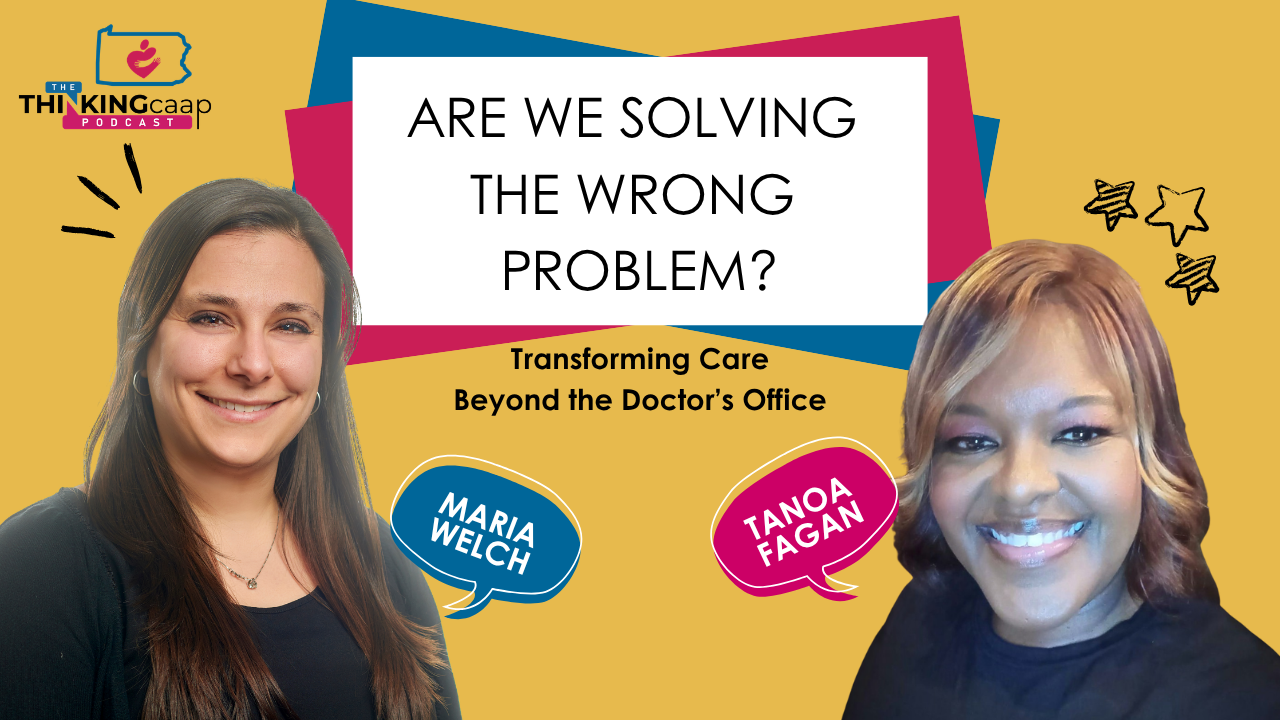
Thinking CAAP Episode 35 Highlights
[00:01] Introduction to PA Navigate and the Episode’s Focus
Beck Moore introduces the episode as a continuation of earlier conversations about PA Navigate.
He explains that this episode goes more behind the scenes with partners on the healthcare and technical sides of the work.
Beck welcomes guests Tanoa Fagan and Maria Welch.
[00:45] Tanoa Fagan’s Background and FindHelp’s Mission
Tanoa Fagan introduces herself as the State Director for FindHelp and explains that she oversees work in Pennsylvania, especially the PA Navigate project.
She shares her background working for the Department of Human Services for about 17 years in public assistance and income maintenance.
Tanoa describes FindHelp as a technology platform that connects people to free and reduced-cost services with dignity and ease.
[03:37] Maria Welch’s Role at Geisinger and PA Navigate
Maria Welch introduces herself as Director of Community Health and Social Needs at Geisinger.
She explains that Geisinger is an integrated health delivery system serving patients and members across Pennsylvania.
Maria describes her work as helping people understand that social care is part of clinical care and that trusted community partnerships are essential.
[06:08] Why PA Navigate Matters in Everyday Work
Beck asks why PA Navigate matters within the scope of each guest’s day-to-day work.
Tanoa frames the issue through social determinants of health and explains that healthcare outcomes are deeply shaped by unmet social needs.
She uses a practical example to show why helping people holistically reduces repeated crisis use and improves long-term outcomes.
[08:20] Trust, Connection, and the Value of Closed-Loop Support
Maria adds that PA Navigate builds trust by creating a reliable connection between healthcare, social care, and the people who need help.
She emphasizes that the platform gives teams a way to continue the conversation and respond to additional needs as trust grows.
Beck reinforces that PA Navigate creates intentional relationship-building between healthcare and nonprofits.
[10:21] The Role of Health Information Exchanges
Beck asks Maria to explain the role of health information exchanges in the broader PA Navigate ecosystem.
Maria describes HIOs as the systems that securely connect health information across care settings so the right people have access when needed.
Beck shares a personal healthcare example to illustrate how shared information can speed up care and improve decisions.
[12:41] How FindHelp Differs from Traditional Resource Directories
Beck asks Tanoa how FindHelp’s approach differs from traditional resource directories and similar technologies.
Tanoa explains that FindHelp improves on the old binder-style model by using technology, automation, and dedicated staff to keep information accurate and current.
She highlights that organizations can also claim their own listings and update them directly when hours, services, or eligibility change.
[16:20] What Closed-Loop Referral Means in Practice
Beck asks the guests to explain what closed-loop referral really looks like on the ground.
Maria describes it as making sure the referral process continues through follow-up, so providers know whether a person actually received help.
Tanoa adds that even when a loop is not fully closed, documenting the outcome still supports better future conversations and care.
[20:45] The Challenge of Coordinating a Cross-Sector System
Beck reflects on how many different players are involved in PA Navigate, including healthcare, nonprofits, state departments, and health information exchanges.
He describes the project as one with many cooks in the kitchen and asks about the challenges of cross-sector collaboration.
Maria responds by emphasizing Geisinger’s intentional focus on shared mission, partnership, and supporting—not duplicating—the work of community partners.
[25:13] Different Perspectives, Shared Needs, and Relationship Building
Tanoa explains that healthcare and social service organizations often describe different barriers, with healthcare emphasizing time and cost and nonprofits emphasizing capacity and resources.
She says the challenge is that each side often has what the other needs, but they do not always recognize it.
Tanoa stresses that bringing these groups into the same room creates breakthroughs, shared understanding, and stronger relationships.
[27:22] Why This Work Takes Time
Tanoa says one of the biggest barriers is the expectation that a statewide closed-loop referral system can happen instantly.
She explains that what PA Navigate is trying to build is game-changing, but it takes time, repeated messaging, and realistic expectations.
Beck frames the work as a true change management and process improvement effort rather than a simple technology install.
[31:29] Why the Right People Finding the Right Resources Matters
Maria notes that strong education, support, and community engagement help reduce implementation challenges and make the process more effective.
Beck adds that some organizations using PA Navigate are not seeing an overwhelming influx of referrals, but rather better matching and better visibility into the people they already serve.
He emphasizes that the platform helps the right people find the right resources more efficiently.
[33:21] What Success Looks Like for PA Navigate
Beck asks what success looks like if the guests could wave a magic wand and shape the future of the platform.
Maria says success means stronger networks, easier access to trusted resources, and a place people can turn to when needs arise.
Tanoa says the ultimate goal is always helping people and sustaining a long-term platform that builds enduring relationships across sectors.
[36:22] Sustainability, Incentives, and Supporting CBO Capacity
Tanoa says long-term success should also include more sustainable support for community-based organizations.
She points out that CBOs often receive funding for services but not enough for staff capacity and human capital.
Beck agrees that sustainability and long-term value are essential to the future of the platform.
[37:02] Advice for Other States Exploring Similar Models
Beck asks Tanoa what advice she would give other states thinking about building similar systems.
Tanoa recommends learning from Pennsylvania’s experience and talking to organizations like CAAP and the PA Navigate consortium.
She emphasizes that onboarding, clear roles, responsibilities, timelines, and realistic expectations are critical to success.
[39:07] Busting the Myth That Healthcare and Social Care Cannot Work Together
Beck asks Maria to identify one myth about social care integration that she would like to bust.
Maria says the biggest myth is that healthcare and social care are separate when in reality they are better together.
She emphasizes that successful collaboration depends on finding common ground, strong teams, and real connectivity.
[40:34] Final Resources, Invitations, and Closing Remarks
Beck gives a series of closing resources, including PAnavigate.org for exploring the platform and PAnavigateHelp.org for CBO onboarding and support.
He encourages listeners to learn about the nonprofits working in their own communities and consider giving time, talent, or resources.
Beck thanks Tanoa and Maria for their leadership and invites listeners to reach out through info@thecaap.org with future questions.
Listeners are always invited to send questions about Community Action to info@thecaap.org with the subject line Thinking CAAP
Episode 35 Transcript
00:00:01
Welcome to the Thinking CAAP.
00:00:02
I'm Beck Moore, CEO of Community Action Association of Pennsylvania and your fearless co-host of the Thinking CAAP.
00:00:08
With me today, we have two great guests.
00:00:11
It's really a part 2 to 1 of our former episodes regarding PA Navigate and go a little bit more behind the scenes, talk to some of the folks who are doing more of, the work on the healthcare side and on the technical side and how those pieces weave together.
00:00:25
So, thank you for being with me today, Tanoa and Maria.
00:00:29
Tanoa, I'm gonna go to you first, and if you can just give us like a little bit of a brief introduction of who you are, what you do, who you represent, anything exciting that you want to share at all.
00:00:40
Oh goodness.
00:00:41
Well, no pressure, none whatsoever.
00:00:45
I'm Tanoa Fagan.
00:00:46
I'm the state director for FindHelp.
00:00:49
I basically oversee basic operations in the amazing and wonderful state of Pennsylvania, and I specialize in the PA Navigate project and all things associated with it.
00:01:01
part of my work in addition to that is I work with the Department of Human Services right now.
00:01:07
Previously, I was employed by them for about 17 years in the public assistance sector, so I did a lot of things in the Office of Income Maintenance, and was able to transition over to FindHelp where I operate this amazing platform today.
00:01:23
on to FindHelp.
00:01:24
FindHelp is a technology platform, that connects people to free and reduced cost services, to make sure that people basically get what they need.
00:01:34
So this gets into the realm of social determinants of health which I bet most listeners are very familiar with here, but we wanna make that super easy for individuals.
00:01:43
Basically you can do a zip code search and indicate what it is you're looking for and get the services that you.
00:01:48
Need and we operate under an amazing mission.
00:01:52
It is to connect all people in need and the programs that serve them with dignity and ease.
00:01:58
And we have this amazing CEO who started this company a number of years ago simply because his mom was ill.
00:02:05
And when he went to go find services, it was just.
00:02:09
Bad, and if you've ever tried to fill out, an application for some of the services related to care, medical care, things of that nature, it's very extensive and so his goal was really to just try and bring that down and make sure that people that have a need could utilize a service where they got those needs.
00:02:29
But not have to give up every version of dignity that you have, every version of pride that may be remaining, and so he's done that and we've done it really well.
00:02:39
About 15 years later, and we operate a huge system at this point, serving millions of people across the nation.
00:02:48
And we have hundreds of customers that are part of what we do and shout out to FindHelp because we have been identified as best in class.
00:02:56
One more time, this is our 5th year.
00:03:00
For social determinants of health and so super excited about that.
00:03:04
Yeah, shout out to Aaron who had the opportunity to sit down with and have breakfast and just chat about the great work that happens there.
00:03:09
So, yes, and I love the fact that you called out that you had been an employee of DHS because I think it really makes the framing for the work that you do.
00:03:18
So helpful because in this space, human services world, it's complicated work and there's so many layers.
00:03:24
And so having somebody else, you know, that has that knowledge alongside of CAAP as a community engagement partner on the PA Navigate project is really super important for us as well.
00:03:34
So thank you for that amazing introduction.
00:03:35
Thank you for the work you do.
00:03:37
And now I'm gonna turn over to Maria, who I've had the great opportunity to get to know a little bit.
00:03:41
So Maria, if you want to introduce yourself and a little bit of the framing of the work that you do within the scope of, yes, your day to day, but then also within this PA Navigate ecosystem work world, whatever we're gonna call it.
00:03:55
Lovely, it's a pleasure to be here.
00:03:56
Hi, my name is Maria Welch.
00:03:58
I'm a director of community health and social needs at Geisinger.
00:04:01
for anybody who doesn't know that Geisinger is an integrated health delivery system, which means we're both a healthcare and a clinical side, across Pennsylvania.
00:04:09
So, residing in the Commonwealth, serving our members and patients, and Geisinger is part of KIHI, which is a health information exchange and, a part of the, the PA Navigate, platform and rollout.
00:04:21
So in my day to day, I have the pleasure of really supporting the social needs work at Geisinger, you know, how do we have the conversations, help people understand that social care is part of clinical care, and there's a really important need to make these connections, fostering relationships with our partners in the communities who do this work amazing every day, and support our communities and the people in need and, are incredibly.
00:04:45
Innovative and pivot, when there's needed to be, when there's needs, and really, you know, understanding how this work comes together.
00:04:53
So, I love what I do and I'm born and raised in Pennsylvania, so I'm excited to see how, something like PA Navigate brings the pieces together and really is breaking down barriers, helping people get connected to these services and resources, across, as needs arise.
00:05:10
I want to shout out a couple of things about your intro.
00:05:13
Also, fun fact, I had my appendix out at Geisinger once upon a time when I lived in Wilkes-Barre.
00:05:17
It was a really interesting experience and I'll tell you more about over drinks one day.
00:05:22
Other thing is that I want to make sure to, to call out is that you've been a really remarkable partner to Community Action across the state this year at our conference, at our award ceremony, we honored Geisinger in particular with an award, a newer award designed really to just uplift when there has been great.
00:05:39
Partnership in resources, in helping to create new opportunities.
00:05:43
And so you've been, Geisinger has been a really amazing funder for mobile food pantries and multiple organizations that is a part of the CAAP network.
00:05:50
So thank you for your lean into Community Action outside of all of the other things that you do.
00:05:54
Appreciate you very much.
00:05:57
Wonderful we're, we're thankful to be part of it.
00:06:00
Yeah, absolutely.
00:06:00
So we, we've talked a little bit about PA Navigate in prior episodes, so we're not gonna get into too much of the nitty gritty of kind of how it operates.
00:06:08
But ultimately for, for you all and each of you, you've kind of touched on this already with your descriptions of what you do, but why does this matter within the framing of your day to day work?
00:06:20
And either one of you wants to go first, feel free.
00:06:22
I'm gonna put myself on mute just so I want to recognize our listeners.
00:06:25
You may hear my dogs singing you a song right now.
00:06:30
I guess I can go.
00:06:32
so I think that the PA Navigate, work and platform are just super important because current statistics around social determinants of health and chances are, again, this audience has heard a lot of these indicate that like 30 to 55% of health outcomes have some relation or connection to.
00:06:53
SDOH.
00:06:54
And basically, if you're looking at it from that standpoint, and if I can bring this down to how I talk to people on a daily basis, let me go for layman's terms here.
00:07:04
Basically, what this means is that if I have Sally who appears in my emergency room because she has fainted, there's a reason that Sally fainted.
00:07:14
And if Sally fainted because she hasn't eaten in several days, I can patch her up as best I can and send her on her way.
00:07:22
But the realities are until we address that food insecurity issue, Sally will continue to return to the emergency room.
00:07:30
The PA Navigate platform is designed to make sure that in addition to addressing people's health, they take that additional moment and address a person a little bit more holistically and that just affords a person the opportunity to be able to be candid and say, yeah, I don't have food and then a person who will be confidential takes that information and makes a referral to make sure that.
00:07:52
Sally's of the world get what they need and the end game there is that what that does is it creates this ripple effect.
00:07:59
Sally doesn't go to the as much.
00:08:01
There's not this inordinate ambulance bill.
00:08:04
All of these things begin to happen as a result of making sure that you address a person holistically and so the PA Navigate platform is created so that Pennsylvanians can do just that.
00:08:16
I'll save some for you, Maria.
00:08:17
Yeah, Maria, what, anything you wanna add?
00:08:20
Yeah, I think, Tanoa really, outlined, you know, what makes the system connection.
00:08:26
It makes it connected and also it, I think it gives a layer of trust and trust is so important in this space.
00:08:32
Trust that a referral can be placed, trust that there are these partners that can really help in the communities that are nearby, but also trust that the person in need, can get help.
00:08:42
and it really gives this layer.
00:08:44
It adds tools to the conversation, but at the end of the day, it's about the connections that people make.
00:08:49
It's the connections that we can help, get people help in the way that they need it and instilling trust that we'll be able to make sure that their needs are met, and it opens up the door for other conversations that might be happening or other needs that the person or family might be facing.
00:09:05
And for our listeners, if you, if you haven't really listened to us consecutively or consistently, shame on you.
00:09:11
But also, if you want to go back and listen to episode 2, I believe it is with Karen Van Zandt.
00:09:17
She's a, a partner, and clearly partner.
00:09:20
She's been a great partner here with CAAP to do some value proposition work for why healthcare should work with Community Action.
00:09:27
but she, we talk on that podcast in particular, that episode about social determinants of health and what they are, and we kind of get more weedy into that topic.
00:09:34
So if you're interested in learning more, please recommend you go to that episode.
00:09:37
But it's part of the framing of what we talked about with Community Action, and we talk about the fact that, you know, genetic code, you know, impacts this much of our life, our zip code impacts this much more.
00:09:46
And then if we add, you know, other layers to that, what you all are talking about is so vital, we know to people's health.
00:09:52
And I think at the end of the day, part of the value add.
00:09:55
For PA Navigate is this intentional relationship building that this creates between healthcare and nonprofits ultimately to help people live healthier, happier lives, and along the way, hopefully also reduce the cost of healthcare longer term, right?
00:10:09
So, from the health system perspective, there's value for the person, there's value, you know, to Pennsylvania, there is value and also part of the reason why we ultimately leaned into this project is the community engagement partner.
00:10:21
So, I want to go back to you for just a second to give a little bit of context for folks around the folks that are at the helm helping to lead this project and you're aligned in this space, but you are gonna do a much better job than I ever can of explaining this part of the work.
00:10:36
So you mentioned about the health information exchanges, and so here in Pennsylvania, we have 5, but can you talk a little bit more about what they are, what they do, and the role that they have in managing the PA Navigate Project?
00:10:49
Yeah, that's a, a great question.
00:10:50
I think it really comes down to that health information exchanges are these organizations that ensure that the information for you as a patient follows you, and is really kept securely, and this is how, regardless of how where you receive care, that information as part of this network is available.
00:11:10
So if you think about it, this helps to reduce, Costs, it can increase the coordination of care, you know, because as a person you might be receiving care in a lot of different places you might go to a primary care location, you might be traveling and need to go to an emergency room because something happens, but really you want that information for the people caring for you to be connected and seamless and really that's what HIOs do.
00:11:32
Keep that information secure, but I think of them as this connector space, and, and I think that's a really important theme as we think about what does a PA Navigate bring in the social care space we wanna have that connectivity.
00:11:43
We wanna, we want our information to not only be secure but accessible to the people who need to help us and that's really what the backbone is around an HIO.
00:11:52
Yeah, so I will liken it for folks, right?
00:11:54
So I am seen at an FQHC local to where I live.
00:11:58
All of my lab testing, my specialists all live at WellSpan.
00:12:02
And so, right, for my FQHC, my doctor where I normally get seen in order to see my lab work, there needs to be some pathway, right, for that information to be exchanged.
00:12:10
And so, I'll kind of reflect back when I broke my arm not so long ago, and get rushed to Penn State to, Hershey Medical Center, right, they were able to access other information that I had because of that shared data system, which impacted, right, types of medication that I got because of allergies that I have and those types of things.
00:12:32
And so, fast paced some of my care compared to, right, if that information wasn't shared across multiple systems.
00:12:41
So With respect to FindHelp, I wanna kind of dig into this topic a little bit more with your all's approach, and I know that you have similar work that you're doing across the country, and, in, in a lot of similar ways to what the, the system that PA Navigate has, has created, but how do you You sort of spoke to this Tanoa about how you've been, FindHelp has been identified as sort of best in class, right?
00:13:08
How do you think that FindHelp's approach is, is different than some of those other sort of traditional resource directories or other similar, you know, technologies that are, are out there in the, in the country?
00:13:21
Well, I think that technology really is the piece that makes us different.
00:13:26
if you think about it, if you've been doing this work for 20 years or more, What is identified as a traditional resource directory is typically a binder filled with a bunch of papers that may be a bit tattered that have like referral information that you can flip to flip through and obtain, you know, hopefully, the most current information.
00:13:47
And so FindHelp basically built upon that premise and put this, of course.
00:13:52
Online, but what we do is we make sure that we take time to ensure that the contents are accurate and up to date and so we have an entire department that is just dedicated to making sure that information is accurate.
00:14:05
They literally go through check phone numbers and websites and so forth.
00:14:09
We've added on components associated with automation and we have automated systems now.
00:14:14
That'll go through and just run every website to make sure that things are still up to date and we also have the opportunity to have an individual to say, hey, I just went to this particular location and something is different from what's on your program card.
00:14:27
They can also submit that information to our departments here so that we can make updates in that fashion and so our goal is to make sure that everything is updated.
00:14:36
And how could I forget the biggest piece here is that when you have a program that is on FindHelp, you have the opportunity to actually claim that program.
00:14:45
That means that if you work there, if you have an association with that particular CBO or organization, you can say, hey, that's my program and in doing so you get the opportunity to go in and claim that program and make sure that that.
00:14:59
Content is up to date and what that affords you the opportunity to do is you can make updates as they occur and that's the best version of an update that could possibly take place.
00:15:09
the example that I think about is like people or organizations that are off like during Christmas break typically do people change hours when that happens?
00:15:17
No, but if you've claimed your program, you have the opportunity to go in and.
00:15:21
And let people know, hey, we're closed from this date to this date and then when you reopen, you can go back in and make those types of changes.
00:15:28
And so, parties or CBOs that have claimed their organizations ensure that this platform stays as accurate as it can be in addition to all those other supports.
00:15:37
Yeah, and so when we reference the CBO, you know, we're referring to just for folks that maybe aren't up on the lingo, right, community.
00:15:44
Benefit organization, community-based organization, ie nonprofit, right?
00:15:48
For the, also, I think the other thing here for, for folks to understand is that in order for an organization to be listed on PA Navigate, you have to have a free or reduced cost service.
00:15:57
So it's not as though every nonprofit that exists out there in the world or every CBO that exists out there in the world is going to have a necessarily all of their programs listed, but those that represent that sort of free reduced cost program is, is what is, is there.
00:16:11
So, I, I wanna, and this question was originally intended for you to know, but I think also important for you, Maria, to share any thoughts that you have.
00:16:20
Part of what our expectation is in the project is the community engagement partner is to onboard folks to the platform, those CBOs, right?
00:16:28
Help them to understand, you know, what it is, how it works, what's the value proposition, how do you integrate it into your systems, and then ultimately claim their program listing, right?
00:16:37
So what you're talking about, Tanoa, so that healthcare knows, right?
00:16:40
Like.
00:16:41
Can a referral be sent?
00:16:43
And then to follow up and keep an eye on the closed loop referral rates that CBOs are expected to maintain or trying to maintain.
00:16:53
What does that really mean though, right?
00:16:55
Like, can you kind of define for us what closed loop referral really, how that, how that looks in the day to day and some of the kind of tactical information about it for people to understand.
00:17:09
Either one of you, doesn't matter to me.
00:17:11
I can, I can certainly kick it off, and, and when I think about closed loop, I think about, kind of the themes that we've been talking about.
00:17:18
It's the connection, it's the updates, it's the continuation of care, and when we think about the social care space, one of the great things about, the FindHelp platform and he.
00:17:27
Navigate is has been the ability to integrate it into a different electronic medical records.
00:17:32
So that's the system of record that your clinical teams are using to document, to track, and to really make sure that you as a person have all the information they need to care for you.
00:17:41
The great thing about these integrations is.
00:17:43
The system, PA Navigate opens up in those, medical record systems.
00:17:48
So when you are working with a care team member, a clinical team member, and they're, they're taking care of you, they don't have to go to someplace else to look up that information.
00:17:56
So it's right at their fingertips.
00:17:58
It's easily accessible, for them to look and to find and to place referrals and really importantly, as a, a clinical team member, you wanna know if the person, that you're caring for received help.
00:18:09
So when I think about closed loop, I think about it as that same term.
00:18:12
Of receiving help.
00:18:13
So if you're having a conversation with somebody today and you know they're struggling to, you know, secure food for themselves and their families, and you connect them to food, you wanna know if they receive food in that follow-up appointment or follow-up phone call.
00:18:26
So it's about the conversation, it's about continuing it and making sure that the connection is made, and that's really important we think about, you know, how people are receiving care, and, and where they have needs, whether they be urgent or, or long term needs.
00:18:42
Yeah, so anything else you wanna add about that?
00:18:45
I think Maria just did a really great job.
00:18:47
I think it's important to note though that, our goal of course is to close every loop with FindHelp, but that's just not a reality, because people are people and life is happening.
00:18:58
There are opportunities where we're just not able to close the loop saying that my good friend Sally that I referred, you know, got that assistance that she needed and, even though that may be the case, we still can document.
00:19:11
You know what that outcome was, by indicating that like we were unable to reach her, things of that nature, or she said she didn't need any assistance at this particular time.
00:19:20
Those are all things that are still documented and are helpful to a healthcare organization that may see my friend Sally at some later point, you know, to say like, hey Sally, we see that we made a referral to you, you know, or for you for a food bank, and I didn't see that she got that help.
00:19:37
Is there a way that we.
00:19:38
Can assist you from here.
00:19:39
So it also furthers that conversation and you know, and it does so in a way that's just non-attacking and, you know, and accusatory, but still just promotes this opportunity to offer some assistance.
00:19:50
Well, I think the other thing that's important here that, you know, again, this speaks to kind of the layered pieces of human services is that someone could be referred for a particular service and they're not, they're not eligible, right, for that particular service or something else where like.
00:20:05
I use the example of often my, my kiddo, right, we have family-based therapy and we were referred for IBHS or, you know, behavioral health supports, and you can't have family, if you have medical assistance, you can't have family-based therapy and intensive behavioral health services at the same time.
00:20:23
And so if we were to get referred for that, it would have been one of those things where, right, we wouldn't have necessarily gotten help.
00:20:30
So I think there's, there's so many different components of whether or not someone does or doesn't, and those are just some simple ones that really aren't that simple, but at the end of the day, like impact somebody's ability to ultimately get.
00:20:44
Get the help that they need.
00:20:45
So, let's dig into a little bit of kind of the, the, the dirty details of this.
00:20:49
This is a lot of, there's a lot of people in this project to coordinate across, right?
00:20:55
We're talking about every human services provider potentially in the state.
00:20:59
You're talking about every healthcare provider in the state, and then you have, right, the health.
00:21:04
Information exchanges on top of that, you have state departments and not just one state Department.
00:21:09
So even though DHS is the sponsor of this project, there are services that span across almost every single state department, also in Pennsylvania that we're we're talking about.
00:21:20
So DHS is the only stakeholder in this, right?
00:21:22
It's, it's everybody ultimately.
00:21:25
So that alone, right, creates challenges.
00:21:28
You're talking about a lot of cooks in the kitchen.
00:21:31
Oh yeah.
00:21:31
And some cooks that don't even know their cooks, and some cooks who know their cooks and right, like have really specific feelings about cooks.
00:21:36
And if you know anything about cooks, they have really specific things that they like to focus on and it's different styles.
00:21:42
And I think that that's really, I think, a good metaphor for some of this project at different times.
00:21:45
You can quote me on that.
00:21:47
For each of you, what, what makes this project challenging, you know, change names to protect the innocent if you need to, but what Anything in particular that you want to call out about the cross-sector collaboration of this and the challenges that we, we face?
00:22:03
And Maria, I, I think one of the things that I'd love for you to sort of speak to is Geisinger's approach to how you all looked at this when you started out sort of before PA Navigate even was, was launching, you were, you all were very, very intentional about the approach that you took in order to grow your success.
00:22:21
So I don't know if you can kind of speak to that a little bit.
00:22:25
Sure, so our approach has always been, you know, showing up as that shared mission, you know, we, our commitment is to caring for our patients and members in the communities they live, but recognizing that the partnerships within the community, that they're receiving care, our, our community organizations who wake up every day who are experts in this space are really the backbone of that care.
00:22:49
and it's about building, building those partnerships.
00:22:51
It's about recognizing, a couple of things, you know, we have a robust data systems that help us understand our patients and members along with what they're sharing with us, and that really has helped us to drive strategies to understand where are the needs, where are the partners who are, doing great.
00:23:08
Work in the communities and where is that fostering of that work together, so bringing it together, making sure that there's accessible resources, identifying that we have the shared mission for caring for people in our communities, addressing needs, wanting to make sure that those needs are addressed, tucked in, or resources are are getting, help.
00:23:28
and it's about reducing those barriers, reducing the stigma, making sure that it's accessible, and building and fostering those relationships, where we have those shared goals.
00:23:37
our community partners amaze me every day with the work that we do, they do, and, and how they bring innovative approaches to their own communities because they know and live in those communities, and that's really where the magic happens with the people that also live, in those communities.
00:23:51
And where that comes together.
00:23:53
So I think it's about this facilitation, and commonality and partnerships that really elevate the work.
00:23:59
I think, healthcare and social care work really hand in hand because of that connectivity that we talked about a little bit earlier, about when we're, you know, in healthcare we can identify some needs, but they're also sharing with us some really private conversations and they're sharing with us their needs and what the barriers are if, you know, you're we're being asked to share or to take a new medicine.
00:24:21
but you can't put food on your table.
00:24:23
we wanna make sure that the most important thing for you is taken care of and that really can be that facilitation to those partners.
00:24:30
and our partners again are the ones doing the work, and I think it's that collaboration and that connectivity that really makes this work, special.
00:24:38
it makes it successful and sustainable, and, that's really how we've approached this work.
00:24:43
we know, we, we don't wanna replicate what our partners are already doing, we just wanna foster and support and elevate and knowing that we can't work in this space without them, and we hope that they, we have the, the same feelings back.
00:24:56
Yeah, I appreciate that.
00:24:57
So you know, a similar question, I think, but a little bit of a maybe a different perspective unless there's anything else you wanna add about what Maria just said, but I think my question is for you is more so around kind of the barriers with FindHelp, you know, operationally that you all had to overcome in launching this, this platform.
00:25:13
And we know that we have a, a little bit of a, a branding issue because FindHelp was also going through a branding change.
00:25:20
We had a former iteration of PA Navigate, so you may, you know, mention some of those things, but what else besides, you know, really hard branding challenges.
00:25:31
Well, if I may piggyback a little bit off of Maria's, response there, which was excellent, I, I think she hit it and just so eloquently, I, I think I'm gonna go a little less Michelle Obama on you and I love me some Michelle Obama, so you do Michelle Obama all you want.
00:25:49
And, and hit some real, some challenges here and I think where I'll preference preface is that, you know, someone once said to me that the truth is like a mountain and it depends on what side of the mountain, you know, your perspective is gonna be.
00:26:03
Amen.
00:26:04
It, it really is.
00:26:06
And so I think that that really just really explains or helps people to visualize the differences as it relates to healthcare and social services.
00:26:15
It, it really is just a perspective piece.
00:26:18
No one is right or wrong, it's just a perspective and realistically when you're thinking about healthcare, many times when you talk to them, they talk about time, they talk about expenses and things like that which are why they don't necessarily immediately participate.
00:26:33
But conversely, you talk to social services, the CBOs, the nonprofit organizations, they talk about capacity, they talk about resources and things like that.
00:26:41
What they miss though is that they have what each other need and so creating these opportunities for them to actually just talk, be in the same room is.
00:26:52
Like an unbelievable game changer and I see it all the time.
00:26:55
You see all these light bulbs go off, you see cards being exchanged and, you know, and information and so forth because it's just the reality.
00:27:03
The challenge is that people tend to sit in their perspective, not recognizing that there is an answer and the answer might be right beside you.
00:27:11
And so I just wanted to kind of throw that piece in, but as it relates to overcoming barriers associated with the PA Navigate project, I think that.
00:27:22
rather than a barrier, I think it is more like the creation of clear expectations as it relates to even education.
00:27:30
one of the things that we see just in the world at large is that everybody believes everything happens instantly, and in many cases it does and.
00:27:41
Exactly.
00:27:42
And so, you know, you're like, OK, we're gonna create this statewide closed loop referral system and platform with all of this connectivity and closed loop referral systems and coalition sharing and a robust community engagement network, and everyone's like, that's great.
00:27:59
Do it.
00:28:00
Now, it happened overnight, magic.
00:28:03
The light switch flipped, everything solved.
00:28:04
Woohoo.
00:28:05
Exactly.
00:28:06
And the truth is that what we are asking for, what we are endeavoring to do is very different than the rest of the world, to be, to be honest, and it's going to take time.
00:28:19
It is going to take adoption.
00:28:20
It is going to take the repeating of the messages.
00:28:23
And that is one of the things that I think has been a bit of a barrier is that people have this expectation that this happens overnight.
00:28:32
But what we are curating, what we are creating is so different.
00:28:36
It, it is so like.
00:28:39
game changing that it takes some time and the creation of just a clear expectation in regard to what you should expect to receive, when you should expect to receive a return on this investment are things that I think are just something that just needs to continuously be repeated.
00:28:57
Yeah, I, I think that one of the ways that I've described this work that we have to remember is it's really a change management process.
00:29:05
You know, it's, you're talking about ultimately integrating a technology into your workflow.
00:29:10
And that sounds really sexy and super exciting, right?
00:29:13
Everybody wants to do it right now, but it's, it, that takes time.
00:29:17
You have to, in order to do it well, you've got to evaluate your current process.
00:29:20
Now, not everybody goes this path, really.
00:29:22
Some people are just like, yeah, we're gonna put it in and it's gonna happen and that's where you start to see the bubble up and some of the challenges that happen.
00:29:27
But it's a really do true change management process improvement, you know, no technology alone is gonna solve your problems.
00:29:34
So you have to go through the change management process.
00:29:36
You have to understand where there are gaps.
00:29:38
What are you trying to solve for?
00:29:40
You put the technology in place by trying to build the the new process to reflect.
00:29:44
The new technology, the new process changes, and that takes time.
00:29:49
And at the same time, right, you're also for the CBO side, not only is that create a hardship of administrative burden, similar to the healthcare side, right?
00:30:00
But you also have the CBOs who are nonprofits who are strapped for resources, and they're challenged to keep up with the number of, you know, clients that and people that they're already seeing on a regular basis.
00:30:12
And the one thing that you'll hear from them, almost immediately when we talk about this platform is, you know, Beck, we don't need any more referrals.
00:30:19
But what's been interesting, and yes, I recognize that completely, what's been interesting about that, and I think we touched on this a little bit on our prior episode is that, Some organizations have used PA Navigate as a platform now to, to manage their referrals, and that's been really effective and what they've seen is there's not actually been an influx of referrals in reality, right, because of the way that they have implemented this technology and managed across, right, all of these different people.
00:30:48
People are potentially finding them differently than what they once were, but in a lot of instances, right, like, The same people who they're already serving are the same people who are getting referred in some instances, right, from a health system, but it may be for something that they're not accessing within that agency or that organization.
00:31:06
Mhm.
00:31:07
Yeah, and I think coupled with the, the backbone that we had talked about earlier, the education, the, the resources that are available, it really helps to make that, be effective.
00:31:19
I mean, and to, you know, reduce some of the, the, the challenges I think that, you know, the, the team has worked through and, and also to really make it a.
00:31:29
Streamlined process where I like how you put it back, the, the right people are finding the right resources and that technology or the P Navigate is the, the connection, the bridge between the two, and, but we couldn't be successful without the conversations and the connections and the teams that are the backbone of the FindHelp and the P Navigate work and the community engagement work that really helps to.
00:31:52
Ensure that the questions are answered, and then there's an ongoing resource too for those partners, both on the healthcare and the social care side.
00:31:58
Yeah, absolutely.
00:31:59
And I think you know one of the, when I first came to, to CAAP, I don't come from human services work and I think it was hard for me to figure out how do I tell the story about what Community Action is, but you sort of spoke to the, both of you spoke to this a little bit in this, this, this relationship piece between, you know, healthcare can't solve the problem alone, nonprofits can't solve the problem alone.
00:32:16
When you come together, it really creates magic.
00:32:18
I had gone to a healthcare conference that was specifically around social determinants of health, and Maria, you and I went to that conference together.
00:32:25
I think it was 2 years ago, maybe, give or take.
00:32:28
But that particular conference was so hypercritical to helping me understand that, that value and really quickly elevated my understanding of why this type of relationship, right, is so important and where there was huge opportunity.
00:32:44
And so if you're listening as a CBO and you're like, I'm still not convinced, let's talk.
00:32:48
I'll sit, I will happily give you some conferences to go to, some reading materials to go to.
00:32:53
But I think from a funding sustainability perspective, a value perspective back to the community, right?
00:32:59
Like there's just so much magic that happens when these players sit in the same room or work together through a, through a project like PA Navigate or a platform like PA Navigate.
00:33:12
In typical Thinking CAAP fashion, we don't have a ton of time.
00:33:15
So I want to get to a couple more questions, to speak to.
00:33:21
Some of the kind of more of the metrics, what excites you both, you know, about, about this work.
00:33:27
So I'm gonna fast forward a little bit through some of our questions that I had said ahead ahead of time.
00:33:33
What for either one of you.
00:33:35
You know, if you were to wave your magic wand and wake up tomorrow, as I like to say, in the big wide world of if.
00:33:42
What does success really look like for this platform?
00:33:46
What are the metrics that really matter the most and what, what gets you excited about that future potentially that we are clearly going to make happen, just, just so you know.
00:33:57
Come heck or high water.
00:34:00
Maria, would you like to go?
00:34:02
I keep going first, so, sure.
00:34:04
Oh, I love, I love questions like this because, we're kind of verbalizing where we want things to go and you're putting it out there in the universe and it it becomes part of the plan.
00:34:14
Yes, but you know, I think, the collaboration and partnership, seeing it grow, having this connectivity as we've kind of talked.
00:34:23
Through on this, this, our time together about making it easier for people to find the right resources, whether they're self navigating themselves, helping a family member or friend, whether it comes from health care to social care or in the social care realm and they're, you know, the conversation starts, but it doesn't always end with one thing, you know, how can we help people as they open up and trust so I.
00:34:46
I think it's about the network that's creating, that we're creating together and it's about ease of finding resources and connecting to resources for the people that need it because usually it's the things we don't expect in the times that we need them, that we want to make sure we have that trusted network, to be able to refer to or connect to and, and to lend a hand when we're not sure where to go.
00:35:07
This gives us a place to go.
00:35:09
Yeah, absolutely.
00:35:10
So.
00:35:12
I think Maria pretty much hit it.
00:35:14
if I could even reiterate anything, I think, ongoing and long term, our goal is always going to be to make sure that an individual receives the services that they need, and, you know, technologies come, technologies go, we add, we delete, we do all of these things, but at the end of the day.
00:35:33
We always want to put in the forefront of everyone's mind, are we helping people?
00:35:38
Are, are we changing, you know, Pennsylvania for the better, and I think that that is a huge component here, which kind of leads us into sustainability of the platform that's really what we hope to see, we believe that it's already done great things and we're only getting better, more nimble at this as we're moving forward and so that sustainability for me, creates a long term, you know, platform that is available and as a household.
00:36:02
Name in addition to that, it also creates these relationships between healthcare agencies, CBOs, nonprofits where they work together even if it's outside of, you know, PA Navigate, it is just the creation of these connections and these long term relationships that just go above and beyond.
00:36:22
honestly, I think that there are opportunities in here to better incentivize CBO's long term so that they have the resources that they need.
00:36:31
a lot of times when I talk to.
00:36:32
CBOs and nonprofit organizations, they say, yep, we always get funding for more food or more whatever, you know, it is that they provide, but they very rarely get additional funding to provide actual staff like human capital and so, you know, incentives that come from these types of operations can afford, you know, those organizations the opportunity to do more and to actually grow their staff so that they can have the capacity to do more.
00:37:00
Yeah, absolutely.
00:37:02
So to know, for you, what advice?
00:37:04
I know that there's a couple of other projects in the country that FindHelp is involved in that are similar, and there are other states that are exploring this as a model in the future.
00:37:12
What advice would you give to those states?
00:37:17
Thinking about embarking on this adventure.
00:37:20
Other than, of course, you know, reflect on CAAP’s amazing community engagement skills, you can say that if you want to, it's fine.
00:37:25
Shout out Royer who really leads that work, not me, to be clear, I'm just a pretty face.
00:37:31
I think you're dead on.
00:37:34
talk to us, honestly, I, I think that conversations with organizations like CAAP and the PA Navigate Consortium, which is comprised of our four health information exchange organizations, if I could shout them out real quick, HSS Clinical Connect, Central PA Connect, and Keystone HIE on the call, You know, just wanna shout them out, but they're great resources to talk to.
00:37:59
I think that that would be a huge component here and then I, I think it really is the other piece that as you begin this work just remember that onboarding matters, the way that you start this project, making sure that you actually have very clear roles, responsibilities and associated time.
00:38:17
Timelines are going to be game changers, particularly because states are looking for returns on investment and you need to be able to create that gold star and tell them when that actually is going to happen and like I said, everyone wants everything immediately and so to be able to create a clear expectation on when those things will take place I think is going to be a game changer for all states.
00:38:41
Yeah, well, and use our successes, use our challenges, use the things that we've found really work well, right?
00:38:46
I usually say to people, there is no new idea, there's just, right, the recycling of an old idea and making it better.
00:38:53
And let's, let's actually live that work harder and smarter, not just hard.
00:38:57
It's an important rule of thumb that I usually tell my children and my team on a regular basis.
00:39:02
So yeah, echo that 100%.
00:39:05
Maria, a little bit of a, a final question for you.
00:39:07
This is a bit different, totally gonna throw you a curveball.
00:39:09
I think it was on the list though, to be clear.
00:39:11
But one myth that about social care integration, right, relationship between healthcare, CBO land that you'd like to bust, that you feel like you just find yourself.
00:39:25
Constantly, you know, frustrated about perhaps that you're like, no, no, that's actually not the case.
00:39:29
This is actually what is actually happening.
00:39:32
That's a, that's a great question, and I would say that, I'm gonna go back to what Tino mentioned earlier about the two sides of the mountain.
00:39:39
it's about the collaboration together.
00:39:41
we are better together, and there are partnership opportunities, in our own communities working together with healthcare and social care.
00:39:49
We make a really great team, and, you know, finding that common ground, finding the teams who, work together in this space.
00:39:57
It's probably the biggest thing, and I would continue to advocate for it, you know, we see success, with many areas and organizations, but, it's, it's always attainable.
00:40:07
The conversations are there, and I think it's about finding the right teams in the organization to foster those relationships, and it's really.
00:40:14
About that connectivity.
00:40:16
So, we are better together and I would say that's the biggest myth, that I probably hear, but, I know that this team and the teams that we've talked about are committed to making those partnerships work and I know we are committed as well and couldn't do this work without our partners in the community.
00:40:33
absolutely.
00:40:34
Well, before we wrap officially, a couple of shameless plugs that we will give.
00:40:38
of course, if you're interested in learning more about PA Navigate, you can simply go to PAnavigate.org and try out what the platform looks and feels like, even if you're not looking for resources.
00:40:47
You can simply also just go on the platform and see what are the resources near you in your zip code.
00:40:51
You're curious, right?
00:40:52
Who are the nonprofits and the CBOs that support your local community?
00:40:55
It would encourage you to think about giving time, talent, resources that could be dollars, right, or time to those organizations.
00:41:02
We're living in a.
00:41:02
world right now where those nonprofits are going to continue to see more need and they're going to struggle with those resources.
00:41:08
And so I want to encourage people to take advantage of understanding who's working in your local community and how can you potentially make an impact as an individual on those organizations.
00:41:18
The other website that I will give a shout out to is one of CAAP's websites, which is PA NavigateHelp.org.
00:41:24
That is a website very specifically designed for nonprofits and CBOs designed to help onboard you to the platform, get connected with our team.
00:41:31
So again, that's PANavigatehelp.org.
00:41:34
If you want to get in touch with Maria or Tanoa, you can email us at info@thecaap.org.
00:41:40
Happy to get you connected to learn more about the work that they're doing.
00:41:43
If you have a future question about something regarding PA Navigate, I know that this is not gonna be the last time we talk about this on our, on the Thinking CAAP, but again, I wanna just make sure to say thank you to Tanoa and Maria for the great work that you were doing and leading the community engagement team, Maria, and the committee.
00:42:00
I know that that is a, a challenge.
00:42:02
it's a lot of conversations trying to figure all the pieces out and you do a great job of keeping us on track and Tanoa.
00:42:08
You're managing all of the people and all across all of the different committees and keeping us all on track as well and just appreciate the work that you do.
00:42:14
And I know that both of you are incredibly passionate about this work as I'm sure that our, our listeners felt today.
00:42:19
Any shameless plugs that either one of you wants to give before we, we wrap officially?
00:42:27
It's OK if you don't have anything.
00:42:28
I love a good shameless plug, so I like to give people an opportunity to, to share.
00:42:32
So, if not, that's all right.
00:42:35
Check me out on LinkedIn Tanoa Fagan, Maria Welch.
00:42:39
Absolutely that connect with me.
00:42:42
Awesome.
00:42:44
Well, thank you again.
00:42:45
I appreciate you both.
00:42:46
Thank you to our listeners for spending some time with us, putting on your Thinking CAAP, and we'll catch you the next time.
CAAP out.
If you have any Community Action questions you’d like Beck or one of our local experts to answer in a future episode, please email your questions about Community Action to info@thecaap.org — subject line: Thinking CAAP.