
Does Work Feel Lonely Right Now?
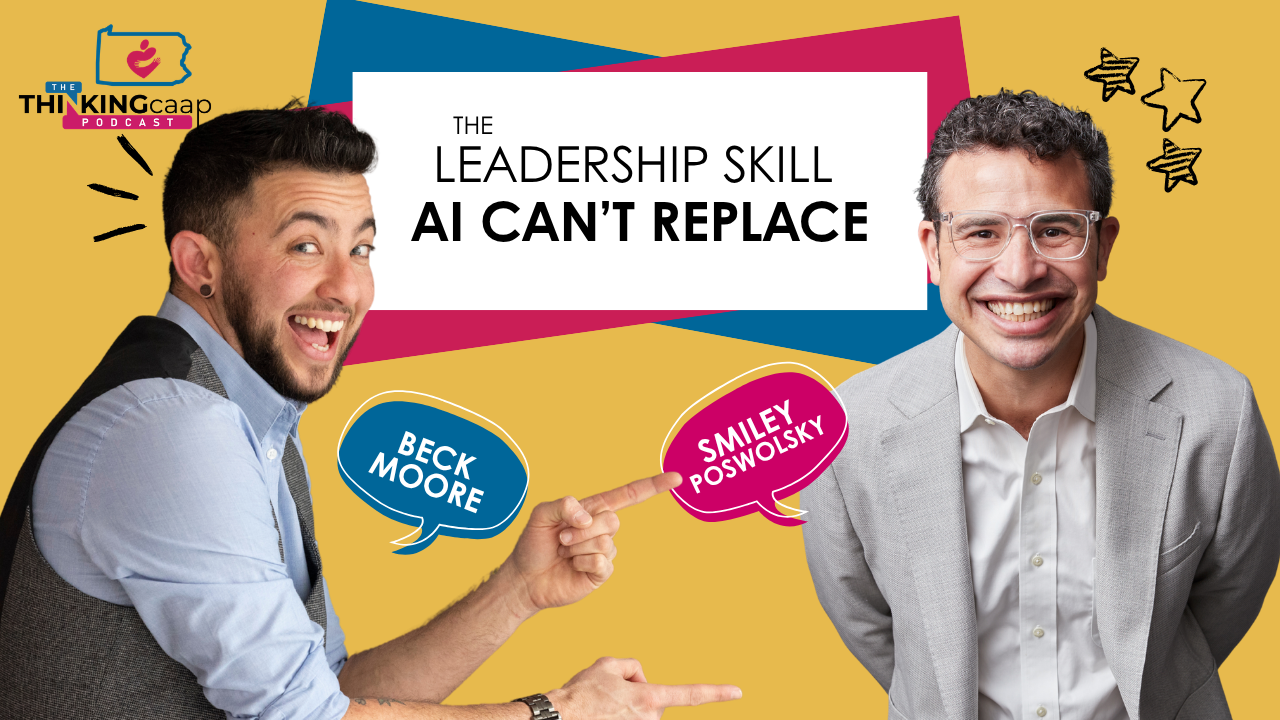
The Leadership Skill AI Can’t Replace
As artificial intelligence continues to reshape the workplace, one question remains at the center of it all: how do we stay human?
In this episode of Thinking CAAP, Beck Moore sits down with keynote speaker Smiley Poswolsky to explore the intersection of technology, culture, and connection and why human relationships are more important now than ever.
Smiley shares insights from over a decade of work in workplace culture, diving into:
Why connection (not AI) is the real differentiator in the future of work
The growing loneliness epidemic and its impact on teams
Practical tools leaders can use to build trust and belonging
How to move from inspiration to real, lasting action
Whether you're leading a team, navigating change, or trying to create a stronger workplace culture, this conversation is a reminder that efficiency means nothing without empathy.
Thinking CAAP Episode 36 Highlights
[00:00] Introduction to Smiley Poswolsky & Summit Theme
Host Beck Moore introduces Smiley Poswolsky as keynote for the 2026 CAAP Summit.
Focus centers on balancing AI efficiency with human connection in human services.
[00:01:22] Building Human Connection in an AI-Driven World
Smiley shares his focus on belonging, trust, and connection amid rapid AI adoption.
Emphasizes doubling down on people as work becomes more complex and uncertain.
[00:03:05] AI Concerns in Human Services Leadership
Beck highlights leaders’ concerns about managing AI without losing human connection.
Organizations feel pressure to integrate AI while maintaining mission effectiveness.
[00:04:40] Introducing the Workplace Belonging Toolkit
Smiley explains his 70-page toolkit focused on actionable connection strategies.
Designed to replace theory with practical exercises for real workplace use.
[00:08:18] Practical Leadership Tools Over Theory
Focus on simple, repeatable actions like better meetings and intentional conversations.
Encourages leaders to test and adapt tools based on what works for their teams.
[00:09:38] Intergenerational Co-Leadership as a Strategy
Pairing younger employees with experienced leaders creates mutual learning.
Combines fresh perspective with institutional knowledge for stronger outcomes.
[00:11:14] The Power of One Actionable Takeaway
Beck emphasizes choosing one idea to implement rather than trying everything.
Small actions lead to meaningful, incremental culture change.
[00:13:36] The Loneliness Epidemic in Modern Work
Smiley shares that loneliness is increasing despite more connectivity.
Connection requires intentional action beyond inspiration.
[00:14:46] Remote Work and Intentional Connection
Beck discusses challenges of remote work and feeling isolated despite constant meetings.
Organizations must create intentional opportunities for connection.
[00:16:05] Creating Connection Through Physical Presence
Smiley shares how coworking spaces improved his sense of connection.
Even small interactions can significantly impact well-being.
[00:18:06] The Need for In-Person Interaction
Leaders benefit from shared space to reduce isolation and strengthen relationships.
Hybrid work is positioned as the best balance moving forward.
[00:20:44] Challenges of Modern Work Environments
Smiley notes the extremes of isolation vs. overload in today’s work culture.
Emphasizes need for intentional design of connection opportunities.
[00:24:02] Smiley’s Origin Story
Smiley shares his early career dissatisfaction despite external success.
A community experience helped him pursue writing and speaking.
[00:27:44] What Makes a Great Audience
Engagement matters more than audience type.
Energy and willingness to participate shape the experience.
[00:30:20] Connection Before Content at Events
Too much content reduces learning and engagement.
Breaks and downtime are essential for real connection and retention.
[00:33:05] Learning Influences & Thought Leaders
Smiley shares authors like Cal Newport and Rick Rubin.
Focus on deep work, creativity, and intentional thinking.
[00:37:55] Personal Habits for Well-Being
Exercise and journaling are key to maintaining balance.
Encourages disconnecting from constant digital stimulation.
[00:41:00] The Value of Reflection and Journaling
Writing by hand creates deeper personal insight.
Slowing down is increasingly valuable in a fast-paced world.
[00:42:16] Closing & Event Invitation
Beck wraps the episode and promotes the upcoming CAAP Summit.
Reinforces excitement around AI + human connection intersection.
Listeners are always invited to send questions about Community Action to info@thecaap.org with the subject line Thinking CAAP
Episode 36 Transcript
00:00:00
What's up everybody?
00:00:01
This is Beck Moore, host of the Thinking CAAP podcast and the CEO of Community Action Association of Pennsylvania.
00:00:06
So excited to be here today with our guest coming to us in Pennsylvania soon for our summit, the 2026 summit, where we are talking about efficiency with empathy.
00:00:17
And what that really means is talking about how to embed AI into human services-based organizations or really any organization.
00:00:25
But without really losing, right, the human-based approach that is so, so important in the work that we do in community action and other human services organizations, talking about, right, where humanity meets innovation, making sure we don't lose that human-based approach.
00:00:38
And so Smiley Poswolsky, I think I said that right, Smiley is our keynote for this year's summit.
00:00:43
We're so excited to have him.
00:00:44
Wanted to have him on as a guest, talk a little bit about the things he's going to be sharing with the audience.
00:00:48
So, what's going on, Smiley?
00:00:51
Hey Beck, hey everybody, it's great to be here.
00:00:54
I'm really excited for the event coming up in May and, excited to join you all for the podcast today.
00:01:00
And Smiley, did I say the last name right?
00:01:02
You got it, nailed it.
00:01:03
Perfect.
00:01:03
OK, cool.
00:01:04
Perfect.
00:01:05
Try really hard to not butcher people's names too badly.
00:01:08
So happy to know I did that.
00:01:09
So you're Smiley, you were a keynote speaker on, I think your tagline says creating a culture of trust, human connection, and belonging in the face of uncertainty.
00:01:19
Yeah, yeah, so yeah.
00:01:22
What, what does that mean?
00:01:22
Tell our audience what that means.
00:01:23
Sure, sure, sure.
00:01:24
Well, I've been speaking now for, over 10 years.
00:01:28
I, I started in this journey, I guess 2013, 2014, early era.
00:01:33
and I've been focused on kind of the future of work and building a culture of human connection and belonging, in the future of work of, of work in, in recent years.
00:01:43
And, and really now my focus is obviously with the rapid adoption of AI technology and tools, And a really complex work environment between multi-generational workforce, hybrid, AI, global markets, uncertainty, the geopolitical situation, the rapid kind of evolution of how things are changing so quickly, and, and how overwhelmed people are in their day to day lives, both at work and at home.
00:02:09
I, my kind of call to arms is to really kind of help people focus on the human connection piece and doubling down on, on our people, and our teams, and our colleagues, and our companies and organizations with a focus on human connection and belonging.
00:02:25
and that's really especially, I think, accelerated in recent years, just as, as AI has become such a, both, both a very useful tool, obviously a strategic tool, but in many ways, kind of, I think, also quite overwhelming for people, whether they're worried about, you know, their job being replaced, whether they're kind of changing the way that they do their workflows, that whole type of thing.
00:02:47
So, really kind of focused on building deeper human connection in the AI world, and in, in a world of uncertainty is, is kind of what I focus on these days.
00:02:55
Yeah, so one of the things that we talked about when we first met in thinking about and trying to decide whether or not, you know, you're really the, the right person for the, the, the summit and trying to figure out, right, like, did this really resonate with you?
00:03:05
As you said, right, like you're not an AI guy, you're not there to talk about, about AI.
00:03:09
I just want to clarify with our audience that that's not what you're there to talk about.
00:03:12
You're really there to talk about the piece that we want to make sure is so at, you know, really a cornerstone of this event, which is that humanity.
00:03:19
Identity piece, right?
00:03:20
And the, the critical human connection part.
00:03:22
This summit is something that's really, you don't know this, I didn't share this with you, but this is a summit that's really evolved over the last few years for us.
00:03:29
It was originally really a, a summit designed to talk about creating equity within local community.
00:03:34
How do we do that?
00:03:36
And it's really, I think, continued to evolve to be what's top of mind for both community action but human services providers.
00:03:42
And as you touched on there, right?
00:03:43
AI is one of those things that I don't know that anybody at this point that I've talked to has said.
00:03:50
Yeah, we know that we need to talk about it.
00:03:52
We need to touch it.
00:03:53
It's here to stay.
00:03:55
I think part of what has really been expressed to me is this worry point about, I'm going to need to manage this as an executive director.
00:04:02
I don't necessarily have people on my team who know how to manage it, don't necessarily know how to integrate it.
00:04:08
And also, I'm really worried because, right, I'm worried about this piece about the human connection component, because we know it is so critical to being effective in our mission.
00:04:20
And so as we think about kind of the things that you're going to be touching on in here in a couple of weeks, months, depending on when this episode drops, I know that one of the, the great things that you're going to be sharing with our audience is kind of this toolkit.
00:04:31
Can you talk a little bit about what that toolkit's gonna be because our audience is gonna, gonna be receiving that virtually before they, before they leave the event.
00:04:40
Yeah, well, just to back up a little bit, you know, I, I think that, you know, AI kind of gets thrown around all of the time and every organization, large, small, nonprofit, for-profit, massive companies, small companies, big teams, large teams are, are thinking about it.
00:04:55
But I think that what's happening often is that it leaves people feeling overwhelmed.
00:05:00
So either you have, you know, the sense, you know, 70% of employees lack the kind of time to even learn AI skills that would help them do their job more efficiently in the first place.
00:05:10
2/3 are worried that AI might replace their job.
00:05:14
And so even if as an organization, you've set a, set a clear strategic priority that that's not the case, that this is a technology, a tool for efficiency, right?
00:05:23
I know that's a big theme of the event, efficiency.
00:05:26
Like, you don't get the empathy piece unless you kind of slow down and actually talk about it a little bit more, and people have the time to learn those skills.
00:05:34
And by those skills, I mean both the AI implementation skills, like how do you use cloud, how do you use chat GBT, like how does that integrate with your systems?
00:05:44
Co-pilot, etc.
00:05:45
but also like, how do you build the human connection skills in that era?
00:05:49
And, and I'm really bullish on the fact that I, you know, AI will replace some jobs, for sure, it already is starting to, especially in the coding engineering world.
00:05:59
but I believe that the majority of jobs will actually be replaced by people that understand how to connect with other people in an AI world, right?
00:06:07
Because if you can throw in a prompt, and it can find you the data point you.
00:06:11
need or synthesize research or draft a report or draft the slide deck, or plan the event almost, or come up with your financial plan, or, you know, kind of your, your, you know, tell you where your, accounting and bookkeeping is off, whatever, like all of these different things, then what we really need is kind of that leadership connection toolkit and that management connection toolkit and that relationship building with clients and customers toolkit.
00:06:39
So that's kind of what, what I set out to do.
00:06:41
And I created this thing, you can, if you're watching on video, I don't know if you're recording the video, but it's called the Workplace belonging toolkit.
00:06:48
It's a 70 page full color guide.
00:06:51
And, you know, I have this experience of I, I'm a, you know, I'm a business keynote speaker.
00:06:56
I obviously love business self-help books.
00:06:57
I'm a, I'm a, I'm a, I'm a book nerd.
00:07:00
I love, you know, business books.
00:07:01
You've got, I can see you got all the, what is it, Chip Heath and the Heath brothers books there, good to great, made to stick, you know, they're always, I drive.
00:07:10
They're always a one word kind of like a.
00:07:13
You know, inspire, drive, range.
00:07:16
Like, I mean, they're great.
00:07:18
I love those books.
00:07:18
They're awesome.
00:07:19
Like, you can, you can find the meaning of your life and the meaning of your work and 10x your business by just reading 280 pages, except they're quite long.
00:07:29
Right.
00:07:29
And in my experience, they kind of, kind of say the same thing after chapter two.
00:07:34
You know, it's like, oh, we had to fill another 270 pages here, just like put in another example, like.
00:07:41
no, no, no bashing on my fellow business self-help authors.
00:07:44
But what I wanted to do is actually kind of cut through the noise a little bit and be like, what would a toolkit look like?
00:07:49
Where we get, get rid of the kind of fluff, and it's like actionable things, like actionable connection exercises.
00:07:55
This is how you start a meeting.
00:07:57
This is a Thrive interview.
00:07:58
This is how you have a curious conversation or a small win party or a mistake aon.
00:08:04
And you're like, what are all those things?
00:08:06
Well, I describe them in the toolkit.
00:08:07
We'll talk a little bit more about them in the, in the keynote.
00:08:10
But really, they're all like these little kind of connection exercises, frameworks and prompts, to kind of keep doing the work.
00:08:18
So that's what people will get with the toolkit is like 70 pages of really action-based habits, tools, exercises to bring into your next team meeting.
00:08:29
for your one on ones, for your off-site, for your team retreat, for your conference.
00:08:33
And really the idea here is that none of these really require any additional budget, right?
00:08:38
Money is hard to come by these days.
00:08:40
so they're all free, but that doesn't mean that's easy, right?
00:08:43
Because they require time and intention and energy.
00:08:48
and my goal is, my, my intention is not that everyone does all of them.
00:08:53
But as a leader, as a manager, you start thinking about like, which ones speak to you, and you try, and you see what works and what doesn't.
00:09:00
Like, that's my whole thing.
00:09:01
And I think it's really important for thinking about, about leadership, about thought leadership, about change management, about navigating uncertainty is what works for one team or, or one organization is simply not going to work for another.
00:09:14
There's so many reasons why that could be the case.
00:09:17
size, you know, what type of community you're serving, financial, considerations, all of these types of things.
00:09:25
But that doesn't mean that none will work.
00:09:27
Some will work, and you kind of have to figure out what works for you.
00:09:29
So that's really is my goal is always to set out Like a wide array of options, possibilities, ideas, and let people kind of pick and choose.
00:09:38
Oh, yeah, like that works for me, right?
00:09:40
I talk about intergenerational co-leadership.
00:09:42
That's something we'll talk about a little bit in the keynote.
00:09:45
This idea of pairing early talent, right?
00:09:48
This like a 24-year-old, 22-year-old, 23-year-old, 29-year-old, that's got a lot of great ideas.
00:09:54
Maybe they're just out of school, it's their 1st, 2nd job out of school, pairing that person with someone that's much more senior.
00:10:02
That has a lot more tenure at the organization, is older, has a lot more experience in the industry to co-lead a project that really matters
00:10:11
Because then probably you get that 24-year-old being like, hm, you know, there's a lot I don't understand about, you know, human services or community action or the work that we do.
00:10:21
It's like, yeah, there is, you're 24 years old.
00:10:24
There's a lot you don't understand, right?
00:10:26
You're great, but there's a lot you don't understand.
00:10:29
But you also get that older person with decades.
00:10:31
More experience, right?
00:10:33
That's maybe been at the nonprofit at the organization in the industry for years.
00:10:38
Curse of knowledge, curse of knowledge.
00:10:40
And they're like, huh, wait a second, this young person is thinking about this in a completely different way.
00:10:47
They represent the future of our organization, right?
00:10:52
They also represent the future of our partners.
00:10:56
Right, our employees, our clients, our customers, the people we serve, the communities we serve, like I should probably understand what's going on in their head.
00:11:02
You get that symbiotic relationship.
00:11:05
so things like that.
00:11:07
So a couple of things that you just said, Well, first, I want to make sure to say, I really don't like business books.
00:11:14
So you got quite a few.
00:11:15
I got a few on your shelf though back, but these are the ones that have resonated with me over the years.
00:11:20
And one of the reasons that, you know, when we were talking to you that I really got excited about you coming is that the things that I really love in speakers, and, and this is part of kind of a cornerstone of any event that we put on.
00:11:32
Anytime we're looking for consultants or educators in in the work that we do from a training and technical assistance perspective is people want the tactical stuff, right?
00:11:40
Like, I'm tired of going to a training, quote unquote, or listening to a conference and it's like, all right, I just heard this person.
00:11:50
wax on philosophically for the last hour and a half, and I'm not left with one thing that I have in my toolbox, the new shiny tool that might change something and how I'm doing it or the approach.
00:12:03
And so to me, right, if I come to a session about workplace culture, let's say, I need at least one thing I'm gonna walk away with.
00:12:10
And I think to your point, right, about this toolkit that I usually say when I speak about workplace culture is that Pick the one thing, cause the small thing that you pick creates big incremental change, right?
00:12:22
We got to pick the one thing.
00:12:24
So Just find one thing.
00:12:27
You don't need to write down all the things.
00:12:28
You can't, you can't execute on all the things at once.
00:12:32
What's something, and it could be something you're struggling with, right, as a leader, that helps you, but also thereby has big change and big wins for your team.
00:12:40
And that's how I, I usually end my keynotes, and we'll do that in Harrisburg, which is why everyone should come, but kind of like at the end of the presentation before Q&A because Q&A is cool, except like 3 people get to hug the whole time.
00:12:53
It's like, OK, I have a question, then it's like not really a question because they're like telling a story or complaining about their boss or something.
00:13:00
I have a really bad place that I work and my name my name tag, by the way.
00:13:04
Let me tell you about this person, Bob.
00:13:06
I mean, oh, I, I wasn't supposed to mention their name that I hate working with.
00:13:09
Wait, you, you messed it up.
00:13:11
but actually, we all kind of find a partner, find someone you don't know.
00:13:15
What are you taking away from Smiley's presentation?
00:13:18
What's the one thing you're going to do?
00:13:19
What are you going to take action on like next week, starting on Monday?
00:13:22
What are you going to do?
00:13:23
Not the 50 things, not the 20 things.
00:13:25
What's one thing that you're going to do?
00:13:27
That you're going to implement right away.
00:13:29
you know, and I think that that's like where we kind of start to get from like, OK, keynote, inspiration, motivation, ideas to action.
00:13:36
Like my whole, the reason I do this work is, you know, my last book is called Friendship in the Age of Loneliness.
00:13:43
I believe, and the data shows we are in the midst of a loneliness epidemic.
00:13:46
It's actually only gotten worse since the pandemic all around the United States and frankly, globally.
00:13:51
And I want people to close the loneliness gap.
00:13:54
I want people to build more connection.
00:13:57
And belonging in a lonely, overwhelming, non-empathhetic world.
00:14:02
the only way they do that is not from a 60 minute keynote.
00:14:05
It's from actually taking action and building off of the ideas, the inspiration, from an event, right?
00:14:13
People get fired up about events and conferences.
00:14:15
I love them.
00:14:15
I go to them for a living.
00:14:17
And you get, you're like, oh my gosh, connection, connection.
00:14:19
And then you're alone next week, the following week, or you're like with your team, and you're like, what was that person talking about again?
00:14:25
I forget.
00:14:26
So it's all about the taking action piece.
00:14:28
So that's the idea of this toolkit is really like, how do we continue the work?
00:14:31
How do we keep going?
00:14:32
How do we take action?
00:14:34
Wait, I had it for a couple of weeks, I lost it, come back to the toolkit, it's all good.
00:14:39
none of this is easy, but we actually have a little bit of of a guide to help us along the way and other people that we can talk to about what they're using it for.
00:14:46
Yeah, the, the loneliness piece really does resonate with me.
00:14:50
So our team, I think as we shared with you when we met, it works completely remotely.
00:14:54
So we work across the state of Pennsylvania.
00:14:55
We've got people, you know, my chief strategy officer is 6 hours away.
00:14:58
Then I've got somebody who's literally my executive assistant lives within 1 mile of where I live, but I don't see her very often, even though she's right here.
00:15:08
And I am somebody who's worked remotely off and on since probably 2008, and used, you know, like Skype and Webex and all of the tools that didn't really work very well.
00:15:18
And so now, you know, today I operate in a world that I'm overwhelmed by all the tools that I have access to.
00:15:23
But my wife was working from home as well for a long time.
00:15:29
And now she's back in an office and I'm, you know, here at the house by my lonesome.
00:15:33
And even though I'm surrounded literally by people all day long via Zoom and meeting with people, we have to be try to be really intentional and cap to try to figure out how do we sort of right, like create connections differently because of this.
00:15:46
But I know that it's something that I said to my wife, like, I'm lonely.
00:15:50
Yeah, me too.
00:15:51
I wrote a book about loneliness.
00:15:54
I like to consider myself a friendship kind of, you know, guru.
00:15:59
If not, if, if not, not guru or expert, but just like someone who's stoked on friendship and cares about it.
00:16:04
And I feel lonely all the time.
00:16:05
I think it's like, it's first of all, it's like you're not alone.
00:16:08
That's a big piece of the research.
00:16:09
And my experience with the book was, I was talking about talking with all of these people who are very connected people that go to events that have teams that You know, are have have wonderful spouses, partners, children, families, etc.
00:16:23
Great, great, great networks, and they're feeling lonely.
00:16:25
So it's like, this is, this is above us, right?
00:16:28
This is not like an individual thing.
00:16:30
It's a collective challenge.
00:16:32
but yet there are, are things you can do, you know, like I work from home too, you know, when I'm not traveling for gigs and for speaking, and I joined a co-working space, even though it's way more convenient for me to work from home, you know, I can wear sweatpants, I can You know, the, you know, get coffee whenever I want.
00:16:50
Like there's food in the fridge, it doesn't cost anything.
00:16:53
It doesn't cost anything exactly.
00:16:54
You don't have to like go out to lunch, but I was just like, you know what, like I felt like I was happier when I left the house.
00:17:03
And like just leaving the house, seeing other people, having like a random kind of chit chat, or like, hey, like, what are you working on?
00:17:10
Or what's your name?
00:17:12
Even just one or two of those, just like running into someone while filling up my water bottle, made me feel better.
00:17:18
And then I got home after a long day, be like, wow, I went to work today.
00:17:21
Like, like, so like I That was something like I realized for myself, like, I don't need to do this.
00:17:25
It's actually inconvenient and more expensive for me to do this.
00:17:29
I have to rent this co-working space.
00:17:31
Also, it's a co-working space where now other people are like chatting and it's kind of loud and I hear their Zoom conversations.
00:17:38
Like this is inconvenient.
00:17:39
And yet it's better for my well-being.
00:17:42
And better for my connection levels, that's a, that's a learning I had.
00:17:47
Yeah, yesterday, we actually, to that point, I had had a lot of our, I know a lot of our executive directors are within Community action in particular.
00:17:55
Those are the folks who I work the most closely with on a regular basis.
00:17:59
And one of the things that we've, we've talked about is just trying to find time to be with each other and we're all, we're all scattered across the state.
00:18:06
So yesterday, we, a few of us met for lunch to just, and I said, this is not intended to be a business meeting, it's just right for us to get together and feel a little bit of connection because sitting in these spaces, a lot of times you're overwhelmed by the burden of running the organization.
00:18:20
You know, you try as try as you might to be vulnerable as a leader.
00:18:23
It's sometimes a little more complicated.
00:18:25
And so it was just a really nice reminder of just spending time and, you know, being in each other's space, because that's what ultimately drives me, you know, I'm somebody who gets energy from being in, even though I consider myself very much an introverted extrovert, I get energy from being with other people, but it also exhausts me at the same time.
00:18:43
It's both a a great thing and a little bit of a curse.
00:18:47
Yeah, me too.
00:18:48
Yeah.
00:18:49
Do you, do you find that when you're doing a speaking gig, you're, you know, like you feel like you're on, on, on, on, on, and then you crash hard when you're on the plane?
00:18:57
Big time.
00:18:58
Yeah, big time.
00:18:59
I mean, you know, I am an extrovert.
00:19:00
Obviously, my nickname is Smiley.
00:19:02
Like, I go to events for a living.
00:19:05
I love it.
00:19:05
I feed off of it, you know, a couple 100 people like, yeah, like.
00:19:09
I love going to things, meeting people.
00:19:12
but I also like, it's interesting, like when I go to a party or kind of like some kind of event, like unless I know somebody there, I like, will be at like kind of the back of the room.
00:19:21
I'll be like awkwardly by the coffee, like kind of hanging out, like looking at someone's bookshelf, looking at someone's bookshelf, being like, oh, cool, like cool books, you know, like, It takes me a little while to warm up.
00:19:32
So it's like I always call it like an introverted extrovert or maybe an ambivert.
00:19:37
Like I love that high from the, from the meeting people, but I also crashed so hard.
00:19:42
And, you know, and after an hour after the event, I'm like, I can't talk to anybody.
00:19:46
I, I go super hard, and then it's just like, boom, I need alone time.
00:19:50
Yeah, I can't people anymore.
00:19:51
I'm, I'm done.
00:19:53
When I, when I first took this job, it was right sort of on the, the little bit of the slow release of COVID.
00:19:59
And so we were tasked with that October then running our conference for the first time in, you know, 3 or 4 years.
00:20:05
And I did not give enough credit to or maybe went into it a little naive that this is the first time I'm going to be around a large group of people for not just a day, but over the course of really 4 days and execute on this conference, right?
00:20:19
And by the time I left that event, I was so physically, mentally drained because it again, it was right like your COVID, you know, time, and then I'm with now 300 people for the course of the week.
00:20:35
And it was a very, and I think about that pretty often in terms of right, like the, the nature of my job is such that I'm either with a ton of people or I'm with nobody.
00:20:44
And so it's very much, it feels a little manic some days, you know.
00:20:47
Yeah, yeah, I think a lot of people struggle with this now.
00:20:50
And I think this is like an interesting thing, a part of our, the new world of work is a lot of people are only seeing their teams, you know, once a year, right?
00:21:01
Or maybe twice a year where they like bring You know, have the budget to bring everyone together or fly people in or whatever it is.
00:21:09
and so it's like all needs to happen this one time a year, which is like the stakes are, that's a lot of pressure.
00:21:15
And then the rest of the year, you're not seeing any people the rest of the time.
00:21:18
It's, it's hard.
00:21:19
It's like if it's, it's not, it doesn't feel normal, you know, and I think that there is a little bit of a yearning.
00:21:25
I'm, I'm not, I'm not in favor of, you know, that, that then going swinging to the other side, which is, OK, you have to be in the office 4 days a week, 5 days a week, you have to move your whole family, or, you know, commute every day.
00:21:39
Like, I don't think that that's right either.
00:21:43
You know, I, I, I really believe that hybrid work is the future.
00:21:47
It's, it's, it's just the best of both worlds, right?
00:21:53
I do believe that hybrid is the best of both worlds, where people can have that flexibility to work from home, to take care of their families, to be more productive.
00:22:02
The data shows people are more productive when they work from home a couple days a week, but then also have that connection.
00:22:08
I also don't think like only seeing your team once or twice a year is, is enough.
00:22:13
we're, we're social beings, we need that kind of, You know, that that human connection, and also for people starting their careers, for people that are younger.
00:22:24
there's so much research on, on the power of, of those kind of, loose connections, right?
00:22:32
that you actually grow in your career by kind of seeing that one person that's like, what do you do here again?
00:22:39
Oh, yeah, like, let me take you out to lunch, or like, you should really meet this person, or you, you know, why don't you come to this client meeting with me, or, meet this partner or come to this, nonprofits, you know, annual, gala that I'm involved with, or I'm on the board of this, you should meet this person.
00:22:57
And then that person one day that you randomly met at that thing is the one that hires you for your next job.
00:23:02
Yeah, no, it's really fair.
00:23:03
I mean, I think that one of the reasons that I thrived in my career is having the opportunity to have people who I was able to see and then model different, like they modeled for me that I was able to pick on, pick up on certain tactics, right?
00:23:15
Certain ways that they explained things that then helped me when I had to go to the boardroom or I had to go meet with a, a funder or whatever it was.
00:23:23
And so, in the way that we operate, we've got to be really, really intentional about it, right?
00:23:26
Like I've got to, I've got to remember, I need to invite this person to the Zoom meeting, so that They can be a part of that.
00:23:33
But I think to your point, it's something that we've, we've acknowledged a cap that we need to be able to try to figure out how to spend more time together.
00:23:40
So we're doing, you know, we're doing a fun day here in a couple weeks, a family day at Hershey Park, where everybody's going to get together and just kind of right, like be together, ride some roller coasters, eat some junk food, and just have, have a good time together.
00:23:53
So we're excited.
00:23:54
I know the team's excited about it.
00:23:57
Can we, can we go back to kind of your origin story a little bit?
00:24:02
I would love to just know kind of what got you into this work, what your, what your backstory is.
00:24:06
How'd you become the workplace, you know, culture superhero that you are today?
00:24:10
Yeah, sure.
00:24:12
so I really fell into it.
00:24:13
Some people kind of have like a very kind of clear progression of, you know, they were a management consultant, or they worked in HR or were a CEO and then they're like, you know what, I'm going to kind of Become a thought leader, you know, or they sell their business or they climb Mount Everest, and then they're like, that's it.
00:24:32
I'm a motivational speaker, like, you know, or they were in the Olympics.
00:24:36
OK, that's not my, my, my situation.
00:24:40
So I worked in Washington DC for the United States Peace Corps, incredible organization, does great work.
00:24:45
I worked for the.
00:24:46
Headquarters there, for a couple of years.
00:24:50
And I had an experience of having this job that on paper was really good, that just wasn't the right fit for me, for a variety of reasons, and, and feeling kind of stuck in that.
00:24:59
And I'm sure there's people for a variety of reasons that can feel that kind of tension of, you know, you kind of have it, you're, you're supposed to be kind of happy.
00:25:09
You, it's like you've checked the box, like maybe your parents are impressed or, your friends are like, that's a good job.
00:25:16
And you're like, Yeah, but it's not it.
00:25:18
and I think a lot of young people definitely can identify with that.
00:25:22
Like, you know, meaning and purpose, it has to be meaningful and purposeful for you.
00:25:27
And it's not just about like, oh, this is a respected organization, or this is a good career ladder, right?
00:25:33
It's, I was working for the government.
00:25:34
It's a very good career ladder.
00:25:39
and that was a challenging place to be, right?
00:25:41
As like, a, you know, I'm a millennial, so I came, graduated from college, the recession of 2008 hit just a couple of years after I graduated.
00:25:50
So it was a tough time to kind of be stuck in this, what I call a quarter life crisis, or, you know, 3rd, 3rd life crisis, midlife crisis.
00:25:59
so my experience was one of really kind of feeling alone there, feeling a lot of FOMO, fear of missing out, a lot of comparison to others.
00:26:09
And, it was really a community for me that kind of helped me get out of that.
00:26:15
I went to this program back in 2012 called the Starting Block Institute for Social Innovation.
00:26:22
it's a nonprofit.
00:26:23
It's no longer around, but it, it brings together people that are interested in using business for good.
00:26:28
So kind of social entrepreneurs, social innovators, nonprofit leaders, people that are really passionate about this idea that, yes, of course, a business can and must make, make money, make a profit, but it also must give back and support the community and, and people that it serves.
00:26:46
and at Starting Block, I've met a lot of believers, people that were really kind of like, well, Smiley, if you're unhappy, you should do something else, like, You know, if, if you don't do that, who's going to do that, right?
00:26:57
You have these dreams, you want to become a writer, you want to become an author.
00:27:01
I was talking about writing a book, and they were like, you have to do that.
00:27:04
If you don't do that, who's going to do that?
00:27:05
I wrote this book, The Quarter Life Breakthrough that I self published.
00:27:09
It sold really well on Amazon.
00:27:11
This is kind of the early days of self-publishing.
00:27:14
And then it got picked up by Penguin Random House to turn it into a book deal.
00:27:19
to republish it.
00:27:21
and that was kind of the beginning of my speaking career.
00:27:23
So I really fell into the kind of corporate keynote speaking world that I'm in now, because I was talking about the initial book.
00:27:30
I had a lot of companies that were interested in kind of how do we attract and retain millennial talent?
00:27:36
What are young people looking for?
00:27:37
They're quitting their jobs every 2 months, like, we want to keep them longer.
00:27:42
And that was kind of how I started.
00:27:44
Yeah, absolutely.
00:27:45
So what's your favorite sort of audience to speak to?
00:27:49
Not that, you know, I'm sure everybody's great, but like, what, what matters to you an audience.
00:27:55
I, yeah, I can't, it's really hard to kind of pick audiences.
00:27:58
The most I just care about is that they're engaged.
00:28:01
I have, spoken to audiences where like everyone's on their phone or once I did a co-working space where like the members didn't know that there was a speaker.
00:28:11
And they're like, so, they're like all type of tying and you're like working.
00:28:16
And I was like, I talked to the person running the event.
00:28:19
I was like, wait, they don't know.
00:28:20
They're like, no, we just do these.
00:28:21
And if people want to, You know, pay attention, they pay attention.
00:28:24
I was like, that's horrible.
00:28:26
Like, I wouldn't want to pay attention to a speaker if like I was in the middle of a deadline or had to finish a project.
00:28:32
So that was like the worst.
00:28:33
But what I care is like a captive audience that's excited to be there, that wants to learn.
00:28:39
my other least favorite is like when they put you like after dinner, like I've done some where it's like during dessert, and people are two glasses of wine in, you know, they're clinking their things with the cake, and I'm like, what?
00:28:52
No one wants a PowerPoint at 9 p.m. Like, what are we doing here?
00:28:56
Like they're tapped, you know, they're tapped.
00:28:58
It's like they've been like had seen slide decks all day long since 7 a.m. and then this guy Smiley comes on.
00:29:05
Anyways, it's actually You can get a great audience then too, because they're a little drunk and they're so they laugh all my jokes seem a lot more funny.
00:29:12
but I don't think anyone, I don't think anyone wants the content that late at night.
00:29:18
No, no, absolutely not.
00:29:19
We try to be really, really thoughtful about the experience at the events that we host.
00:29:24
So like we rarely do speakers over meals, because to your point, I, I know I sit in a lot of conferences and It, it's just I know and I speak a lot, so it's distracting to the speaker.
00:29:38
Even though it's, you can't see a whole lot with the lights typically, right, but it's distracting when you're up there.
00:29:44
It's, I just want to eat my cake.
00:29:46
I just want like 10 minutes of downtime and so that that experience as a conference goer really matters and we try to be very thoughtful about that.
00:29:54
Last year, unfortunately during one of our keynotes, we, the, the service crew started like dumping buckets of ice in the main room and I'm like, can we just like not, it's We paid, first of all, I paid a lot of money for this person to listen for this room to listen to, and secondly, It's just rude.
00:30:12
Stop it.
00:30:14
Yeah, and I, you know, one of the things, and I, I talk about this a little in the keynote is like this idea of connection before content.
00:30:20
And I think we have this sense at conferences with good intention, like we want to put in as much content as possible.
00:30:28
Right?
00:30:29
Because we love learning, right?
00:30:31
We want the AI speaker, and the culture speaker, and the marketing speaker, and, you know, and the financial speaker, and the kind of government policy outlook speaker, like we want it all, like give it, you know, we want to fit in that person and that panelist, and that panelist and that panelist.
00:30:48
But for the audience experience, it's too much.
00:30:53
And in order to learn, you have to have downtime.
00:30:57
You have to have break time.
00:31:00
And you have to have connection time, where people can actually just talk to each other, right?
00:31:06
Or talk to nobody.
00:31:08
Right, right, or take a walk or have a cup of coffee, like, what, you know, it's like when, when people have breaks, they're like, it's break time.
00:31:16
Find somebody new and like fill out this scavenger hunt, and you're like, oh my God, it's break time.
00:31:22
Let me go to the bathroom.
00:31:24
You know, like, let me go to the bathroom.
00:31:27
Let me get my coffee and drink the coffee and enjoy it.
00:31:30
And in that downtime, I'll probably have a great connection with somebody.
00:31:35
Yeah, it's one of the things that my team knows like all I don't.
00:31:40
I don't care if you decide what the menu is.
00:31:42
The things that I care about.
00:31:43
Number 1, there should be coffee all day, please, all day.
00:31:47
And if not coffee, soda, like I have something to keep people going, I'll probably have a Red Bull stand at some point or another, but there's got to be coffee all day.
00:31:55
And to your point, there's got, we've got to let people, a lot of folks in our network, right, like they're, they only see each other so many times because they're traveling, they're working so hard.
00:32:03
And so in our conferences and summits, we want them to spend time together.
00:32:06
That's part of why they come is to see each other, right?
00:32:10
And that is so core to what we try to, try to be really thoughtful about doing.
00:32:14
And, and a lot, you know, one of the things that people don't know is that in the human services work, we are at a lot of convenings, we're at a lot of conferences, we're always trying to learn, right?
00:32:24
And then we're also required to be at a lot because of the nature of the programs that we administer.
00:32:29
And so we go to a lot of things that it's just not conducive to learning and getting out what we really are trying to get out of it.
00:32:37
So, yeah, we try to be very, very thoughtful about that.
00:32:40
And the experience that everybody has.
00:32:42
It's just, and running events is, it's a little bit of an art form, right?
00:32:45
I mean, yeah.
00:32:46
So there's only so much that people can take before they kind of, you know, tune out.
00:32:51
And also now with attention spans lower than they've ever been before.
00:32:55
Yeah, 100%.
00:32:57
So what's your, one of the things that we love to ask some of our, our keynotes and the folks we work with, and I'm sure you're gonna get this question on stage too.
00:33:05
Well, you know, make sure to point out that they probably didn't listen to the podcast if they ask this question, but OK.
00:33:12
What's, what's some of your go to books like, who are some of the folks that you really love to listen to, read?
00:33:17
What's, what's your inspiration today?
00:33:19
What's, what's keeping you kind of like on your toes that you're, you're enjoying learning about?
00:33:25
Yeah, that's a, that's a great question.
00:33:28
you know, there's so much happening and so much going on.
00:33:30
Like I, I've kind of tried to take a little bit of a, I was kind of trying to keep up with everything.
00:33:36
And then I started to kind of give up on that and realized that that wasn't possible.
00:33:41
but, you know, especially kind of, for the work that I do, I really appreciate Cal Newport.
00:33:47
I don't know if anyone's familiar with his, he, he wrote, the book Deep Work, which is about like, really kind of like, if you want to be a creative, if you want to create amazing work, you have to just create the conditions to really go deeper and think hard and, and tune out the social media and tune out, The overwhelmed.
00:34:10
He also has a book called The World Without Email, and slow Productivity.
00:34:14
And I just love like his general ethos.
00:34:16
I think he's not on any social media, which I just deeply respect.
00:34:20
I can't, I can't quite afford to do that just because I don't make a living unless I get booked to speak.
00:34:26
And part of how I get booked to speak is I got to do a little bit of promotion.
00:34:30
I try to keep it.
00:34:31
A little bit of, not too, not overboard.
00:34:34
I just really respect him as a thought leader and kind of as somebody that's putting out content to the world.
00:34:40
I really love Rick Rubin's book, The Creative Act, which is kind of like, almost like a, meditation on creativity.
00:34:51
I love books that are kind of like philosophical in nature.
00:34:55
Bird by Bird by Anne Lamott, which is about writing and becoming a writer, The War of Art by Steven Pressfield, which is about kind of how hard it is to create things and overcoming fear that blocks you from putting your work out into the world and actually sitting down and writing the book, or creating the podcast, or launching that new project, or shipping the app, or whatever it is that you work on.
00:35:20
so those are a couple, and yeah, I, I mean, I've got this whole bookshelf behind me, so I'm, I'm in a room here.
00:35:27
I'm in a room surrounded by bookshelves.
00:35:30
They have an old house that has built-ins upon built-ins.
00:35:32
There's not a lack of shelf space in this house, and I am surrounded by books and I, the kids love to come in here and be like, have you read all of these?
00:35:39
Yeah, it's been a while, but yes.
00:35:42
That's great.
00:35:43
How many kids do you have?
00:35:45
We have two.
00:35:45
I have an 8 and 9 year old, and it's, They both love to read, which I love about them because it was one of the things.
00:35:51
It was one of my things that I used to escape as a little kid.
00:35:54
And oftentimes my mom would be, you know, standing beside me and be asking me to do something, and I would just turn her off because I was in the thick of reading.
00:36:04
So it was always, yeah, it's a great.
00:36:06
I love that they love to read.
00:36:08
So my last question, yeah, especially now, especially now, just, you know, I feel like young people, it's really hard for them to sit down and read.
00:36:14
And there's a lot of data showing that people are just reading less and less of all ages, frankly, just because of, you know, TikTok and Social and vertical videos being more engaging and entertaining, and more dopamine, and to just sit down and read for an hour or two is a is a beautiful gift, actually.
00:36:32
It's very true.
00:36:33
It's one of the things that we have always tried to do diligently every single night.
00:36:36
And this is not what I'm about to say is not a judgment call on anybody who does do this.
00:36:42
We really don't do electronics in our house.
00:36:46
Because, you know, my, my son has special needs and it just escalates him by spending too much time on the technology and if one does, and the other is gonna want it and vice, you know, vice versa.
00:36:56
So we, we don't really do a lot of electronic time unless there is something.
00:37:01
If we've got something really long car trips, that's about the only time.
00:37:05
But to be clear, it's got to be right, like at least a 3 to 4 hour car trip or more.
00:37:10
Otherwise, we just don't just.
00:37:13
Don't let him do it cause it just deregulates the heck out of them.
00:37:17
Yeah, that's really hard to do, but really commendable.
00:37:21
Yeah, it's incredibly hard to do and they regularly tell us they hate us for it, but, you know, that's, I usually say, well, welcome to the 90s cause It's the way it is.
00:37:33
Anyway, well, my last question for you, Smiley, I wanna make sure to be respectful of your time.
00:37:37
And we're coming up on the hour here is, you, we talked a little bit about kind of the introvert, extrovert, kind of, like, piece of, of how you and I both feel.
00:37:47
But what's the thing that you kind of dedicate to spending your time to, to keep, I hate this phrase, but keep your cup filled.
00:37:55
I, I've been saying I've lost my cup.
00:37:58
It's filled with something that shouldn't be filled with somewhere in the house, but What's your, what's your go to activity?
00:38:06
my go to activity, or just a few, I can't, it's hard for me to pick one, but exercise, just my, my jog, you know, I run 4 or 5 times a week, or, or work out, and really just that, that for me is non-negotiable.
00:38:20
I can feel like on a day where like, oh man, I didn't work out this morning.
00:38:23
Like, that's why I'm feeling stressed or anxious, or like I have too much to do.
00:38:28
And as soon as I work out, I feel better.
00:38:30
It's like medicine for me.
00:38:32
and I think just the importance of taking that time, whether it's outside or at the gym, whatever it is, for me, is, is, is the reset I need.
00:38:40
I just, the more and more, you know, we go into this techno tech tech, tech fueled, AI fueled universe, the more and more I find myself kind of wanting just more time just to, to work out and, and sweat, honestly.
00:38:59
so that, that for me.
00:39:02
it is, is really critical.
00:39:03
I've also kind of really kind of gotten back into, I think journaling is so key.
00:39:09
I'm, I'm in San Francisco, so the people are very hardcore AI people here, not all of them, but this is kind of an epicenter of all these companies are all based here.
00:39:19
This is where like the investment's happening, the venture capital, the, the top engineers in the world.
00:39:24
So, I, I, you know, I kind of come across some of these people, and they're all just like, Journaling through Cloud these days, right?
00:39:32
Or through ChatGPT, like their whole inner world is with AI.
00:39:39
And there's something about that where I can understand the efficiency.
00:39:43
Speaking of efficiency, I know that that's our theme.
00:39:46
I get it, because then AI has your thoughts.
00:39:48
It knows where you're headed.
00:39:49
It knows where you where you were, it knows what your goals are.
00:39:52
But there's something about like, I'm holding up a notebook here for people that are listening to the audio, just putting it in a notebook, and it just sits there, and it's just yours.
00:40:01
And you flip through the pages and you see the pen on the paper, and I know we're sounding like, you know, you know, boomers.
00:40:09
Boomers, boomers here, millennial, older millen elder millennials, but there's something about it just sitting there and it's only for you, that I think is precious.
00:40:20
And I think, I'm not saying not to put use AI with your thoughts or your creative process, but something about slowing down and kind of taking that moment and having that reflection process is really powerful.
00:40:33
It, it kind of, I think it's even more powerful now, taking that 5 minutes, 10 minutes, 15 minutes, you know, daily to do.
00:40:42
It's almost as if those ideas are precious, and, and more powerful.
00:40:48
I have a very good friend.
00:40:49
Her name is, is Jenny.
00:40:50
And one of the things that Jenny told me a long time ago was, I would encourage you to, at the very least, if journaling is not your thing, and this is advice that I've given lots of people.
00:41:00
At the very least, take a moment to write down when you're experiencing something new for the first time and reflect on it.
00:41:06
Because as we get older, we experience less, you know, less new things, pretty, pretty often, you know, like less, less frequently.
00:41:12
And so, if you take that moment of reflection, that can be what your regular prompt is.
00:41:16
And once you sort of really build that habit and build that muscle, it will get you into that pattern of, of, of writing differently.
00:41:24
So, yeah, I, I, it's something that I try to do and I'm failing at miserably at the moment, but I love the physical aspect of the pen to the paper, to your point, right?
00:41:33
There's something just grounding about it.
00:41:36
Well, Smiley, I know that I am super pumped as somebody who considers myself a little bit of a practitioner of workplace culture and trying to speak to that topic on a regular basis.
00:41:45
I'm excited to hear you.
00:41:46
I know our audience, the folks that we've talked about and shared that you're going to be there are excited about having you.
00:41:52
Gonna be May 20th and 21st in Harrisburg.
00:41:55
If you haven't had the opportunity to register, folks would encourage you to go to the thecaap.org.
00:42:01
Check us out.
00:42:02
There's a little link at the top of that website, click there, find out about who all our speakers are.
00:42:06
It's a two-day event.
00:42:07
Again, talking about AI, talking about workplace culture, how these two things really come together in the intersection of this work, efficiency with empathy, super pumped.
00:42:16
So finally, thank you for spending a little bit of time with me.
00:42:18
Thank you for sharing a little bit about your origin story.
00:42:21
My pleasure, Beck.
00:42:22
Thanks for taking the time.
00:42:23
Thanks for having me.
00:42:24
I'm excited to see everyone in Harrisburg, May 20th, May 21st.
00:42:28
Can't wait.
00:42:28
It's gonna be amazing.
00:42:30
Thanks everybody for putting on your thinking caps.
00:42:31
We'll check, check you again the next time on the Thinking CAAP.
00:42:38
Thank you for being a part of this episode of The Thinking CAAP.
00:42:41
Check the show notes for resources and links to other episodes.
00:42:44
And don't forget to subscribe and follow to be notified when new episodes are released.
00:42:49
If you have any community action questions you'd like Beck or one of our local experts to answer in a future episode, please email your questions about community action to info@thecaap.org.
00:43:01
Subject line, ThinkingCAAP.
Thank you to our listeners for spending some time with us, putting on your Thinking CAAP, and we'll catch you the next time.
CAAP out.
If you have any Community Action questions you’d like Beck or one of our local experts to answer in a future episode, please email your questions about Community Action to info@thecaap.org — subject line: Thinking CAAP.