
Leading Together
Ambitious Leadership Without Competition?
In this episode of Thinking CAAP, host Beck Moore is joined by Hattie McCarter and Ellen Min for a deeply honest conversation about friendship, leadership, boundaries, celebration, insecurity, and what it means to grow without comparison.
Together, they reflect on how their relationship began through CAAP spaces, speaking opportunities, shared values, and honest check-ins that became something much deeper than professional connection. The conversation explores what leaders can learn from healthy friendships: how to recognize what people carry, how to build trust through consistency, how to celebrate others genuinely, and how to name insecurities without shame.
Ellen, Hattie, and Beck also discuss the vulnerability of leadership, the exhaustion of being seen through only one part of your identity, and the importance of surrounding yourself with people who can tell the truth, hold your humanity, and remind you who you are.
This episode is a powerful reminder that leadership is not just about what happens on stage, in meetings, or in public roles. It is also shaped by the relationships that help us stay grounded, honest, joyful, and human.
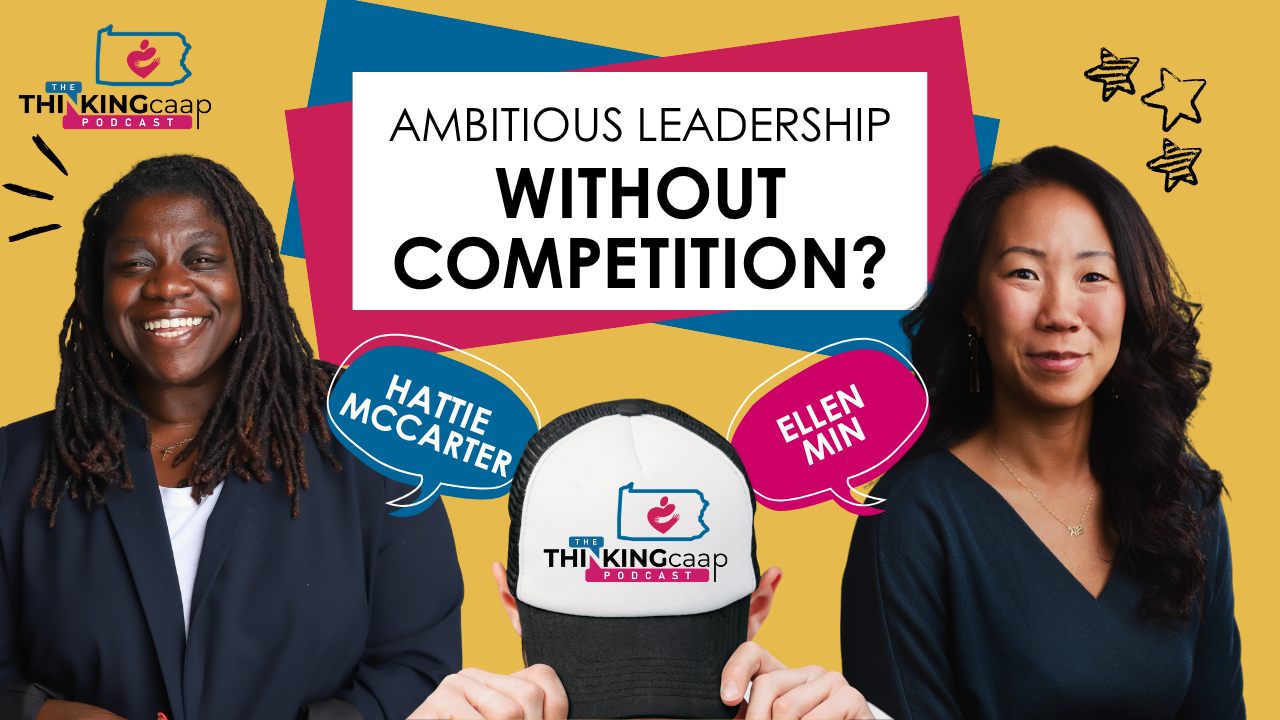
IMAGE DESCRIPTION: A yellow background with Hattie McCarter’s photo on the left and Ellen Min’s photo between them. Between them are speech bubbles with their names, and an overlapping ball cap with the ThinkingCAAP logo on it. Above them is the headline question, “Ambitious leadership without competition?” in all caps. There are stars and exclamation points in the background.
Thinking CAAP Episode 37 Highlights
[00:00:00] Introduction to Leading Together
Beck Moore welcomes Hattie McCarter and Ellen Min to the Thinking CAAP podcast.
The episode sets up a conversation about friendship, boundaries, leadership, growth, and comparison.
[00:00:33] Why This Conversation Matters
Beck frames the discussion around the overlap between personal friendship and professional leadership.
He notes that while the three may seem different on the surface, their stories share meaningful intersectionality.
[00:02:09] Ellen’s First CAAP Summit Experience
Ellen reflects on first meeting Beck at a CAAP Summit where Hattie and Esther were also speaking.
She remembers checking in with Beck as the event organizer and appreciating his honesty in that moment.
[00:03:42] Beck’s Memory of the First In-Person Summit
Beck shares that he had been trying to connect with Ellen for a while.
He remembers the pressure of organizing CAAP’s first in-person summit after previous events had been virtual.
[00:04:17] A Different Kind of Event Space
Ellen describes walking into the summit and immediately recognizing that the room felt different.
She saw people willing to say the hard things, center the people being served, and challenge the room in meaningful ways.
[00:06:02] Remembering Clint Smith’s Keynote
Beck reflects on Clint Smith as a powerful speaker, poet, and performer.
Ellen explains that the people in the room helped her understand the summit was about deeper learning and real connection.
[00:07:04] The Purpose Behind the CAAP Summit
Beck shares how the summit grew from CAAP’s work around equity, hard conversations, and community action’s mission.
He explains that the event is designed to help people learn, leave with tactical tools, and feel renewed.
[00:08:51] Hattie and Beck’s Origin Story
Beck reflects on meeting Hattie through a speaking event where both had memorable “mic drop” moments.
He shares how he later realized how close Hattie and Ellen already were.
[00:09:42] Ellen’s Role at Dickinson College
Ellen shares her current work as Associate Director for Student Access and Achievement at Dickinson College.
Her work centers on student advising, alumni mentorship, fellowships, graduate partnerships, and supporting students beyond their four-year experience.
[00:11:19] Hattie Introduces The Lead Up
Hattie shares the vision behind The Lead Up, a magazine focused on breaking narratives, building leaders, and becoming more fully ourselves.
She explains that the publication will focus on people, leadership transformation, and the good, bad, and ugly of leadership.
[00:13:46] Beck’s Vulnerable Contribution
Beck shares that he wrote something vulnerable for The Lead Up about power dynamics.
Hattie explains that she encouraged him to go deeper and use the platform to speak transparently.
[00:14:30] Trust and Safe Relationships
Beck reflects on how both Hattie and Ellen quickly became safe people for him.
He shares that their friendships grew because he felt he could be authentically himself.
[00:15:47] Friendship, Leadership, Boundaries, and Competition
Beck introduces the overlap between friendship, leadership, speaking, and professional community.
He asks how they navigate boundaries, conflict, and the possibility of comparison or competition.
[00:17:14] Hattie on Internal Conflict and Consistency
Hattie explains that she does not feel conflict within the friendship group because she feels accepted as herself.
She shares that she is intentional about representing the people she loves well, especially because their communities overlap.
[00:19:18] Ellen on Carrying Things Well
Ellen shares the line, “Just because I carry it well doesn’t mean it’s not heavy.”
She explains that boundaries require processing first before asking others to hold something with you.
[00:22:02] What Leaders Can Learn from Friendship
Beck connects their friendship dynamics to workplace culture and leadership.
He highlights the importance of recognizing what others carry instead of assuming your own stress is the most important.
[00:24:19] Competition vs. Shared Success
Hattie explains that competition makes her uncomfortable because she believes another person’s success does not take away from her own.
She reflects on the importance of honesty, trust, and clear intentions in professional relationships.
[00:28:15] Defining “My People”
Beck asks Hattie what she means when she says “my people.”
Hattie describes her people as those who can be trusted with her most vulnerable parts and who do not weaponize her struggles.
[00:31:05] Recognizing Burnout and Holding Space
Ellen reflects on a moment when she and Hattie recognized Beck’s exhaustion and set the agenda aside.
She explains that sometimes support is not about fixing, but witnessing what someone is carrying.
[00:33:46] Culture Starts with Knowing People
Beck connects the conversation to workplace culture and trust.
He explains that people need to be known before leaders can understand how to support them.
[00:36:38] Consistent, Trustworthy Behavior
Hattie explains that trust is built through consistent behavior over time.
She shares that alignment between words and actions matters deeply in friendship, leadership, and work.
[00:39:20] Energy, Reciprocity, and Relationship Investment
Beck reflects on the energy it takes to pour into others.
He explains that relationships do not have to be equal in the same way, but there does need to be some form of reciprocity.
[00:42:48] Genuine Celebration and Amplification
Ellen explains that celebration only matters when it is genuine.
She describes celebration as support, amplification, showing up, and speaking someone’s name well in rooms they are not in.
[00:44:59] Hattie on Celebrating Leaders and Women of Color
Hattie shares how Ellen taught her what it means to celebrate a good friend, a woman of color, and a leader.
She explains that celebration can look like opening doors, sharing opportunities, and affirming someone in real time.
[00:48:09] Reflection as Celebration
Beck names Ellen’s ability to encourage people to pause and reflect as one of her superpowers.
Ellen connects that practice to doing the inner work needed to show up well for others.
[00:50:16] Naming Insecurities
Beck opens a conversation about insecurities and how they show up in leadership and speaking.
He shares his own experience with imposter syndrome, anxiety, and physical manifestations like shaking or sweating.
[00:54:01] Hattie on Race, Visibility, and Identity
Hattie shares how being a Black woman shapes how she enters rooms and how others perceive her.
She reflects on the exhaustion of proving her worth while also carrying her family, community, and ancestors with her.
[00:58:08] Beck on Identity and Disclosure
Beck reflects on his experience as a trans man and the choice of whether or not to disclose that identity in certain rooms.
He connects this to questions of tokenization, representation, and whether people want him for his expertise or his identity.
[01:01:25] Ellen on Insecurities, Feedback, and Calling In
Ellen shifts the conversation toward having people who can hear your insecurities and reflect honestly back to you.
She shares an example of giving Beck feedback about a summit speaker and appreciating how he received it.
[01:04:29] Vulnerability as a Leadership Tool
Hattie explains that talking about insecurities is not weakness; it is where growth happens.
She challenges leaders to share enough of themselves to build real connection and prevent people from creating false narratives.
[01:07:20] Expectations, Vulnerability, and Leadership Pressure
Beck reflects on the expectations leaders often feel pressure to live up to.
He explains that even when full vulnerability feels difficult, leaders can start with small moments of honesty.
[01:09:02] Giving Grace to Leadership
Beck names the loneliness of CEO-level leadership and the difficulty of knowing how much to share.
He encourages leaders to find small, safe ways to create vulnerability with their teams.
[01:11:17] Audience Reflection: How Do Your People See You?
Hattie offers a reflection question for listeners: “How do your people see you as a leader?”
She encourages leaders to ask trusted people for honest feedback and use that insight to grow.
[01:13:31] Personal Leadership Brand
Beck connects Hattie’s question to personal leadership brand.
He encourages self-evaluation and knowing yourself as part of becoming a stronger leader.
[01:14:41] Community Rooted in Joy
Ellen closes by encouraging listeners to find people they can be in community with, rooted in joy.
She reflects on the importance of doing the hard things together while still laughing and having fun.
[01:15:53] Gratitude for Friendship and Leadership
Hattie expresses gratitude for Beck and Ellen’s leadership, professional relationship, and friendship.
She shares that she feels grateful to be in community with both of them.
[01:16:15] The “Link” Exercise and Final Reflection
Beck shares a camp-style activity called “link” to illustrate the commonalities people share.
He closes by connecting that exercise to the links within their friendship and the human connections that shape leadership.
Listeners are always invited to send questions about Community Action to info@thecaap.org with the subject line Thinking CAAP
Episode 37 Transcript
00:00:00
What's up everybody. Welcome to the Thinking CAAP. I'm Beck Moore, the host of the Thinking CAAP podcast and the CEO of the Community Action Association of Pennsylvania. And with me today, I'm so freaking excited. Two of my besties, sisters from other missers, Hattie McCarter and Ellen Min, people that are near and dear to I know our association and have been presenters, speakers, participants, soon to be speakers, been on the podcast before. can't say enough good about these two ladies. Welcome, Ellen and Hattie.
Thank you for being with me.
00:00:32
Thank you.
00:00:33
So we've I know that our audience knows you all we've heard you know, Ellen, you came on the podcast previously you did a little bit about your origin story, how do you presented at our conferences and our events for the last I think four years if I'm not mistaken. I really want to start with our discussion today though, you know, the purpose of being here is really talking about leading together talking about friendship boundaries, growth without comparison. how we all sort of are connected in very similar space.
But I wanna start with a little bit about our origin story, because I think for our viewers or folks who have met us all in person before, I think we're all lined up in a room together and people are like, these things are not alike, right? But there is so much tremendous intersectionality in our stories and who we are as people. And I think, You know, as we all talk about all the times and the discussions that we lead around diversity, equity and inclusion.
There is so much more that we have in common, I think between the three of us, then we don't ironically, even though from face value, right? It may not appear that way. So I don't know who wants to start by talking about our origin story, but I think we sort of have this layered piece. And I think we talked in the prep call, you know, how do you, sort of the, the cog. of this wheel a little bit.
00:02:00
I'll let Ellen go first.
00:02:04
Why me? goodness. I love you.
00:02:06
because I love you.
00:02:09
The very, I think the very first time I met Beck was going to a CAAP summit as an attendee. And I was going not because, I, I mean, clearly I wanted to meet Beck, but I knew that Hattie you were speaking and that my friend who is out in Philadelphia, Esther, was a speaker as well. And so I thought, my gosh, I have. this very close sister of mine in Philly who's coming all the way in to speak and Hattie's going to be there. And I really loved the topic. And I thought, okay, I have to go.
And when I came upstairs, I could see Beck that you were as the person who was organizing the summit, you were smiling, you're greeting people. But I could sense that look behind the eyes that I know I have at an event. So I came up to you and said, hey, I'm Ellen. I know you're Beck, you're organizing. And I remember I felt like I had to check in with you. was like, how are you doing? Like, how are you doing as the organizer? And I think you just did kind of a sigh and you were honest with me.
That's what I appreciated was that it wasn't like everything is great. Everything is fine. You had this, you know, I have lots of great people working, but I am a little bit nervous. It's the beginning. And so it was that moment that we shared. that was so honest and we just met and we took our first photo together at that moment. And then
00:03:42
And to be clear, I just want to interrupt for just a moment and say, I'd been trying to get on Ellen's schedule for a while, like on her calendar. She's a hard lady to lock down to be. so I'll say that out loud. And I just sweat through like four layers of suit that I had on at that point, just trying to set up a step and repeat that is very large. so when you came to me, was like, we had just finished and it was our very first CAAP summit that was in person.
So up until then we had only operated those events online. And so we were sort of taking this leap about, you know, do you really want to come and spend time with us at this event? So sorry, go ahead.
00:04:17
And I appreciate you reminding me of that because I think when I asked, how are you holding up? How are you doing? You did mention that you were sweating profusely. We're going be friends because if you can tell me the honest truth about what your bodily functions are doing in that moment, I'll say we're going to be good. And then when I walked into your summit, I've been to so many conferences and spaces where I walk in and I... look and I say, okay, this is going to be everyone nods, everyone's keeping it safe.
We're learning and no one's really going to ruffle feathers. Nothing's going to be really deep. You get some numbers and information. No, these were, I looked around and was like, my gosh, these are the people that I am having personal relationships with because I know these are the people who are saying the things that are hard to say. truly advocating for those who are in the center of the work.
Not just like I have this mission and I feel great about myself, but I have this mission and I'm centering the people you're serving and actively bringing their voices in. I mean, it was quite the room. the way to say it is that it was one individual that I had followed on LinkedIn and really appreciated their voice. And I had never met them in person. I was like, I know you don't know me, but I follow you on LinkedIn. I truly appreciate all the things that you say. I learned so much from you.
Can we have a picture? So I knew it was automatically a different summit because I was like, these are all the people who are going to say the things and who are really there for the right reasons. And then your speaker, like you had a keynote speaker that really pushed the envelope and he was saying things on my wall. I kept looking around like this is
00:06:02
Yeah, Clint Smith. is a powerful individual. He's a poet. He is a beautiful soul, an amazing actor. have said this more times than I can count. I want to be Clint Smith's buddy. I hope one day he wants to hang out with me as much as I want to hang out with him.
00:06:19
Yeah, yeah. These are the people that were in the room. Not the people I just want to learn alongside, that I'm going to learn from, and that we are going to really push each other to think outside of our own perspectives and lived experiences. And so that's how I knew. And then from then on, I think you and I kept connecting. And there was just this sense that we're the real deal.
And when I asked Hattie, like, hey, This Beck individual, that's how I knew, was like the people who I trust with my own life trust their lives with you. And so I knew, this is going to be a relationship beyond, I attended your summit and I learned things. It was going to be much greater than that.
00:07:04
I appreciate you sharing that so much minutes. That event is so near and dear and special to my heart. was an ironically it was an event that during COVID our board had created a committee to help create change and really ground the work of community action in the fact that we were created to create equity within local community. Right. And so how what should our response look like in this moment where our country is struggling right. We don't know what to do. with our feelings, we need to have hard conversations.
And so this idea of this event was born. And so it was sort of handed to me in that very first year was a virtual event. And I just said this to somebody else a little while ago. Like there wasn't really, this was in December when I started, there wasn't really a lot planned at that point for February when the event was going to happen. And it, that event has just grown really tremendously today. We do it in a hybrid environment, but the point really is to how do we bring together people who really want to learn?
but also get tactical things and leave with this sense of sort of renewal that in the spring, you're exhausted by winter, we're sort of all coming out, right, of our caves, whatever they look like, however big or small or heated or not heated, and we're trying to get ourselves ready for now, the next season of whatever is to come. And that period of time, that timeframe is, it's a moment of exhaustion and it's sort of like, get everybody back into it. And so I love that event.
Both of our bookends are beautiful, but our summit is just a different feel.
00:08:48
I love that.
00:08:51
So Hattie, you and I have talked about our origin story in the speaking event that we were at where we both sort of had these, you know, little bit of mic drop moments and, you know, saw each other from afar and we're like, you know what? This lady is going to be my friend. She just doesn't know it yet. This guy's going to be my friend and he doesn't know it yet. But our relationship has really grown in a lot of ways too over the last few years.
And then I sort of discovered that That that it wasn't actually that long. I think it was like only about a year and a half ago that I just I didn't realize how close the two of you were.
00:09:26
yeah.
00:09:28
because you have past history and working together in lots of different ways. So I just kind of like wiggled my way in to hang out with the two of you, because I love you both.
00:09:39
I appreciate that.
00:09:42
So I think with respect to kind of then like what we all do on a regular basis, I think we all work in really similar space. So, and Ellen, since the last time you were on the Thinking CAAP, your role has changed a little bit. I think you were just at the beginning about to start. So can you just remind everybody what you do in your quote unquote regular life?
00:10:02
I'm at Dickinson College, my alma mater. I returned there after 20 years from graduating from Dickinson, and I'm the Associate Director for Student Access and Achievement. Basically, I'm providing access opportunities for students to expand their story beyond their four years at Dickinson. So whether it's competitive fellowships, graduate partnerships, I co-advise the Women of Color Summit and co-advise the Trendsetters First Generation.
students, I'm trying to create alumni mentorship programs for all of our students so that people can connect with alums outside of their four year, while they're within their four years to strengthen the student experience and then student advising. So I'm supporting students with their four year journey. So yeah, lots of back in the education space and I love it.
00:10:53
And Hattie, want to make sure that, and you just spoke at the Women in Color event at Dickinson, believe I saw the picture. As I said before, we were scrolling through some pictures with my son and he knows you and he was like, Hey, that's Miss Hattie. So I love that. You're about to launch a really exciting, you know, new platform. And I want to make sure to give you an opportunity to kind of just, you know, a little bit of a shameless plug moment here, the lead up. So go ahead and talk about it.
00:11:19
Thank you. First and foremost, so happy to share this space with people who I so love and I have no problem in pulling up for. So I just wanted to put that out there to everybody. But I have decided to launch a publication titled, The Lead Up. It is a magazine to where we talk about where we are breaking these narratives, these cycles, our silence. but also rebuilding ourselves into who we are and who we want to become as a leader and really talking about the good, the bad and the ugly of leadership.
And so this is a platform where I want people to talk about the transformation of leadership and not really the performance of it because the form is what really gets us to not really walk into our path of who we are as leaders. really having a special understanding of leaders who are marginalized with all those intersecting identities.
But I want to give people this magazine to use as a resource, but really as their own, I title it like its own corporate Bible, because those conversations that people want to talk about, but they don't have a safe space to do that. And nor is anybody really publishing it. And so we're not really about like data, facts, logic. We're really about people. And as I stated before, our three principles are breaking, building, and becoming.
And so this magazine, I'm supposed to have to come out in April, but I'm a little bit of a perfectionist. So it is coming out in June. And so it's going to be a quarterly publication, definitely collaborating with a collab creator in Harrisburg. So I'm really excited. Beck, you are one of our first contributing writers. So I'm so stoked. I'm trying to get the homegirl Ellen and Dr. Sessions, AKA Dr. Queen Latifah, to come aboard and write an article as well. So I'm just really excited about it.
I really hope that it blesses people in a way that they can see themselves in the article, see themselves in the magazine.
00:13:30
Like my goal is for this to go global. Whenever that time comes, I'm here for it. So this is an adventure. I really had no idea in what I am doing, but I'm like, if not me, then who? So I'm just really, really happy about it.
00:13:46
So I love it. I'm excited about it. I wrote something that's really, really, really vulnerable that I am both terrified for people to read and happy for people to read. Because I think it talks about things that are important from a power dynamic perspective. So that's what say for now. But thank you. was difficult.
00:14:07
really good
00:14:13
I had to pull it out of you. was like, you know, like this, I see you, but this, I need more from you. said, cause you have a lot to say. Here is your platform to say that unapologetically, be transparent. I said, I wish somebody would say something.
00:14:30
Yeah, no, I appreciate I mean, I think that kind of leans into our conversation. So before I get into my question, so I just want to recognize that for both of you, you know, I am somebody that I don't trust very easily. You know, I may say about being sweaty and I will always be honest about being sweaty because we all get sweaty from time to time. It's like on your episode, Hattie, talked about like, haven't you ever gone to the bathroom and realize your underwear had been on inside out all day and you're like,
00:14:56
like now.
00:14:59
That happens and I will be honest about it. That's a huge thing. throws you off. I am not the only one. I want to know if our listeners have had this experience, email me please, Beck at thecaap.org. I want to know.
00:15:11
listeners now.
00:15:13
Anyway, but I think for both of you, there was just something genuinely about your spirit that it was just you were both just an immediate safe space for me. And so I just want to say that about both of you. I mean, it's part of I think why our friendships have grown. just didn't. There was there was no there was no layer there. I don't know how else to say that. There was just I just knew, right? Like I could be authentically me and that was not that was going to be that. So I appreciate you both for that.
00:15:45
You're welcome.
00:15:47
So we have, thank you, we have all of these overlapping and layering pieces of kind of friendship and leadership that we work within. Because we all are speakers. all go out and talk within our local community. Our local community, even though it is large, is not that large. It's rather incestuous when you think about, like everybody knows everybody in most of these groups that we're all speaking within.
And so there's lots of layers between the friendship and the leadership component and, potentially what some people might sense as a, I think a possibility about competition. But for us, I want to start with a little bit kind of this idea of like creating healthy boundaries, kind of leaning into a little bit of, you know, what's, what's the healthy boundary line versus the over-reliance on someone and writing what can become, I think, maybe a sense of co-dependence.
Then also how are we navigating kind of the potential every relationship has some form of conflict, right, whether or not we name it or not. And so what you just said there, Hattie, about kind of calling me out about that article, you want to want to start with kind of just write, like, how are we each navigating the conflicts within our relationship? What makes it easy?
Because I think, you know, not only put words in your mouth, but I feel like in the moments that if there has been something hard, it hasn't really been hard.
00:17:10
Right.
00:17:11
And so what are your thoughts?
00:17:14
so I'll go first. think for me, I always have an internal conflict. I really don't have a conflict with this friend group per se in this professional relationship. because you both have allowed me to be me, right? There's no expectations in the friendship, in the working relationship. And I think there's this level of understanding that already came with the relationship. Right? Like this is who I am. And it was kind of like either accepted or not respectfully.
But we allowed each other to grow and learn and just really love on each other as much as possible. So I'm just really grateful for this opportunity that we have, but also to like. I'm such a worry ward. And I I experience anxiety, right?
And so with that, with that, I'm always thinking about the other person when there sometimes I shouldn't have to write, especially when I know I'm in a safe space, but I'm always cautious or very intentional about how I engage the people that I truly love and that I have a high regard for.
And so because of that, I'm always worried like, let me make sure I'm continuing to be consistent with Ellen and with Beck and making sure that I'm also representing them in a good light because I know now that we are connected through community, I know if I say and do something outside, eventually it's going to come back and reflect on the both of you, right? Or it's like, oh, well, did you know that Hattie did blah, blah, blah, blah, blah? And so it puts you in this conflict situation.
So I know I never want to do that for the people that I truly love and care about.
00:19:14
Yeah, no, I appreciate that so much.
00:19:16
Mm-hmm.
00:19:18
Yeah, I'm listening. sorry. I love the saying just because I carry it well doesn't mean it's not heavy. And I really appreciate you Beck and Hattie because you know what I carry. And you take the time to understand that. And I think the boundaries over over boundaries versus over reliance is
00:19:20
Go ahead.
00:19:51
Just because I know that Beck and Hattie might be willing to hold something for me doesn't mean that you should always have to. So I'm always wondering, okay, so in order to protect the friendship and my individual well-being and your individual well-being, I always think, have I processed this first? So I know Beck and Hattie, were both some of my major supporters during a time of transition in my career, but I...
think that in order to have boundaries in our friendships where we don't over rely on each other, I do the work. I do the work, I process it, I work through it. And then I have the two of you to help me grieve, rage, process, understand, and help come up with solutions on, okay, what can we do next? Or sometimes if I say, Like I have processed it to the point where I understand what I mean. I'm like, hey, can you just listen or can you just meet me now? Let's not talk about it.
And I think that boundary comes with knowing yourself well enough and making sure that you pour into yourself because we've all been there as people and as leaders where there is someone who has come to you completely unprocessed. And they're activating all of your things. They are processing out loud. They are venting and not connecting. And they're expecting you to carry and not understanding what you carry.
So I think because we're so aware of each other and we see all that we carry that we understand before we place something on you told for us. hold, like before I put anything into your hands before you hold it for me, I have done some of the work to really examine what it is that I'm pushing over to the two of you. And then the two of you hold it so wonderfully, caringly, compassionately. And I know that whatever I give to you to hold, that it will be in the most sacred way.
00:22:02
One, think this framework is, if our listeners are listening, they're like, what, purpose does this really serve for me in terms of how do I learn from this discussion? I think that is part of why I wanted to have this conversation on the Thinking CAAP because I think, right, like there's a, there's a learning to take away from the way that our, we live and work within our relationship. Because while I think again, from an outsider's perspective, there could be this sense of competition from all of us.
It's, it's just, there's. There isn't. And we had this discussion and kind of talking about what we wanted to talk about today. the ego that exists a lot of times in kind of the management conversation, Or the, to your point, Ellen, like recognition of what we each carry, that aids in the ease in which we have relationships. And that is an important consideration for anybody who's leading people, anybody who's working alongside somebody or no, it doesn't matter.
If you're on a project team, if it's a peer, right, whatever, like sometimes we get so wrapped up in my stuff's the most important stuff. We just, we just make assumptions. Like I use the example all the time about like, I worked in the service industry for years as a bartender for like 15 years. worked at. as a server and a bartender in a very, very busy restaurant in Hershey. So like think summertime, if you've ever been to Hershey park and you go to a nearby restaurant, it's just absolute chaos.
And people are just so ignorant to you as a server. You've had a long day. I know your sunburn. I know you drove from Jersey or wherever New York to come to Hershey park for the day and you got 10 screaming kids and you all drove together in a carpool and sure your onion rings, maybe they're not as crispy as they should be, but guess what? I'm also having a crappy day.
00:23:57
And my reflection of my service isn't just, you don't assume I'm a bad server, right? Maybe I just had some stuff that happened before I got to my job this morning. And so it's the easiest comparison to make, right? So we think about how that exists within the framework of sort of an office dynamic, and it's not as evident always.
00:24:19
Yeah, I honestly I've experienced this yesterday to where I was just so mind blown because I'm like, we're on the same team. We don't have to compete because if you're winning, I'm winning and vice versa. have never been one like being in competition with somebody really makes me uncomfortable, which is why I don't play spades because that's a dangerous game. especially among black people. Okay, if you got black friends, play spades and you don't know how to play, don't do it.
Just get the tea, the water, the chicken, whatever. But I just realized like there's just certain parts of me, like it makes me feel more comfortable because I am, I feel like I'm more of a servant leader, right? I want to make sure you have the access and the opportunities to be successful because that's going to make me proud. Because I truly know deep down on the inside that whatever is for me is going to be for me regardless. And nobody can really take that away from me, even if they tried.
So when I see competition or when I feel it, I'm always asking like, what did I do for you to feel like you got to be in competition with me? And even if I feel like that competitiveness within myself, I have to check it very, very quickly. And this goes back to what Ellen said that so inventory? Are you self-aware? So I'm like, okay, why are you feeling like you need the same recognition as this person or that person?
And I'm like, well, I've asked myself, well, maybe I've always wanted to be on this board or I wanted that access. Now as an entrepreneur, I'm like, well, this person has this connection. I just want to get connected. But I don't think people are really honest about some of the relationships that they have and what type of relationship they want to have. Cause I will respect you more if you just come to me and be like, look, I'm just trying to get to know the people that you got.
Cause I'm trying to elevate this way. And I feel like you can help me do that. And if I can't, cool, but don't just ride my coattail and not be a genuine friend, not be a genuine leader. Because once I see you not,
00:26:39
being that way and your intentions and the impact that it's having on our relationship, it's going to make me not trust you. And when I don't trust you, that is a problem because you have lost complete access to me, the things that I will be willing to give to you, whatever that is, I gatekeep it because I'm like, how do I begin to trust you with me? If we are not in a space of understanding and I feel like you trying to compete with me.
Well, it's like all these dynamics, but I think what hurts the most for me when it is your own people. That's, that's when it hurts the most for me. And so I, when I say this is a mountain that I have been up and down for the past two and a half years. So it's like, okay, I just. The people that I know closely, like Ellen Beck and our other circle of trust, I'm like, that's it for me. No more new friends. I think I'm good. We okay over here. You stay over there. You want me to? Yeah.
I'm like, we just gonna shut it down. And so I hate being that way because I want to be open. want people to have the things and be successful. But when I start seeing that your true identity,
00:27:44
My friend Ross
00:27:59
And when your true identity starts impacting me to where I feel like I'm just stuck, I can't move, I'm not at peace, I don't trust you, I'm on guard all the time, we got to disconnect. So that's in a professional or even person.
00:28:15
Yeah, I want to go back to something you said there to kind of reflect on it because let me start with the question first. When you say your people, how does that define for you?
00:28:24
Mm-hmm. Ooh. So my people are those who I can trust with my most vulnerable pieces of me, right? My people are those that I have gone through the trenches with and they're still there. And they're not using the trenches. They're not weaponizing what I've gone through, what I have said, my missteps against me. My people are those where I can see similarities but aspire me to be great.
My people, know, the best, one of the examples I can give is that I put something in our circle of trust chat with me, Ellen, and a couple other of our close friends. And I think it was maybe a couple of weeks later and everybody else was responding except for me. So then I get a text, a side text from Ellen. She was like, hey, friend, I'm just checking on you. Are you good? And I think it took me a little bit longer to respond. Then she called me and I'm looking at my phone.
like, I was like, I know Ellen is going to bring some out of me. I am so not ready today, but I picked up the phone anyway because I know it's Ellen and she was like, Hey, what's wrong? And I was like, I'm good. She said, no, you're not. I was like, Ellen, I promise you I'm fine. She was like, Hattie, you are what's going on? Cause you're not responding. as you usually do in this, in our group chat. And I just unleashed and she listened and she provided perspective, but she also spoke into me.
So when I say my people, that's who I need, right? Even with you, you're like, look, what's going on? Like, I just want you to know, like I got you. And when somebody says I got you and actually mean it, that means a lot to me. Cause I've always been the one that had everybody else.
00:30:24
and I didn't allow people to have me. So like you and our other group, and when you say like, I got you, I believe it. I'd be like, okay. And I'm at ease because I know you're being honest with me and I know you're going to do everything that you can to help me in whatever capacity that is. So that is my people, ones that I can literally write it out for. So when people like, do I need to pull up? I'm serious about that. I'm like, just.
I'm like, give me the name, the address, what they look like, who they mama, their grandma. I'm coming for everybody. Cause you not fixing mess with my people.
00:31:02
How does that resonate with you, Will?
00:31:05
Well, it's reminding me of the time back that you had and I met in Midtown Harrisburg. I think the idea like I know we're getting to this question will be a little bit early, but just, know, the recognizing the burnout and the need for support. So it's you are so in tune with the human being in front of you, not back with the title back, which nonprofits you belong to or which awards you've won.
00:31:39
Cheers.
00:31:40
Hahahaha!
00:31:42
you all the awards. Like you're so attuned to the human being that when you arrived, saw it in your eyes. And I was like, and before me and Hattie even got to the whole reason why we were meeting, there was business that we were going to talk about. But we scrapped that and we just sat with you and said, like tell us what is happening. And we gave a lot of space.
It's noticing the shifts in energy when someone is quieter, less responsive, something is happening and it's not us being like, well, Hattie's not saying anything in the group chat. What's wrong with her? It's something is up and I want to check in and I want to see how your heart is doing. And there are times that we have just supported each other. not by fixing, more like witnessing. We just were witnesses to your sweatiness, to whatever was happening, the pain, the grief. And we just hold that.
So I think the recognizing burnout is you are, again, we're going back to like, you're so in tune with your own emotions and how they show up that you can recognize it in. people who work for you, work with you and your friends. Because Beck, I don't know if you could have gone into any other space where you had a meeting and agenda and somebody would have said, I can see it in your eyes, something is up. Can we stop and talk?
Those are the people that I want to be in community with and those are the people that I want to have relationship with. That when I walk into a room and I have my face on, I'm like, no. I know you well enough to know that that is not genuine. What is going on?
00:33:46
Yeah. And I think that again, to go back to kind of the listeners, you know, that you can't, it's part of what we try to lean into from a workplace culture perspective all the time. You have to get to know people before you can really create a thriving workplace. can't, you don't know how to support somebody if you don't know just basic things about them. Right. And you don't create a space. You don't start with trust. For most people anyway, some people sure you might. but that's not the way I operate.
And I think anybody who has complicated layers of identity, who's carrying anything, most of those folks, right, us included in that, we don't start from a place of trust. I try to, but I know that my past dictates otherwise. No, I want to, I want to be able to let go of things, but it just, it's too deep, you know? I've been hurt too many times by people who I did trust, right?
00:34:32
I never do.
00:34:44
So it's just, it's just not a reality. So I think though, right, again, to create trust, to create that just space where you walk into somebody's office, whether again, it's a peer supervisor, manager, a manager of a manager, somebody who works for, you for you, who you're the leader of, like, you can't, you gotta, you gotta be able to create a little vulnerability and be honest about. and get to know each other before you can find that.
There are those people who just have that sort of empathetic soul that right away are gonna know, but generally, that's not often. So yeah, no, was reflecting on that as well while Hattie was sharing, and I remember saying to you, that's a heavy question right now. And I just kind of shared, I'm not gonna say the baseline because it's far more complex than the baseline, it was a heavy moment in our family that we were dealing with. And you're like, we could have canceled or rescheduled.
And I was like, no, no, I needed, I needed this time. So, you know, I, and even yesterday we were chatting about something and Hattie texted me afterwards and she was like, Hey, you look stressed. you okay? And I was tired and my son was home for the holiday still. And we were trying, I was trying to juggle him being downstairs and me being upstairs and trying to get work done. And there was other things going on too. And I didn't respond right away.
And Hattie then sent a ridiculous meme, was like, hey, I asked you a question. What's going on?
00:36:24
What's up?
00:36:25
Yeah, no, but I appreciate that so much about all of us.
00:36:31
Yeah. And also, I didn't mean to you off.
00:36:35
Go ahead.
00:36:38
I think for me, how you can establish just with me is consistent, trustworthy behavior. I have to see you in action. I have to see you as other people. But I also have to make sure that your words and your behavior aligns. I think that is the Libra side of me, right? Because I want balance, I want harmony. but also as a person just like you, Beck, that has been hurt tremendously by giving their all, pouring so much into people.
And to where that love is not reciprocated, to where that trust that I'm trying to give is not reciprocated, to where just me as Hattie, those vulnerabilities that I'm giving you, you take them and you dismiss them. So when I don't see that, I'm always asking questions like, wow, is this who you really are? Or is this who you've been the whole time? I just ignored it because I'm trying to see the bigger picture of you. And you kept telling me, this is a red flag. This is a red flag. here's a book.
Here's how I really am. Let me close it for you real quick because I don't need you to see all of that. And so for me, it's just the consistency for me. If I don't have that in whatever ship I'm in, I just began to question my value, but I began to question the relationship. And I think even as a leader, we always have to be mindful of how we interact with people, but we can't expect for our team and our organizations to do things if we are not a reflection of that.
If we're not being consistent in our behavior, if our words and our actions are not parallel, are you going to make a mistake? Absolutely. And this is where grace comes in that. But I'm like, I always give you three chances. If out of those three, you still not doing what you need to do. And if I'm coming and I'm telling you what I need as a friend in our community, and you still feel like it is okay to continue the inconsistency, then that's when I got to cut you loose.
And it's difficult when you got to cut somebody loose and you still work with them. You still know that you are going to see them in certain areas.
00:38:57
So then you gotta ask yourself, how now am I going to respond? How am I going to start engaging with this individual and still set those healthy boundaries? Because sometimes people don't even know that you can cut them off. That's the sad part.
00:39:16
Yeah, well, are they paying attention?
00:39:19
Probably not.
00:39:20
I mean, think that's, I think sometimes we, you we, I think we've talked about this before.
This is going to sound probably cold a little bit, but in a world that is heavy and I'll speak for myself for me, I, you know, I had to evaluate what the return of investment of time is and there's gotta be, you know, if I, one of the things that I, you know, I'm working on right now is I, know, somebody told me recently, she's like, you pour out of your heart, you lead with your heart, which means you're constantly pouring out of yourself and you don't pour back in yourself.
And so if I'm going to pour into you, right, because that comes with energy loss for me and what I have the capacity to do in other parts of my life, then it doesn't mean you need to pour back into me the same way I pour into you. But there's got to be, right, there's equality in the relationship in some way, right? Like if I'm going to invest my time in you, take time away from my family and take time away from my work, I would hope that like, you know, there's, you're going to at least lean in a little bit.
And if you don't, then I got a question. Is this coming with direct harm? Is it coming with harm later? Because now I've, know, or if you know anything about like, can talk about spoon theory theory, you can talk about like all kinds of different versions of this, but like, you only have so much energy to give it any single day. So to a degree, there's a little bit of a value proposition in the relationship side, which again, it sounds cold, but I think that's the reality for me today. I only have so much to give.
And that's a hard lesson because we talked about this the other day. I don't like letting people down. I'm constantly worried about letting people down. And that's kind of my own insecurity that I'm challenged with. I want to transition a little bit to kind of the celebration component of I think what we've been able to do for each other and how that's really resonated with each of you.
So I think we've all been in moments of thriving and the other one is struggling and there have been times where we're all thriving and there might be some piece of struggle that we're having, right? But it may not be as evident as other times. what is that? What?
00:41:45
I think really resonates with you in terms of right, like how we've each lifted each other up, or is there an example of something that's really like been helpful for you or something that you want to call out in terms of that kind of celebration component. I also think this is an important part of the puzzle in terms of how we work alongside of people, how we work with people celebration.
When people think about celebration, I think a lot of times they think they think about like, OK, you got to give the extra money or you got to give the vacation days. Right. But we know that celebration of people comes in lots of other ways. And I can't. Sure, how do I love to give you pile of money? I also have to give you a pile of cash if I had it. I don't have any, to be clear. But like there are other ways right in our personal relationships that the moments of celebration really matter.
So be something as simple as a text on a particularly great day or when it could be a LinkedIn like, but what's the thing that really resonates for each of you?
00:42:48
Go ahead, Hattie.
00:42:50
No, no, no. I was already talking. Go for it.
00:42:54
I'm thinking about this.
00:42:59
I don't think it matters unless it's genuine, right? And that's what I struggle with. I've had people who have told me that they are celebrating something about me to me, but then I find out that it was different on the other end when I'm not present. And I'm sure we've all had those moments. So I love celebration in... don't even think I need someone. It's that value aspect. Like people value, like when I will screenshot something like, hey, Hattie, I just saw this or, hey, Beck, this is wonderful.
Celebration to me is support, amplification, and in the most genuine way. And it's very simple. And I think celebration is showing up. So... If there is a way that I can show up for something that is happening for each of you in a different way, like Hattie with the launch of lead up, I'm wondering how am going to amplify and celebrate this and back with your summits and the work that you do and also the work that your wife does or we're constantly trying to find ways to be present in an authentic, genuine way.
And I also know that if Beck and Hattie mentioned my name in a room. It's going to be in a beautiful, kind, generous way. And that celebration is, that is an amazing opportunity. There's so many times I'm like, Hattie, there's this opportunity I heard of, can't do it, I would love to pass it to you. Or like, there's this thing, I'm so excited about it, I'm gonna lift your name up. So I think those are the ways that I have seen celebration between the three of us. And then I've...
00:44:55
really responded well to.
00:44:58
Yeah.
00:44:59
I think for me, first and foremost, Ellen has really taught me what it means to celebrate a good friend, but also celebrating a woman of color and a leader. And so I really learned that from her. At first, I was like, wow, she is really intentional about putting people in spaces that matter. And so I will say thank you, Ellen, for that because I didn't know what that meant. I just thought like, where I go, you go. But I'm learning that I don't always have to go with you to be in support of you and for you.
And so I truly believe in paying it forward. So every time I hear of an opportunity, I'm like, I have this person, this person like, I'm definitely going to put back on for that. Ellen, absolutely. If there is a business, I'm like, how can I support? What do I need to do? How do I get you in front.
And even in organizations where I work in, if I know that I have a sense of authority or power to pour back into you and highlight you in a way that I know that my platform may not have that ability in doing, but I know that this platform does, I'm going to do that. And so I truly believe in giving people all the praise, right? And also name dropping, because once you be like, do you want... Do you know the CEO of CAAP? I'm like, and dude, I'm like, it's my best friend. They're like, what? I'm like, mm-hmm.
What you gonna say? Well, can you? I absolutely can. He would be more than happy to help you. Let me drop a bug in his ear. Same thing for Ellen. So when Ellen did the Women of Color Summit, I was so proud of her. Ellen is a busy bee like myself. And I was just so proud of her and how she was navigating. that space being a leader, but also being an example to those young women. And even when she got stressed, like me and our other friend Claire, uh, friend Claire was there and that's a tongue twister anyway.
And so we were looking, she was like, Ellen is nervous. I was like, I know we got to talk to her. So like, you know, just sit down. I was like, get you something to eat. And I was like, I know, but I have to clean this up and I want to make sure I was like, friend, you're good. Everybody's great. Doing a fabulous job.
00:47:19
I just need you to have several seats." And she was like, you're right, I need that. And then in five minutes she got right back up again. And I didn't, I wasn't trying to hold her hostage at the table, but every time she came back, I was like, you're doing an amazing job. I just want you to know I'm proud of you and thank you for providing us opportunity. Sometimes that's all people need. It's just a nice little rub on the back, like, you know you're doing an amazing job, right? And she's like, I am.
I'm like, you are a baddie. Go out there and do what you need to be doing. People just need words and feelings, but people really just need you to be present. That is the best support. That's the best celebration that I could ever have. So when you call me, like, hey, I need you to do, I would like, will draw any and everything for you. Cause I know you would do the same for me.
00:48:09
Yeah. One of the things I want to call out that I really appreciate about you, Ellen, is that you, you celebrate people in a way that I don't know that I've really ever experienced before in that when you, you know, you know, that somebody's either going through something great or something that's maybe difficult or something that's in between, but there's definitely like a need to process whatever the thing is. You will call.
people out to say not call people out that's not the right thing you will say right like have you taken a moment to reflect on this and take in a moment to. Understand for yourself right like what this really is and what the impact really is and you remind people to do that in a way that comes from a place of what feels like a place of genuinely genuine caring. And it's a good reminder that I don't know that I've. Yeah I don't.
know that there's anybody else that I've ever sort of worked with that been in a friend relationship with, regular relationship with, whatever, you know, relationship. So it's, just think it's, it's one of your superpowers.
00:49:20
Mm-hmm.
00:49:21
Thank you. But that's kind of like full circle, where we have to do the work to really love ourselves and care for ourselves and know ourselves so well that we can show up for others and do the really important work for our communities, our families, our friends. And so it just is always like that's on like, have you processed this or even me? Have I processed enough before I bring it to other people? just Like I can't stress that enough.
00:49:54
How do you, were you gonna say something? Okay. I want to talk a little bit more if we can, as we kind of wrap to the end here, unless there's another topic that you really want to jump to that since we're like, you know, kind of mid conversation right now, anything else anybody wants to call out at the moment.
00:50:13
No.
00:50:14
Well, it depends what your question is.
00:50:16
Well, I'm gonna get there. Although people might be tired of listening to this love fest. So they're like, shut up. We know you like each other. That's okay. It's true. So let's talk a little bit about kind of like naming the insecurities. Can we go there? Are we ready to go there? we comfortable? we we have the energy capacity to go there?
00:50:35
You do. I do.
00:50:37
Okay, I mean, yeah, I do too. I started by talking about this a little bit before we really started. So when we think about kind of our own insecurities, right in our in our work in the ways that we show up in the world, how do we do we feel like, I know we've had individual conversations, we may have had a couple like collective conversations about this. But is there anything that we want to name that we haven't named already in terms of how we show up in kind of our regular work.
And I will happily start by saying that I have the most ridiculous imposter syndrome monster on my back on a regular day basis that most people would never imagine, but it's there. And sometimes it shows up in ways that I can't control, like literally like shaking. Cause it's just right that anxiety that you talked about Hattie, right? Like it's there and I can't turn it off. And that's just how it physically manifests.
Other times it is profuse sweating, but not because I've been working on anything, but just cause that's how it manifests.
00:51:50
That's true.
00:51:54
But I think we are all people. And the reason I want to talk about this is because I think we are all people that from an outsider's perspective, people who don't know us, right? They see three powerful people on a stage and they think, you know, these people have it together.
And I think we largely do on a regular basis, but that doesn't mean that it's still not hard to stand up on the stage or stand up in front of the group of people, whether it be students or, you know, medical professionals or nonprofit professionals or whoever we have the opportunity to speak to at any given point. So, I for me, I'm always thinking about, Like, you know, and I've talked about this on the Thinking CAAP before, you know, I really didn't ever think I was going to amount to anything.
I thought I'd be dead by the time I was 30. I didn't really think that, right? Like, they just, there was no path to anything that I could see, you know, when I would be asked, right? Like, what do want to do when you grow up? Right? Like, I just see darkness. I don't see anything in reality. And that's, I think, then when I am on the stage, I have these moments that are sort of out of body moments where it's like, what am I even saying? Why is anybody listening to me? Why is anybody paying attention?
And certainly this cannot possibly be really resonating with anybody. Or sort of this fear of like, you know, being found out that you have no clue what you're actually doing. And I know that I do to be clear, but I think that's the voice that's sort of. I'm trying not to feed in today's version of myself, but it's hard, right? Because it's just there kind of lurking. And sometimes that voice gets louder and louder. And again, outsiders don't necessarily see it.
00:53:41
That's a deep question. And wow, that will probably take another 45 minutes. Ellen, do you want to go first, love?
00:53:53
So you go.
00:53:54
And if you don't answer the question, that's okay. That's okay, too. I'm happy to just call it out by name and saying that like all of us have it. Some insecurity.
00:54:01
No, We do. I, you know, I have a few. One, you know, me realizing being able to put a name to what I experienced, me being a neurodivergent, right, and actually understanding what that is. But really, it's kind of like a beautiful thing, but it's something that I will, I can't get rid of. And that is really me being a black woman. I don't always want to take the conversation to race, but it plays a huge role in my life. It plays a huge role in my career.
And it's like, how can I fully show up as Hattie, a woman of color in all these spaces? Knowing that when I walk into rooms that people are automatically going to think that I'm angry or that I am emotional or that I don't know what I'm talking about or that, you know, when they find out that I'm from Alabama, you know, that Southern bias that comes upon me, the way that I speak is an insecurity.
So all these things go through my mind when I enter into so many rooms to where the only thing that I know how to be is just silent. And even with that, it burns me up because I'm like, I have this person on this shoulder saying like, you know, you gotta speak for the people. You know, you gotta talk. You know, you gotta show up. And then on this side is like, girl, don't do it because you know, they're not listening in a way. They really could care less. You know that you are the token at this table.
And so, and then when I walk into rooms where people that look like me, I'm like, okay, well, am I black enough? Am I able to speak like everybody else? Am I able to be received by my own people? Am I able to be heard? Are people gonna make room for me as I'm trying to make room for them? And this is me.
00:56:20
being honest, like this is something that I have been struggling with for the past almost couple of months. Cause I'm just, I'm so exhausted from just being, I'm so exhausted from having to prove that I am worthy, having to prove that I do have value and I bring a lot to the table. But when my color is the only thing that you see when I walk in the room, and the missed opportunities that people have and not getting to know me because all they see is this, right?
And I'm over here trying to prove to them that I'm more than just that, but this is who I am. And so it's this constant battle, similar to you, like with the whole imposter syndrome. But since now it was like, I don't even want to be an imposter. There are moments where I just want to be invisible, where I just want to enter into a room and nobody knows me. Right? Cause I'm like, if you don't know me, then you won't projecting biases on me. I won't have any anxiety.
I'm just over here till then, but it's, very difficult because I know that people look up to me. know that people see me in a certain light and I know that I have positioned myself in a way to where.
00:57:44
I that I have positioned myself in a way that where I'm not just bringing me, I'm bringing my parents, I'm bringing my ancestors, I'm bringing my father's name, I'm bringing my community with me. So was like, I'm always rubbing up against that. And so it's a huge insecurity because like, just want people to know me as Hattie.
00:58:08
Yeah, I feel that. Thank you for being vulnerable and sharing that. I think this is where I think our again, like from a visual perspective, people don't assume that there's similarities. But this is part of what why I wanted to kind of dig into this part of the conversation, because I think, you know, for me, as somebody who lived for 38 years of their life as a as a woman, most of that out lesbian. I now have the benefit and privilege of when I step in a room, people don't know who I am.
They don't necessarily know that I'm a trans man. And so I think for me, it's very, it's very similar, but also different because I can choose whether or not I want to say. But I am terrified of sometimes saying, because is someone only going to see this thing? Right. And then assume that whatever it is that they assume, and is it going to reinforce what they think about the trans community? Or is it going to. potentially push on a boundary to help expand their thinking.
And I, I think it's, I had this moment where I was thinking about transitioning and coming back to the greater Harrisburg area, because I had been living here and moved away, lived outside of Philadelphia and was thinking about right where I wanted to move next. And I had my therapist at the time when I was deciding what I wanted to, if I was going to make the choice to transition or not. said, if you wake up tomorrow and you didn't know anybody, and you looked in the mirror, who would you see?
And I was like, well, you know, I'm gonna cuss. Well, damn, that's a really powerful question that you just asked me because if I don't know anybody that I'm waking up, you know, as the version that now appears to most people, as Beck with a beard and, you know, fairly masculine individual most days, snappy dresser, maybe, some might say. Thank you very much.
00:59:58
Very handsome.
01:00:03
But the decision about coming back to Harrisburg, right? And am I going to not say that I was this person? Am I just gonna recreate who I am? Am I gonna sort of, right, like just delete my prior person? Or do I just reintroduce? Because are people only gonna see this now? And I think a lot of times because of the work that I do as the CEO of CAAP, you know, we get invited to a lot of meetings, a lot of task force, a lot of groups, I get invited to a lot of boards. And the question then remains, right?
Like, well, I lived and worked in this area for a long time, not in the same type of position, not in the same type of privileged position as I sit in now, but those boardrooms were never open to me before. Right? Certain rooms, certain people, they wouldn't take the meeting with me. Again, privilege of power and position for sure. But now am I here representing because you want Beck who you think is smart or you want Beck because you want the token of a trans man.
And if you want the token, tell me you want the token. That doesn't mean I'm going to silence my voice. doesn't mean I'm going to be any less vocal. But if that's why you're asking, just I need you to tell me.
01:01:20
Yeah.
01:01:25
All right, Ellen. I'm doing a different spin because I hope I know the two of you probably know a lot of my insecurities. I'm able to share it.
A different spin I think that the two of us talked about was kind of like in our planning meeting, I'm kind of bringing it back is is how regardless of my insecurities, I think we all hold them is being able to surround myself with people who I can share that with and they can check me and kind of be an echo back like here's, here's what I'm feeling and being able to name it or here's how I'm perceiving the situation. We all know we're not perfect.
And there have been times when we have been able to approach each other and say, Hey, so
01:02:21
Like the example I had talked to you about back is I think it was just so beautiful how when I asked like, Hey, do you have capacity to receive some feedback about one of the speakers at your summit? Say this is my experience and how the speaker made me feel and some of the words that created some ouch moments. And I really loved how you leaned into that. You're like, huh, okay. And you listened, you didn't take it personal. wasn't me as a personal attack, but there was a mutual respect.
Um, and I think we have all of our insecurities and to be able to have people in our circle that we can name it with and people circle who we trust to call us in and say, uh, you may have created some harm without realizing and us being able to be open to that. I think all of that is, um, why I really truly appreciate the relationship we have and that we can impart as a wisdom onto others is to say, we're all insecure. There's all these insecurities.
But being secure enough to name it, to be in community with others, to call out the ugly insecurities, to be able to say we're also not perfect. And when we maybe take a misstep, we have people who lovingly speak to us about it. I think all of that is just going to make us better leaders and better humans and help us to relationship better with one another. Hashtag adult better.
01:04:02
Yes, fair. That's very true.
01:04:05
Mm-hmm.
01:04:08
wanted to ask something but it's gone out of my head. I think my ADHD meds are wearing off for the day. Where's my booster? Where's my booster?
01:04:21
So if I could, oh, go ahead. No, no, no, go ahead. I also think it's important to like...
01:04:22
Good.
01:04:29
As we talk about insecurities, talking about these things is not a bad thing. This is where the growth comes in at, right? And one of the things that I have seen, especially from the leaders that I've been under now, is that their lack of ability to discuss their insecurity with their team. I think with them, sometimes they feel like it could be a failure or I don't want you to see that vulnerability of me. But knowing that that is the most valuable piece in a working relationship.
I don't need you to tell me your whole story, but I need you to tell me something to where I don't start developing my own narrative about you. That could be completely wrong. And this is where that disconnect happens with a lot of leaders. Hence is why I wanted to put together the lead up because I want to talk about these things. So if you don't wanna talk about it, here's a space and a platform where you can do so.
But it's just that a lot of leaders don't feel like, I don't know if it's because we're not on the same pay grade, we don't have the same alma mater, that whole confirmation bias that we talk about a lot. But I'm always curious, why don't you wanna share that piece about you that knows going to connect you to your team. That is that missing piece to the puzzle. And I get frustrated as an employee because I'm like, you want all of me, but I can't have all of you.
You want to know everything about me so we can have a better relationship. But what if I want a better relationship with you? Because if I know that part of you, right, then that's going to help me to stand in a gap or be proactive when I can discern that something is coming that I know might be a trigger for you. Doesn't matter where it's coming from. I don't think it's always the leader's responsibility to stand in the gap. Sometimes the employees got to stand in the gap for the leaders.
But if I don't know how to do that, if you're not sharing those things with me, because what if I trigger you unintentionally, right?
01:06:49
And then this is domino effect. so I'm always curious, especially very high political corporate type of system leaders. It feels like they can't be a certain way with their people. But then you ask them, why don't we have a culture of belonging? Like, are you exhibiting that? Are you showing your vulnerability? Are you taking accountability for what you're doing? So how do you expect for your organization to trust you if you're not leading by example?
01:07:20
Yeah, I think, I think what is sometimes the case, I'm not saying in all cases is that there is this layer of what feels like expectation and kind of go back to the insecurities question. It's something that again, I've spoken about before that I, you if we had met 10 years ago, you know, I don't know that you would also, you, you all would be able to even draw the line to who I am now. Cause I'm just, it's just, I'm just so different than I was.
But living up to kind of what the expectation is in instances is really a difficult line to have to walk. And so I think sometimes leaders are in spaces that they feel like there's an expectation they have to live up to. And if they even move a little bit away from that, that there's going to be retribution. And I'm not using, wait, then the scenario that you're describing, Hattie, because I agree with you wholeheartedly, right? Like, I think you. vulnerable leader in order.
have to model behavior in order to create that. You have to be willing to give of yourself in order for people to give in to you.
01:08:28
So what I want to make sure people hear me say is that if you're in that environment where you feel like there is that expectation, it doesn't mean that you can't have safe space where you are vulnerable with your team because they're going to protect you, right? If you create the environment, even if you step out of those doors. that can't be the same version of you that exists. But that's a hard thing to try to figure out.
01:09:02
This, think if you've not sat in a CEO spot, people will be like, okay, back, right? Like that's some, this is some crap you're about to say, but it is lonely at the top, right? Like figuring out who you can rely on, how much you can share. my experience is that people weaponize when I've shared. so it's, to be able to still be vulnerable with my team is sometimes a little hard. And we forget sometimes, right? Like if you've, depending on where you've been in organizations, it's hard to give grace to leadership.
And I'm again, I'm saying this just in respect to the people who are listening right now, not to you specifically in your situation, but I think it's a hard thing to try to suddenly be vulnerable when you've never allowed yourself to be vulnerable. But there's stepping stones to that. So, right? Like if you're listening and you're like, yeah, I can't do it. Okay. Well then what's the one thing that you are willing to share? Like, just, were you underwear inside out for the day? That was at it?
Is that the vulnerable moment? Did they get your breakfast order wrong when you went to wherever you got your breakfast, right? Did you hit a deer and suddenly your car's all messed up and you're upset about it you gotta deal with the insurance and all the things? Like, what's the thing, or what's the line in which you can be at least to start to create that space? Because I just don't think that, There's gotta be some giving up of your power a little bit, right?
In order to get the grace that you need then as a leader.
01:10:40
Right? Right. I agree.
01:10:44
Ellen, you have anything you want to add to any of that?
01:10:48
No, I the two of you covered a lot of it.
01:10:53
All right, so we've been together for a while now and I want to be thoughtful of your time and energy that I know that this takes to have these conversations. Is there anything else that either one of you wants to lift up or a question that you want to ask each other that has sort of been left unasked or that you feel like you want to talk through anything in particular?
01:11:17
No, I do want to propose a question, not really to us, but to the audience who's listening. And this is something that I know we're going to take a deeper dive at our summit in a couple of weeks. But I want you all to ask yourself, how do your people see you as a leader? Right? Ask yourself that, but also ask the people that you trust in your organization or even in your community that question. And if they give you some constructive feedback, about, are some areas of improvement or this is what I see.
And you start, your heart becomes convicted. Then I want you to ask yourself, okay, well, how do I become the leader that I know I can be? Those are two different questions, right? And we really don't sit down to really think about how do people see me? And if you don't care how people see you, then we have to have a deeper discussion.
01:12:16
personal leadership brand.
01:12:18
Yeah, because if you don't care how people see you, then we might need to suggest some therapy resources because that is important, right? So I always, I love asking, I even do coaching with a few people and I ask them that question, well, what type of leader are you? Well, I'm a good leader. I'm like, well, what does that mean? Who told you that? Did you tell yourself that? Cause I tell myself all the time. So I'm like, really take some time to unpack peel back that onion to like, how do people see me as a leader?
And then if not, who do I want to become within the next three to five years? And let that be a goal. And if that is building community, if that is doing more self inventory, if that is, you know, really having those difficult conversations with people you trust about your insecurity, right? Or really just taking some time for yourself and be like, who am I? and what energy have I een giving out to the world that's been a little toxic? Because we've all done it, right? And how can I start to pour back into myself?
So I just wanted to propose that to the audience
01:13:31
I think it's a really excellent point. It's one of the things I know. think, Ellen, have you ever spoken at Hobie? We got to get you on that event because I know how do you spoken. I've spoken there. got to make sure that that happens because the folks who attend that, it's a leadership event for youth. And I've spoken for the last few years at it. But it's one of the things that I've talked about is personal leadership brand. And if you leave the room, how do people describe you as a brand?
That's to do that self evaluation is important. Again, I think to know thyself, right, is part of the path to become a really excellent leader and to also create space where everybody gets the chance to know everybody. Ellen, any closing thoughts on your part, any shameless plugs you want to make before we wrap?
01:14:24
know just that I appreciate the two of you so dearly and greatly. And I loved having this conversation. I mean, it's just like the three of us talking anyway.
01:14:37
Right. Sorry listeners. Welcome to the Inside of Our Brains.
01:14:41
And the shameless plug is just also find people you can be in community rooted in joy. Like the amount of times that the three of us have gotten together and like laughed or said each other things that have us cackling. Like we just really need some joy. And I'm grateful that we could do all the hard things, but then also we have a lot of fun. Like that's.
01:15:07
Yeah. That's the good stuff. I was looking, go ahead. Yeah. We were doing, the three of us are doing a panel together and we were talking about the brainstorm for that. And Ellen, you sent me some pictures that we're going to put in the slide deck for this presentation. And, know, one of the things I noticed about flipping through those pictures is every single picture that I've ever taken with either one of you or the three of us, there is always such joy in my smile. Can feel that moment.
Even that lunch, dinner, drinks, whatever it was that we went to, where we talked about the really hard thing that I was going through at the time, even that picture, I can feel the joy and the time that we spent together. So yeah, I love you saying that. Hattie, any other last thoughts?
01:15:53
No, this was amazing as always. I thank you so much. I thank you for your leadership. I thank you for our professional working relationship, but I'm so grateful for our friendship and the two of you. I couldn't have been blessed more. So I'm always grateful to be in community with both. I appreciate it.
01:16:15
I appreciate you all both so much. The last thing I'm going to say then for our listeners is just kind of a reflection point is as a former camp counselor, you know, teacher, person who worked in youth education for a long time, one of the games that we used to play is kind of an introduction icebreaker game. No, it's not human. Not no. Thank you. I'm out for human. Not if you don't know what that is, Google it.
We used to play this game called link and it's this really simple activity where everybody stands on a line. And the first person starts by sharing what their name is and something simple about themselves. And they continue to share things about themselves. And if you in the audience, right, the person who's sort of standing in the line, there's something that resonates with you or something that you have in common. You scream as as you possibly can.
If you're in an outsource, link and you run up and you link arms with the person. And by the end of the exercise, you have a full circle of people who are linked together. And I think, you know, when I think about us, when I think about our relationship, you know, there are. again, so many links to who we are. But I think it's a really simple exercise in helping people understand just the commonalities that we have as humans.
And so it's a game that I used to always play because it's sort of set the level of expectation and how we were going to function as a group within that outdoor space or within a classroom space. So just want to leave our listeners with that thought and appreciate you both to our listeners. Thank you for. Hanging out behind the curtain a little bit of our relationship, this little trio and appreciate everybody putting on their Thinking CAAP for a little while and we'll catch you on the next episode.
Don't forget if this is episode drop before the summit, register for the summit, go to thecaap.org. Check us out. Great summit on May 20th and 21st. And if you didn't get a chance to catch us, check out the recap and please see what I did there. Recap come again next year in May. We'd love to have you there. Thank you everybody for listening. Thank you for being a part of this episode of The Thinking CAAP. Check the show notes for resources and links to other episodes.
And don't forget to subscribe and follow to be notified when new episodes are released. If you have any community action questions you'd like Beck, or one of our local experts to answer in a future episode, please email your questions about community action to info@thecaap.org. Subject line, Thinking CAAP.
If you have any Community Action questions you’d like Beck or one of our local experts to answer in a future episode, please email your questions about Community Action to info@thecaap.org — subject line: Thinking CAAP.