
Empathy Mapping: The Simple Tool That Changes Conversations
You’ve brought diverse voices into a room.
Now, how do you ensure they are heard equally?
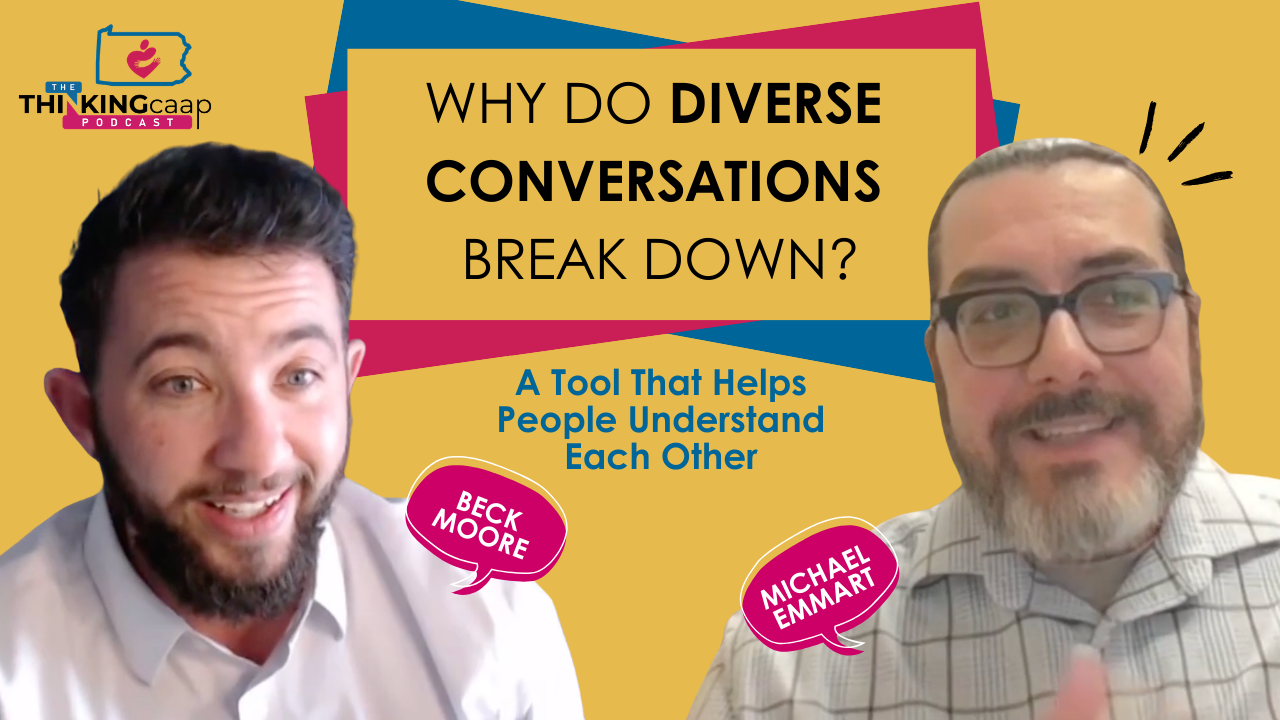
In this episode of Thinking CAAP, Beck Moore sits down with Michael Emmart to explore empathy mapping, a design-thinking tool that helps communities better understand each other’s perspectives. Originally used in product design, empathy mapping is now helping organizations reduce hierarchy in discussions, strengthen collaboration, and uncover deeper insights about community needs.
Together, they discuss how empathy mapping aligns with the mission of community action, why curiosity is a critical leadership skill, and how generative questions can transform conversations from problem-focused to possibility-driven. The episode also tackles important topics like tokenism in stakeholder engagement, the limits of virtual meetings when building empathy, and how slowing down our reactions can lead to more compassionate and effective service.
For leaders, facilitators, and anyone working in human services, this episode offers practical insights on listening deeply, engaging authentically, and building stronger community partnerships.
Download an Empathy Map diagram here.
Learn More about Just Conversations and Michael Emmart’s work here.
Thinking CAAP Episode 33 Highlights
[00:00] Introduction to Empathy Mapping with Michael Emmart
Host Beck Moore welcomes Michael Emmart to discuss empathy mapping, a concept from design thinking.
Michael explains its origins in customer-centered product design and its adaptation to community building to elevate diverse voices and reduce hierarchical barriers in group settings.
[01:44] Using Empathy Mapping to Balance Power Dynamics in Community Meetings
Michael describes how empathy mapping helps equalize voices in meetings involving parents, schools, courts, and social services.
By mapping what each group thinks and feels, participants gain mutual understanding and recognize shared concerns, fostering equitable dialogue and stronger community engagement.
[04:05] Empathy Mapping’s Alignment with Community Action and Needs Assessments
Beck highlights how empathy mapping aligns with Community Action’s mission for equity, connecting it to tripartite boards and community needs assessments.
They discuss how this process helps validate lived experiences beyond surface data, uncovering deeper insights essential for effective community solutions.
[07:11] The Impact of Well-Facilitated Empathy Mapping on Collaboration
Beck and Michael agree that when empathy mapping is done well, it creates space for curiosity and understanding across differing perspectives.
This generative dialogue breaks down barriers and leads to more collaborative, inclusive problem-solving than initial assumptions or biases allow.
[10:06] Creating Safe Spaces to Challenge Assumptions and Empower Voices
Michael emphasizes empowering participants by encouraging curiosity and validation, combating learned helplessness.
Beck adds leadership insights on delegation and capacity building.
[14:13] Shifting Focus from Deficits to Strengths in Human Services
Beck Moore emphasizes the importance of balancing attention between deficits and strengths in relationships and service delivery.
He advocates for recognizing aspirations and contributions to empower individuals rather than viewing them solely as problems to be managed.
[19:18] The Power of Vulnerability and Curiosity in Leadership
Michael Emmart discusses how asking questions with genuine curiosity—rather than criticism—enables deeper understanding and creative problem-solving.
He highlights vulnerability as a leadership strength that fosters collaboration and diverse perspectives.
[22:15] Embracing Flexibility and Continuous Growth in Roles
Beck Moore shares how CAAP’s dynamic project-based approach requires employees to be adaptable and embrace evolving responsibilities.
He encourages a mindset of openness to change for growth and innovation in human services roles.
[24:04] Inclusive Stakeholder Engagement for Effective Empathy Mapping
Michael Emmart describes the necessity of involving diverse stakeholders—including frontline workers, community members, and service recipients—to capture authentic perspectives.
This ensures comprehensive solutions in human services initiatives.
[27:15] Authentic Representation and Expertise in Collaborative Spaces
Beck Moore highlights the importance of sending knowledgeable representatives to collaborative discussions.
He cautions against relying solely on titles and stresses preparation and lived experience to ensure meaningful participation and informed decision-making.
[28:19] Addressing Tokenism in Including Lived Experience
Beck Moore and Michael Emmart discuss the discomfort and tokenism often involved when including people with lived experience in meetings without meaningful follow-up or representation.
They emphasize the importance of authentic engagement and advocacy for the communities represented.
[31:21] The Importance of In-Person Interaction for Building Empathy and Connection
Michael Emmart explains why virtual meetings fall short for work requiring empathy and relationship building.
He highlights the value of sharing physical space, food, and nonverbal cues to foster trust and understanding among participants.
[33:18] Avoiding Deficit Focus and Emphasizing Family Strengths in Human Services
Michael highlights common mistakes in facilitation, particularly focusing only on family weaknesses instead of strengths.
He stresses the need for agencies to recognize and repair these shortcomings to better support families.
[37:03] Managing Disagreement through Values-Based Facilitation
Michael describes his approach to handling conflict by distinguishing values from strategies.
He uses convergent facilitation to uncover shared values beneath disagreements and create safe spaces for emotional expression to foster mutual understanding.
[40:07] Prioritizing Relationship Building for Successful Long-Term Collaboration
Michael emphasizes the necessity of dedicating time to build relationships before tackling complex problems like foster care reform.
This enables participants to see each other’s humanity and work collaboratively rather than viewing dissent as antagonism.
[42:01] Understanding Human Reactions During Unexpected Delays
Beck Moore and Michael Emmart discuss varied passenger reactions to a flight delay caused by a tragic event.
They highlight how stress and fatigue shape responses and emphasize the importance of empathy and recognizing individual humanity in service situations.
[44:14] Avoiding Quick Judgments in Service and Social Work
Michael Emmart explains how clients in human services are often mislabeled as uncooperative due to circumstances like limited resources.
He urges practitioners to approach situations with empathy and curiosity rather than judgment to better understand and support individuals.
[46:07] The Power of Curiosity in Client Communication
The conversation focuses on the importance of asking thoughtful questions to uncover underlying reasons behind clients’ behaviors, such as missed calls.
They discuss adapting processes to meet clients’ needs effectively rather than assuming unwillingness or resistance.
[49:27] Extending the Space Between Stimulus and Response for Better Interactions
Michael Emmart encourages finding personal reflective questions that lengthen the time between stimulus and response.
This enables more thoughtful, present, and compassionate interactions in both professional and personal settings.
[51:47] Promoting Justice Through Appreciative Inquiry and Community Engagement
Michael Emmart shares about the Institute for Just Outcomes Through Conversation at Case Western Reserve University.
He closes the conversation with Beck by focusing on using appreciative inquiry to improve justice in human services and community-driven prevention efforts that support collective child-rearing.
Episode 33 Transcript
00:00:00
What's up, everybody? I'm Beck Moore, host of the Thinking CAAP and the CEO at Community Action Association of Pennsylvania. Thank you for tuning in to this week's episode. With me is a former guest, Michael Emmart.
00:00:10
Emmart. Did I say that right? Michael Emmart. Yeah, Emmart.
00:00:14
Okay, thank you. Who was on a prior episode where we talked about conversations worth happening and some projects that he's been involved in alongside of our strategic planning consultant and. And a good friend of mine, Kelly Stewart, who has done a lot of work within the community action space. But we wanted to invite Michael back today to explore the topic that he kind of touched on briefly on the prior episode, which is that of empathy mapping. And so to start, Michael, I think let's.
00:00:44
Just. For people who are new to this concept, they may know it in another sort of phrase or in theory, but maybe never heard to it referred to this way. So can you start by talking to us a little bit about what. What it is, how to describe it to people? Sure.
00:00:59
Well, empathy mapping is actually borrowed from design thinking. And so if you were perhaps a manufacturer of some kind or in software development, you'll use empathy mapping to try to decide what is it that my customer wants, what needs are there that we can fill so we can create a product that, well, that people want to purchase. And. And I ran across it with one of my colleagues at the Institute for Just Outcomes, and I immediately saw, like, wow, this is a really great way to bring in a diverse, you know, sort of number of perspectives into a room. And a lot of my work in community building is, how do you bring some level of equality to the voices that are in the room?
00:01:44
Right. So if you consider parents, schools, members of the court, members of social services, members of nonprofits, all in one meeting, we could create a list of the hierarchy there. And our list might be a little different, but we would probably agree that there's a hierarchy. And unfortunately, most of the time, parents are at the bottom of the hierarchy. Right.
00:02:05
And whether the courts of the system are on top of the hierarchy, I guess, is debatable. And one of the first things I want to do is make sure that everyone in that room is understanding each other. And so that's why I like to use empathy mapping. It's a pretty simple tool that we facilitate in such a way that folks are able to share sort of what they're thinking and feeling, what are they seeing, what are they worried about, what are their hopes for the future? And so, perhaps I can send you a PDF of the form that we use.
00:02:36
I print out these large poster board size images that people fill out together. And so parents will be in one part of the room sort of filling out their diagram and the systems folks will be on their side and the schools will be in their area. And then they, in the aftermath, they're going to just take a tour and they're going to learn about, you know, what other perspectives are in the room. And one of my favorite parts is often you'll have people go, hey, that's, you know, we have the same thing over on our side, right? So as a parent, I have the same thing that the CAAP workers have on their board.
00:03:09
And the CAAP workers go, wow, the parents have the same thing on their board that I do. And so as we're able to bring more voice and more equality in the voice that gets to get shared in the room, we see that that continuum of community engagement and being able to defer to the community sort of be strengthened. That was a really long answer to what is it? But no, no, no, that's okay though, because I think it's in, in a lot of ways the, it's, it's not that, it's not that complicated, right? I mean, I think when we hear the term, it sounds like something that maybe is for far more complex.
00:03:45
I think, you know, the devil's in the details ultimately in terms of how you facilitate it and if you could send that PDF that would be great. Happy to include that in the resource notes for our listeners and folks who are watching. But I think in a lot of it's. And it's just, it's so aligned with what I think community action does in our core because, right. We were created ultimately to create equity within local community.
00:04:05
But that may seem right, like it sounds very complicated, which it is. There's lots of micro and macro level pieces that are involved. But at its core of how we do it, you know, it goes back to community needs assessments that we're required to do every three years. There's intentionality built into the structure in terms of having a tripartite board, right, where you have 1/3 elected officials, 1/3 people who have lived, are living, have experienced poverty, 1/3, right. Local community business folks.
00:04:34
And so you create this really intentional boardroom that has those voices. And so in community action, like empathy mapping, if facilitated in the appropriate way, is sort of built into the formatting of how we exist in terms of the community needs assessments. There are agencies are required to do. There's also a piece around. Right.
00:04:56
Having, you know, doing focus groups and making sure that those voices are lifted up and to gut check the data. Because the data that we see, I think we talked about this on the last time we talked. The data that we see may be an indication of a pain point that is five layers deep. And so until you get sort of to what I will describe as the user experience or the customer experience, you don't really know what you don't know. So I think we know it's, it's more than just being empathetic.
00:05:28
Right. It's really trying to create, I think, the tools for people to better understand your experience versus my experience and find the commonalities. Yes. And to give people a framework with which to begin sharing their voice. Right.
00:05:43
Because we're aware of the hierarchy that's in that room, in that boardroom or in one of my community meetings. And certainly everyone, Right. We're not that smart. Everyone in the room is aware of the hierarchy. And those who are being paid to be there often.
00:06:01
Right. So the, the folks who are at their job and, and this is part of their day is they're going to come to a community meeting and listen to parents and listen to, you know, other representatives from the community. They're sort of prepared to share what's on their agenda. Right. But those who are representing lived experience, it's not as easy for them to prepare, to share.
00:06:22
Right. They don't have a. Let me tell you the mission, vision and value statement of my agency, and here's my title. And so it provides a mechanism for them to be able to capture what their experience is and then for it to be shared and not just seen as just as valuable, but to really be just as valuable as well. This is my job description, so this is what I'm doing.
00:06:46
And so I guess my question is, you know, at its core, when done, when done well, because I think we can all agree that practices like this can go very, you know, very well and can be facilitated with great opportunity and success. And then that there are other facilitations of I'm sure this type of process that can fail pretty miserably if, you know, and in some cases I think probably create harm.
00:07:11
But when done well, and I think my guess is that it creates a space where people better understand people are more willing to lean into solutions that maybe they weren't at first pass, maybe thinking that was, was a reality or something that, you know, if they had to guess, they might not find Themselves agreeing with, on the front end of the, of the, you know, the decision making process. Do you feel like that that's, that tends to be the case, that you find that. Right, like through this, this, when done well, that that's what happens? Yeah, I think so. My hope is, and to tie it back to our discussion we had about worth having.
00:07:57
One of the primary elements of conversations worth having is this idea of generative questions. And what I want to do is I want to provide folks an opportunity to both share about themselves, but also to really be faced with how can I get curious about those who have a different perspective than I do. Right. If I'm thinking about a particular problem, for me, I think this exercise, what it does is it allows us to see a variety of different perspectives on that problem. Think of it as a bunch of different folks describing a beautiful sunset or describing a glorious home of some sort, right.
00:08:35
Where we can't see the whole thing at once. And so each one of us has to contribute. I want to cultivate some curiosity around that. And if I can do that generatively, then our suggestion and our researchers. The suggestion of our research is I said that in a followed up way, if I can.
00:08:58
So our suggestion and what we find in our research is that the more generative we can be, the more curious we can be, the more interested we can be in perspectives that aren't our own. It becomes regenerative to the group. Right. And so you have some repair that begins to occur amongst folks who, whether they were aware of it or, or, or it wasn't at the forefront of their brain. The, the, the curtain comes down, the walls come down between different groups of people and through that, that activation of curiosity.
00:09:35
And so how do you, is there any way that you're intentional about, or can you give examples maybe of ways in which you can help break down kind of the assumptions that people bring to the table then as they're sort of sharing? Because I'm sure that I think about conversations that I have about workplace culture and really trying to get people to say more definitively, right. Like this is not about something you think is happening. This is about the actual experience that is happening. And so what's the.
00:10:06
Can you think of kind of, how do you create an environment? Could be through, you know, rules that you're setting up. It could be just holding people accountable and what they say. But what are the ways that you kind of remove the assumption piece that people bring with them? Because like it or not, I talk about this all the time when I talk about workplace culture.
00:10:25
We all bring assumptions with us wherever we go. Right. Our brain is predicting things before we even have a chance to unwrap the bias that our vision brings sometimes. Yeah, I think that's a really good question.
00:10:39
When I really, in all of your. That folks feel empowered, you know, we talk a lot about things like self-efficacy and we talk about, oh goodness, what's the term I'm looking for? Learned helplessness. Right. And a lot of times our systems cultivate helplessness.
00:11:04
Right. And so if you think about that, that empowerment spectrum, and I'm, I'm coming up short on the author, but there's this, you know, power over power to power with power within. I'm not, forgive me, whoever that, whoever's model that is, I often think we get very stuck on power too, which is, I'm going to be the conduit for everything for you. That's why I came into the helping field. I'm going to be, I'm going to help you get to everything.
00:11:32
I'm going to make sure. Well, of course, this, the, the problem with that is that if I am the, the power to. For everything, well, then when I'm either gone because my program lost funding or I'm not in your life because you've graduated from the need for that, well, then your, your conduit to everything has been removed. And that's how we see folks sort of come back into the system. Right.
00:11:58
They come in and then they leave, and then they come back in and then they leave. It's our best intentions. So I try to remember that. Wonder, appreciate, validate and empower. Well, and it's interesting because a workplace culture perspective.
00:12:11
I think the other thing that we talk about a lot at the thinking CAAP is around how to create great leadership and great team. And what you're talking about also I think impacts. And I've been that leader who's been like, everything is through me because that was just the way that the system was set up. But I didn't know how to do any differently as a leader. And so when I think about folks who are struggling to delegate and how to create the infrastructure and how to delegate, I think this is also an important lesson to think through.
00:12:40
Right.
00:12:42
Part of what we literally just talked about this at our leadership team meeting around when you're lifting something up in terms of a concept idea, project, I want you to, you know, my vision, you know, my perspective, you know, what's important to me, I want you to think through, right? Like, how does this Fit within the framework. What are the steps that. What are the questions? You know, I'm going to ask right away and then come to me with what you think the suggestion is, because chances are you already know the answer.
00:13:08
And by continuing to ask me, I'm just getting in the way because I can't be as responsive as you need me to. And so it takes away from my CAAPacity. It takes away from the organizational CAAPacity. So I think it's an important lesson for leaders to also understand. You touched on something else that I wanted to go back to a minute ago.
00:13:24
I should have written it down. I have a pen and pad of paper with me, but I, I didn't. It was something with respect to. It'll. It'll.
00:13:34
I'm gonna hope that it's gonna come back to me. But again, I think, I think this is a really important concept to think through just from an organizational structure perspective as well. So when we sort of think about, right. The rules of engagement, when you're doing this exercise, what does that look like for people? Like, are you really setting the behavior expectation up front or are you sort of just kind of letting things happen and then correcting, if necessary?
00:14:13
I usually allow it to emerge however it emerges. My one suggestion is that folks not be too focused on deficits. So, for instance, one of the sections is on what are we seeing. Right. And so my encouragement is, yes, if there are things that you're seeing that are deficits, to CAAPture them, however, in any situation, in any relationship.
00:14:43
Well, in most relationships, we would hope that there's not only deficits. And so can we give an equal amount of time to identifying the strengths that I'm seeing, The strengths that I'm hearing. Right. The, the, the aspirations that I have that are for a desirable future for. Whether it's for me or whether I'm a caseworker, and it's for the folks on my caseload, we're very deficit focused often.
00:15:11
And, and that's. Unfortunately, that's the result of needing diagnosis and needing funding. And. Yeah, it's just the way we're built. Right.
00:15:19
Like, once we fix them, it's. There's this great video that I share a lot about, you know, fixing problems just whelms people. And it doesn't overwhelm, it doesn't underwhelm, it just whelms. And so you don't. It's why in workplace culture, right, you fix the problem that is in the list, people find more problems.
00:15:34
Right. You don't really ever create any strong process. So Sorry, interrupt, but feel that in my bones all day long. And it's the nature of anytime we're sort of evaluating a situation, we're like, okay, let's do a survey, look at the survey. Let's hear what the problems are.
00:15:46
When we do reviews, right, we talk about how people can improve. We don't talk about the really great things and how to do more of the great things. Every aspect of life is right, how to fix it. How to fix it, how to fix it. Yeah.
00:15:56
And there's probably an evolutionary psychology reason that we're focused on deficits and somebody more alerted in that area could speak to that. What I know, though, is that people don't like to be problems to be managed. Right. And in all of my relationships, I don't want to be a problem to be managed. In fact, goodness, I'm thinking that's probably one of the worst things you could say to me is that our relationship is on the basis of your problem and I have to manage it, Right?
00:16:23
Yeah, right. And even folks who are in receipt of whatever services are being provided, educational, housing, healthcare, whatever the case may be, they want to be seen as a partner in that process, Right. They want to be seen as a contributor to the solution. Not think of how helpless you feel if you're sitting on that little, you know, paper sheet at the doctor's office and you really don't understand what's going on and you really don't understand, you know, what's happening next to you. That that's not a.
00:16:56
That's not anything any of us want to feel. We want to be part of what the doctor's saying and where my treatment is going. And I think that's. That's the same for anyone that we really want to contribute. We don't want to be managed.
00:17:10
Now the way that funding structures are set up often is that we treat people like problems to be managed. And I think that. I think that does often leave them very overwhelmed. Yeah, agreed. And I think when I think about the best examples of some of the programs that our agencies do, right, with the Self Sufficiency program or CIRCLES program, where our agencies are wrapping resources around someone to ultimately create economic mobility for their, their home and for their household, family, individual.
00:17:41
Right. It's creates a space where people can be vulnerable to share what's happening in all aspects of life. You know, so let's say that the transmission just went out on the car or suddenly, right. They lost some form of insurance or whatever it might be. That's the problem that it's about the agency and the person that's seeking the service.
00:18:05
Right. To come together to try to figure out the solution. And it may be that the agency can help in this capacity and then that leads to another opportunity. But ultimately the way that they've been able to, our agencies have been able to build those programs is through looking at really all of their sort of unrestricted dollars. Because most programs that exists from a funding perspective aren't going to pay for the transmission for a client's car.
00:18:34
Right. There's nothing that really speaks to that or they're not going to pay for somebody's car insurance. But the car insurance issue creates a larger problem for that particular person. And so it's just, I think needs in human related, social needs are so complex and yet the funding is so prescriptive. Yeah, I know what the question was.
00:18:59
I found it somewhere. The add kicked in and helped. We were talking a little bit about kind of the questions, right. And people not feeling comfortable with not having an answer and this idea of what that creates. And so I just want to reflect for a second on.
00:19:18
We oftentimes are asked to step into situations where organizations are saying, look, we have this problem and we don't know what to do. And so what I will typically tell people or even just presenting at something, right. About a particular topic and someone say, you know, hey, Beck, I have this problem. Can I just kind of, can we talk about it for a second? And I'm, you know, usually in a room full of people and I'll usually ask a couple follow up questions.
00:19:43
But then what I tend to say is I'd like to talk to talk to you about this offline. Because usually situations like this are far more complex than what they are. Just first pass. And so then I'll sort of try to take people through what I call this kind of unboxing process of just asking questions. And I find myself needing to say up front, I'm asking the question not because I'm being critical, but I'm trying to seek to understand because for whatever reason, the questions make people really.
00:20:12
I can just see the physical reaction sometimes, right. That they're just getting like, oh, is this guy trying to. So trying to poke in my bullet wound right now? Yeah. And it just, it definitely puts people kind of, you know, in defensive stature, if you will.
00:20:29
Yeah. Well, if you think how difficult it is to go to someone and say, hey, I have a problem I don't know, a solution to, will you help me? Sadly, very sadly, that's that's frowned upon. And our cultural. Right.
00:20:45
And so then to have additional questions that maybe I don't know the answer to, I, I'm, I'm vulnerable upon. Vulnerable upon vulnerable. And, and, and I think that there's a particular application to leadership here. Right. That leadership can be vulnerable.
00:21:02
And there's not a weakness in, in vulnerability as a leader. In fact, that vulnerability allows you to incorporate more voices, which allows the solutions to be more creative and more collaborative. You know, I was thinking about the example you gave about, hey, you know, you're closer to the problem. Think about the questions I would ask you. That's fantastic leadership.
00:21:26
Because if you decide everything, then the creativity is limited to whatever's between your ears. Right, right. But, and I don't, and I don't know this world best. Yeah. But if, but if I've got seven people, 10 people, maybe I have 15 people on my leadership team.
00:21:41
Well, that space between the years just expanded exponentially. Right. And now there's so much more opportunity for creative thinking. And if I can activate the prefrontal cortex by being a little strengths based. Right.
00:21:54
And get them thinking about where the possible solutions are, there's a much better chance that we're going to come to some really fantastic stuff that we may never thought of alone. Yeah, absolutely. Absolutely. I mean, that's, that's part of. Anytime someone new starts at CAAP, potentially, I have a conversation with every new hire because we're not that big and so I have the privilege of being able to do that.
00:22:15
But one of the things that I will say to people is that if you are someone who really loves a job description and doing exactly what's in a job description, this isn't the place for you. Because we look at every project sort of as a pro, you know, in a project management perspective because we want to utilize the strengths of the team. And that means you might be really good at data analytics and you're assigned to this specific project at your core of why you were hired. But if we have another data analytics project that I need some insight in, you're going to get pulled into it. And so if you like a world of black and white, very specific sort of prescribed thinking and tasks don't work here, you're going to become immensely frustrated.
00:22:56
And I think sometimes people say, oh, yeah, no, no, I'm comfortable with that. But then they're like, oh, my job description's out of date. And I'm like, well, it's going to continue to be out of date because I'M telling you, every six months, something's at least something's going to change. So. Yeah.
00:23:10
You know. Yeah. And how can we, how can, how can we. How can your organization. Right.
00:23:15
Cultivate an openness and a, and a curiosity and sort of a generative mindset to how can my position grow and change and breathe, especially when, if we're in the human services field. Right. That those positions should breathe, they should be alive. Right, Absolutely. So I think we've touched on this a little bit, but I want to ask the question again to get a little bit more specific.
00:23:44
Who should be in the room when really creating this and going through this empathy mapping process. You touched on a little bit in your description. But I want to ask the question more directly so people can hear it again potentially. Yeah. So I think it's really valuable to make sure that you identify all of your stakeholders to a particular
00:24:04
goal. Right. And so I was involved in a recent project with some counties here in New York where they were looking at reducing contact with their child welfare and juvenile justice system. Right. And so we did some community asset mapping and I did it in two waves.
00:24:23
We did it first with the county folks, but then they often named a lot of different organizations and so we did community asset mapping with them as well. Because oftentimes our bureaucracies. And I don't mean that in a negative way. Right. Just the agencies, the letter agencies.
00:24:41
They know organizations, but organizations know people. So they know about Sally and John and Mike and Beck. Right. And you want Sally and John and Mike and Beck at the table. You don't just want the CEO of XYZ agency, whether it's a non-profit or a lettered agency.
00:25:00
Right. And so we go through the process of getting as many stakeholders to the table as possible. I prefer very large groups. I. You want to facilitate how to, you know, narrow the, the front door to CAAP.
00:25:13
I want 500 people in the room. Yeah. Right. Layer upon layer. Right.
00:25:18
Man. Yes. Okay. Yeah. Yep.
00:25:21
Yeah. I. And I want to make sure that our representation. If you think about one of my favorite agencies in New York State is the Children's Home of Wyoming Conference. They're.
00:25:31
They're in Binghamton, New York. They're a fantastic agency and I love their CEO, but I don't want just their CEO there. I also want their supervisors and their caseworkers and. Right. How can I get as many different voices and perspectives from that agency in the room?
00:25:45
Now, of course, you're limited by their availability and, and you know how much of their Budget, they can, they can assign to a particular problem. But most of those, most of those community, community oriented agencies are more than willing to show up in those kinds of spaces. And then also parents are often, you know, the hardest groups to get to show up in spaces often are teenagers. Yeah. You know, so what's the, what's the secret to getting them in the room?
00:26:17
Oh, trusted voices. Right. So if I want, if I want teenagers in the room, how can I get the most popular teacher at the school or the football coach or the, the local youth leader at the Baptist church? Right. And if I, if I can get those trusted voices to be in the room, they'll bring the young people with them.
00:26:39
But that emerging adult population can often be the most difficult and often the most valuable as well. Yeah. It's interesting because a lot of times where CAAP sits in this human-related social need world, we have to sit in a lot of thinking groups, listening groups, either as a convener sometimes, or is just an entity that understands the layers of all of the pieces. And a lot of times the request comes directly to me and I will always say to people, people, if it's something that I'm not knowledgeable about, you really don't want me. Right.
00:27:15
Let me find somebody who really better understands and can be a representative voice of CAAP. But I just have the CEO title. Right. I don't work in this space. I haven't worked in this space.
00:27:26
So I try to be really thoughtful about that. But what's interesting is a lot of times this request will come in, it's like, well, no, we really want the CEO though. I'm like, but why? Like, I don't. I'm gonna have to ask my team and other people that know this worker in this work to get this perspective.
00:27:40
So, okay, I'm happy to do it. But then I need you to give me the questions ahead of time so that I can do some research. Because otherwise I'm just going to sit there and I'll be a pretty face for you. But you know, you're not going to get much content out of me. Yeah.
00:27:53
And you know, that's a really great. There's an analogy to be made there between what you're talking about and saying, hey, okay, you want me here, but you have to understand that I, I can't give you, I'm not going to have all the answers. I'm going to go back. You know, we, we often do the same thing with fol. We give these lived experience positions to and we say, hey, we want you to come into our agency, we're going to give you a desk, and we want you to represent your entire community.
00:28:19
And, and we want you to sit in meetings where you don't have a chance to go back to them and report back and ask questions. And I think it's a. It's. It's uncomfortable to say, but it's also. It's often very tokenistic.
00:28:31
Not sure if that's a word or not. That. Is that right. But we engage in a lot of tokenism with folks in this effort to bring lived experience into the room. Now, I'm all for it, but let's make sure that it works the same way that it works when you go to a meeting where, hey, I'm going to go back, I'm going to talk with my folks, you know, and I'm going to see what the representative consensus is, and then I'll be ready to represent that.
00:28:58
So if you can give me a heads up on some questions that you. That you think I have the answers to those sorts of things. That's been a really uncomfortable reality in this work is seeing all the effort that's going into bringing lived experience in the room, but seeing it done in a way that really is a lot of tokenism. Yeah, Yeah. I mean, I experience that fairly often in terms of what I'm asked to sit on as.
00:29:24
Just because of who I am as a person, whether it's a parent of a child who has special needs or as representative of the LGBTQ, you know, plus community. And I just, I really try to help people understand that, you know, it's a form of allyship to recognize that. Sure, I can speak to my experience, but I don't speak to this whole community of people who are dealing with this same thing. And so in order to be a good ally, you have to say that out loud because otherwise I don't think that. Again, it kind of goes back to this idea of assumptions.
00:29:58
People just, you know, group all people in this category of this type of particular thing. Right. Track, you know, identity, however you want to describe it, in the same bucket and depending on all kinds of circumstances. Right. Determine what the actual lived experience is in that situation.
00:30:17
So I, Yeah, I think it's. It's an important recognition here for people to hear that if you are someone who recognized who. Who is specifically the person who is being asked to represent, you know, lived experience, ask for the space be, because that's. You're being an advocate for yourself and the group of people that you were asked to represent. It is perfectly okay to say, I don't know.
00:30:41
This is my experience. It would be far more helpful for me to go back and ask other people than just to simply say what my experience is, because it's potentially this much of what the actual lived experience is. Well said. Well said. Well, thank you.
00:30:59
I'm curious what your thoughts are here and with respect to. So CAAP, we work virtually, you know, almost 100% of the time. We see our team sees each other, you know, twice a year because of the events that we run. We, a handful of us will see each other more often than not. You know, my executive assistant, thank God, doesn't live very far away from me.
00:31:21
Otherwise I don't know what I would do in life. But when you're doing this work, do you feel like it can happen in a virtual setting as well as an in-person setting? No. No, I, I probably wouldn't even attempt it in a virtual setting. I think that there's, there's something to be said about people sharing air.
00:31:40
Right. In fact, I usually try to begin it or end it with sharing food together because there's so much that can happen over sharing a meal. And we've been really lucky to have, you know, local restaurants step up to host and in a lot of these spaces. And it's so much more effective to be able to, to feed people, to have the meat together and, and to begin those. That relationship building, even in an informal manner, before we, we get to the formality of whatever it is that I'm facilitating.
00:32:11
Yeah, no, I appreciate that. I mean, I think it's something that people will ask a lot about how to create space in a virtual environment. And I think it takes a lot of really intentional actions to create the relationship when, you know, you just operate in this little plastic box. And it's certainly when you have so many different people coming to the table to have a discussion, can appreciate that it's. It's not realistic to do.
00:32:37
Right. Yeah, well, and when you're talking about building empathy. Right. So we know that our mirror neurons don't work as well virtually. We know that we don't pick up on body language as well either.
00:32:49
And those two things are so critical to empathy. Yeah, right. I mean, outside of don't be a sociopath. Good rules. Rule to live by and put it on.
00:33:00
Yeah. Outside of that, I need to be able to see your body language and I need to be able to connect with you. I need those mirror neurons that I have to be firing and to be Looking for where do we have similarities. And it's just so limited in a virtual environment. Yeah, no, I appreciate that.
00:33:18
Any common mistakes that you want to call out that you've seen sort of happen in the facilitation of this type of activity? Yeah, well, I sort of hinted at one, which is the deficit focus. Right. And so I had a fantastic parent at a, at a location, you know, just point out that the, this was a child welfare application. Just point out that the system was only focused on the weaknesses of their families and to not see the strengths of their families.
00:33:55
And sadly, I don't know if they really, outside of employing their creativity, which is a nice way of saying making it up. I don't know if they really had the capacity to know what the strengths of the family were. And so that, that was something that we had to do some repair and I do a lot of trust repair. That was something we had to do some repair on because there really had to be this recognition on the part of the agency that said, yeah, we're not good at that, we're not good at that. And, and can, you know, can you help us get better at that?
00:34:34
Yeah, well. And I think reparative work is, we talk about reparative parenting in our house pretty often, you know, when we say something that maybe we didn't mean to say and being thoughtful about it. I think reparative work can happen in all kinds of different settings. And that's a whole other topic for a discussion that frankly is making me think we should have an episode about that. But never forget my, my bonus daughter.
00:34:57
I had, I had yelled about something about, to the kids about something that they, I thought that they had done. And I don't, I really try hard not to yell. Right. But I also recognize that sometimes I'm just at CAAPacity and I don't recognize it before I react in my house. And so after the fact, I had gone back and said, I'm really sorry, you know, I shouldn't have yelled.
00:35:18
And I, I recognize that you didn't do this. And I, you know, terms for a seven-year-old at the time to hear not the way I'm telling you right now. And she sort of looked at me and like kept along and so I was like, all right, well she's not ready to hear that, so that's fine. I went back a little while later and said it again and she, without skipping a beat, she looked at me and she said, yeah, I heard you the first time. Words don't make it go away.
00:35:41
And I was like, oh, she's not wrong. Right. It's about the actions. But it was a very good reminder from the words of a seven-year-old. Right.
00:35:52
About what is important in the kind of reparative work. And it's not just about the words, it's also about the, the actions. But I, but I think with respect to kind of the, the strength-based piece in human services space, I know having gone through a lot of intake processes trying to find the right services for my son, that, that's one of the questions that always initially makes me really sad. And it's hard to sometimes answer because you're just in the thick of it, but it does do something right to your psyche to sort of like, like ground you before you get into the really hard stuff. So while I may not be prepared to answer the strength, I know that when I sort of reflect back on the process, then going through the intake process, which has all kinds of pitfalls, frankly, there's a reason why that's so very important.
00:36:46
Yeah. Yeah. I think I have probably like two more questions for you, if that's okay. Yeah, that's fine. How do you, do you ever find yourself in a situation where you're handling kind of disagreement among the folks that you're talking with?
00:37:03
And how are you, how do you find that you disarm that situation?
00:37:13
So, yeah, all the time.
00:37:17
Right. And I, I, I don't know that it's my responsibility to disarm the feelings. Right. Or the, or the disagreement. My goal.
00:37:30
Well, I have a couple of goals. One is that I, I want to make sure that we're not confusing strategies for values. Right. And so I'm a big fan of convergent facilitation in this regard, which is recognizing that you and I can have very similar values, can have vastly different strategies, and often we can have vehement disagreement about the strategies and never get to the values part and never recognize that we're both coming from the same place and, and that ought to bring us together instead of divide us. Um, and so I, I spent a lot of time making sure that I'm listening for values and I'm trying to help interpret those values.
00:38:12
Right. So that was the V in, in wave. Right. So I'm, I'm going to get really curious and I'm gonna, I'm listening for values and I'm trying to help folks because there's often a lot of emotion in the work that I do. Rightly so.
00:38:25
Rightly so. And I want to make sure that Folks feel like I can express this emotion in a way that's safe. And you were talking about sometimes we reach CAAPacity and we yell and often we're yelling because something feels unsafe in us. And we're not going to do a therapy session with Beck right now. Promise, folks.
00:38:47
I mean, I probably need it to be fair. Yeah. But, you know, so how can I, how can I help folks feel grounded in their values and so that you can feel safe in expressing what it is? Sort of what am I really upset at? Right.
00:39:01
Because I might, I'm probably not upset back and probably upset at the situation. And the reason I said at the situation is because it's violating this value of justice that I have, you know, or that this is just not right. And when I can express it that way and Mike can help me express it that way, then people are going to hear it. They're not hearing me yell, they're hearing this is not just, or this is not fair or this is not proper. Right.
00:39:27
So, yeah, yeah. The idea of the, the pain funnel is something that I know we've talked about a little bit. I think we touched on it the last episode that we did together too. It's right. Like the pain is an underlying cause of something.
00:39:38
So asking the questions helps to figure out again. Right. Is this thing the outcome, the response to something that you don't even know about? And more often than not, that tends to be the case in my experience. Whether it's an operational issue, it's a feeling.
00:39:54
Right. It's a response. It's just we're too complicated as creatures to, to not have it beside reaction to something else. Usually. Yeah.
00:40:07
And, and I tell folks I, I'm usually dealing with, with very big problems that have big names. And I tell folks our projects aren't going to be three one-hour meetings. Right. We're going to, we're going to be, we're going to be at this for six months to a year with varying, you know, representation in the room as it, as it breathes because it's, it's alive. And because I frame it that way, the experience that way, I get to spend a lot of time in the beginning just relationship building.
00:40:41
Right. Because, you know, before we try to solve some big issue, you know, like narrowing the front door to foster care, we're going to be in a relationship with each other first. And sometimes that can be a little frustrating for some folks who want to get right to solutions, but I want to build relationships amongst the people in the room first so that when you hear Becky L. You know, Beck, and you see Beck's humanity, and you. And you give him the benefit of the doubt that where he's coming from is this healthy, good place, and he's not. Who's that maniac yelling over there, Right?
00:41:15
And if we don't have relationship, you're just that maniac yelling over there. Yeah, yeah, yeah. No, I think it's. It's this Into a degree. It's this idea of, right.
00:41:24
Like, I can't. If I know my neighbor, I can't be. I'm not. I'm more likely to not be mad about whatever the thing is, right? So, like, if I notice that my neighbor's trash is never out on time and the trash cans are blowing around, I don't know anything about my neighbor.
00:41:36
And suddenly I find out that they have a mobility issue, right, where they literally can't. Can't take out their. Their trash. Well, that. That changes things, right?
00:41:45
But again, we jump to the assumption about, here's the problem and. Right. Oh, they're just lazy or, oh, whatever, right. I was on a plane once, and there was a situation where, you know, we were sitting on the tarmac for hours. It's a late flight.
00:42:01
And if you've ever flown into the Harrisburg area, a lot of flights home tend to be the late flight. And it's, you know, you're getting in at midnight and you're tired. You've been traveling all day. And so I was in. I think it was in Atlanta, and we were sitting there for hours, and the captain kept coming on the plane and saying, you know, on the loudspeaker and saying, you know, really sorry, delayed, you know, crew, we're trying to get a new crew.
00:42:27
Can't really give you any of the details other than we're just trying to get a new crew. Well, after probably, I think it was like three hours, come to find out on the announcement that there had been an individual who had. Who had died and their crew was trying to get home because they were so, you know, overwhelmed with what had happened that they did not feel like they could take care of the people on this plane. Now, I was horrified by the reaction on the plane because it just, like, it didn't do anything to most of the people who were just annoyed that they weren't getting home. But for those of us, you could sort of.
00:43:07
You could literally, Michael, hear sort of two reactions that happened like, I don't give a rats, you know, tiny about what's happening. And then the other people are like, oh God, like we're so sorry. And you know, I'm, I'm just a little late to home, but I'm still getting home, you know, or to my final destination, whatever that might be. But I just, I think it's so interesting. I also use the example a lot of times as a, as a, somebody who worked in the service industry for a really long time as a bartender, as a server in a very busy restaurant, is that people just forget their humanity sometimes who are in kind of those types of spaces where it doesn't mean I'm a bad server because I forgot the catch up six times.
00:43:46
It might just be because I had a really crappy morning and I. Something else in my mind, you know. So I think it's when I think about this work that you're talking about, it's, it's really, I think reminding people about, you know, other than self, you know. So I think my last question for you, unless there's anything else that you want, want to touch on before my last question. So I'll kind of pause there for a second.
00:44:14
Anything else you want to share, regards regarding this kind of topic. Well, you know, since you opened the door, I just really quickly I got to thinking about your example of I'm not a bad server because I forgot the catch up five times. I think that a lot of times those who we might identify as service recipients, right. Of whatever sort, we're often very quick to label them as uncooperative in some way or another. Right.
00:44:43
And you know who you are, caseworkers, if you're quick to do that, right? Yes, Alan. And I think we have to really be careful because just because insert, you know, the equivalent of forgetting the catchment seven times, it doesn't necessarily mean that I'm a non-cooperative person and we see this a lot in the child welfare work that I do that parents are seen as uncooperative. I, I saw that the most horrific example for me was I saw, you know, they asked the parents to bring a healthy snack to visit with their children and they bought a bag of chips. Right.
00:45:20
Well, the bag of chips was what they could afford because they were in an urban community and, and, and there were no healthy snacks at the little bodega that they could get to. I'm sorry, that's a New York City term. There were no snacks in the convenience store that they could get to. Healthy snacks. And so we can be very quick to label folks as uncooperative because we, we.
00:45:40
They're not doing exactly what we want exactly when we want them to, but that's when we're guilty of managing them as a problem instead of seeing their humanity. Well, I think that goes back to the idea of the questions and sort of coming at things with a spirit of curiosity, because I. I hear. I hear this issue a lot in some of the training work that we do is, right, like, how do we try to reset on our team? And they're just. They're tired, they're burnt out, right?
00:46:07
They're working with more folks than they ever have been before with fewer resources. They've not gotten a break. Right? And there's just a lot happening in this space of human services. And so.
00:46:19
Right. If you happen to find a particular client or participant of a program that's not calling you back, for instance, it could be that the person's not not calling you back just because they don't want to call you back. It could be circumstances, right? Create a situation in which there's no alignment with the times that you're available, because maybe they just work a different shift than when you're available. And so how do you try to ask the question of that person, Right?
00:46:45
Hey, can I ask. I've been trying to reach out to you a few times, and you finally get on the phone with that person.
00:46:51
Is there something that was preventing you from giving me a call back? Maybe they ran out of minutes on their phone. There's so many different things, but we don't know unless we ask. We got to do it in a thoughtful way and can't just make the assumption. I mean, sure, it could be some people just didn't want to call you back, but more often than not, there's probably an underlying cause to it.
00:47:10
And so I think to that end, I think we've got to figure out a way to identify where there can be solutions created. Because it could just be that from a process perspective, we don't have the right process in place to support this individual with just some basic, simple needs, you know, and it could be scheduling a meeting, it could be making a call back, right? So is there a way to build in something that gets the answer you need in order to continue to process their application or get them to the next step? Yep. Yeah, we're very quick to tell ourselves stories, right?
00:47:41
So I pass you in the hallway in the morning, and I say, hey, Beck, how you doing? And you don't reply. And I go, wow, what a jerk. Beck is, right? I don't think to myself, oh, he didn't sleep his kid's sick.
00:47:51
His, you know, he got in an argument with his partner on the way to work. He's got a deadline that's just beating him up. I don't think about any of those things. I think, what a jerk. And that's unfortunate, but it's our nature.
00:48:03
It's our nature. And so raising awareness and getting curious about, wow, why would Beck not say hello to me? And the negative answers, there's probably very few of them. There's a whole lot more of the sick kid, fight with partner, deadline, something, you know, something wrong sort of answers that, that we've got to spend time getting curious about. Yeah.
00:48:24
More often than not, it's probably just because I didn't hear you. You and me both, friend. You and me both. Oh, man. I, I, I wish I.
00:48:32
Honest and honestly, for folks who are neurodivergent. So, you know, I have some serious adhd. Thank God for medication. But if my brain is concentrating on something else, I literally, I mean, I feel like it's a little bit of a superpower. I used to do this when I was a kid.
00:48:47
I used to drive my parents crazy. I would just, I would be sitting and reading, and I could block out everything else. My mom would be sitting there yelling at me about something, and I would be like, what? Because it's just part of the way that my brain has been able to create space, to function. But I think, again, right.
00:49:05
Like this idea of the, the stories we tell ourselves. So my last question then for you, Michael, if you're, if you're willing to stick around for just another minute, is maybe this is part of what we just touched on. But what's the one kind of powerful question that we should be asking ourselves more of or more often, oh, wow. What's the one powerful question?
00:49:27
Well, I'm going to say that that's going to be individual to each person, because what I'm going to encourage you to do is to find the questions that allow you to lengthen the space between stimulus and response. Right. The old. The old. We have a quarter of a second that we often think between the answer and, or the end of the question and the beginning of our answer.
00:49:53
Right. So what questions can I ask myself to lengthen that time a little bit so that I can be my best self, so I can be present with folks, so I, I can try to avoid the instances in which I'm overwhelmed? And of course, this is valuable to us, whether we're working with clients, working with a customer that we want to sell something to spending time with our children and certainly with our partners. How can I, how can I extend that time between stimulus and response? So for each of us, it's a different question, but it's probably the most valuable question.
00:50:29
I love that. I appreciate that so much. I'm going to. Again, we come up with a lot of good t-shirts in this podcast. So one day we'll start producing all of them and people will be able to buy them and, or somebody can sponsor the making of all of them.
00:50:42
But I love that. That's a great, that's great. And as somebody who, again, operates in a virtual environment, I often will joke that I can live in awkward silence for a long time.
00:50:56
A lot of people are processors. We've got to give people enough time to respond. And so we have our biweekly network calls with all of our executive leadership of our agencies across the state. And we'll ask a question, and I'll usually ask it four and five times and probably people think I'm a little annoying when I do it, but I do it intentionally because more often than not, the last time I asked the question, somebody finally asks the question that they've been kind of, you know, thinking about or it sparks. Oh, yes, I meant to, I meant to say, I meant to ask this question.
00:51:26
So it's something we kind of joke about a little bit. But yeah, no, I think that's a really great piece of advice. Any shameless plugs you want to do, Michael, about anything you're working on or projects or where people can find you if they want to talk to you more, if they want to engage with you on a project. Sure. So I would certainly plug the Institute for Just Outcomes Through Conversation.
00:51:47
We have a great group of folks who are interested in using appreciative inquiry in order to bring greater justice in the outcomes that are experienced by those who contact the human services field. So we, we spent a lot of time in the area of child welfare and juvenile justice and the adult criminal justice system, but also in environmental movements and regenerative processes. Right. And if anybody wants to reach out to me, it's really easy. You see my name.
00:52:19
I imagine I'll still be there in the video. So it's Michael.Emmart@case.edu the institute is housed at Case Western Reserve University and they've been fantastic partners for us in this work. Our most recent project is Prevention through Appreciative Community Engagement. And that's what I've been talking to you about over the last couple of episodes is the ability to bring those communities together in order to do more deferring to communities so that we can see the village raising the child and not our systems raising the child, which I think is something we'd all agree is a is a much more desirable future. So thanks for the chance to little plug here at the end back.
00:53:02
Absolutely. I love a good shameless plug and appreciate you so much. Michael coming on again a second time for the conversation. We'll have to make sure to get you to one of our future events. I'd love it actually meet in person to your point earlier about relationships and not just exist in this little plastic box that we're living in right now.
00:53:18
Thank you to our listeners for putting on your Thinking CAAP for a little while. If you have a question or a suggestion about a future for a future guest, you have somebody that you'd like to get on the podcast, please don't forget to email us at info@theCAAP.org We'd love to hear from our our listeners for suggestions. And thank you for spending a little time with us, Michael, and to everybody else. Have a great rest of your day. CAAP
00:53:42
Thank you for being a part of this episode of the Thinking CAAP. Check the show notes for resources and links to other episodes and don't forget to subscribe and follow to be notified when new episodes are released. If you have any Community Action questions you'd like Beck or one of our local experts to answer in a future episode, please email your Questions about Community Action to info@theCAAP.org subject line Thinking CAAP.
If you have any Community Action questions you’d like Beck or one of our local experts to answer in a future episode, please email your questions about Community Action to info@thecaap.org — subject line: Thinking CAAP.