
The Secret to Keeping Members Engaged
In this episode of Thinking CAAP, Heather Holloway flips the script and interviews host Beck Moore, CEO of the Community Action Association of Pennsylvania, for a behind-the-scenes conversation about what CAAP does, how membership works, and what it means to support a statewide network of Community Action Agencies.
Beck shares how CAAP supports Pennsylvania’s 42 Community Action Agencies through training, technical assistance, professional development, advocacy, enterprise solutions, conferences, partnerships, and responsive member support. He reflects on the importance of building real value for members, creating a stronger sense of community, and making sure agencies feel seen, heard, supported, and connected.
The conversation also explores CAAP’s growth, including revenue diversification, CAAP Learn, partnerships with other state associations, project administration, team expansion, and the challenge of staying relevant in a changing nonprofit and human services landscape. Beck discusses how CAAP balances data, instinct, mission alignment, and member feedback while continuing to build infrastructure that supports both current and future needs.
From adaptive budgeting and AI to disaster case management, PA Navigate, leadership development, and the evolving role of associations, this episode offers a thoughtful look at the strategy behind CAAP’s work and the promise the organization makes to its members: that they can be vulnerable, share what they are struggling with, and know CAAP will be there to support, connect, protect, and celebrate them.
Want to follow along with Beck’s leadership journey? Connect with him on LinkedIn and say hello!
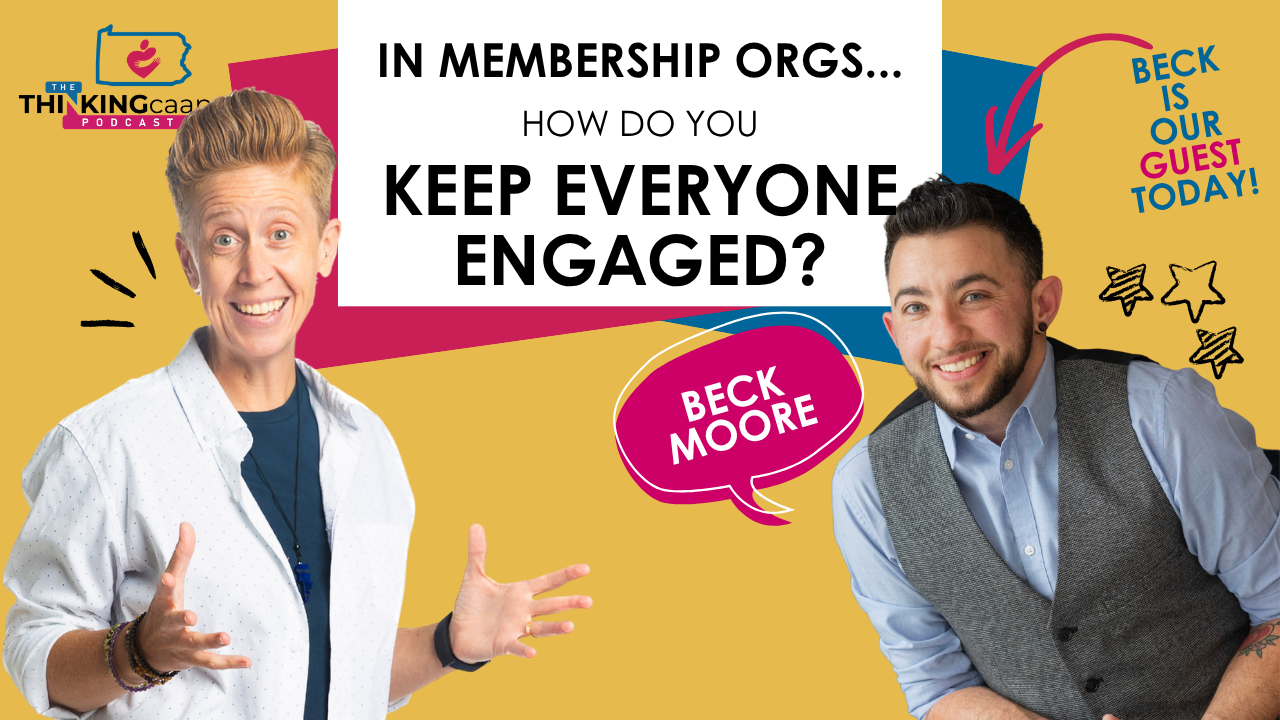
IMAGE DESCRIPTION: A yellow background. Heather Holloway is gesturing in a questioning face on the left, and Beck Moore is leaning in from the right with a smile. The headline is in a white box in the top center of the graphic, “In Membership Orgs… How do you keep everyone engaged?” There are small star and line callouts, with small excited text that reads, “Beck is our guest today!”
ThinkingCAAP Episode 40 Notes
Behind the Scenes with CAAP, Membership, and Association Leadership
[00:00:00] Flipping the Script
Beck Moore welcomes Heather Holloway back to Thinking CAAP.
Heather takes the host seat and interviews Beck about CAAP, membership, association work, and supporting Community Action Agencies across Pennsylvania.
[00:00:50] What CAAP Does
CAAP is a membership-based organization that supports Pennsylvania’s 42 Community Action Agencies.
CAAP provides training, technical assistance, professional development, advocacy, enterprise solutions, conferences, summits, and other member-focused support.
Beck emphasizes that CAAP’s primary focus is helping members get what they need to thrive.
[00:02:05] Supporting Agencies of Different Sizes and Structures
Beck explains that CAAP’s member agencies vary widely in size, structure, and capacity.
CAAP helps agencies share best practices, connect with peers, and feel less alone in the work.
The statewide association serves as a connector, convener, and support system for local agencies.
[00:04:42] What Members Are Buying Into
Membership value is both tangible and relational.
Members receive resources, training, connection, support, and access to a statewide Community Action network.
Beck explains that joining CAAP means buying into a shared community, not just a list of services.
[00:06:00] Rebuilding Value and Community
Beck reflects on his early listening tour with executive directors.
He heard that members had sometimes asked for support and been told, “That’s not really something we do.”
Beck explains that CAAP shifted to a new mindset: the answer may not always be yes, but it should never simply be no.
If CAAP cannot solve a problem directly, the team works to connect members with the right expert, partner, consultant, or resource.
[00:08:44] Finding the Right Support
Beck shares that CAAP does not need to be the direct solution to every problem.
CAAP’s role is often to help members find the right support.
He connects this to CAAP’s partnership with Holloway Media Services and the value of trusted partners who understand nonprofit and human services work.
[00:12:04] Staying Relevant to Members
Heather asks whether keeping members or staying relevant is the bigger challenge.
Beck says the two are deeply connected: if CAAP remains relevant, members are more likely to stay engaged.
He compares membership-based organizations to credit unions, where people continually decide whether the value is worth the investment.
[00:13:14] The Challenge of a Membership Model
CAAP has worked to expand value while keeping membership rates thoughtful and manageable.
Beck notes that CAAP has kept rates flat while growing services and support.
The challenge is continuing to do more without unnecessarily increasing costs for members.
[00:14:06] Affiliate Members and Mission-Aligned Partners
CAAP has created space for affiliate members who are mission-aligned but not Community Action Agencies.
Other human services organizations can benefit from CAAP’s learning spaces, conferences, summits, and resources.
These connections can also help CAAP members build relationships with smaller or culturally specific organizations doing important work.
[00:16:29] Diversifying CAAP’s Revenue
Beck shares that CAAP’s operating budget has grown significantly since he started.
The organization had to look at what it already did well and identify ways those strengths could create new revenue opportunities.
Revenue diversification allows CAAP to expand member value while keeping membership costs stable.
[00:18:56] CAAP Learn and Learning Management Growth
Beck identifies CAAP Learn as one of CAAP’s strongest revenue diversification strategies.
CAAP Learn allows CAAP to create, administer, improve, and share training content.
CAAP now works with other state associations by white labeling learning content and helping them solve training and capacity challenges.
Revenue from CAAP Learn is reinvested into the system so it can continue to grow.
[00:20:53] Building Content That Solves Real Problems
Beck highlights the home visitor safety course as an example of training that met a strong need across the network.
Other courses support onboarding, compliance, and required training needs.
CAAP Learn helps agencies access training that is practical, relevant, and scalable.
[00:22:36] Project Administration and Mission Alignment
Beck explains that CAAP has also diversified through project administration.
He uses diaper distribution as an example of work that aligns with Community Action, even though CAAP is not doing direct client service.
CAAP supports partners by managing reporting, compliance, coordination, and infrastructure.
[00:24:10] Growing the CAAP Team
CAAP had about five team members when Beck started and has grown significantly since then.
Beck looks for talented people who can work across projects and bring strong, flexible skill sets.
CAAP’s culture is project-based and skill-based, rather than limited to narrow job descriptions.
[00:27:03] Hearing More Than the Loudest Voices
Heather asks how CAAP hears from all members, not only the most engaged.
Beck explains that CAAP gathers feedback through surveys, course evaluations, conferences, informal conversations, and engagement tracking.
CAAP wants to hear from executive leaders, middle managers, frontline staff, new employees, and people across every level of the network.
[00:28:14] Investing in the Next Generation of Leaders
Beck shares that more than 60% of CAAP’s executive leadership network has turned over in recent years.
Many longtime leaders have retired, transitioned, or passed away, creating significant leadership gaps.
CAAP is focused on developing emerging leaders, middle managers, and future executive leaders.
[00:33:13] Current Member Requests and AI
Heather asks what members are asking for right now.
Beck identifies AI as one major area of interest.
CAAP’s summit is part of an ongoing response, not a one-time conversation.
CAAP plans to keep watching AI trends and bringing practical learning back to members.
[00:34:13] Funding Changes and Adaptive Budgeting
Beck explains that agencies are also trying to respond to changing funding environments.
He shares that adaptive budgeting could help agencies plan for multiple scenarios, know when to pivot, and keep boards informed.
Beck notes that Community Action Agencies are skilled at pivoting, but the next opportunity is planning before the pivot.
[00:38:12] Balancing Data and Instinct
Heather asks how Beck balances data with instinct when making decisions.
Beck shares a board member’s reminder that the question is not always whether CAAP can do something, but whether it should.
Beck describes himself as a big-idea leader and emphasizes the importance of having a team that can help focus priorities, assess fit, and push back when needed.
[00:41:05] Trusting the Right Gut Feeling
Beck explains that some opportunities are worth pursuing because they may lead somewhere important.
A small speaking engagement, partnership, or project can sometimes open a much larger door.
He says association leaders often need an entrepreneurial mindset and the ability to connect one opportunity to the next.
[00:43:04] Honoring CAAP’s History While Reinventing
Heather asks how Beck honors CAAP’s history while giving himself permission to reinvent what no longer works.
Beck connects this to mission alignment and choosing projects that fit CAAP’s role.
He shares disaster case management as an example of CAAP waiting until it had the right infrastructure before stepping into a larger support role.
[00:44:24] Disaster Case Management and State Infrastructure
Beck explains that Community Action Agencies are often already present during disasters, even if they are not always publicly recognized.
CAAP can administer, coordinate, manage compliance, and help agencies get paid for their work.
Beck sees CAAP becoming a critical piece of state infrastructure while elevating local Community Action Agencies.
[00:47:40] Healthcare, Nonprofits, and PA Navigate
Heather asks whether stronger state-level support can help offset challenges happening federally.
Beck connects this to PA Navigate and the value of healthcare and nonprofit partnerships.
Nonprofit support can help address needs healthcare cannot solve alone, while potentially reducing healthcare costs.
[00:48:27] The Importance of Data Sharing
Beck explains that data sharing is essential to proving the value of Community Action and nonprofit partnerships.
Better data can help show cost savings, health outcomes, and long-term impact.
Beck says getting the data right can help address myths about what Community Action does and why it matters.
[00:49:16] Economic Mobility Takes Time
Beck explains that Community Action connects people to resources while helping them grow household income and move toward economic mobility.
He emphasizes that self-sufficiency does not happen in one year.
Beck reflects on his own long runway from homelessness to executive leadership as an example of how progress takes time.
[00:50:27] What CAAP Is Most Proud Of
Beck says he is proud of creating a recognizable, trusted brand for Community Action in Pennsylvania.
CAAP has grown trust, strengthened resources, rebranded, and become an organization funders, partners, and members look to.
Beck is also proud of seeing CAAP team members lead projects, step onto stages, and represent the organization.
[00:55:12] Looking Ahead Three to Five Years
Beck expects agencies to continue facing challenges around funding, legislation, housing, and community needs.
The work will remain complicated, but he is hopeful because of Community Action’s innovation.
He encourages listeners to follow local Community Action Agencies and CAAP to see the creative solutions happening across Pennsylvania.
[00:57:21] CAAP’s Promise to Members
Heather asks what promise CAAP makes to its members.
Beck says members can be vulnerable about what they are struggling with, and CAAP will be there to support them.
CAAP’s promise includes helping members tell their story, get help, celebrate success, solve problems, and feel cared for as part of a larger Community Action family.
[00:58:53] Support for Other Association Leaders
Beck invites other association leaders to reach out if they need support.
CAAP has helped associations think through CRMs, infrastructure, systems, and future member needs.
Beck emphasizes that associations need to build for what members will need in the future, not only what they need right now.
[01:00:23] CAAP as a Supportive Partner
Heather summarizes CAAP’s value, including training, resources, summits, and direct connection with Beck and the CAAP team.
The conversation reinforces CAAP’s role as both a resource hub and a relationship-driven partner.
[01:01:10] Closing Reflections
Beck thanks listeners for joining a different kind of Thinking CAAP conversation.
He shares his appreciation for the work, the CAAP team, member agencies, and partners.
Listeners are invited to learn more, follow CAAP and Beck on LinkedIn, and consider membership or partnership opportunities.
[01:01:58] CAAP Out
Heather thanks Beck for leading the charge.
Beck and Heather close with appreciation and the familiar “CAAP out.”
The standard podcast outro reminds listeners to check the show notes, subscribe, follow, and send Community Action questions to info@thecaap.org with the subject line “Thinking CAAP.”
The ThinkingCAAP Episode 40 Transcript
00:00:00
What's up, everybody?
Beck Moore, CEO of Community Action Association of Pennsylvania and the Thinking CAAP podcast host.
And with me, my fearless co-host, Heather Holloway, Holloway Media Services.
What's up, Heather?
00:00:11
Yeah, Beck, thank you so much.
It's so such a thrill to be here.
this one in particular, is gonna be a good one.
I'm hoping so.
00:00:17
So we're flipping the script a little bit as we've done a few times.
And so while typically I'm sort of the host, sometimes with Heather by my side, sometimes not.
And singular host.
Heather's gonna be interviewing me.
00:00:29
So I'm technically the guest.
So I am gonna be quiet and turn it over to you.
Wow, amazing.
Oh my gosh, you're giving me the hot seat.
00:00:36
So Heather Holloway hosting the Thinking CAAP this week.
Oh my gosh, a dream come true.
OK, so here we go.
Beck, CEO of the CAAP in Pennsylvania, the one in the hot seat.
00:00:50
Brother, tell me about CAAP for those that don't know.
Sure, so if you're maybe you're tuning in for the first time, maybe you sort of like.
Understand a little bit about what we do.
But ultimately, CAAP is a membership-based organization.
00:01:03
We are tasked with supporting the 42 Community Action Agencies that serve every single county here in Pennsylvania.
We do that through training and technical assistance, which doesn't really sound that sexy and exciting.
It really means professional development, training, trying to reduce administrative burden, right?
We provide, we provide enterprise solutions, licensing, which we can get into that because that's also a really sexy topic.
00:01:27
I'm sure people are dying to know about.
We do some advocacy and lobbying, and then we have a whole other kind of mix of projects that we take on, but our primary focus, no matter what we're doing, is always our members, right?
So that is our primary support.
Those are the people who we are here to take care of and make sure that we're providing.
00:01:46
Whatever they need to really thrive.
Sometimes sharing best practices.
Of course, we have our conferences, our summits that we run, which are super exciting.
If you want to learn more about those, you can go to our website, thecaap.org.
00:01:57
But yeah, that's, that's who we are.
We're here to support Community Action Association, Community Action Agencies primarily.
Yeah, and that can get a little confusing.
There are Community Action Agencies, and then there's Community Action Association, which that's what you are.
00:02:13
what I love is, just like you, you just itemized all of the support.
And I think when you, when you, really whittle this down, that, that's what it is.
You are supporting these agencies that don't have the departments and the, maybe the funding or the education.
You're bringing all of this sort of under your umbrella and saying, By becoming a member of CAAP, you get all of this.
00:02:43
Yeah, and, and I think at the same time, it's also supporting organizations because our, our kind of range of agencies that we support are anywhere from almost $40 million dollar organizations to as low as just under a million dollars dollar organizations.
And so it's a pretty, that's a pretty big wide, you know, range of organizations, if you think about that, and kind of what that all encompasses structurally.
So some of our agencies, they've got really robust, right, communications teams, they're really robust.
Community development, fundraising teams, and then we have folks who don't have anything.
00:03:15
And are still doing the thing, you know.
So sometimes it's just bringing best practices.
It's really, it's highlighting those who do have all the infrastructure, bringing the pieces together.
My golden retriever has decided to join us, by the way, so you can, I love it.
00:03:32
It's bringing together those groups.
It's thinking through complicated problems, thinking about how can we learn from, you know, this one piece of something that's happened really well, bringing together like positions, so they're trying to think through something hard.
So it's, yeah, it's supporting those who don't, but it's also supporting those who who do, and in just a really wide variety of ways.
And sometimes it's just Simply bringing together a conversation to be like, you know what, you're not alone in this.
00:03:57
We know it's hard, and sometimes you just need to vent, and you need the right person to vent to who understands.
Because if you're not a communications professional, let's say like, And you're talking about, you know, search engine optimization to somebody who doesn't understand or you're trying to talk about click through rate.
Like I just can't get people to open this darn email.
Well, that doesn't resonate with somebody who's a case manager, right?
00:04:17
And you're working in the next cubicle over with.
So bring those like groups together.
So you just can vent for people who understand what you're talking about.
It's important.
00:04:25
Yeah.
And let me tell you, from my previous relationship of a, of a nurse to my wife today who's in digital marketing, I mean, two totally different conversations.
I feel much better, you know, in the position that I'm at today.
I have somebody to talk to, who can relate, right?
00:04:39
I mean, that's, that's the ultimately, who can relate.
So, let's talk about membership today.
42 agencies, around the state, membership is a choice.
You don't have to be a member of CAAP, right?
00:04:55
What do you, what do you believe members are really buying into with the CAAP?
So, for me, it's a couple things.
I think if you ask some of our members, they would probably say similar things.
But for me, I'm always trying to think about the value proposition that we bring, right?
00:05:16
What are the things that tangibly you get?
Because an agency spending, you know, anywhere from roughly right.
$5600 a year, which isn't a lot of money, it doesn't sound like, but when you have very few dollars that are unrestricted, that that could be a lot of money.
The smallest amount you could pay is somewhere in the range of maybe $1500.
00:05:42
That's all based off of, you know, an equation that we have based off of certain allocations of dollars.
Again, super sexy topic we could get into if you really want to.
I don't want to hear about it, but What is the, what do I get, right?
What do I get?
00:05:56
If I pay this.
What can I count on receiving?
And when I first started at CAAP, there, we couldn't really point to anything.
We had our network call that we host every 2 weeks where all of our executive leadership gets together.
00:06:11
We had a learning management system that was in its You know, a place where people could learn online, but it was really in its infancy still in terms of what was developing in the courses that were there.
We had our conference, but you still had to, you know, in some instances, you still had to pay to use some of those things.
And so, really trying to get very tactical about what do I get out of these membership dollars.
So it's, that's part of it.
00:06:33
And I think the other part for me is At the time that I started, not all of our members that are members today were members when I first started.
And what I really wanted to try to do was how did we create a sense of community again, where people wanted to come together, they could learn from each other, when they're all together, when we're the host of that space, how did we make them feel seen, valued and appreciated, appreciated and understood?
Like they weren't alone.
Like they could rely on their, their, their counterparts, right?
00:07:05
How could we bring them together, find like opportunity.
And then I think the last thing is feeling like, sure, we may be very, very different in our approach of how we approach and tackle poverty in local community, but creating a unified voice.
In some sense, right?
That we were all working together to make sure that these things were happening, right?
00:07:26
And that people felt that.
And it's not, it's not perfect to be clear.
I, you know, I don't want anybody hearing this episode and be like, oh, just, you know, Beck thinks he has it all together.
No, we still have challenges, we still have difficulties.
00:07:37
It's not perfect every single day.
I think we stumble just like any organization does, but we are always trying to learn from our members and listen to their needs and being responsive to them.
So what I've said from the very beginning is.
When I first got here, we heard loud and clear.
00:07:56
I did this big listening tour, right?
I talked to any executive director who would take my call or my Zoom.
Take my meeting, whatever it was, and just ask like, what are the things that you really value about CAAP?
What are the things maybe you don't value?
00:08:08
What are the things you wish we did?
And over and over and over again, people said this one thing numerous times.
Well, we would, we would call you, you, right, the bigger you, not me, because I wasn't here, but And we would ask the question, hey, we need this.
Can you do this?
00:08:25
Is this something you can take care of?
And the response more often than not was, no, that's not really something we do.
But I was really struggling with the answer of, well, then what do we do?
Because it didn't, it felt like, OK, we host a conference.
00:08:40
We have some webinars, we have this network call, but what value does that really bring to people, right?
And so, what I said to the team after that listening tour was, from this point forward, and I say this to every new team member that starts from this point forward, if somebody calls and asks, can we do this, the answer is never going to be no.
Not because we're necessarily going to do the thing.
But because we're going to try to help find the right person to find the solution, right?
00:09:05
It may not be us, we may not have the expertise, we may not have the bandwidth, we may not have the capacity.
But We're going to find and try to vet the right person or point to, this is the person who can help here.
Right.
And sometimes it could be, yes, but not right now.
00:09:21
Because we just don't have the capacity, but let us think about how we can kind of prioritize this and put it within, right, our, our scope of what we're going to do in the next 1 or 2 years.
And that's part of why we partner with you, right?
Because you all have the expertise in terms of marketing and communications expertise.
Am I a jack of all trades?
00:09:37
Do I know know enough to be dangerous?
Sure, yeah, I can talk to you about SEO.
I can talk to you about click through rate and how to get your emails open.
I can talk to you about, right, like the right messaging and how to be a shameless promoter of all things.
00:09:48
You're hired, but, but I, but I'm not a designer.
I don't have the capacity to build out the system in which you operate and also cannot, don't have the time to hold your hand through building out a new website or Creating the social media content, right, that, that you need.
And so we try to partner with folks like you that have that internal expertise that we know we are going to be thoughtful about pricing because our agencies are still nonprofits.
And we want to make sure that the vendors and relationships that we do create also are thoughtful about keeping resources where resources need to, and that they're going to do what they say they're going to deliver on, because a lot of consultants out there.
00:10:32
Don't actually deliver on what they say they're going to do.
And so I know I've heard the horror stories, right?
Like I spent $50,000 with a communications company, and I didn't get anything I asked for.
Yeah.
00:10:45
Yeah.
And I think we want to make sure that that doesn't happen, right?
Right.
And, and, and you are, I mean, you're, you're the proof, right?
00:10:53
It's, it's your team is an extension of you, your partners are an extension of you.
And I see this play out in other organizations where I see the team members, and then I see the leader, I'm like, oh, wow, OK, you, you're two degrees of separation there, can be a great thing, can be a bad thing.
In your case, it's a great thing.
I, you're, you and your teammates, and of course, selfishly bringing us on.
00:11:17
I mean, it's just, it feels really good to work with you because there is care, there is, the, the desire to, to lift everyone up.
So, to lead like that, Beck, it's, it's beautiful to watch.
and, and so your agencies get to, you know, this all of this is a byproduct for your agencies to, to receive.
what I want to piggyback on this.
00:11:44
In your experience, now we have 42 agencies.
Is it, is it, is it, in your experience, is it keeping members or staying relevant to them, that is, Tougher tougher waters to navigate.
Keeping the agencies with you or staying relevant to them.
What's, what's tougher?
00:12:04
I don't know.
I think that's a hard question to answer.
I mean, I think it's a little, I think it's a So I've worked in membership based organizations, almost all of my career.
And I think one of the things that I remember talking to a friend of mine about was, you've got to view this as sort of like a, a little bit like a Of a credit union, right?
00:12:33
Credit unions are different than typical financial institutions, because you're a membership based organization, then right, like I can choose to take my business somewhere else.
Same is true of our members.
And so, but when you sort of train yourself to think about constantly balancing the value proposition back.
Keeping members ends up being answered by the question of how do you stay relevant?
00:13:04
Because if you're staying relevant, you keep your members.
Oh, you know, it's really, it's not, I don't think it's.
It's not that hard.
It's a difficult business model, because you've Got to continue to keep newer resources.
00:13:22
And when you're somebody that is a high achiever like me, and you're constantly trying to think about what's the newest thing, how can I keep, I keep making it better and better and better, it costs more and more money.
But your revenue stays the same because Your members, you don't want to increase your membership costs, even though you're doing more, and you could make, you could make the argument, I could charge more.
And maybe eventually we do, but we've, we've kept our membership rates flat because we also recognize the State of the Union and what costs look like.
And You know It's, it's important to us to be thoughtful about all of those things, but ultimately, the better you think about what keeps you relevant, the better you keep, you keep your people.
00:14:06
And we've, we've started to think about and done this a little bit is that we have this group of affiliate members, so people who are mission aligned.
Because human services work is complicated, and we want to create kind of this shared space where other organizations who are mission aligned to Community Action can also come and, you know, be taken care of by our, our team and all of the folks that we work with.
Because if you just go to kind of your standard consultant to help with this thing, it's going to take a really long time to explain and that's part of why you may not get the, the, the right resource out of that consultant because they don't understand your business, they don't understand your business model.
So, so part of what we've tried to think about is not only how can we be relevant to Community Action Agencies, but also how can we be relevant to other human services organizations, and bring them into the work that we do.
00:14:56
And so today we open up our conference and our summit.
To non-Community Action organizations.
Because we also know there's learning that they can bring back to our members, and we want to try to create this space where there's convening opportunities.
And potentially be intentional about some of those where those relationships can form, because there may be organizations who are really small, but are doing deeply culturally appropriate work.
00:15:21
That could be a real benefit to an organization who's struggling to try to serve a particular, you know, subset of the community or a specific population of the community.
So I think to go back to your question though, it's, it's sort of like.
It's a little bit of one of the same worries in the former organizations I was in, there was always this churn of recruitment of people and recruitment of volunteers and recruitment of new members.
And what's interesting is, As we've gotten really, really good at serving our people.
00:15:50
People are just coming to us, right?
Like I'm not having to actively recruit.
I was just gonna say 42 member agencies, but are you tapped out or can you get more?
We can do more.
00:15:59
We, we consider our core membership only Community Action, right?
Our affiliate members, though, there's no, there's no limit.
We also no CAAP if I can.
There's no CAAP on our CAAP.
00:16:10
That's good.
And I, then we have this whole other kind of subset of people that we work with that we're a consultant that we work, we work with them, work with other associations, right?
It's kind of this whole mix of other really customers, right?
Not just members, but customers that we're we're working with.
00:16:27
Well, let's tease me up perfectly for my next question.
And you talked about keeping rates flat, membership rates, membership rates flat.
So how then do you diversify the portfolio?
Yeah, it's complicated.
00:16:41
It's complicated because when we, when I first started at CAAP, we were just a little bit over a million dollars operating budget.
If I'm reading my tea leaves correctly, we'll probably be in the realm of about $8 million for a year.
Wow.
I think, give or take, give or take a million.
00:16:57
Yeah.
When I first got here, I think the other thing that was in the strategic plan, it was just said diversify revenue as a need because we were so reliant on a singular funding source, and that's not a great look for any nonprofit.
That's scary, which, which we are, we're, you know, at the end of the day, we're a nonprofit.
And so I had a couple ideas and, you know, brought them to the board at the time, and they're like, I know, it's not really their thing, right?
00:17:24
And I think it was A lot of the things that I was bringing to them were very reliant on my skill set individually, because we didn't, we just, we didn't have a strong enough team yet to think about how could we work with outside groups.
And Ultimately, what it, what the no sort of led me to reflect on was, what were we already doing really well, and what did we have the infrastructure to Sort of building to the future of what I saw the organization potentially being, right?
So we put in a, a community, we put in a a CRM, a customer relationship management software, we, continue to build out our learning management system.
And we saw a lot of energy and enthusiasm building around our learning management system.
00:18:11
We also saw people continuing to drop off of sort of our regularly scheduled programming, our webinars.
We still had OK attendance, but And I felt this myself, right?
Like, what's the first thing that drops from most people's schedules when they're trying to schedule an already overscheduled life webinars.
Yeah, I'm going to commit to this.
00:18:29
It's in 2 months.
Yeah, yeah, I'll make it work the 2 months and you're like, yeah, no, this is a mess, and I can't do that.
And they're going to record it anyway, so I'll get the recording and then I'll watch it and I never will watch it, and here we are.
Yep.
00:18:41
If it's a real, I mean, we all laugh about it because it's true.
Yeah.
And if you are the person who stays on the webinar and like actually like does the webinar, God bless you.
I appreciate you so much.
00:18:51
You are a miraculous being.
I want to know how you manage your time.
So, I started to look at, OK, what do we do really well?
What do you already already have traction around?
00:19:01
And we started, so we started diversifying our revenue by thinking about how could we market out our learning management system.
We'll do all the administration for it.
It doesn't cost us a lot of money to do the work that we do.
We know that we're going to have to keep creating content that's really like we are content creators, really.
00:19:19
How do we keep creating this content and how do we keep feeding it back into the system, learning from the people that are on this platform that are actively learning, so that we can also be informed about how to create our content.
How do I grow my users there?
Because inevitably, if I learn more about what people want, it could potentially point to other opportunities.
So we started marketing out this learning management system, and I'm happy to say that today we're working with a number of states.
00:19:46
So shout out if you're on this list to my association counterparts, Washington, Oregon, Minnesota, Arkansas, Kansas.
We just signed on, with New Jersey, let's work with Alabama.
So a ton of other, if I missed you, I don't think I did.
I missed anybody.
00:20:03
We work in a ton of other states.
And what's really great about, again, this partnership.
It's helped to diversify our revenue.
But every dollar that we're making goes right back into that learning management system to grow the content.
00:20:18
We're solving a problem for other associations because they, many of them, you know, don't have a ton of staff, and you can't, it's really, really hard to do all of the things that we do with just one or two staff members.
You just, you just can't, right?
This is too much.
You got to be the face, you got to be the trainer, you got to be on the road.
00:20:37
You got to make sure people feel like they're being served, right?
It's just, it's too many things.
And so we also knew that I knew that my counterparts were really struggling with how to get things done, right.
And so it also solved a problem, which is fantastic.
00:20:53
And so that's created that started started us to think about, OK, now, now that we've done that, so basically like we take all of our content that's on our learning management system that we call CAAP Learn in Pennsylvania.
We white label it over, we can, you know, individualize it a little bit, we can, you know, create other content specifically for you.
And then as we continue to grow our content, your content continues to grow because we're continually white label labeling over it.
And we also believe deeply in continuous improvement.
00:21:21
And so that means Every single day, every single month, you know, we have somebody who's behind the scenes learning about what worked well in that learning and what needed to change.
And so it's also continually improving.
And so some of the courses that have gotten a lot of the trainings that are there, the one that people have just been chomping at the bit about, I think recently is our home visitor safety course.
It's not a lot of trainings out there around, right, how to, what do you, how do you need to prepare before you walk into someone's home?
00:21:54
How do you keep, keep yourself safe?
We need to be watchful for, thoughtful about, because that's, that seems, I don't know about you, but to think about just walking into somebody's house.
That you have to go and visit and hold accountable to something that they have to be held accountable to pretty anxiety driving.
I feel that when I go to visit my family, so I can't you're a stranger.
00:22:15
That is incredible content.
Yeah, absolutely.
And so that's a course that we, you know, we know that a lot of people have really reacted well to and I really enjoyed.
And then there are other things that are on there too, but, you know, like sexual harassment training, things that everybody's got to sit through at least once a year or maybe every other year.
00:22:32
And so it's also serving a need from just kind of an onboarding perspective.
And so then we've looked at other ways.
We've looked at other projects that have been really aligned that either maybe the state or a local partner needed an administrator on.
So we're not doing direct client work, right?
00:22:48
Like we are not working directly with correct.
Yes, right.
We're not like we have this, this grant to do diaper distribution.
But we're not actually Bringing the diapers to the people, right?
00:23:03
We work with partners who are doing the work.
We hold them accountable to what they need to be held accountable to.
We do all of the reporting, we report back out to all of our partners.
And so that's a project that is very much aligned with the work of Community Action.
00:23:15
And so yeah, the again, though, I think that with the part of where we saw the most change from a revenue perspective was.
What do we do really well, right?
Learning management system, we do really great administration.
We're really great at making sure that we maintain compliance.
00:23:32
And when I say we, I really mean my team, not necessarily me.
Shout out in particular to Georgia, who is a rock star in this space.
And how do we utilize those skill sets to continue to, to grow, right, our revenue, all the while making sure it's Pennsylvania and Community Action, specifically in Pennsylvania first.
That's got to be the mindset because they're our primary customers.
00:23:55
Yeah.
What, what I love about this so much is you're diversifying the portfolio, you're finding other ways to, you know, to bring funds in, as a nonprofit, not, not pushing that onto your members because we know, you know, every dollar counts.
but what I also love seeing is the growth of your team.
So it's almost like I hear you like, oh, I just, you know, we're bringing that person on, bring that person on.
00:24:17
So tell me about the expansion of the team.
Where was it when you started and where we are today?
Yeah, I think we had 5, I think we had 5 when I first started.
right now, we have 12, full time people, I believe, yes.
00:24:31
we have 1 part time person.
We're about to hire, 12 more people.
Wow, 12.
Wow, that's bananas.
00:24:43
I keep saying that out loud, and I just can't even wrap my brain around it.
And some of our projects are, and things that we do are, you know, it'd be like a year-long project or a 2 year long project.
And so some of those staff end up being temporary roles for a little while.
But part of what I say to anybody is that We really want to make sure that when we find talent, we're going to keep it and try to continue to source projects that we can keep those really talented folks, because I just had this conversation with somebody a little while ago, we were doing final interviews for a position, is that You, if you really want to stick to, if you're kind of the person who's like, I love my job description, and I love reflecting on my job description, and I want to do the things that are in my job description, and I want to stick to those things, and that's all I want to do.
00:25:30
This is not the place for you to work.
I don't operate that way.
I never have.
I never will.
00:25:37
Many hats.
No, nope.
If you love thinking about, right, like, and project managing things out, and you like to work with project teams who are really diverse and skill set, that is the way that we look at everything we do.
So you may have the job description of, right, I don't know, operations associate, or, you know, director of community engagement, or I don't know, COO, whatever your title is, executive assistant, frankly.
00:26:05
You're, if you have this really strong skill set in this thing, you're going to be involved in other things.
That's just the way that this works.
So, as we think about those new projects and hiring more people, I'm also trying to think about like if this project comes on board, or if we look to this project, or even it could even be through the lens of now we have somebody who's really excellent at this thing.
We're going to potentially look for a project that helps to continue to keep that person long after, right, the 1.5 year project comes to a conclusion.
00:26:33
That's awesome.
That's awesome.
And that I think I, this is what I most adore about Community Action Association of Pennsylvania, of UEC, of everyone there is you really care.
And we, we really care about each other and the diversity of your team.
00:26:51
I mean, I just love all of that.
and so for my next question, you know, we're talking about when we're leading, you know, a large diverse membership base.
How do you ensure that you're not just hearing the loudest voices of your members, and that you're making sure that everyone has a voice?
With you, cause you already show with your with your team, like everybody I know if they came to you back, you'd be like, I'm listening.
00:27:18
And it's not, yeah, yeah.
I mean, and sometimes I think I have to end up saying, right, like I don't have capacity to listen right now.
I don't, you know, my, I've got a lot of complicated things that happen in my home.
who our family is, who I am.
00:27:33
And so there are just times that there is something heavy and I just, I don't have capacity, and I try to be thoughtful about that.
So I, but again, I'm not, I'm not perfect.
I will say that also again.
When it comes to our members, you know, it's interesting because there are those organizations who really rely on us very heavily, and then there are those that never come to us.
00:27:51
We probably could not hear from maybe but once a year.
You know, they're sort of there lurking behind the sidelines somewhere in the, you know, somewhere behind the screen.
And then there's a sort of in the middle, and Again, I'm going to go back to kind of when I first started, but Really, the people that we were engaging with the most in the very beginning were executive leaders.
And, and let me be clear to all of our executive directors who are hopefully listening.
00:28:20
They are very important, right?
They're the people who carry a very heavy burden.
Those are the people who I am engaging with the most, but the people who we really need to make sure to be thoughtful about are the frontline folks.
The folks who are brand new to the organization that we need to keep top, top, top talent, we need to attract new talent, top talent, we need to keep those new folks.
00:28:42
We need to continue to invest into the people who I don't get the opportunity to see very often.
And how do we design training for not just the executive leaders, and that's really who we were speaking to in the beginning, but also the middle management, the people who want to become middle management, the people, God help you.
The people who middle management is not the sexiest thing to ever do.
If you're in it, I feel you.
00:29:06
I've been there.
And then the folks who are at the very beginning of their career, or right, they maybe their case management, their direct, their direct client, their teachers in classrooms, right, they're, those folks who we need to get in front of those people because, We've entered a phase in at least our network, the folks that we serve primarily that we've had over 60% turnover in our executive leadership.
And those are folks who have been in their jobs for anywhere from maybe, you know, a few years upwards to 45 years.
And they're leaving, they're retiring, or some of them passed away.
00:29:43
We had a lot of deaths in the network in the last few years.
And There were executive searches, that's something that we've we've done for our agencies that we can do for agencies.
And in a lot of instances, the#2 was hired.
Which is fantastic.
00:30:00
I love seeing that, you know, I was a#2 that got the opportunity to be the top banana.
But what that created also was a big gap.
Right.
And so, how do we invest back into the folks that are now looking to grow so that we can fill the#2 spot.
00:30:19
Because filling the 2 spot in the 2 spot with somebody externally is going to be hard.
And so we know that we need to try to figure out how to invest back and sort of right, the folks who we're not hearing from the most.
And so we've tried to be really thoughtful, you know, it goes back to CAAP Learn again, where we have a a survey that people have to fill out, which we survey people a lot, but there's a reason for it, right?
Like, We have people fill out the survey about what do they think of the course, what do they wish they had training on?
00:30:47
And so a lot of times those people that are behind the scenes that are taking our trainings are engaged with us, that we're not necessarily talking to, we've tried to embed ways to talk to them, so that they're helping to inform the continuous improvement practice, right, that we're trying to to maintain.
Another good example of this is that we used to do this huge survey, and we still, we still do a version of it to be clear, where it was like, tell us everything and every anything and everything you could possibly tell us about how your organization is, is running, and how we can be helpful, basically.
But the problem is, as an executive director or CEO I'm not talking to every layer of the organization every single day, right?
I'm talking to my management team.
00:31:27
But I can't point to the professional development that every single case manager needs.
And so we were really our system of trying to understand what our folks needed was kind of broken.
And then during our conferences, the times that we do get in front of people physically, right?
We again try to be very thoughtful about just how do we create sort of the formal and informal ways of getting the feedback from folks.
00:31:52
And if we're not hearing from people, the other thing that we've built into our system is.
Being able to look at least once a year and who is our most engaged and who are our least engaged, and then how do we think about reaching out to those folks who are the least engaged.
And even if it's just a simple, right, like, Maybe the executive director is the only person who we really get the opportunity to talk to, making sure to get in touch with that person and just be like, hey, how you doing?
Everything cool.
00:32:17
We haven't heard from you in a while.
Is there anything we can do?
Is there anything you're looking for?
And, you know, usually it's there's.
00:32:23
There's not necessarily anything.
But that's, that's a really, I think other important part of trying to figure out that kind of balance of the folks who are always calling.
Right.
And then the folks here you know, maybe not hearing from, trying to get in front of the right people, right, and kind of evaluating.
00:32:41
I haven't heard from, you know, Dave in a while, I need to reach out to Dave.
Yeah, I love how thoughtful that is.
You're not just, you know, you become a AAA member.
They're not calling you, you know, to see how you're doing.
00:32:55
But with, with, with having the, the 42 agencies, you're able to do that.
You're able to keep eyes on it.
It sounds like you're keeping track too, so members, listen, we don't know, yeah, we know we know who's engaged.
We know who's not.
00:33:07
Yeah, we know who's hanging out with us.
So yeah, right, we wanna hang out with you.
So 2026.
We're we're talking about modern era here.
00:33:17
What are some requests that are coming through from your members?
I imagine two little letters.
I imagine AI is popping up all over the place.
But besides that, what else are we talking about right now from the members?
00:33:28
What are they asking for?
Yeah, so AI is something that we, and that's, you know, we have had been hearing that for a while.
That's why we have our summit in May.
I don't know when this episode will be airing.
00:33:37
But, you know, at that at this point in time that you're listening, it could be that the summit already happened.
But Part of what I hope people hear me say in the AI response is that it's not going to be a once and done summit, right?
We're going to continue to evaluate and look for, you know, all of the updated sort of trends and how do we bring those back and what's what's sort of happening.
I think that, honestly, one of the things that We've been talking about for a while is how do we continue to be responsive to the ever evolving changes in funding.
00:34:13
And so where we've really been, and I just had this kind of epiphany yesterday, as a matter of fact, I was at a nonprofit summit that I had the great opportunity to speak, speak at with two of my good buddies, Ellen Min and Hattie McCarter, shout out to my chosen family, got to share the stage with them.
is we've been leaning into really kind of the development side and That's, that's tricky because not everybody has the dollars to invest in a development staff and trying to grow, unrestricted revenue, which I still believe in deeply, to be clear.
But I, I had this epiphany that we heard a session on adaptive budgeting, and creating a budget that continues to adapt with sort of every day of the year, every moment of change sort of builds in scenarios.
And You know, back about a year and a couple months ago now, we had had this moment in human services world where budgeting or money got held, right?
00:35:16
We didn't know what was going to happen.
And so we had to think about how do we sort of inform, right, scenario-based planning and budgeting.
And we had talked about that a little bit.
We didn't really, we have not really found a great tool for how to showcase that or how do you build that into your planning discussions.
00:35:33
And so I'm, I'm just continuing to think about like, OK, well, how do we just raise more money?
How do we get more money back in the hands of our agencies, which is part of what we're always trying to do as well.
Like if I can get my agencies paid back for what they spent on me, then I win all day long, going back to that value proposition, right?
But when it came when it yesterday, I had this moment where I was like, you know what?
00:35:52
This is, this is, this is the thing, right?
Like this, this could be a real great opportunity to help bring A response to something that people we don't really know how to effectively.
Plan We pivot, we pivot like bosses.
But how do we build in the scenario planning?
00:36:11
How do we keep our boards informed?
How do we really seriously.
Understand 6 months ahead of where we might need to pivot.
What's the lever I know I need to pull.
00:36:24
And so I'm excited.
I mean, I know it's, again, it's really super sexy topic, adaptive budgeting, but, you know, you heard it here first.
It's coming to a Community Action Agency near you in terms of learning.
Do yourself a favor, Google it.
00:36:39
It's super smart, and it really helps to inform a lot of things.
So I'm excited to bring some more information about that, because I think it solves a lot of things that we've heard.
We just, we're tired.
We don't know if we can keep pivoting.
00:36:52
We don't know how to keep pivoting.
We've been pivoting for years and years and years.
We know that fiscal is complicated, all the tracking we have to do, right?
We have very heavily.
00:37:04
Heavily administered, you know, in deep compliance rules around all of these things.
And so I think that's, that's the thing that's going to be outside of AI that I think AI can help with, to be clear.
But I think that's, that's part of what we're going to be really looking at in the next, in the next few months, guarantee there will be multiple sessions about it at our fall conference.
All right, you heard it here first, get your tickets now.
00:37:32
It would be amazing to have a, crystal ball, right?
And this almost, is almost like that.
It kind of sounds like it.
Now listen, I'm in marketing and I'm a professional speaker.
00:37:44
I don't know about adaptive, adaptive budgeting, but it sounds like it's a little bit of a, a crystal ball.
Talking about informing decisions.
When it comes to major decisions about programming, membership, or growth, now you said that when you started, you were about a 1 mil, agency.
Now we're up to 8 million.
00:38:01
So you're doing something right, kid.
So how are you, you are, you are.
How do you balance what the data says with what your instincts tell you?
Yeah, so, one of my board members had made the comment at a meeting once about, it's not a matter of can you do something, it's a matter of should you do something.
00:38:25
And that's a really, I think that kind of hits to the core of a little bit of your question is that with Georgia and I, my chief strategy officer and I were looking at the statewide contracting platform, right?
So you can see what, what things are coming up open for bid.
And there was something in there.
And I like, I think she probably saw the twinkle in my eye, and she's like, Beck, we're not doing that.
00:38:49
She already knows hitting no right now.
We're not bidding on it.
And I, I kind of laughed.
I was like, no, no, I was just curious what it was, to be clear, I wasn't like ready to bid on it in that moment.
00:39:00
As you're opening up a Word document, start typing over here.
I, I honestly, I think that's, that's, that's really part of it that is right, like having a team who, yeah, they're willing to go on the journey with you as you and I've said this before in this podcast, like I am a A big idea guy.
I love big ideas.
I love thinking about strategy and right, like what's the right door?
00:39:26
What's the right thing to kind of rattle a little bit, that's going to lead to this and lead to this.
But having a team who is going to sort of right, say, well, that back, no, like this is we got to focus on this right now.
We got to do this is really, really important, so that Right.
Sometimes the big idea can get in, get in the way of the instincts of like, cause I get excited, I want to do, right.
00:39:56
I'm a high achiever.
I like doing big things.
So I think having the team to sort of help balance that out is is really super key and making sure that you listen to them also, because you can have the team, they can be saying, don't do this, and you're like, yeah, I'm doing it anyway.
And I've made that mistake before, and probably will again at some point, but The air is human and we're, we're aware, we're aware, yeah, and, and you have the trust and the confidence from your team to push back a little bit.
00:40:22
I know, you know, in our agency we're going through that, we're experiencing growth.
Thank you so much, and so there had to come a balance in a time where I was like, hey, you know, we have, we have projects that we want to do and we want to get across the finish line, but They'll be there.
Let's make sure that we service our clients to the highest and best, and then come back.
So we literally just went through the same thing, you know, it's, I, I'm the visionary too.
00:40:45
My head is in the clouds, but then thank goodness, Amy's there to keep my feet on the ground.
So I feel you on that one.
And I, I think sometimes though, also, it's like they're, the things that I will say that I will say no, we're doing it anyway, it's In times that there's been maybe some resistance.
I think part of what I've really Pushed the moments that I've pushed hard have been the moments where That my gut is telling me, I know this is going to be the thing, right?
00:41:19
Like, I know, I don't know what it is about this.
But it's going to lead to this, and usually it's something that may not seem like it's that big.
It could be a speaking engagement, but it's going to mean that I'm going to have to travel, and it means that I'm going to have to be gone, and it means sometimes it's going to be right up against the conference, which is going to make the team a little bit nervous, because if I'm not back, like I'm the guy who's on stage quite a bit.
Which they would be fine if I wasn't there to be clear, but I know it would make, it makes them feel better if I'm there, but.
00:41:51
Sometimes it's those little things that lead to the bigger opportunity that I just, I don't know what it is.
I don't know what, what the thing is.
It's like, you have to be.
Sometimes a little bit of an entrepreneurial mindset when you run an association.
00:42:09
You got to be willing to sort of trust your gut and think like, How does this inform the thing that informs the thing that informs the thing?
And in a lot of ways, I, I liken us a lot of times to a consulting firm.
And so we've got to be thoughtful about that just kind of continuous churn of, of, of clients and dollars and projects in order to make sure that we have the revenue to sustain what we've built and continue to grow for our members.
Yeah, yeah.
00:42:40
So much weighing on your mind, my friend.
So much weighing on your mind.
It's not evil genius.
I don't, I don't, it's just.
00:42:51
You just I don't know.
It's like you gotta How do you build like this little empire?
Yeah, like, it's a lot of fun.
Speaking of about building an empire.
00:43:04
OK, so, so CAAP, how long has CAAP been around?
We, so we celebrated our 50th anniversary last year.
So we're 51 years young.
51 years young now.
00:43:16
Community Action over 60, right?
Yeah, yes.
Many of our agencies are celebrating their 60th this year, but I think it was the 60th sort of started about 2 years ago, if I'm not mistaken.
And you've been at the helm for how long?
00:43:31
4 years and 123 months, and like 2 days.
44 and a quarter years ago.
So Beck, the, the mission runs deep.
The mission of CAAP runs deep.
00:43:46
So how do you honor what's been built while still giving yourself permission to reinvent what's no longer working?
Oh Yeah, I, I think it.
It goes again back to kind of that idea of what is mission aligned in terms of projects.
So, you know, for instance, I think there's a a contract that we have doing some disaster case management work alongside of a few of our agencies in the northern north central part of Pennsylvania.
00:44:24
And Community Action is often there during a disaster.
We may not be called out in name, you may not know they're even working with a Community Action Agency, but our agencies are, are already at the, you know, in a lot of instances already doing a lot of work with disasters.
And so there was some kind of a group of individuals who had not been really completely supported, had not had their needs met after a hurricane in that part of the, the state where there was a lot of flooding.
And at one point, I had been talking with the Department of Human Services, about 2 years prior to this, about how CAAP could potentially be involved, and could we be a support system on a statewide basis?
00:45:09
Would that be something that we could do?
And at the time, I said no, like I was like, you know what, we're not going to continue to pursue this because we just don't have the infrastructure is not right, the capacity is not right.
I don't have the right team in place.
And so we're just, we're not at a point where we can take any more of this on.
00:45:25
And so, Kind of backed out.
And then when this smaller opportunity came up to support these individuals, I was like, OK, well, now is the time to see whether or not this is something really we can be doing.
And so in this particular instance, we are an administrator to make sure that people are getting the services that they need, making sure that, right, the agencies who are doing the work are getting paid for their time to support those individuals.
And I think that that project is really kind of a good reflection of What we, again, going back to kind of this idea of like what we do really well and what our agencies do really well.
00:46:01
I don't, I don't.
We're not equipped to support individuals needing help, right?
But we are equipped to make sure the agency can be responsive, and then they are making sure to be compliant, hold them accountable if there is an issue there, right?
And then make sure that they, right, get paid for the work that they're doing.
00:46:20
And that may sound a little silly, but here's, here's the thing to also note about this is that it's also a solution to the state, because While we are a Commonwealth, right, Contracting with all of these individual agencies who are doing that work increases their burden, which increases their costs as a state.
And I can do it for cheaper than them just hiring, you know, a whole bunch of people to do the work.
So, I think the other thing is going back to kind of this idea of what do we do well and where we can offset costs.
My hope is that CAAP becomes a really critical part of state infrastructure, so that it takes burden off the state and we're where we need to be and often where we already are in Community Action.
00:47:08
And what that really does for our members, then kind of take this conversation back, you know, The whole way around It highlights who our organizations are who were already there, right?
But maybe not thought of because.
They weren't, they were too busy doing the work and so they couldn't tell the story.
Yeah, I don't even know they exist.
00:47:29
And so through this work and through these contracts that we're continuing to find and think about, right, if it continues to elevate the Community Action brand all along the way, we do our job.
Yeah.
And do you, and, and with this, you know, this, this hope that you just mentioned, like, with, with what's happening nationally and, you know, healthcare is, is a hot topic, by seeing this dream play out, does that offset What happens federally?
Do we have more than support, you know, because of the state that we can help our folks out and I mean, I, if we can, here's, I mean, here's the thing, right?
00:48:08
Like, We have, we've, I think we've talked about on the podcast a couple of times, the PA Navigate project is that when healthcare and nonprofit work together, it helps to ultimately reduce the cost of healthcare and gets people the help that they need in things that healthcare alone cannot solve.
If we can continue to think about, right, and somehow track that and what that requires to be clear is also data sharing on the healthcare side, to be able to give us back what their cost savings have been in some way.
And if they're tracking the health outcomes of those individuals, also making sure to tell us, right, like, did they see a reduction in this, or did they see a reduction in that, like we need that back and forth.
But I I do think that if we can get the data sharing right, ultimately, it sort of solves this myth of what Community Action does or doesn't do, which hopefully leads to more support, not just in Pennsylvania, but also the country on a whole.
00:49:16
Because our job ultimately, yes, it is to connect people to welfare systems, right, and get them the right resources, but to grow their household income to be self-sufficient economically mobile, so that they're not reliant on those systems.
That takes time.
That doesn't happen in a year.
But when I think about the time that it took me from being homeless, to becoming an executive, there's a long runway there.
00:49:39
There's a lot of things that had to happen.
And I didn't have a Community Action Agency to help me, right?
But that That work, when that happens, it, it, it grows local economy.
We've talked about before, Heather, right, it glow, it grows local economy, it grows county economy grows statewide economy, it gives back to local community, and it ultimately helps to reduce other costs like health care.
00:50:06
Yeah, yeah.
Oh, that's the dream.
I'm gonna keep dreaming.
I'm gonna keep holding that vision.
00:50:12
All right, I just have, I have like 3 more for you.
Are you in?
Are you in for it?
Yeah, yeah, let's do it.
00:50:17
OK, before we get there, just taking a pause really quickly.
Is there anything that I haven't asked that you'd like me to ask?
Nope.
Because these next 3 will probably round it out.
00:50:24
OK, perfect.
OK, back to the show.
All right, well, speaking of that dream, what are we most proud of, Beck?
What are we most proud of a Community Action Association of Pennsylvania?
00:50:35
I, I'm just.
Creating a brand.
You know, right?
I mean, talking to a marketing professional is hard.
00:50:47
Takes time, just like your climb, it takes time.
It's And when you're, when you have 42 agencies who are all branded differently and all called something different, and are some nonprofit and some in public government, you know, county government, as I've talked about before, that's what our members are.
Regardless of being around for 60+ years, it was really initially very hard for me to wrap my head around the story about how do I around the idea of how do you tell the story about Community Action.
And what's been really phenomenal is, we've, as we've grown from a trust perspective with our members, as we've grown our resources that we provide to our members as we strengthened who we are as an organization, we've really, I think, become a brand that people look to and seek out.
00:51:39
Some of our opportunities that we have in front of us are because funders have said, like, hey, we know that you can do this because you, we've seen you do it.
Would you be willing to think about doing this?
That is a huge testament to the team that we've created, the trust that we've created, what we've showcased back to, right, our partners.
we've been invited to be thought leaders of a number of different projects and been invited to a lot of discussions, tables to help inform other things, and that's spoken at NASA, I spoke at NASA, which was wild.
00:52:15
And I just, that's As somebody who really didn't think they were ever going to be anything, to be able to reflect back that, and I That I can and have.
is huge.
And I, you know, I, I was with an organization, a large nationally recognized organization for a long time.
It's how I started my career.
00:52:36
You add up all of the different organizations that are part of this national federated model, was there for roughly 15 years in total, all over the country.
And when I left the last two, I was really struggling with like what I was going to do next, and thinking to myself, like, I don't really know if I can.
Is this me?
Is this the team, right?
00:53:04
Like, is this just happenstance that I found myself in these situations?
Like, did I really do this?
Am I capable of growing a team?
Am I capable of growing an organization?
00:53:14
I want to believe that it's me and the people together, but I just don't like, I don't know, right?
Like.
And so I left one of those organizations and I went to another one.
I, you know, I, I showed that I could do it in another organization.
00:53:26
And then I got here and I'm like, OK, like, this is, this is a big leap.
Like I've been at this organization for 15 years, and now I'm going to do something completely new.
It's still nonprofit.
It's still a membership based organization, but I don't know anything about, I know about this much about human services at the time, right?
00:53:47
So I'm also just really proud of being able to show to myself that I've grown an organization.
In a way that some people spend their entire career trying to grow.
You know, and so to be able to reflect and see what we've created from a trust perspective and a community awareness perspective, and really, I think created a brand.
We rebranded, right?
00:54:08
People.
Look forward to the events that we have.
I just, that's that feels good, and to have a team that I really trust and believe in.
That's also just carry on the top.
00:54:19
Yes, yeah, and to be able to see them doing things that I don't need to be the person on the stage, you know, like, I know this person can go and do it, and that is going to lead to other opportunities too.
It doesn't have to be me being the sales guy, right?
Like it's everybody's doing that churn now.
Yeah, yeah, your team, one of the best.
00:54:38
It's really fun to work with them.
Yeah, I love that.
Mel's in Oklahoma right now, like rocking the stage at a conference with a contract that we developed.
Yeah, I mean, it's just right, people are, people are doing the thing.
00:54:50
Yeah, yeah, well done, friend.
Well done.
All right, 2 questions, here we go.
Let's talk about the future.
00:54:57
So this is the epic, if you looked ahead 3 to 5 years, but what do you think?
let me see.
What do you, where do you think we're gonna be at in the next 3 to 5 years with cat?
I think our agencies, you know, unfortunately are going to continue to be really challenged with how to be the most responsive they can be in an environment that is just continuing to change the, you know, the choices that are being made from a legislative perspective are going to impact our community.
00:55:31
And that's not a, that's not a political statement, that's just a reality, right?
Any change creates other change.
Butterfly effect, right?
There's going to continue to be different types of resources shifted to other things, and so I think it's going to continue to be hard work.
00:55:50
And that's never going to change, frankly.
But I do, I do think that We It's also going to be more complicated to create the solve.
You know, it's If you look at housing, for instance, right, like, and now, thank goodness, right, the housing action plan is created and the state is really evaluating how to put funds in the housing, but Things are more expensive.
It's more complicated to try to get somebody housed, right?
00:56:27
The Economics are more difficult because things are more expensive, like that, that is just going to continue to be really difficult, But What gives me hope about that is that Community Action in particular is incredibly innovative.
And I know we'll continue to lead the charge.
You may not hear about the thing.
But follow your local agency on social media, follow us on social media, right?
00:56:53
Because we're going to continue to really highlight those innovations because they These organizations know how to create solutions like nobody else, and while I know they're going to continue to be exhausted executive leaders and people out in the field doing the work, I know that they're going to continue to kind of do it and do it well, and we'll be along their side to to help them.
That's it.
Walking each other home.
Yeah.
00:57:19
All right, last question, friend.
Here it is for all the cookies in the jar.
What is the promise that CAAP makes to their members?
That you can be vulnerable and share what you are struggling with, and we will be there to support you.
00:57:42
To tell your story, help you get help.
And I think Also be there to celebrate the really great things together, right?
Like, I think somebody said to me, and I joked about this on another podcast at some point, is that when you come to Community Action, as a family, and I was like, well, OK, I'm sure it is.
But it really, really is, and I've said this, I've said this a couple times, it, you know, it's, we take care of each other.
00:58:15
We don't always get along.
That's OK, right?
Family doesn't always get along.
Wouldn't be called family if we did.
00:58:23
But we take care of each other.
And I think that is really what our commitment is like, we're going to, we're going to help take care of you.
And we're going to introduce you to the really great people, we're going to tell you that the people to stay away from to try to protect you.
And we're going to lift you up when you need to lift it up, we're going to celebrate and be there together.
00:58:45
Yeah, Bottom line, it's an association that you want to belong to, because you belong.
00:58:49
Heck yeah, everybody.
Yeah.
00:58:53
And I, you know, if you're an association leader out there, and you're looking for support, or you're just sort of not sure where to turn, please pick up the phone, email me back at thecaap.org, you know, The CAAP.org.
Happy to be there to help.
We've supported other associations through the implementation of CRMs that didn't have any of that infrastructure.
Happy to, you know, literally hold your hand and contract with you to do it right at a reasonable rate, or just simply say like, hey, these are the questions you need to make sure to ask and be thoughtful about, because You know, the one thing that we have to consider to think, continue to think about in terms of how to, regardless of your Community action association, or your, you know, the hospital association or your, you know, the cemetery association, I don't care who, what is, there's more associations that you can shake a stick at.
00:59:45
But we have to think about how to build for the future of what our members need and build the infrastructure to support their their futures, not just the now. And that's, that's a heavy lift when you really don't have infrastructure to begin with. And that's, that's part of what I was kind of met with here is, we just didn't have that.
Like I was googling how to get in contact, like who is Wendy Melius, the executive director of, right, what's her email address? Because it just, it was like 10 Excel docs that I couldn't access because my SharePoint wouldn't work the right way.
Like that, that's the world that folks are living in or they're budgeting an Excel doc, and they're like, I don't know how to do this.
1:00:23
So I would just say, if you're out there listening, you need help, please know that we're happy to assist. Happy to connect you to smarter minds than mine. Like, you know, we have a rock star team that is here to help and support in whatever way, shape, form or that that folks need.
1:00:41
There you have it.
Community Action Association of Pennsylvania has been around for 50 some years, will be around for the next 50.
You can become a member, get training, resources, go to the live summits, connect with Beck and everyone at the CAAP for your membership, for your, for your agency needs.
1:01:00
It's true, and hopefully, Heather Holloway will be there.
Hey. I’d love to be there!
1:01:06
Amazing.
All right, Beck, what's your, what's your sign off for this Thinking CAAP?
1:01:10
Thanks for hanging out with us.
Thanks for, thank you for listening and talking about something that's a little bit different than our typical topic.
I know, you know, association work is, it's weird. It's a weird job. I just didn't realize how many associations there were.
Until I started here, and now I've been here for a while, and I still think it's weird, but I love the work that I do.
I love my team. I love the agencies that we support. I love our partners.
1:01:32
So thanks for listening to something that's a little bit different. Hopefully you found it a little bit insightful and peek behind the curtain a little bit. If you want to learn more, if you want to partner with us, check us out.
Follow us on LinkedIn, follow me on LinkedIn.
Continually posting out good content that sometimes is live for anybody to use, and sometimes it's behind lock and key.
So you got to become a member to find out the really deep secrets of what we're throwing out there for our agencies.
So, thanks, Heather for hanging out.
1:01:58
Oh, my pleasure, Beck.
Thank you so much.
Thanks for leading the charge.
Cool.
CAAP out.
If you have any Community Action questions you’d like Beck or one of our local experts to answer in a future episode, please email your questions about Community Action to info@thecaap.org — subject line: Thinking CAAP.