
Leadership, Advocacy, and the Future of Community Action
Stronger Together
Community Action Agencies are highly regulated entities, and yet they are expected to remain nimble, responsive to the needs of their community, and innovative. HOW is that possible?
In this episode of Thinking CAAP, Beck Moore and Heather Holloway welcome Amanda Shelton, CEO and Executive Director of the Texas Association of Community Action Agencies (TACAA), for a conversation about Community Action, state association leadership, storytelling, advocacy, and the evolving needs of local agencies.
Amanda shares her journey from working at a local Community Action Agency in Harris County, Texas, to leading the statewide association that supports agencies across all 254 Texas counties. Together, Beck and Amanda compare the Community Action landscape in Texas and Pennsylvania, including differences in geography, public and private agencies, disaster response, funding, and how local needs shape local solutions.
The conversation also explores how Community Action tells its story, why economic impact matters, and how agencies can better communicate the realities of poverty, affordability, and the Benefits Cliff. Amanda emphasizes the importance of knowing the audience, choosing the right messenger, and helping people understand that most families are much closer to instability than they may realize.
Beck, Heather, and Amanda also discuss the changing role of state associations, the pressure of advocacy, the importance of data, the relationship between state offices and local agencies, and the growing need to think differently about AI, intake systems, administrative burden, and human-centered service. The episode closes with a reminder that Community Action is stronger when networks move together, learn from each other, and continue telling the story of why this work is important.
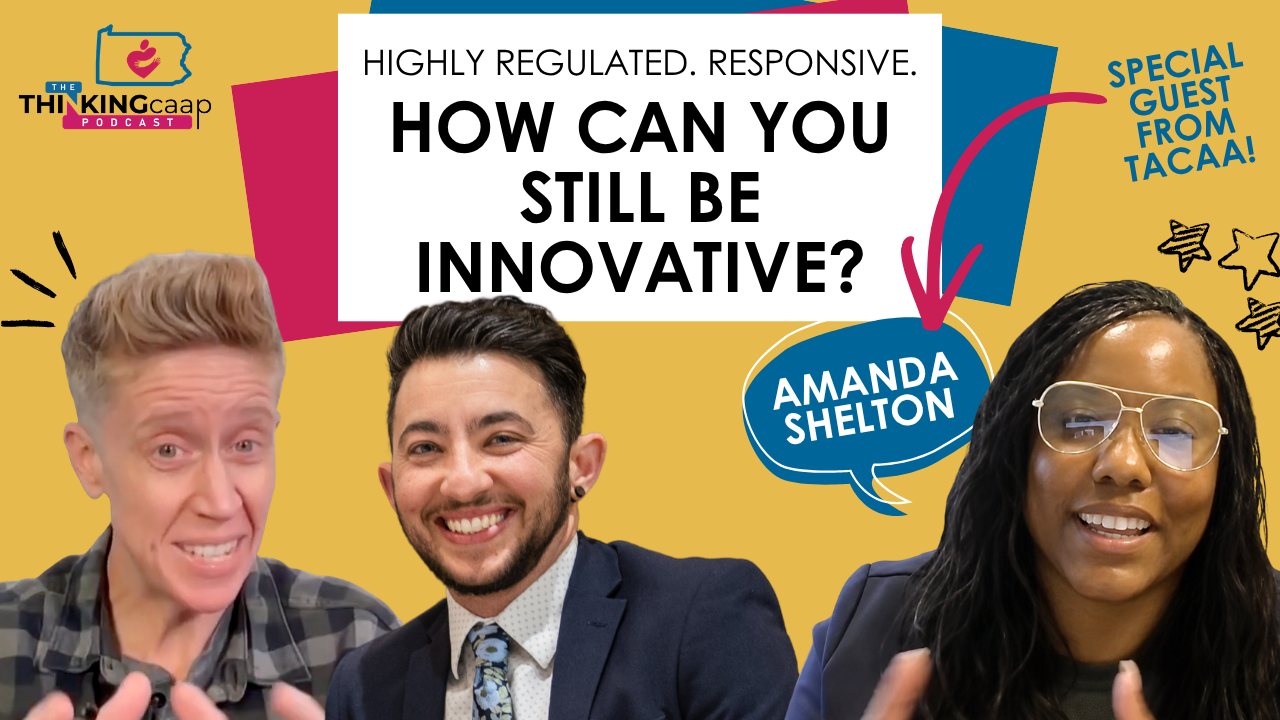
IMAGE DESCRIPTION: A yellow background with Heather Holloway and Beck Moore’s photos on the left and Amanda Shelton’s photo on the right. Between them are speech bubbles with their names. Above them is the headline question, “Highly Regulated. Responsive. How can you still be innovative?” in all caps. There are stars and exclamation points in the background.
Talking Points for Episode 39 of The ThinkingCAAP
[00:00:00] Introduction to Amanda Shelton and TACAA
Beck Moore welcomes Heather Holloway back to the Thinking CAAP podcast and introduces Amanda Shelton, CEO and Executive Director of the Texas Association of Community Action Agencies.
The episode begins with a conversation about Community Action, state association leadership, and the shared work happening across Pennsylvania and Texas.
[00:01:50] Amanda’s Community Action Origin Story
Amanda shares that Community Action found her when she was looking for her next career step.
Her work began at a local Community Action Agency in Harris County, Texas, before she transitioned to the statewide association.
[00:03:22] Understanding Community Action in Texas
Amanda explains that Texas has 38 Community Action Agencies serving all 254 counties.
The conversation highlights how Texas agencies often cover large multi-county service areas, while Pennsylvania has more single-county agencies.
[00:06:20] From Local Agency Work to Statewide Perspective
Amanda explains that her local role was heavily focused on crisis response, especially through major disasters like Hurricane Harvey and the Texas freeze.
At the state level, she now thinks more broadly about Community Action’s economic impact and how the work is described across the network.
[00:07:03] Community Action as an Economic Driver
Amanda explains that some Community Action Agencies are among the largest employers in their regions.
She emphasizes that the network should talk more about the economic value and community investment created through Community Action.
[00:09:50] Longevity, Burnout, and Remembering the Why
Heather asks Amanda how she has stayed in the work for so long without burning out.
Amanda shares that she returns to her “why” and emphasizes that taking care of yourself is necessary in order to keep serving others well.
[00:11:43] Supporting the People Who Support Communities
Beck reflects on the pressure of supporting Community Action professionals who are themselves serving people in crisis.
Amanda adds that she is a recovering perfectionist and has learned to celebrate small wins with her team.
[00:13:54] Telling the Story of Community Action
Beck asks where Community Action can improve in telling its story.
Amanda explains that agencies need to understand their audience and choose the right person to carry the message.
She notes that the messenger could be a board member, community partner, participant, or someone directly connected to the impact.
[00:16:09] Creating Messages People Can Relate To
Heather reinforces that marketing and messaging should help people recognize themselves in the story.
The conversation emphasizes that people often need a point of connection before they fully understand a community challenge.
[00:17:10] Misconceptions About Poverty
Amanda explains that many working individuals are closer to poverty than stability.
She emphasizes that people are often working very hard but remain one basic disruption away from instability.
The conversation points to affordability, rising prices, and the need for Community Action to be part of that public discussion.
[00:18:14] How the Role of State Associations Has Changed
Beck explains that association leaders increasingly have to navigate political environments and advocacy work.
Amanda shares that she did not expect to spend so much time convincing people that basic services like keeping lights on or supporting early childhood education should exist.
[00:21:15] Defending the Existence of the Work
Amanda explains that one of the most unexpected changes is having to defend whether the work should exist at all.
The conversation reinforces that faith-based organizations, nonprofits, healthcare, and government all play roles, but no single entity can meet every need alone.
[00:24:10] The Right Messenger Matters
Amanda connects Beck’s ambulance story back to messaging and who carries the story.
The discussion highlights the value of partners explaining how Community Action helps make local support possible.
[00:25:18] Poverty, Benefits Cliff, and Economic Mobility
Beck discusses the number of people living in poverty in Pennsylvania and the reality of families slightly above the poverty guideline.
He connects this to the Benefits Cliff and the time it takes for someone to move from low wages to a sustainable income.
The conversation reinforces that economic mobility is not instant and that one emergency can disrupt progress.
[00:26:52] Talking About the Causes of Poverty
Amanda shares that Community Action should talk more about addressing the root causes of poverty, not only the conditions of poverty.
She encourages agencies and marketers to find the deeper story and understand who needs to hear it.
[00:29:07] Micro and Macro-Level Work
Beck references CAAP Board Chair Megan Shreve’s point that Community Action works at both the micro and macro levels.
The conversation turns toward data, outcomes, and how Community Action could better use information to influence policy and tell the larger story.
[00:31:27] Using Data to Influence Policy
Amanda explains that she would use Texas data to show how policy decisions affect neighbors over five, ten, twenty, and thirty years.
The goal would be to use data not only for reporting, but to shape long-term policy decisions.
[00:32:45] LIHEAP, Utility Costs, and Future Need
Amanda explains that Texas receives enough LIHEAP funding to serve only a fraction of those who currently qualify.
She connects future utility costs, data centers, population growth, and energy demand to the need for stronger policy conversations.
[00:36:34] Strengthening State and Local Partnerships
Amanda explains that Texas has a good relationship between the association, state office, and local CAAs.
She emphasizes that strong partnerships require recognizing the people involved, understanding compliance responsibilities, and keeping communication transparent.
[00:39:43] Communication, Transparency, and Respect
Amanda shares that being narrow-minded is never the best way to move a relationship or argument forward.
Transparency and communication are named as essential pieces of successful partnership.
[00:40:53] Staying Nimble in a Changing Landscape
Amanda describes the current environment as the new normal and says responsiveness is now a constant part of the work.
She encourages organizations to redefine, reshape, and embrace opportunities before change becomes a requirement.
[00:43:44] Compliance, Regulation, and Respect for the Work
Beck emphasizes that Community Action Agencies are heavily regulated and must follow extensive compliance requirements.
Amanda explains that Community Action deserves respect because the network has survived and adapted for decades in a highly regulated environment.
[00:46:42] What Texas Is Celebrating
Amanda shares that the Texas network is increasingly understanding its strength and power together.
She explains that even amid uncertainty, Texas agencies are moving forward with a strong sense of possibility.
[00:49:16] Partnering on the CAAP Summit
Beck shares that Pennsylvania and Texas are partnering around CAAP’s upcoming summit.
The summit will focus on AI, efficiency with empathy, and maintaining a human-centered approach.
[00:50:01] AI, Intake, and Human-Centered Systems
Beck shares a personal example of going through intake 16 times in one day during a mental health crisis.
He explains that kindness alone is not enough when systems do not talk to each other.
The conversation highlights the need for better systems that reduce burden on both participants and agencies.
[00:51:24] Let the Robots Do What They Do Well
Amanda explains that AI should handle tasks that create administrative burden so people can focus on human-centered work.
The point is to let people return to coaching, trust-building, and showing up for participants.
[00:53:47] AI as Enhancement, Not Replacement
Heather reflects that AI does not replace the human work; it enhances it.
Beck shares that even basic AI use has helped some workers save significant time each week.
Amanda notes that automated reminders or follow-ups can make a major difference for people living in crisis.
[00:56:23] The Summit as a Starting Point
Beck explains that the summit will likely be the kickoff to more AI learning and support.
CAAP will listen to attendees and identify where future education or resources may be helpful.
[00:57:19] Gratitude and Network Leadership
Amanda thanks Beck for leading innovation in the network and sharing ideas with other states.
Beck reflects on their friendship, collaboration, and the importance of trusted peers in this work.
Heather closes by thanking both Amanda and Beck for taking care of neighbors through their leadership.
[00:59:38] Closing and Resources
Beck encourages listeners to learn more about TACAA and local Community Action Agencies in Texas.
He also invites listeners to visit CAAP online and support the organizations local to them.
The episode closes with a reminder to subscribe, follow, and send Community Action questions for future episodes.
The ThinkingCAAP Episode 39 Transcript
00:00:00
What's up everybody? This is Beck Moore, podcast host and CEO of Community Action Association of Pennsylvania. With me today is my fearless cohost, Heather Holloway, Holloway Media Services. What's up Heather?
00:00:13
I love that you have not one but two titles. So I'm going to say an optimistic extraordinaire, Heather Holloway, and I'm so thrilled to be here. Thank you so much.
00:00:18
Go!
00:00:23
Happy to see you, it's been a bit. You always. Well, you've been busy, I've been busy. I feel like I've recorded like five episodes without you.
00:00:25
You
00:00:27
See you then.
00:00:33
Calendar invites, Jen!
00:00:34
don't know, you know what? Everybody's been.
00:00:36
Not Jen.
00:00:38
Joe.
00:00:39
Jen, shout out to Jen, my executive assistant. Scooby-Doo, as we affectionately call her around here. I don't know what I would do without her. As I tell her all the time, there would be no CAAP without Jen. So I appreciate Jen so much. But also today with us is my bestie, Amanda Shelton. I made the mistake of saying once when I was at your conference in Texas, Amanda, I am basically Amanda in Pennsylvania. And somebody in the crowd was like,
00:00:41
Shout out to Jen.
00:00:57
Mm-hmm.
00:01:09
No, you didn't.
00:01:11
You cannot claim that. Now I did the same thing at your conference, so it's all good.
00:01:16
not nearly as fabulous as Amanda Shelton, but Amanda is the CEO Executive Director of TACA, the Texas Association of Community Action Agencies. Amanda, thank you for being here. This episode is really about kind of a couple things about community action in general, another person's perspective, you know, running another state association, so doing similar work to what we're doing here in Pennsylvania at CAAP, but also someone who has been in community action for a little while and has a little bit more of some backstory than what I do for sure. And so different perspectives. Just really happy to see your face today.
So thank you for being here.
00:01:48
Same, same. Thank you, thank you, thank you. Happy to be here.
00:01:50
So Amanda, just kind of some softball questions as we ease into things. So remind me how long you've been with Community Action and a little bit about your origin story, if you will, about where you started in Community Action and how you got to the association.
00:02:05
let's see. So if you want the exact number of years, I'm not going to know that. But what I do know, what I do know is most like everyone else, I had no idea what Community Action is was I was honestly just looking for what my next thing was going to be. And, you know, there's a little thing happening at the time. And so we I found that should say I found Community Action or really it probably found me. And I didn't think it was going to be a lifelong career, but it is the only thing that I've done post grad school. And I absolutely love it.
And so I was with the local community action agency in Houston, Texas, Harris County for about probably 13 years. And then the most recent four years, I have been with the association. Yeah, we started. And so.
00:02:59
like right around the same time-ish.
00:03:02
ish. Yeah, I would say right around the same time. But while at the local community action agency, I did any and everything community services block grant backwards and forwards through and through work through some of the most difficult disasters that we had in that area before transitioning to the association.
00:03:22
And so you are from Houston originally. Yes. And now right now you're in Austin running the association, but just like CAAP, right? You cover the whole state. And if you can, just for some perspective for our listeners also, how many agencies you have there in Texas that you support as the association or how many organizations are there in Texas in general? And then public versus private for our listeners, right? Reminder that. We got some folks that are some agencies that are public means they're embedded in local county government, while others are considered nonprofits and every state has a mix.
So here in Pennsylvania, we have 42 agencies. So Texas, Amanda, if you can just kind of share that perspective.
00:04:01
How many counting do you have?
00:04:02
We have 63 counties in Pennsylvania.
00:04:06
Yeah, you know, it's size that matters.
00:04:08
Well, you know, I just want to brag a little bit because, you know, he has 43 agencies now. So we have 38 community action agencies in Texas and it covers all 254 Texas counties. So scale, we have some very far reaching areas and some that have some pretty large service areas, honestly, like 30, almost 40 counties. In terms of our public versus private, of that 38, around
10, 12 of them are public entities and ours looks different. Some are county governments, some are cities, some are actually the counties themselves operating and that's mostly concentrated in the very metro areas of Texas.
Other than that, it's the private nonprofits and again, expansive reach in terms of what they do.
00:04:59
Yeah. So we have 67 counties in Pennsylvania, to be clear. I just needed a moment for my brain to connect to the dots. But I want to say I've driven through Texas. I've driven through the longest part of Texas and like took me like three days. So, I've visited Texas a number of times for different conferences, including yours, Amanda. So, you know, spent a little bit of time in Texas, but yes, Texas is far larger than Pennsylvania. We'll say that out loud. The difference is just, think the grouping of our agencies versus yours. Like we have. far more that are singular county than what you all do there.
So that's one of the kind of the distinct differences. So what we were saying was a little bit of the difference is that Texas has, whereas Pennsylvania has singular county agencies, whereas your demographic of your agency is comprised far more of multiple counties. Cause what do have in counties? have 250?
00:05:52
254 Texas counties. Yes. So in our case, most of our single county entities are going to be in our really large metro areas. for example, when I was working with the Houston entity, I only had Harris County. Now, Harris County, though, is the fourth largest county in the United States. So our CSBG line out of Malone for some exceeds what some other agencies receive as well around the state.
00:06:20
Absolutely. So thank you for the backstory. just want to help our listeners kind of like level set around some of the differences. So again, I think everybody who listens at this point has heard us talk about community services block grant is the one unifier across all community action agencies in terms of our funding. But as we've talked about pretty often, right, local responses based off local community need as part of kind of a secret sauce of what we do.
So as we kind of think about your origin story a little bit more, how has your
perspective shifted at all in terms of kind of like how you saw Community Action as a local agency rep, staff member versus today as the association. How has it changed, how has it broadened?
00:07:03
I think it's a good question. think for myself, especially toward the end of my career there, it was so focused on crisis response. In Harris County, in that part of Texas in general, we saw Hurricane Harvey, we saw the freeze happen. We saw there was another flood that didn't make the same national attention, but we saw like this crisis response that happened year after year, sometimes twice in a year.
Now, when I think about how we talk about community action and looking at all of Texas and all the nonprofits that I have just the privilege and pleasure to support, it's how do we talk about community action in a way that goes beyond this very singular community driven, but really talk about what is the economic driver into what we're doing, right? In some areas, no, this wasn't my experience, but in some areas of Texas, for example, the Community Action Agency is the largest employer in that particular region. And we don't hear that conversation quite often.
And so I think for me, just a need to shift how we really talk about the work that we do, the impact, the results, and how we invest into communities is even more important now than what I realized when I was directly so close to
the need and the solution. I think I've gained just broader perspective overall of the work and the differences, but also what is the piece that kind of weaves us together? Yes, it's Community Services Block Grant, but really it's the economic drivers of what we do that we should really kind of hone in on. So, personal mission.
00:08:47
Yeah. Yeah, well, it's hard, right? Because when you're in it every single day and unless there's any reason for you to be linked to the association in very beginning and or the broader work, you're in it, right? You're doing it. You're doing the thing. And so to be able to see that larger perspective is is difficult. And so I think it's one of the things in Pennsylvania. We've got something like forty eight hundred employees across community action in the state. We're.
If you look at us collectively across the country, the way that we like to talk about ourselves is that we're one of 15, only 15 nationally networked human services providers, right? And that has power. So when you think about them, the collective number of people that we're serving, but when you're in a local agency and just so in the thick of things, you just may not see it that way.
00:09:32
Yeah, yeah. It's easy to have like the blinders on. Yes, we're learning from one another, but it's just because we're so close to, you know, solving the problem in the community. And that's what we're intended and supposed to do. So I think this would make what you and I do kind of unique in that way.
00:09:48
Heather, do you have a question?
00:09:50
Yeah, I do. Yeah, actually. Thank you so much. Yeah, Amanda, you said that you've been working for all about 20 years now.
00:09:59
Don't give me more. Just take, take.
00:10:03
Right. I'm curious, folks out there listening right now, the longevity, you've been there. Do not burn out from the work.
00:10:14
Finding your bestie. That's a shameless plug here.
00:10:17
Yeah, that is part of it. I think as you you kind of like navigate your way through the work, if I had to think back on it, there have been times where I've had to stop and really ask, what is my why? What's my reason? For myself, I've always kind of come back to the same answer, even at different points and different perspectives, and also realizing that to
do this work, very challenging work, very complex problem that we're trying to solve. To do the work, you have to first take care of yourself. And I haven't always appreciated that. I think these last two years have made me appreciate it a bit more.
I haven't always appreciated that, but showing up for myself the same way I had to show up for my team. had a team of 35 individuals and now showing up in that same way when I have a much smaller staff. But
Really taking care of yourself first and foremost, but also really centering and figuring out what is the reason, what's the driver behind what we do. Because unfortunately or fortunately, we don't always have the endpoint. There's always something that we're trying to figure out. There's always the next thing that we're trying to do really well. So having that moment is the pause, reflection, and then it gives you the fuel to continue.
00:11:43
Yeah. think it's, it's so what you said is, certainly important. We've talked about it a lot. I know Heather, you and I have talked about it. It's something we both speak about. The challenge for me oftentimes is that yes, trying to take care of myself, but also you're trying to take care of the people that you're supporting in a different way than the clients of or right. Participants of community action, right? I'm trying to take care of the professionals that are trying to support all of the folks that they're serving. And I don't know about you, but that
adds another layer of pressure and less ability sometimes to take care of myself.
I mean, partially because as we've talked about, I'm a Virgo and I can't help myself and I'm a fixer. And so that's part of my problem. I know I will own that, but there is, right? Like I care deeply for the people that I'm serving and know if they ask a question, they really need something. They're being vulnerable enough to ask the question of me, right? I'm not in the work every day. And so then
how quickly I get back to them or how quickly the team gets back to them. It just, comes with a different type of sacrifice almost or different type of pressure because you know how hard they're working and trying to match pace.
And so I know that for me, that's one of the challenges of this job. I don't know how you feel about that.
00:13:00
Definitely a challenge, although I'm not a Virgo and we can spend time later talking about our zodiac signs, but I am a recovering perfectionist. And so for myself, thank you Heather for that little amen I got, but for myself, it's been really important to celebrate the small wins and not just to know them, but to actually take time to celebrate them with my team.
As someone who always I'm setting the bar high and then higher the next time. What can I go past that? That part has been really important. Not that I always remember it, but it is something that I try to just practice constantly.
00:13:43
Do you have a follow-up question, Heather?
00:13:47
I can, you- not unless you have one.
00:13:49
No, no, I do. just wanted to make sure to ask.
00:13:52
Yeah, go right ahead brother!
00:13:54
So as you think about, again, kind of that evolution of community action and your understanding and the work that you're doing now, and you think about part of our job at the association, regardless of how you look at training and technical assistance, right? Regardless of how you look at staffing and sizes, things we always talk about when we're sort of in a room together as associations. But when you think about part of our job being that we're supposed to be telling the story of community action. Where do you feel like we, and this is not a criticism to be clear to anybody who's listening, is listening from another association.
think we all have to strive to do this better. But when we think about how to tell the story, what's our miss? What's sort of the messaging that we should be focusing on differently? And I think you hit on it a little bit ago when you talked about the economic drivers of community action and what we create, but.
00:14:49
Yeah, I think that's a big one. also think just understanding our audience. And I don't think we always take the time to really try to understand who's the receiver on the other side, right? And so tweaking that message of what we're doing and to whom we're doing it for. And also, I think the piece that we
miss kind of like within that as well is who is the person carrying the message. It doesn't have to be the staff person, it doesn't have to be the executive director. It can be the county judge that sits on the board that has a completely different perspective and is going to draw people in a different way.
I think we missed the opportunity for it to be the actual child in the Head Start classroom the same way that it could be the, you know, person responsible for the affordable housing units within a community. part I think is we've somewhat missed the mark in talking about what we do. Even if it's to use the same words, the same language, but a different person communicating that message could speak volumes in a way that, you know, us bragging on ourselves is not going to do in the same way.
00:16:06
Yeah, no, think that that's fair. Quite other.
00:16:09
from the marketer on the call here. Amen. Preachers say love. Because the ultimate question is who can relate? Yeah. Your messages have to answer that question. Have somebody raise their hand and say, me, me, me.
00:16:21
Yeah. Yeah.
00:16:22
Well, and I think a lot of times in this work, part of the challenges, right, like we think about homelessness, for instance, it's something I know that we've touched on a couple of times on this podcast, is that unless you've been housing insecure, unless you've been worried about paying rent, it just doesn't seem like a reality to you, right? So, and even if you hear the story, there's still some form of, right, like perspective that you bring in terms of, well, you know, somebody should have done this differently, or they should have made this choice differently. So unless you've been in that situation,
you just may not think it's real.
And so how do you tell the story in a way that to your point, the right appeals to somebody that it suddenly connects differently to, this is real now because I have this thing that's in common with this person or I have this thing that overlaps with this person.
00:17:10
And if I can just add to that, think in how we talk about ourselves and community action, a lot of what we're trying to break through is already the misconceptions around poverty itself. so, you know, once we start talking about the fact that most people are closer to poverty than they are closer to stability, and this is everyday working, you know, everyday working individuals, right? Once we start talking about the fact that people are working really, really hard,
really darn hard.
want to say something else, but they're working extremely hard just to make sure they're in a place where a normal basic day-to-day interruption doesn't throw them back into a place of instability. That's the part that we have to start talking about. We know people are talking about affordability. We know people are talking about rising everyday prices. Where do we center ourselves in that and who's going to relay that message? I think we have a big responsibility to be a part of that and talk about it in that way.
00:18:12
Absolutely.
00:18:14
I can imagine that your role today is just a wee bit different than say, years ago. So I'm curious what a little bit. Yeah. What's it like right now? Like, what is it like in your role on the street versus say two years ago? I imagine stakes are higher.
00:18:36
This is my question and that's question.
00:18:43
I'll first if you want me to. I think it's... Go ahead.
00:18:48
No, go ahead. I will follow right behind you.
00:18:50
mean, it's one of the things you and I have talked about before. Like I didn't take this job to be a, to be a politician. And I feel like I'm find myself in a spot where I have to be a bit of a politician. Thankfully I've hired a director of public policy who comes from a world of politics and understands all the things far better than I do. And so I've been able to step out of that space a little bit, but it certainly something that it's just a constant pivot, pivot, pivot. and trying to figure out the messaging that resonates with the next person.
that, you when you go in one office versus another office, there's going to be naturally things that appeal or don't appeal. And so trying to figure out when you're doing the advocacy and the lobbying work that we need to do right now, it's one of the things that is certainly, I think, yes, it's a part of what we are supposed to be doing as an association, but there's also a whole other slew of things that we're supposed to be doing as an association. Go ahead.
00:19:49
I'm going to, I guess piggyback. Two years ago, if you, if someone had asked me, would my role be convincing everyday people or decision makers even that
people's lights should stay on.
I don't think I would have told you yes. Or trying to package the message in such a way where you can believe that it's important that a child have access to a quality classroom before the age of five, before the age of six. I did not think that part of the work would become such, I guess,
a huge part of what we do now, day in and day out, especially in the last two years.
Yeah, that's why I have to end on that one.
00:20:53
I hear like the majority of your time, sorry, Becky, you're wiping your eyes here. The majority of your time used to be helping the people that need help. Now it sounds like half of that time is convincing. These folks need help while trying to help. It's like you're being pulled at both ends.
00:21:15
or understanding the decisions that you're making means more people will come through the door. However, there's a belief of some people that the work is not important. And I can understand the work doesn't require additional investment. I can walk down that road or does the work, should the work stay exactly the same? Okay, I walk down that road. But the fact that
it's called into question, should it even exist is one that I did not expect two years ago.
00:21:52
So I had to... take a ride in an ambulance recently and the ambulance driver was asking me what I did for a living and I was explaining what I do and I said I work at Community Action and that we basically help community action agencies who do this work, right? And he said, that's the work, that's really, that's what churches should be doing. Now, we have a whole conversation about the fact that, you know, we were listening to the whole time Christian Rock and I was feeling a little proselytized to the whole time in the ambulance. But I'm not going to go there.
But what I think is so interesting about what he said is that, yes, of course, faith-based communities should and are helping people. However, faith-based communities cannot do it alone. Nonprofits can't do it alone. Health care can't do it alone. And I think the
The misnomer right now is like part of one of the myths that I feel like we're busting is that any single entity can do it by themselves. Because like it or not, the world is comprised of lots of different people and people's comfort level walking into a church to get help or a place of faith is very different than the next person.
And churches alone are reliant on the congregants that are coming to that location. And if people are walking in through those doors, aren't willing to provide help,
00:23:28
because maybe they don't believe that this is a reality that people are facing. I just think it's such an interesting and far more complicated perspective that people need to open their minds up to. And I was just really taken aback when I'm in this ambulance dealing with a situation that I was dealing with and then hearing this man talk about this. I was just like, this moment where I was like, I want to school you on what you think you know. But I also don't have the mental capacity right now because I'm dealing with a crisis. Right, right. I personally was fine.
But you know, there was someone in the ambulance that I needed to make sure to take care of right.
00:24:10
It just going to tie it in, but going back to something that Heather mentioned earlier, like who carries the message even in that because it's important that it comes that the. the help comes from the faith-based organization is what the person was saying. Imagine for those agencies where the faith-based organization is such a significant partner, if that faith-based organization is the one that's saying, hey, we're able to do this because a community action agency, blah, blah, blah. And then he can make those, he, she, whoever it was, can make those connections, I think, differently versus
hearing it and someone else should be doing that.
Why not make all the connections if the right person was carrying that message? Not that you weren't the right person, but I'm just.
00:25:04
No, it's well, right. was not in a different. To be clear, I was not in that moment because I was just like, I don't know what to say to you. And I don't have the capacity to think beyond what is happening in this emergency.
00:25:06
for setting
00:25:18
Well, and I think the other thing is, within Community Action, you know, in Pennsylvania, have 1.2 million people living in poverty. That means at 100 % of the federal poverty guideline, which is, Google it, friends, if you're out there, right, what that actually means in terms of household income. But suffice to say, it's not a lot of money. And then Community Action, right, depending on the state, are then working with folks that are slightly above the poverty level. So those people who are the one emergency away, right, from, you know,
being back in a situation that they've overcome.
And I think that's the other thing, right, is that this perspective on the gap that exists with Benefits Cliff and as people were becoming more economically mobile, right, the actual household salary that it takes and the amount of time it takes to get there. Because I don't know about you, but the jump from, you know, making $30,000 a year to $75,000 a year took a little bit of time.
00:26:14
Yeah.
00:26:16
as it does as you get your skills, as you advance, you find the right person, you find the right business. We'll talk about misconceptions of like, a church should handle the work that y'all do. What are some other common misconceptions about community action that need to be addressed, Amanda? And especially if there's another executive director out there trying to find that messaging.
00:26:40
Oof, other common misconceptions.
00:26:46
Anything that lights you up or gets you like, I wish they understood this.
00:26:52
I wish we talked more about our work around the causes of poverty. instead of for our primary focus seems to be the message of how we address the conditions of poverty. And there are several community action agencies around the country that are doing some really incredible work focused on just the root causes of poverty. Those stories we don't talk about. at least in my mind, in my 15 plus years of doing it, we don't talk about those stories in the same way. And also think just going back to something I said earlier, it's not just the misconceptions about our work, but to whom we're doing that work for.
And I think just a lot of education and talking about poverty in a different way needs to happen to
for there to be a deeper understanding or even possibly an appreciation for the work that we do. Yes, some stories are around, it was, you I was making 30,000, I went to make 75,000 and there's some stories that I've always had a thriving career and then a fire happened. I've always had a thriving, I've been in a place of stability and then there was a medical emergency and that medical emergency shifted or I had a
a place in a company and things were going great. And then they decided to downsize.
I have due to the workforce in the current landscape, I was not able to put myself back into XYZ position. We don't talk about that enough. And I think if there is an executive director, an agency, a program director, whoever is listening, the next marketing professional, it's finding those pieces of the story as well. And then again, also recognizing
who is the intended audience at the end of the day and who should carry that message forward. So if we can address some of the misconceptions just around poverty, realizing there is no face of poverty any longer, I think we'll get closer to people that are understanding who we are.
00:29:07
Yeah, as our board chair, Megan Shreve says here pretty often is that we do micro and macro level work, but we don't often talk about it that way. mean, that's. When you think about kind of the, we're gonna get into some of the really sexy, know, amazing part of community action right now. Think about the data that we have access to at community action. How do you think, and now we'll also preface this by saying that there's a difference between outcomes versus outputs, right? And I'm not gonna get into that whole level of discussion and try to talk to everybody about logic models and why that matters.
But we do have access to a pretty significant amount of data within the work that we do. How do you, if you could wave a magic wand tomorrow and to be able to leverage that data differently, any thoughts about what that might look like?
00:30:14
Hmm.
00:30:17
Is that a question we prepped for? know it's just, I'm just, I'm thinking out.
00:30:23
If we could, if I could wave a magic wand and take the 40 years of data and what?
00:30:37
How would you utilize it differently than the way that we've been utilizing it? Because I think one of the things that I said at a lot of healthcare conferences, I've been to lot of healthcare conferences, and one of the things that a lot of times is like, well, right away within healthcare, it's like, we should do a study on this. We should do a study on that. We should talk about how poverty makes us more likely to experience these things from a health outcomes perspective. And we should do a study. We should do a study. Well, the thing is, there's more studies than you can shake a stick at. I don't think we need another study.
I think it's all about accessing the data that we have available to us to be able to showcase things differently and through a different lens or perspective. How should we be really leveraging the data that we have available to us within community action? What would that look like? If you could wave a magic wand tomorrow.
00:31:27
In Texas, if I could wave a magic wand, I would say...
00:31:35
If I could take some of the decisions that are made within our state and overlay that with who are the neighbors that are walking through the door and use that data to say, this is what your decision is going to mean in five years and 10 years and 20 years and 30 years, I would
love to be able to have that type of.
influence on policy with the data that we have at our fingertips. I know right now it's not our data isn't sliced and diced in that way. But if I did have, I guess, a magic wand, I would love to be able to do that.
00:32:31
really helps paint a picture. It really helps paint the face, right? The who is it being affected and how your decisions today are going to affect tomorrow. And like you said, it's one moment away.
00:32:45
Yeah. I mean, even we talk about LIHEAP all the time in the state of Texas, we're unique. So LIHEAP, Weatherization, CSBG all flow through, for the most part, flow through our community action agencies. And we talk about LIHEAP all the time. There's a piece that we don't talk about is the appropriation for the state of Texas is enough for only one eighth of those who qualify today for that assistance.
We don't talk about
And so if I could take that picture and then project what will take the projections of what they think utilities are going to cost in five years and 10 years, especially with the introduction of data centers and changes and population growth in Texas, what does that mean? How what does that mean from a policy perspective of what Texas should receive or what Texas could receive if we had that that information? So, like you said, paint a different picture. but hopefully with the ability to influence some considerable policy.
00:33:48
And for folks who aren't aware, don't know that we've talked about LIHEAP a lot on the Thinking CAAP, so do yourself a favor, Google, but Low Income Home Energy Assistance Program. Look at me, knowing some acronyms.
00:33:59
Yeah
00:34:02
Once in a while, I'll pull one out. No, think that that's really because I think we know that we're able to be able to predict certain energy costs. We know that we're able to predict, you know, within reason temperatures and how temperatures fluctuate. You know, I use the example pretty frequently about my own heat at my house. We have oil heat. We have the rule. No heat till trick or treat. Porkhead mentality sticks with me. I can't help it. So if I can get to Thanksgiving without turning my oil heat on, I'm in because that saves me $500 a month. And right now, you know, I don't think I need to tell anybody oil is expensive right now.
it just got to last week, it was like 90 degrees in Pennsylvania. This week, we're back to the thirties. So I turned my heat back on. was hoping to, you we manage our budget pretty specifically here in the Moore household. And so that little bit of heat costs, look. If you're trying to get out of debt like my house is, it's important every little bit matters.
00:35:05
Absolutely, and then you have to try to offset it with electric heat for get about it because electricity is on the rise
00:35:13
I was gonna say not to make light of it, but then the flip side is we have, have, you know, window units, because, you know, we're, I ain't Texas, Amanda, we're in Pennsylvania. story, I was putting plastic up on my windows this year, in my old house. And so Heather, I'm sure you know what I'm talking about, right? You know, the wrap and you get the hairdryer out, and I'm out, you know, blow drying my windows. So I send Amanda a video and she's like,
Why are you blow drying your windows? And I was like, well, welcome to Pennsylvania. We have an old house. Every little bit of heat matters.
00:35:49
Thank
00:35:49
And I want you to know I've been quiet for the last five minutes because I don't know what you're talking about. I cannot. have no idea. None. But I do know that oil is more expensive. I do know that.
00:35:55
Tell her,
00:36:05
We have people at Pennsylvania who have coal, right? Like it is, is a wild heating systems up here in the Northeast, Amanda.
00:36:12
And I mean, I bet if we pulled it. So yes, our states are very different sizes, population percentages and all of that too. But I Pennsylvania receives considerably more in LIHEAP than Texas does.
00:36:26
Yeah.
00:36:28
I would imagine so. don't know those numbers off the top of my head, but yeah, I would absolutely imagine so because colder temperatures, right?
00:36:34
question is, how can state and local agencies strengthen their partnership? Have any ideas there?
00:36:45
I like I should start with the fact that Texas has a really good relationship. So in our state, we have a pretty good relationship, even though it looks different than some other state associations and also with their local CAAs. And that's something that we build over time. I think if I think about the bit I do know kind of around the different states, I think the best
partnerships and relationships are the ones where state offices remember that there are people involved in the process.
The state offices, because they have the oversight, it's easy to get very narrow focused on the compliance portion of the work and the monitoring portion of the work and forget the kind of human centeredness of what we're And also just, you know, for the communities. And then on the flip side, right, because it's a two way street and relationships should be on the flip side for the community action agencies is also understanding that the state also has their piece. Right. And so as much as we are looking at the human center perspective and the systems and, you know, how do we make create these transformational opportunities?
It is the fact that there is a very compliance and monitoring driven. And they don't always go in parallel, right? And I think that's just a part of that dynamic within that relationship. Monitoring compliance, at least in my experience, has never been as innovative as what you see at the really local level. Compliance and monitoring just doesn't move that quickly to become innovative and kind of catch up to what's the next thing and the next need. So I think kind of just both understanding those dynamics and having respect in the kind of push and pull that can be developed. But with any relationship, the transparency is important.
The communication is critically important. And having the same baseline goal in mind, I think is what creates strong relationships between the two.
00:39:09
Not that I'm a relationship expert. Anyone lists the name, don't. Take it as a grain of salt.
00:39:16
Listen, you've been in this role. You need you know a thing or two. there any books that you've read on relationships that have gotten you? You know where you need to be Any guidance on leadership and how to I don't know negotiate what what's what's some of the top skills that you need to? To know both ends of the story
00:39:39
Mmm, we going deep I'm trying to see in that vault
00:39:43
I see. So nothing that sticks out in terms of anything that I've necessarily read recently. But from where I sit now with the state association,
Being laser focused is just never, not laser focused, I don't think that's fair, but being narrow minded, let me say that, is never a way to win, let's say, the argument. We take in a lot of information, we filter a lot of information on a day to day. We have a responsibility, of course, to our members and all of that, but also it's that same respect that we have to give to
the other stakeholders in the room. And in our case, it's our state office, right? Or it's even the federal office.
And so it's an interesting balance, I think, that we have to play. But again, the transparency communication are the two pieces that must go hand in hand to be successful.
00:40:53
So as you think about kind of the every state, know, every time there's administration change, just like on the federal level, right, priorities change, different perspectives are brought in. And it feels like part of the challenge in running organizations like this is just the ever shifting kind of landscape of priorities, funding landscape. When you think about kind of the evolution of your organizations in Texas,
What advice would you say to organizations in order to stay nimble and be able to be reflective of those priorities and be thoughtful about those priorities?
00:41:34
Mm.
00:41:35
My personal opinion, this is the new normal. This is, I think we have moved away from, I think we'll see after this, moved away from two consecutive term presidents. And so if we're looking at changing leadership, vision, priorities every four years, being adaptable is not, or responsive is a
constant in what we do. you know, we can, yes, it's a part of our Roma cycle. Yes, it's a part of just a proper way to do business, but it's also understanding that you have to think really outside of and even in all of this, there's a, there's opportunity, I think, to redefine, reshape how you're doing business.
And not only is the opportunity before it becomes a requirement, it's embracing it now. Because I do think every three to four years, this is what we're going to have. It's gonna be a change. And also there's a significant change I think that's happening just within communities as well and what their requirements are. So don't just focus on the top down, but also what your community is demanding of you and asking from you. is also going to continue to change. think there's some key. beliefs that have been kind of been implanted in the work that we do, know, good, bad or ugly.
Some new kind of like thought processes around taxpayer dollars and efficiencies and waste. mean, these are conversations we weren't having before. Well, no, I take that back. These are conversations we've always had internally. These are not conversations that the everyday person was having. And now that that is a part of people's thought process and belief systems.
00:43:37
It requires you to even think about the work that you're doing in a different way.
00:43:43
So.
00:43:44
Yeah, I think one of the things that we know that people have this perspective of the work that our agencies do is that we are not at, you know, the compliance that we are required to follow the rules that we are required to follow that their lackadaisical and they created all this room for, you know, problems and challenges. I think anybody who works in this can tell you otherwise and can point to, you know, 75 rules that they have to follow around insert thing here. You know, again, do yourself a favor. If you think, you know, ask one of the folks who work in this space, call me.
I'm happy to give you a list of compliance and place where you can access what those compliance rules are. But our heavily regulated entities that have to follow lots and lots of rules in order to maintain our standing as community action agencies and, or as Head Start providers and, or as insert program that an organization within community action space. overseas, administers, however you want to put it. Anything else you want to add to that, Amanda? I know that we've talked about that in the past, and I know it's a frustration that we both have.
00:44:57
Yeah, think, well, I think the frustrating part is that we don't talk about it because it's just a natural part of, you know, what we do. But I've even found myself going into representative offices and talking about that exact thing. We are highly regulated because they are block grant funds. The state has oversight to that. Right. And what does that really look like? And instead of for assuming. that there's an understanding of how the dollars flow, of how they're invested in communities. And more importantly, like what's the regulatory environment that we're operating in? It is constantly preaching that message over and over again.
And of course, to that audience, right? That audience cares that they are highly regulated. We can prove, it's not just that we're improving systems, but we can prove that we are efficient. we have to start talking about ourselves in that way. So if there's any frustration, it's less so about the regulation. I can actually live with that one. It is about the fact that we don't, that others don't understand how highly regulated that we are and that we meet those requirements. It's not just that it's a report card and we're passing and we've done it consistently. There are not many organizations that have survived 60 years, not many.
Forget organizations, businesses, companies don't survive 60 years in as highly regulated and ever-changing environment that we have found ourselves. So, yes, we should pat ourselves on the back, but also make sure that people understand. We deserve a little respect when we walk in the room, because we know what we're talking about. Yeah, true.
00:46:41
Thanks.
00:46:42
Come on, come on, instead of piggybacking. What do we have to celebrate in Texas, Amanda? Tell me some good news.
00:46:44
off of that
00:46:49
Good things to celebrate. As a network, I think we are... really starting to understand our, I don't want to say power as a network, but that we are really stronger together. And so I think at a time that is so, is it divisive? Is that the right word? Divisive? In a time of that, we are stronger because we are together as a network in Texas. And
we are finding even within the kind of fluctuation, the uncertainty, we are continuing to find those kind of creative opportunities that could exist. And in a time where the future is challenged, we are still moving forward as though we have a very strong future ahead of us.
that, mean, Texas can be a difficult place. And I'm not saying like, yes, there are sometimes barriers created that make the job more difficult. But I absolutely love, especially as a Texan, I absolutely love Texas and I love the possibilities of where we can go and how we can go forward. so, you know, we've launched some new initiatives. I've learned from others like Beck, just possibilities of when you kind of move as one. And as a network, I think we're all kind of having that aha moment together. So that's really exciting.
00:48:19
We're stronger together than one voice, right? When we all unify in whatever ways we can, it creates great opportunity. It's part of what the success has been here in Pennsylvania that we're excited about continuing to manifest.
00:48:35
Heather, were you going to ask another question?
00:48:37
I'm just looking at the questions and I don't see any right now. Go for it.
00:48:40
Anything in particular Amanda you want to shout out or things that are coming up that you're like, hey, you know, want to call this out. I know you've got your conference coming up. That's, know, by the time this episode airs conference where already have happened. Yes. know you got a birthday coming up in a couple days here. So happy birthday in advance. We're going to be doing some work together partnering on our summit that's happening in May during Community Action Month. Yes.
which I'm excited about working with you all and hope I'll to some of your members.
00:49:14
Say more. How are you partnering?
00:49:16
Yes, so we created an opportunity to share over our summit, spring summit with other associations. We want to make sure that we know right now AI is so important, but not losing that human centered approach to AI. And I know Amanda feels similarly to myself. And so we'll be hosting our summit, May 20th and 21st, virtually and in person. And so created a pathway for Texas to be able to participate in the virtual experience.
00:49:43
text.
00:49:45
Awesome.
00:49:47
So shout out to our Texan counterparts that will be hanging out with us. Amen.
00:49:52
Yes, exciting.
00:49:55
AI and human centered work. mean, do they go hand in hand?
00:50:01
Look, as someone who just experienced a hell of an intake process dealing with a mental health crisis, I went through intake 16 times in a single day. 16 times. First of all, let me tell you, when you're dealing with a really hard situation, have to repeat yourself 16 times while you're still standing in a hospital is exhausting. So we can say all we want that we have a human centered approach in this work. But our systems don't talk to each other. And so you can be as kind as you want. By the time I got to number 16, I was exhausted and not very kind to the poor person who was answering the phone. There's got to be a better way.
And I plan on talking about that more on stage when we get to summit. But let me tell you, I think that's... It's not just about the singular organization, right? It's about the system in which we work and there's just gotta be better ways of making these things work so that it reduces time on the people who are experiencing the intake process, but also the administrative burden on the agency's part. Imagine if those 16 different groups hadn't had to do intake that many times and they were able to just reflect on the very first time the discussion happened.
00:51:24
And the way I kind of say it, Heather, is like, let the robots do what they're going to do so the people can do what they do really well. It's. I don't know. I haven't done a poll. And so, you know, as people listen, they can do their own quiet, you know, nod of the head. But who who enjoys? taking the documents required for the application process. If you ask, I have not worked in casework, but is that the part that you enjoy? Right? Let people get back to the coaching aspect, the, am here to let's do, I need to build trust with you. How do I do that? Right? How do I show up for you?
We always kind of use that saying of,
meeting people where they are, but what happens when the people say, meet me where I am, but faster, more efficient? We have to respond to that. And again, we are highly regulated, monitor compliance, all of that. Before someone says you have to do it, start to really think about and embrace now what it will look like, what it's going to mean, because we know it's going to change the workforce. We understand that, right? How do you allow it to change your workforce in a way that works for you? I think we... we have to start asking those questions.
so I think Beck and I both entered this year saying, you know, what? No, no, no. That was last year. End of last year. We had a conversation about it and both entered this year saying like, how do we just get people to a better understanding? And I think we're finally that's what this opportunity creates is just understand a bit more about what is what what are all the components of AI.
00:53:23
doesn't mean you need to like them all, doesn't mean you need to adopt them all, maybe you need to take a step back and understand, you even in a place? That's fine too, but we still have to talk about it before it's, you know, the robot that's gone out of control and you can't control, like me, and in my mind that joins meetings when I don't want it to, you know, I have to get better at it. So, it's not just you, it's me.
00:53:47
What I love hearing right here is the human isn't replaced. The work is enhanced. You're able to delegate, right? ZonaGenius, your ZonaGenius is working with the person eye to eye. The paperwork literally weighs you down. compliance, have to... It's required, right. So what I love to hear, because I think a big fear with AI is replacing, I don't see that in this line of work. I see enhancing.
00:53:57
Yeah.
00:54:03
But it's required,
00:54:14
No, I think that I just read something about the state of Pennsylvania had done a study with some of their employees who had started to utilize AI and it was really basic functionality AI, right? Like, so don't quote me here, but it was like, you know, using chat GPT to do something. And ultimately what they were able to track is on average people are saving upwards to 10 hours a week. Well, 10 hours a week to save so that I can
spend 10 hours doing the things that matter rather than the pencil pushing and the administrative burden work. That's a substantial amount of time. That's over a day.
00:54:50
Yeah.
00:54:54
compounded is a week, full-time week. Yeah, sorry Amanda.
00:54:57
I was just going to say, and if I'm the person on in the crisis, right? And I came and I needed, I'm trying to figure out all these other pieces of my day to day. If I missed a phone call, that automated, hey, a phone call reminder, that automated text message that, yeah, I was supposed to do X, Y, Z. Oh, I have two days to do it. Yes, that is what the person who's living and breathing in the crisis may need in that in that moment. So.
00:55:27
Again, this past week, was in a part of the hospital, I wasn't allowed to have my phone and or I wasn't getting a reception and I missed like four different calls that were gonna decide on something that happened afterwards. And so then I'd have to leave that part of the hospital, I'd have to go back outside, I'd have to make the phone call, right? And or simply I think about people who are calling after hours when somebody's open. If I work third shift,
And I need help. How am going to get help? Because I only get 15 minutes to eat my dinner and then I got to get back on the floor.
So what happens for that person who is going to sit on hold potentially for however long? There's all kinds of, think.
00:56:12
Saturday makes the most sense and I need to do it at Saturday at 5 a.m. I should be able to do it and access it Saturday at 5 a.m.
00:56:21
Yeah.
00:56:23
So I know this is not going to be the only time I know that we touch on AI. know that there's going to be more to come. The summit is just, think, kind of the kickoff to more learning in a lot of ways. We'll listen to the folks who attend and see where else we can be helpful and are excited about bringing a lot of people together to hopefully create some forward momentum or bringing some great vendors. And they're such a great mix of topics. So if you haven't checked it out yet, go to thecaap.org. the top link there on the website. It'll take you to the summit for more information. You can get registered.
If you're on LinkedIn, I'm sure you've seen it on LinkedIn because you can't even scroll a little bit without seeing something about LinkedIn or yours truly. Thank you very much. How the media services for that.
00:57:09
You got it. Our pleasure.
00:57:12
I mean, I thank you for spending a little bit of time today. Anything else you want to shout out or call out?
00:57:19
Not really, except to just give you your own personal kudos for always kind of like leading the innovation within this network. Yes, I've done it for, I don't know, I keep changing the number. I'm about to say 10 years. It's probably closer to 17, but I don't actually know. But I've done this work for quite a long time. And, you know, I have from the time that I met you, just the way that you think about it, how you have moved, you know,
Pennsylvania for, but more importantly, your ability to just, your willingness, as you say, to just share with the rest of us. It has now pushed Texas forward. pushes other States forward.
And so thank you for that. And the work that you do, don't know how often you get your kudos and your shout outs and, but you are absolutely amazing at what you do and more importantly, because you're willing to just give it to everybody else. And so thank you for that. You are doing more for people and communities than you realize.
00:58:17
Thank you. appreciate that. And if I can do just a little thing to help, then always willing to do so. thank you very much for saying that. I appreciate you. And same goes back to you because you have been my phone a friend since the day that we spent our first time talking together. I remember I was at Turkey Hill parking lot at a gas station because I was on the road and we talked for, I think like an hour and a half about the things that we were doing. And you were trying to figure out some things in Texas and
You've just been somebody that I can rely on and be like, hey, I have this crazy idea. What do you think?
And just so I always appreciate you taking the phone call.
00:58:52
Of course, anytime.
00:58:54
All right, Heather, any shout-outs before we wrap?
00:58:58
I just feel like I want to jump on this love fest. Amazing to meet you and
00:59:03
Not to give any criticism or anything, but if you had been at the fall conference, you would have gotten to meet Amanda in person.
00:59:10
I was taking all the notes and figuring out how to change my code.
00:59:17
You know, I was out of the country or I would have been there. But no, I mean, I just want to say, you know, thank you for doing the work you do. Thank you. Taking care of your residents and it's more people like you and Beck needed now more than ever. So thank you to both both of you for taking care of our neighbors.
00:59:38
Thank you for that. If you're looking to learn a little bit more about the association that Amanda supports as the executive director of CEO there, TACA, get, me accountable here, Amanda. TACAA.
00:59:52
Yes, there is.
00:59:54
Check her out, check out what they're up to as an association, find out about local agencies there, think about dedicating time, resources, dollars, whatever that looks like to the organizations that are local to you in Texas, or check us out at thecaap.org. Thanks everybody for listening, putting on your Thinking CAAPs for a little bit, and we'll check you the next time. Thanks for hanging out.
01:00:18
Thank you for being a part of this episode of The Thinking CAAP. Check the show notes for resources and links to other episodes. And don't forget to subscribe and follow to be notified when new episodes are released. If you have any community action questions you'd like Beck, or one of our local experts to answer in a future episode, please email your questions about community action to info@thecaap.org. Subject line, Thinking CAAP.
If you have any Community Action questions you’d like Beck or one of our local experts to answer in a future episode, please email your questions about Community Action to info@thecaap.org — subject line: Thinking CAAP.