
Workplace Culture & Leadership
How Empathy Drives Engagement
In this episode of Thinking CAAP, Beck Moore and Heather Holloway welcome Marie Conley for a conversation about leadership, workplace culture, empathy, health advocacy, and what it means to live a “point-worthy” life.
Marie shares how her nonlinear career path shaped her work as an HR anthropologist, giving her the opportunity to observe workplace dynamics across campaigns, nonprofits, higher education, healthcare, hospitality, and leadership development. She reflects on what strong leaders do well, why administrative support and onboarding are often undervalued, and how small intentional actions can create meaningful engagement across an organization.
Marie also opens up about her rare disease diagnosis, her experience with Cushing’s disease and adrenal insufficiency, and the way that journey changed how she understands energy, boundaries, purpose, and empathy. Her “point-worthy life” framework offers a powerful reminder for leaders, caregivers, and human service professionals: every decision, relationship, and responsibility uses energy, and we have to be intentional about where our points go.
The conversation closes with practical insight on workplace kindness, medical advocacy, onboarding, generational communication, and how leaders can create cultures where people feel seen, supported, and valued.For more from Marie Conley:
LinkedIn: https://www.linkedin.com/in/mconleyconsulting/
Website: https://www.mconleyconsulting.com/
Conley Cushing's Disease Fund: https://kickcushings.com/
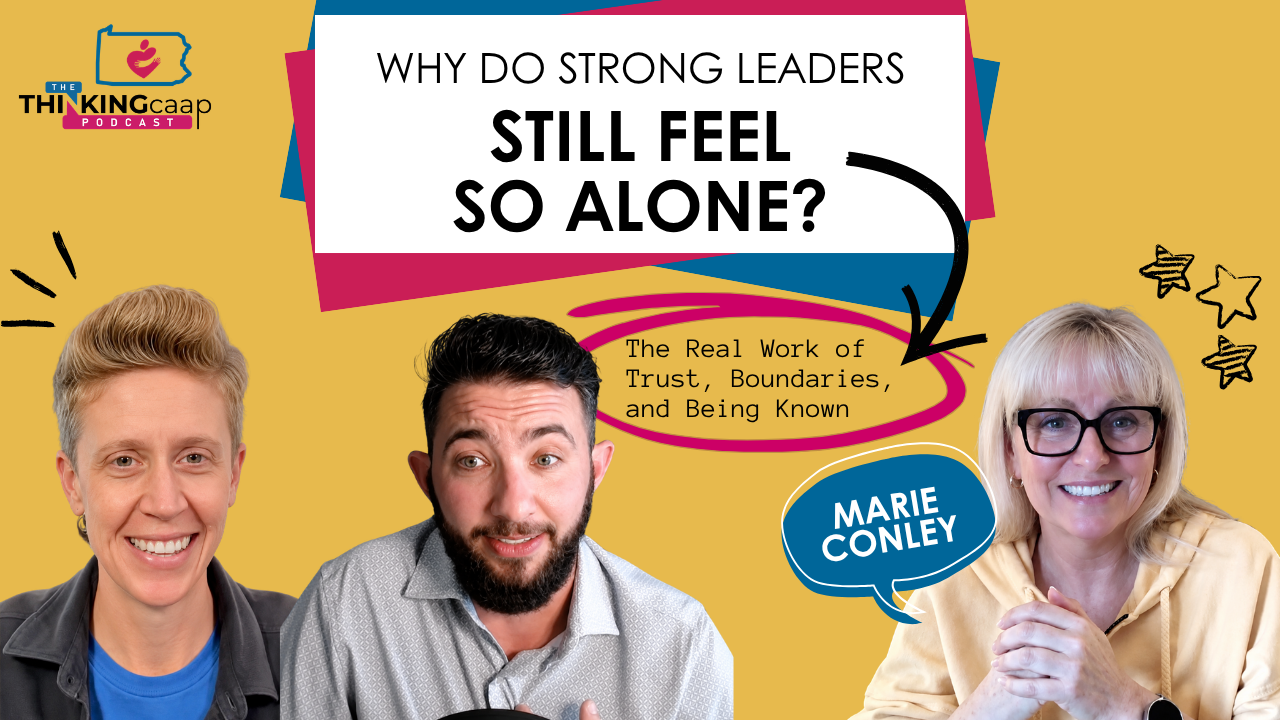
IMAGE DESCRIPTION: A yellow background with Heather Holloway and Beck Moore’s photos on the left and Marie Conley’s photo on the right. Between them are speech bubbles with their names. Above them is the headline question, “Why do strong leaders still feel so alone?” in all caps. Below that is a casually circled question with an arrow that reads, “The Real Work of Trust, Boundaries, and Being Known.” There are stars and exclamation points in the background.
Thinking CAAP Episode 38 Highlights
[00:00:00] Introduction to Marie Conley
Beck welcomes Heather Holloway back to the Thinking CAAP podcast and introduces Marie Conley.
Heather highlights Marie’s work in leadership, workforce engagement, communication, empathy, and rare disease advocacy.
[00:02:22] The HR Anthropologist Lens
Beck introduces Marie as an “HR anthropologist.”
Marie shares how her nonlinear career path shaped the way she observes people, leadership, and workplace culture.
Her experience across government, nonprofit, corporate, healthcare-related, and higher education spaces helped her understand both strong leadership and the hidden dynamics inside organizations.
[00:06:36] Finding the Treasure in People
Marie describes herself as both an HR anthropologist and HR archaeologist.
She looks for the strengths, personalities, and potential that often stay hidden in workplaces.
Her motto: make big things happen by making the little things count.
[00:09:32] What Great Leaders Do
Marie explains that great leaders surround themselves with smart, capable people without feeling threatened.
Strong leadership is not about being the center of greatness.
It is about helping others shine.
[00:10:32] Intentional Connection as Leadership
Marie emphasizes that leaders need to slow down long enough to connect with their teams.
Simple check-ins, listening, and everyday relationship-building can strengthen trust and engagement.
The higher leaders rise, the more intentional they have to be about staying connected.
[00:12:56] The Value of Executive Support
Beck highlights the importance of strong administrative and executive support.
Marie reinforces that gatekeepers and support staff are often central to trust, access, and organizational success.
The conversation also explores how leaders can build trust, set expectations, and let go without creating confusion.
[00:17:00] Marie’s Rare Disease Journey
Marie shares how she became more comfortable talking about her health journey over time.
At first, she did not want to seem weak or be defined by her diagnosis.
She now sees sharing her story as a way to help others feel less alone and advocate for themselves.
[00:21:46] Diagnosis and Self-Advocacy
Marie describes years of symptoms, specialists, and unanswered questions before being diagnosed with Cushing’s disease.
She brought extensive documentation to appointments, reinforcing the importance of tracking symptoms and advocating for yourself.
Her story is a reminder to listen to your body and take your own experience seriously.
[00:25:42] The Point-Worthy Life Framework
Marie introduces her “point-worthy” framework.
Everything she does has a point value, including physical, mental, emotional, and intellectual energy.
This framework helped her decide what is truly worthy of her time, energy, and attention.
[00:29:25] Boundaries for Heart-Centered Professionals
Heather connects Marie’s point system to social workers, empaths, leaders, and human service professionals.
Marie explains that many people are spending more points than they actually have.
The framework gives people permission to protect their energy without guilt.
[00:32:05] Everyone’s Experience Is Real
Marie reflects that everyone’s pain and experience are their own.
Leaders do not need to compare hardship.
They can create space for people to feel seen, heard, and acknowledged.
[00:35:18] Nobody Has Infinite Points
Marie explains that emotional labor can cost as much as physical exertion.
Every relationship, responsibility, and purpose draws from the same internal reserve.
Protecting your points is part of protecting your ability to serve.
[00:38:43] Burnout and the Cost of Powering Through
Beck reflects on how exhaustion can eventually show up physically.
Marie adds that stress affects the body before it becomes visible.
The conversation reminds leaders that powering through has a cost.
[00:43:27] Creating Safe Spaces for Health Conversations
Heather asks how leaders can make workplaces safer for conversations about health and well-being.
Marie explains that leaders can model openness and normalize vulnerability.
Taking care of yourself is not weakness.
[00:47:22] Pre-Onboarding and Human Details
Marie describes how small details before someone’s first day can reduce anxiety.
Information like where to park, where the bathroom is, and what to expect helps people feel welcome.
Small acts of care create belonging.
[00:55:32] Two Types of Onboarding
Marie explains that organizations need both job onboarding and relational/cultural onboarding.
Employees need to understand the role, but also the people, rhythms, mission, and informal dynamics of the workplace.
[00:57:53] Big Wins Belong to Everyone
Marie emphasizes that organizational wins should recognize everyone who contributed.
Receptionists, janitors, support staff, and behind-the-scenes team members all shape success.
Shared celebration strengthens culture.
[01:00:00] Loneliness and Kindness at Work
Marie notes that many adults feel lonely or unseen at work.
Small acts of kindness and connection can meaningfully change the workplace experience.
Beck and Marie discuss simple systems, like thank-you notes and cards, that help leaders follow through on care and appreciation.
[01:05:08] Health Advocacy and Respectful Persistence
Marie encourages people in uncertain health journeys to listen to their bodies, document symptoms, and ask smart questions.
She cautions against relying too heavily on internet rabbit holes or unqualified advice.
Her closing encouragement: document everything, keep asking questions, and do not give up hope.
[01:10:22] Leadership CAAP and Closing Reflections
Beck thanks Marie for sharing her story, expertise, and “points” with the audience.
He shares that Marie will be part of CAAP’s upcoming Leadership CAAP program for emerging Community Action leaders.
Listeners are always invited to send questions about Community Action to info@thecaap.org with the subject line Thinking CAAP
The Thinking CAAP Episode 38 Full Transcript
00:00:00
What's up everybody, welcome to The Thinking CAAP. I'm Beck Moore, your host, and with me today has been a while, and to say that out loud, Heather Holloway, Holloway Media Services, what's up Heather?
00:00:09
gosh, I'm up. Hey, yeah, great to be back. Thank you so much. I am so thrilled to be here. Thank you, Beck.
00:00:14
course, my pleasure. I was laying in bed last night talking to my wife about something and I went, brr, brr, brr. And she said, did you just brr, brr, brr? And I said, yeah.
00:00:23
So that means
00:00:24
prepare a sound effect so I hope that's okay.
00:00:26
That's okay. That's totally okay. Really excited to be with our next guest as I usually am, but this particular individual I've known for a long time, we've worked together in different capacities, got to know through a mutual friend and so excited for our paths to cross again and to be working together intentionally on a couple of projects. And so we recently had coffee with Marie Connelly, who's our next guest today.
00:00:28
Surely fine.
00:00:51
And was like, you know, we need to get you on the podcast. shouldn't, haven't asked you yet. I should have asked you a while ago and she graciously said yes. So thank you, Marie for being here. It's great to see you. So today we're going be talking about kind of Marie's journey. And before we jump in, I'm going to have my fearless cohost do go through Marie's bio because she said such a better job when it comes to bios than I do. So Heather, take it away.
00:00:59
Thank you.
00:01:16
Thank you so much. Here we go, Marie. Today's guest is Marie Connelly, founder of Connelly Consulting, a WBENC certified women's business enterprise that helps organizations strengthen workforce engagement and leadership through communication, empathy, and thoughtful strategy. Marie is a certified HR professional who often describes herself as an HR anthropologist, can't wait to dive into that, studying workplace culture from the C-suite to frontline teams to understand what truly helps people and organizations thrive. Her work is also deeply personal.
After receiving a rare disease diagnosis in her 30s, she became a passionate advocate for resilience and meaningful human connection, founding the Connelly Cushing Disease Fund, and serving as co-chair of the Pennsylvania Rare Disease Advisory Council. Marie, we are so glad that you're here. Welcome to the show.
00:02:08
Thank you so much. I appreciate it.
00:02:11
Dot dot dot, she's also just a lovely human and a fun person to hang out with. So there's also that, I'll say that. My pleasure, my pleasure.
00:02:15
Well, thank you. I'll see if there's any surpass any bio.
00:02:22
It's nice to also have a professional voiceover artist that actually reads your bio. Put Heather in my pocket to read my bio at Speaking Engagement, that would be great. So we have a bunch of questions we want to ask. We're going to kind of start, I think, with the HR anthropologist discussion a little bit, because I know, Heather, that excites you, it excites me. I think all three of us are really aligned when we talk about the workplace culture pieces of this work. And so I think our first question for you is just really what kind of sparked your fascination with workplace culture in the human side of organizations?
And just talk to us a little bit about that.
00:03:03
Sure. Thanks again, guys. I'm just excited to be here. I think my career path has been extremely nonlinear. I started out in campaign work, moved over and worked in a governor's office for a period of time, did statewide campaigns decades, decades ago, then moved in to working as a consultant with some nonprofits. I became the director for the Children's Miracle Network at Penn State Children's Hospital, and then moved into my own consulting practice and have had such a great opportunity to work on so many different things. You know, I had the honor of working with Sue Paterno when everything was happening at Penn State.
And first they had hired me to start Coach Paterno's foundation. Clearly we all know what happened. And one of the things that the family, but specifically Sue, wanted to look at was the fact that there was this individual embedded within a college community and so many of his actions went unnoticed. And so working with an FBI profile, we became very much aware of, you know, a nice guy offender. And so... We worked with a pilot program with the Pennsylvania State System of Higher Education, and I worked with a group out of Massachusetts.
And then we worked with many male survivor groups and we created a child sexual victimization program for higher education. And what was really important there that this wasn't embedded within a legal or an HR. So it was just this online, you could click it. It was really about making sure that the people that are interacting with the community understood what the signs were. So that was impactful and changed my life. And then I had the great opportunity of working with Girl Scouts and with QVC and then things like working and creating a internship program for Hershey Entertainment Resorts.
And there it was based not only on the opportunity for students to come and work in the park,
00:05:24
but we created a 12 week leadership development curriculum working with Shippensburg. And I think that passed and I'm probably forgetting a number of different clients, of course, but it has allowed me such a unique opportunity to really observe so many different people in the workplace. Many times we talk about leaders and there are a lot of leaders who don't have titles. So I got to see those dynamics, which I always thought was fascinating. I think the great thing you have the opportunity to learn is sometimes what great leaders do, but also the kind of leader you don't want to be. I've served.
00:06:07
I'm sorry? No, I was just going to say big time. I think most of us can say the things that we know that we don't want to do and what we don't want to look like. Like I became a teacher initially because I didn't want the eighth grade English experience that I had to happen again. Right. Like I know the things that I feel so deeply are very much based on the personal experiences of the things that I never want to look like this person in what how they show up.
00:06:36
I think I took so many of those different observations. So many times, you know, I maybe didn't appreciate it at the time, but now when you're sitting at the back of the room and able to watch and listen and learn, which is what I always encourage younger generations to do, is it allowed me to really look at workplace dynamics. I kind of joke too that I am an HR archaeologist. because one of the things I really like doing is taking those observations.
And then when you bring it into a workplace culture, into team dynamics, there's so many sparks about different personalities and different people that, you know, maybe go unearthed or are walked over. And what someone may look like, you know, this is just a rock or it's just some dirt. I
00:07:14
you
00:07:33
I feel like a gift that I have is finding that treasure. And I think that's really a part of leadership, which is how do you make people feel seen and heard? And kind of what my motto has always been is that I try to make big things happen by making the little things count.
00:07:53
Hmm, because they do.
00:07:54
Yeah, big time. I know when we work together on a project, Marie, even our interactions, think, you you've, you've what you said there, right? Like you find the rock, right? And I think you also help to shine the rock, not to be too, you know, metaphorical here, but I think you really like shine the rock and make it better than what it realizes it is.
And I know that like even just the conversations that we had way back when, I don't remember how many years ago now, but you definitely gave me words of encouragement to believe in myself at a pretty dark time in my life that I don't even think you knew at the time what you were able to do for me. So I'll just say that out loud. I'm going to get teary-eyed, so I'm going to stop talking about it. I'm worried about something else, so I'm going to not go there.
But I just, want to make sure to say that out loud because it's definitely, I think, I want to reinforce that that's something that you're definitely, I know who have done for me and others. And I was a part of your leadership program with the student program that you talked about. And it was, I think that was such a remarkable thing to watch because you really created that program from the ground up and were really thoughtful about the things that you embedded within that program to help those folks.
be able to speak to people within the community right here from a pretty varied group of professionals that otherwise they would not have been exposed to necessarily, unless they were invited in the room. And the likelihood of being invited in the room is, unless you have a really great leader, is a rarity, right? So just will say that out loud too.
00:09:29
No, thank you.
00:09:32
Aw. Aw, I love that. Well, hey, listen to this. Back in 1998, I was a Herco employee. I worked for Hershey Entertainment. I was a costume character. And I wish I would have had your leadership program because I always felt like I was a leader. Captain of the softball team or, you know, first chair in band or whatever. So I'm curious, in all the experience that you have in all these different workplaces. What do great leaders do?
00:10:06
I think there's a lot of ways you can parse that. I think, of course, many people think about leadership and they think about the programmatic and side that has to be accomplished. I think first and foremost, great leaders surround themselves with better people and smarter people and aren't intimidated or jealous of that.
00:10:29
Amen, hallelujah to that.
00:10:32
I think the way we are in general as a society, there's so much emphasis on these small, short soundbites about greatness and people forget that it doesn't always have to be you. And I think, you know, back to your point before, if you can make, yeah, we're going with this metaphor, something more shot, like, something that was so dull and maybe no one even thought could sparkle. And you make that shine in a way that not that that person just feels good, but they then go and find that rock and they polish it. think to me, that's great leadership.
as hard as it is, I've been in the position, whether it's sitting on boards or working with clients that I've had the honor of being around some really strong leaders. I think there's so much pressure to constantly move, move fast, move hard. That intentional pause, and I joke because one of the facilitations that I'll work on is, I call it like red tape to red carpet, like really small.
00:11:36
sure.
00:11:56
inexpensive ways to make leaders create better engagement. Having a good administrative support that will help you be strategic in your scheduling. Like two hours a month that is non-negotiable, that all you're doing is walking around and seeing your team and not picking up criticisms, but just how are you? How you doing? Taking an opportunity to engage. And it doesn't matter. busy you are, you have to leave that strategic intentional time to connect. And I think there's so much pressure on bottom lines and ROI. But that to me is a very, very important part of leadership.
Yes, you have the budgets and you have the HR and you have legal compliance. There's all of that stuff. I want to believe that most people are in positions because they did that stuff well. It's about the connection that often gets lost the higher up you get. That's my observation.
00:12:56
Yeah. so shout out to Jennifer Lindsay, who's my executive assistant, who is just a phenomenal human. If you check out our LinkedIn, we just did a feature article about her and just the work that she does. you know, she is, I tell her all the time, I was like, I, you know, I would furlough me before I would ever furlough you to be clear. Like this place doesn't work without you. And I just had a conversation with her about, because I just, my schedule is just disgusting. I, there's not even, that's not even the right word for it. And so I, There's no time to do any work, right? Like I'm always in meetings all of the time.
And that is not a sustainable practice in a Zoom world. And so we had to, when I came back from the holidays and we just sat down to do her review and we started talking about kind of the next year and really like what I needed from her and what she needs from me. And one of the things I just said to her, I was like, we've got to get to a point where I'm not taking more than three meetings a day. That has to be the thing. And that sounds crazy. for somebody who takes probably 10 meetings a day, but I'm not doing anything well if I don't do that. And so she's just a phenomenal gatekeeper, right? Somebody who takes care of all the things.
And I wish I could bottle her because if you've experienced her support, know you've never, like, there's nobody like Jen. And we call her Scooby-Doo affectionately because if you can't find something, you say, hey Jen, can you Scooby-Doo this for me? And she does. So I say that with love and respect in my heart. She is like, just so good. So yes, I believe that in my core, experienced it on a day-to-day basis. And I'm not saying that-
00:14:32
Yeah.
00:14:33
What I love about that too is I think so many people underappreciate that role and it's something that I have always taught, especially when you talk about onboarding and new employees. And part of this came from the fact that I was 21 years old and I was the scheduler for the, at the time,
00:14:36
No, no, no.
00:15:01
the governor of the fifth largest state in the country. And to me, part of my success was creating those relationships with the gatekeepers. And people come and go, gatekeepers stay. And, you know, I was raised to be respectful. I was raised to be kind. But man. Being kind and seeing an administrative support team for who they are and what they are and what they do, and not being dismissive of a title, which I think so many people make that mistake. mean, shame on them because sometimes at the end of the day, if two people need to get in the door and one is dismissive and the other isn't, guess who's getting in the door? So.
00:15:49
Well, it's hard for it. It was hard for me to trust an executive. I mean, I've had a executive assistants, but I never really fully trusted them. But so I think it's also like people will have a tendency. I'm sure you've seen this. Like they have a tendency to not be able to figure out how to get out of their own way and how to utilize somebody. If you can set up the rules of engagement for what you need, expect, right. And slowly lean into those things. It's easier for you to let go. It's easier for them to understand the expectations. So they also don't mess up. Right. So like I think there's a means and way to do it.
can have a whole other podcast about that. honestly, we probably should Heather, so hold me accountable to it. All right. I want to make sure, Marie, to get into a little bit about your personal journey, because I think it's continue to evolve your outlook, if I can be so bold as to say out loud. So your professional work, as we've kind of talked about, centers around empathy and connection. And I think you're Like I said, your life experience has really deepened that. So you were diagnosed with a rare disease in your mid 30s. Sarah?
Can you share a little bit about that moment and really kind of how it's continued to evolve your outlook on this work?
00:17:00
Sure. So again, thanks for allowing me the chance to even talk about this. It's funny because I've just really come to terms and Beck, you were one of those people in my past that has made me feel more comfortable about doing that. And part of that was, you know, I didn't want to seem weak. I also didn't want to seem like some martyr because I'm more than my disease. But I also recognize with the help of really good friends that my journey can help others. And so when I was, moved over to the Children's Miracle Network and I noticed I was having bouts of bronchitis and pneumonia and strep and shingles.
And I was that weird person in the doctor's office that kind of got off on the fact that like when you got your forms, like I didn't have to check off anything, which I guess is like my karma because now I need basically like an encyclopedia to bring in with me. So I had a great PA who was, I'm going to give Mike Federer a shout out, who was looking at things differently and saying, well, you know, let's check this, let's check that. I then started noticing some other unusual things. We were trying to have a second child that really wasn't working.
I blamed my husband because I was waking up at about one, two in the morning and like staying awake, like awake and then just starting to work. I blamed him because he was snoring and blah, blah, blah. So I had that going on. I started gaining weight and I'd always been very health conscious. I mean, I love me some cheese fries and nachos, like, you know, still always work.
00:19:06
Who doesn't like some cheese fries, the way? Heather doesn't like cheese, which I think she's still a little bit of a pouty. But like the lack of cheese interest, just... Anyway, sorry.
00:19:21
I'm not even hearing this correctly. So there was, you know, I was noticeably gaining weight. Couldn't figure that out. I was training for a sprint triathlon after having done two half marathons while being sick because I was like, my God, I really need to figure out a way to stop gaining weight and fractured my hip. And I never even so much as had a sprain. And then just so many other things. Like I never really had acne and I was like a 16 year old at Target buying like everything. So I share all of this to say there were so many unusual symptoms, but why?
I was at the dermatologist for stuff, but like why would a gynecologist have any reason to think about like why I had strep and then why would a pulmonologist because I was having bronchitis and everything have to think that this has anything to do with this weird thing growing on the bottom of my foot. So eventually, jump ahead almost three years. My parents have come up for Thanksgiving. Four weeks later, I walked in their door at Christmas and my mom started crying because I had looked that different that quickly. So when this started in 2009, I was, you know, about maybe 130 pounds. By the time of my diagnosis, I was 205.
In addition to everything else. So my doctor or my PA was trying to do everything I had seen at that point, probably about seven different specialists documenting everything. which is a really big part of advocacy and your own being your own self advocate. And then he said, we're not cutting this, sent me down to Penn and went to a doctor down there. He was like, this isn't us. I think this is, you know, endocrinology. Like I had done for the last three years, look that up. And when I got in there in June of 2012,
00:21:46
I will never forget I had a five inch binder that I was bringing doctor to doctor and look, I was not a supermodel, but my vanity is what really got me diagnosed because like screw the strap, you know, the strap, my fractured hip, I, you know, of course wanted a second child, this thing on my foot, whatever, fix this weight gain. So that's what I thought I was there for. And when I was with her, She said, have you noticed any unexplained illnesses? Brittle bones, da da da da, and went through and I just started crying because everything she talked about, I had had.
And this was almost three years, a solid year of trying to get diagnosed in totality, three years of all these different symptoms. So while I was there, she said, I don't want you to Google this after you leave.
00:22:45
Which is so hard.
00:22:47
Yeah, this could be this very unusual thing called Cushing's. And I had had two dogs with Cushing's. So I was like, am I going to have to go to the bathroom a lot? Is my hair going to fall out? Like that was what happened to my dogs. Like what's happening here? And at the time, one out of every million annually were diagnosed with the disease. So pretty rare. You know, was confirmed diagnosis within two weeks.
00:23:03
Queen.
00:23:16
what it ended up being was a benign tumor on my pituitary that was sending messages to my adrenal gland to push out cortisol. So at the time of my diagnosis, I was drowning in cortisol and your cells need cortisol to do its job. every system was complicated, reproductive, know, bone brittleness, my hair was falling out, you know, every, I could no longer process and break down carbohydrates, proteins and sugars, everything. So There's no cure per se. The only way was to do a brain surgery. I did the brain surgery, unfortunately that failed. At that point I became even more sick, jump ahead seven weeks, had to have my adrenals removed.
So that caused a secondary rare condition called adrenal insufficiency. And then since there, it's the gift that keeps on giving. You know, there's actually, think more dollars that go towards curing Cushing's for dogs and horses than humans. So it's a long story, but it's not uncommon for a lot of rare disease patients. And, you know, through there, I had to live truly a whole new life. Subsequently, then I had to have a surgery to remove part of my lung. I had to have a hernia fixed. I had to have a full hysterectomy and bilateral oophorectomy. I've probably been in and out of the hospital over 50 sometimes.
Some of those are hospital stays as well. And again, my parents raised me to be kind and empathic, but this created, I joke that I wish God could have been more subtle, but I am I'm really lucky because I live with no regrets. I also had to live my life very differently. I call it living a point worthy life. I couldn't really figure out and I remember, I can't remember her name, Patty, Maddie. One of the, I remember when she, when you guys were interviewing her, there were so many similar things that she had shared as well, but in the way that she looks at life.
00:25:42
But it was very hard for me to share with friends and family how I needed to live my life. And so everybody kind of understood the Weight Watchers, you know, point program. And so like everything has points. I had to learn through some really hard trials and tribulations that everything that I do as a human now has a certain level of points. And it's not just physical, it's also my mental capability, my intellectual capability. You know, when someone's like, don't worry, you're, you know, you're adrenaline will pick in. Nope, no, mine doesn't. Now, I'm like, you're wrong, but gotcha.
You know, things like this, when I talk about being point worthy, something like this is like 10 points for me. I only have 20 points a day. So this forced me
00:26:41
you
00:26:42
to live a very point-worthy life. It's made me have to make difficult decisions about what is worthy of my points and how many things in my life did I give points to that weren't worth it. It's allowed me to reevaluate at different times when my son was younger. He was younger when all of this was going around or happening. My points at the end of the day had to be for him. So therefore everything else had to be altered. Now he's away at school. You know, my points are important for my family, but most important for my clients. And I don't mean that, I mean it because I love what I do.
And I want to make sure that whatever I do, I'm giving my very best of, but it's also forced me. I think in a very intentional and I'm a very grateful person that what is in my life now is point worthy. And, you know, even my friends and Beck does it too, like, I hope this isn't taking too many points or I don't know if this is point worthy. But it's also forced me to have to let go of some things in my life, people and things that didn't protect my points. You know, it wasn't like an intentional conversation calling someone and being like, you know, protect my points, peace out. But it's that extraction. And it's a litmus test for me.
You know, I'm sorry.
00:28:13
want to make sure to say thank you for spending some of your points on this discussion because I think it's so important for people to understand and I think for people to hear your journey because there's, I mean as we were talking about before we hit record officially, I think there's so much intersectionality. I was just talking to Carlo actually about this this morning Heather, around kind of the intersectionality of who we are as people is so much more diverse and far more deep than what we really, I think, understand when we first meet somebody for the first time.
I just, think sometimes that's lost because we get scared about sharing a story, right? We get nervous for whatever reason. I you know, thank you for saying what you said about your vanity. You know, it's, I joke around all the time. Like I'm starting to lose my hair. I am, I don't like, I just started to transition into this person. that I finally recognized for the first time and now I've got dad bod and I'm losing my hair. And it's not the same to be clear, but I think there are so many pieces of all of this that I think are just important for people to hear and sharing your story. I'm just so thankful for your willingness to.
So I didn't, I'm sorry to cut you off. didn't.
00:29:25
And to add to that really quickly, this is so fascinating because you already said it, intentionality. I mean, you are so intent on using the points specifically on purpose and you're giving us permission, all the social workers out there, all the heart centered empaths out there that we are allowed to put boundaries up. We're allowed to put guide rails on our time and our energy. We're allowed to do that. And we don't have to face a near-death experience to get there. Listen to my friend, Marie. She is giving you the roadmap. So you said what, 20 points a day? Is that the scale?
00:30:07
It's funny because, again, just starting to do this and talking to Beck about it, I probably have given like five or six speeches now with different groups, leadership groups, because I've really transformed this into how I feel this is important for the pillars of purpose and empathy and energy. And I actually do like an exercise in there because I'm a very tangible person. for people to understand what their points go to. And I think as leaders that, you know, when you do some of these exercises, you're putting down on a daily basis. It's so funny. I had one person who came up to me afterwards and he said, I had 85 points.
And I said, okay, so now you have 20 a day. Where are they going? What are they doing? And it really forces you. And again, I don't want someone to have an eight hour surgery with two surgeons and four hands up your nostril and 12 holes in your belly to learn what I've learned. And I want to believe that I would have come this way, but I wouldn't have. think I was always, like I said, a good person, but this lens and this intention has forced me to be very strategic. And Beck, it's funny when you said something about your hair.
I think that's the other thing that's so important, not just with rare disease diagnosis, but everybody's journey is their own journey. Right. And I think a lot of times people try to say like, and that's why I think I had such a problem talking about my disease, because I didn't want someone to say, I know it's not as bad as yours, or I didn't go through what you went through, but what you went through. And I learned that. when I was at Children's Miracle Network because...
00:32:05
that the gift that I was given to watch families interact with these kids. And I remember you had some of the most extreme illnesses and then you would have a parent who was giving their son away on a stretcher to two doctors they didn't really know because they had to put in screws. And they were like, I know this isn't like everybody else. I said, no, like this is. Like everybody’s experience is theirs. I think, again, going back to leadership, how can we help people figure out that it's real and that they deserve to feel these emotions?
Now, I do think as leaders, too, it's important sometimes to make people realize through that lens of empathy that some people may be experiencing things in a different way. You know, and I when I work, especially with generational communications in the workplace and, you know, I'm working on a college campus right now. I think there is a tendency sometimes for younger generations to want to die on every hill. Right. Everything is an atrocity. Everything's an affront. And. You can only die on the hill once you can be bloody. You can lose a limb. But, you know, and I think that's part of this awareness to.
when people are dealing with their own things, whether it's a chronic illness, whether it's repercussions of symptoms that are coming from different drugs, everything's real.
00:33:43
Yeah. Well, pain is relative, right? Like I can't, I'm not in your body. I can't understand your experience other than what you tell me. And just like, can't understand my experience, right? Other, no, these absolutely. But I think that's part of some times we get into this habit of right? Like, which is, which is worse? you know, you, I, you shouldn't feel bad about this because I've had it this bad. And I just, that's, you know, I try not to cuss on the podcast. So won't say what I'm really thinking, but that's, that's crap. But it goes back to this empathy muscle that sometimes we don't stretch and we don't work out and we forget.
But I think the other thing about what you're talking about is also some of the ROI of relationships and boundary setting that is hard for me, I will openly admit, as somebody who experienced a lot of trauma and family dynamics. It's hard for me to set certain boundaries with certain people because or why I take the meeting sometimes with somebody who I know that there's not a lot of ROI there, but I'm giving my points. And so that's part of what I know for me and is important for leaders right now and particularly for those who work in human services more because the burden of the work is so heavy right now, more than it's ever felt.
I was just talking with a potential keynote for a conference we're going to be doing. And I just said, was like the level of exhaustion that I can feel in the room with these individuals. And so that question of How are you spending your points? What's the ROI, whether professional, personal, or otherwise, is just so important right now. So, so important.
00:35:18
Well, and especially with, as you just mentioned, you know, the groups that are in front of you, the clients, your colleagues, you know, all work has dignity and purpose. But I think what I had that I was forced to learn is that Being in a setting and feeling someone's pain or trying to help someone see the beauty of what they do can be as many points as me going down onto the Peloton and doing a 45 minute workout. I have to live that way or I end up in the hospital. And I've done that.
I mean, it is, have, I don't have the luxury of, you know, you healthy people who your brain's going to kick in to your adrenals and say like, just push out a little bit more cortisol to get me through. I don't have that. So it's almost like I'm in a car and I can only run on fumes for so long. And then it's called an adrenal crisis. And then I'm in the ER. And the problem for me is if I take too many meetings, if I do not, you know, every week, I look at how I'm planning my points, you know? And if I don't, and I share this in my remarks, is that it was very selfish of me in retrospect because I was trying to prove that I wasn't different.
I was going to be different than any other Cushing's patient with adrenal insufficiency. That's what the textbook said. They didn't know me and I can rock this. And the problem is I think sometimes when we push it, the person who felt it the most was my son because he was watching me crash and get rushed to the ER. He one time had to take me in while my husband was parking the car and I collapsed and I...
00:37:24
I didn't know this until he wrote his essay for college, but he was screaming. And this 10 year old, no one got me out of the foyer right away. You know, so I think sometimes as humans, as leader, we don't think of the ripple effects of every single time that we give. Because when I do my point system and when I talk to people about their point system, what is that thing? What is that person? What is that? Why? that needs to have your points and you need to protect those because whether you have adrenals or not, nobody has an endless or an infinity amount of points.
And so I try to weave that into everything I do, whether it's generational communications with empathy or whether it's doing my CliftonStrengths team building because... If I can take my experience and allow people to see their worth, the protection of their time and the impact it has on others, then maybe that's one of the reasons. I don't ever believe that God gives them something with each other's, but maybe it's the gifts that I've had before and how I can make this journey maybe a little easier for someone else.
00:38:43
Yeah, I I think that Heather and I both have talked about this before on the podcast and, you know, but we'll repeat again. think you can, whether you have a rare disease or not, you can think, oh, I can just keep powering on. I think I can keep powering on. think I can keep powering on. as people who represent, you know, I talked about two major injuries in a year, tearing my ACL, having to have a knee surgery, breaking my arm because of passing out in the middle of the night.
Like those things don't happen because You know, it was a reflection of how tired I was, how much I was forgetting to just like be intentional about just doing something really simple. You walk the wrong way because you've got your mind on 35 other things. You know, like it happens. Burnout is real and you can think you can keep powering on. I can do this for one more day, but something it all comes with a cost. And I think.
00:39:40
walking manifestation, not solely because of stress, but what cortisol does to the body. Every, because I was drowning in cortisol and that is exactly what happens when you are stressed. Whether, and you know, and that's the thing, people can think that stress is an external manifestation. It's internal before it presents itself externally. So every system in your body is affected by that stress.
00:40:14
Yeah. Well, and I think that, you know, I am going to somebody right now to work on just kind of trying to heal my mind, body and soul right now. And I think one of the things that she told me in one of my recent sessions was that you're somebody that leads with heart, regardless of whether or not, you know, you're fixing something in your house or you're helping a client work through something or whatever. And she's like, and that comes with a cost to your soul, literally. Right. So you're always pouring out.
And what's happening in your body is that your body's saying like, hey, tap, tap, you need to pour into you because you don't have anything to pour in anybody else. And I think that also comes with a choice about, yeah, I'm going to take this health follow-up meeting, or I'm going to get the test that my doctor said. Or like, I put off blood work for almost a year and a half, and then I finally got my blood work back. And they're like, your cholesterol's through the roof. Awesome. Yeah, there's some genetics playing out there, but that's also because of other health issues.
And so I just am continually having to remind myself that this all comes at a cost. And when you are somebody who, to Heather's point, you're an empath, you're an empathetic leader, you lead with heart, however you want to describe it, you're pouring more out than what you realize. And so if you find yourself listening and you're like, yeah, this really resonates with me, reach out to us. We're happy to put you in touch with some other professionals that do work in this space.
Because I think it's when you are really like servant leader, when you work in human services, there's so many of us who that's a reflection of kind of how we lead on a regular basis.
00:41:52
Well, and think you just touched upon to something that is, you know, a really important lesson that I learned and I try to share with with people is that importance of, you know, your own medical advocacy. I think, you know, as people who tend to feel things deeply and put a lot of, you know, I think a lot of us do not just, you know, the three of us today, but, you know, I was so dismissive. of my symptoms, like, you know, that's probably just because I'm a little worn out today. Or, it's probably just, you know, because I was around somebody who was, had a cold. Like you, you know, I blamed shampoo, shampoo on my hair falling out.
You know, you, you, because it's not unfit in your narrative and more importantly, with busy people, you're, the time that you need to dedicate to just get your blood work done. That is probably one of the most important things I try to explain to people is understanding and listening to your body because, you know, it's sending you the signal.
00:43:01
You only get one, right? You get one. You get one. And I may think that I'm Superman, but I'm not. Heather, I want to make sure if you have questions, because I know that we have a finite time with you this afternoon. And I feel like our conversation might go a little bit longer than what we have time with you. So if you have a question that you want to make sure to ask Marie, I want to give you the opportunity to.
00:43:27
I mean, this has all been fascinating. I want to jump in so much because I had my own health scare, you know, in 2022, which I speak on and it is exactly that. I just stressed myself out so much that I developed a physical reaction to this stress. And had I not contained it, I do believe that I was on a one way ticket to a heart attack. I believe or something or something. So, you know, and through a lot of mindfulness techniques through you know, reading and taking care of myself. I've been able plus medication. I mean, let's not be let's not fool ourselves because we're organic, but we're we also need tools.
So I use the tools and have come out as a better leader, a better wife, a better all the things. So and that and because of that, that was the origin story. That's how I live my life now. So so I so thank you for sharing your story. I guess the question
00:44:11
...
00:44:24
that is percolating here is, you know, how do we create the environments to make it feel safe enough for our colleagues or our teammates or employees to come to us if they have a health issue? I mean, it could be so taboo if they come if if somebody comes to a leader and says, hey, I'm not feeling well, I might have to go through this. That could be a job loss. So there's a lot of, you know, fear there. So how do we as leaders create that culture and environment to say,
00:44:51
creators.
00:44:54
Come on, you know, talk to me.
00:44:56
I think sometimes too, it's by example. I think, know, Heather, I've heard you speak about it before. The fact that you share your story means that it's okay to talk about it. And I think sometimes in the workplace, not think, I know in the workplace, you know, especially those of us that I think are like more of that Gen X where you went into the office sick. You know, you I always called the George Costanza that one episode where like he would park his car all the time and then sleep underneath the desk so that everybody thought he was the first in and last out.
And I think that very much for especially Gen X and a generation where, you know, we are all predominantly in more leadership positions. It's something that we need to learn from, especially Gen Z and even Gen Alpha coming up that mental health is real and taking care of yourself and having a balance in your life is not a weakness. so, you know, and then there's the balance, right? Like you need people to have that place of productivity, but also to, of course, and we're very lucky that there are, you know, federal and state laws in place to protect people that have disabilities.
But I also think, and I know, Beck, you had talked about this before about onboarding. think I'm a real big believer in a pre-pre onboarding where you, and it's my philosophy is a little bit like when somebody's great at what they do and then you promote them, they're great at that skill, they're not necessarily great at managing humans. I see sometimes in the workplace when they talk about mentorship, a lot of times, and this is where, again, I live, breathe, love CliftonStrengths. A lot of times you have people who want to be mentors that probably shouldn't be mentors, right? And that's where CliftonStrengths comes in.
So having somebody come in and have a mentor that is a good relator and can share that, look, we're actually a really good place.
00:47:22
If you're feeling uncomfortable about something, if something isn't feeling right, come to me. And I may not have the answers and I'm not HR, but I'm going to be able to make that connection. and by the way, here's where the bathroom is. And don't go to this vending machine. Always go to the one on the third floor. Those little things again, making big things happen by making the little things count to take away some of that anxiety before someone comes into the workplace where they're not. sitting at their desk because they're afraid to ask them where the bathroom is. So they're about to get a UTI, right?
So those little things make a difference. But I also think as a leader, having the ability to on a smaller basis, making people feel like it's okay for there to be a potential vulnerability, but vulnerabilities are not weaknesses. And that's That's a real cultural and generational shift too. I mean, I think we always talk about, maybe we're not allowed to talk about like DEI anymore, but I think one of the things that isn't necessarily acknowledged as much is the generational differences because that touches upon everything too. And I think that's a really important dynamic in the workplace.
And I think hopefully with small changes, the right mentor. It allows people to feel more comfortable about a learning disability, about an illness. I'm upfront with clients in the beginning to say, when I'm doing presentations, there's a lot of people who can do this without looking at their notes. I'm making the decision I'm going to have my notes here and I may refer to them. It's because I don't want to spend my points, waste my points memorizing something and not being with you versus I could memorize it, but then that's taking my points away from any personal exchange that I might be able to have at a greater extent. That makes sense.
00:49:30
We do something similar to what Brie Groff, a prior guest and author, does, which is to give people's favorites. We've adopted her user manual technique. The user manual technique, if you go to the episode that Brie Groff was featured in in October, I believe, we talk about this concept. And it's really kind of like... allowing when you have a new project team or a new team, you talk about the things that matter to people or when you show up at your best or right now at work, I'm showing up in this way or when I'm having a hard time, here's what you can expect.
Or if I don't understand something really just to better understand how we function. with the generational component, you know, one of the things that I talk about in my presentations is around being a generational agnostic because I hate this. you know, categorical boxing of people based off of one identity. And so I don't, but I won't argue is that of course, yes, there are generational differences based on lots of different things. But ultimately, what it comes down to for me is just ask people how they prefer things, right? Like you could have, guess what?
You could have a boomer that really understands technology better than me as, you know, a cusper between, you know, millennial and genetics. You know, it's not uncommon. we just sort of categorize people in these ways and we forget to just ask the question for crying out loud. Like, what would you prefer? A text or an email or a Teams message or Slack or whatever? Because every
00:51:04
Yep. And it's funny because my approach to and I know we've talked about my approach to the generational communications is it's not necessarily an age bracket, but it's understanding that there have been lived experiences for many people that are certain ages that come in that someone questioning or someone saving something. It's so like there was a there was a There was this young person who got so frustrated all the time because their boss always was so big on recycling paper and wanted to reuse everything and da da. And when we were doing this exchange, the person shared, I grew up with parents of the Great Depression.
We didn't throw away anything. And then I joked, I'm like, I still see because my mom see because my grandmother see. wrapping paper. I don't think I've ever reused it, but it's this, you know, like when it was a really pretty thing every Christmas, my Bob G and she had nine kids and like a bazillion grandkids every Christmas present, it was folding the wrapping paper and putting it to the side, you know? And so I agree with it's not necessarily the age, but these experiences that sometimes people are coming into. that's why empathy and kindness are so important, you know, so important.
00:52:32
Yeah. Yeah. mean, if you if you're to zoom out on my shelves, like I've got little things all over my shelves because they're just these funny little things that remind me of this moment. It's the same reason I get tattoos, right. They remind me of moments. I sort of look at them as right, moments that I am choosing to remember that are on my body or something that I save. And, you know, my wife is not a saver. And she's like, why do you still have this thing? like, well, that reminds me of this thing that happened in this time. But it's and it's because of how I grew up that I know that I do that.
it's also because of the generational influences that I have. So I far more reflect, Like kind of a child of the eighties than I do my millennial side, because the people that I spent the most time with were 15 and 16 years old. My aunt Becky and my aunt Susie, shout out to them. They're fierce listeners of the podcast. But they were children of the eighties. And so that's what resonates with me, which is very different than somebody that's potentially in my same age bracket. And I'm also just an old soul. come to appreciate it.
I want to go back to the onboarding conversation because I also think that, and Heather, I know that you have a time crunch, so I'm going to say thank you for being my fearless co-host for the time that I had you. I want to make sure to wrap up things with Marie.
00:53:46
Heather, thank you so much. It was great seeing you.
00:53:49
my gosh, the same. I'll see you around here, Central Pennsylvania. I won't take too many points. You have been a phenomenal guest. Thank you for all of your wisdom and for sharing your experience because I know there's a listener out there going through something and you gave.
00:54:03
hope. Absolutely. you. That means a lot. Thank you so much.
00:54:07
See ya. I know that we lost Heather as our co-host right now, but I want to make sure to just get to a couple more questions that I want to make sure. want to wrap back up into something you mentioned though about or go back into something they mentioned about onboarding because you and I have had this conversation before and I don't know if we've talked about it before on the Thinking CAAP, but this idea of onboarding I think is so mission critical to people and I think a lot of times like we forget that new jobs are one of the most high anxiety driving experiences that we can have, Like really have things, having a baby.
getting married, the death of a loved one, the death of a pet, buying a house, starting a new job, ending a job, all, know, placement of a child. All of these things are things that are big moments in our lives. But then for whatever reason, when we have new people who start with us because of all of the worldly twirly chaos of everything else that is happening, I think sometimes we just forget, right? Like, I just need to tell this person where do they, is there a fridge they can put their lunch? And for whatever reason, then on their first day, We show up and throw up and tell them everything they need to know for the next 30 years.
And they're just wondering, where do I get a pencil? Right? And so we've just forget the basic tools for them to accomplish the task we've hired them for. And now it takes three months for them to figure out just where is this one thing that if they had it on day one or heck, even on day two or the first two weeks, it would have been a game changer.
00:55:32
I kind of like to talk about it as if there are two simultaneous onboardings taking place, right? Or should take place in my opinion. One is the true work onboarding, policies, procedures, jobs, right? I also think simultaneously relying on, again, love, clifton strengths, and you can find those treasures. And I also think too, A lot of times we make the mistake in the workplace that we silo onboarding, right? The mentor for communications has to be someone in communications. The mentor in legal has to be legal, et cetera, et For this like second onboarding, it has to be somebody that embodies and aligns with the mission of the company.
and somebody that becomes. someone that your new team member feels comfortable going to. And again, where do I put my lunch? Like we get a lunch break, but do people really go out or do they stay in?
00:56:44
to
00:56:51
Do they eat in a room together? Like do they eat at the same time?
00:56:53
Right. What I'd really love to encourage is a me survey. And it is, what's your favorite candy? What's your favorite memory? Do you like pets? Do you, if you want to share, do you have a family? The little things, like if they love Skittles, how hard is it to stop at a store on the way in and there is a cup of company cup full of Skittles. Those little things that I like, and again, this is probably not a great way of saying it, but one of the things that I've always loved doing is I think I've had this ability to make certain people seem more thoughtful than they are at that moment. Not because they don't want to be.
It's that I can be a kindness whisperer. it goes back to the original part of our conversation. Life moves so fast. But, you know, it's been a horrible snowstorm and you have your team. that's going out at 11 o'clock at night and they're shoveling so they're ready to get to the parking lot the next day. That's their job, right? It's their job. But it was really cold out. So why not make sure when they come in, you're acknowledging that? A lot of times I talk about the fact that we tend to have large company wins and the message may go out to that team. everybody was part of that.
I remember talking to a municipal team and, you know, there was a big one in the parks and rec and I said, they said, Well, yeah, we did, we'd send an email to everybody in parks and rec and I said, the receptionist at the front door played a role, the janitor that cleaned up everything at night played a role, like, it's not taking away and there's a special time to do that. But big wins should be shared by everybody too. And I think
00:59:15
You know, that deviated a little bit from onboarding, but I think that goes to the importance of making sure somebody feels truly welcomed. You do that at your home. When you have a new guest coming to your house, you make sure that towels are out so that they're not like scrambling and opening up every single cabinet. You make sure that you've called ahead of time to find out like, well, what's your favorite cereal or do you like bagels? Well, we're talking about a workplace.
00:59:44
to be clear, I do, this is something I think about all the time. the people in my life that I keep the closest, this is the experience that I also received from them. it's, I appreciate this.
01:00:00
81,000 hours of your life will be spent in work or some work-related activity. 20 % of adults say that they feel lonely in the workplace. think it's 60 % feel that nobody in their workplace, no one understands who they are as a person.
01:00:26
I've been there. Or feel unsafe to share.
01:00:28
Yeah, can't we fix that just a little? And again, it's not, I'm not naive. I'm actually kind of cynical. I'm not expecting people to pull hands and sing kumbaya and skip out. kindness and helping to create situations where kindness can be seen to me is a no brainer. And that's what I...
01:00:38
Me too! Me too.
01:00:57
That's what I embody. That's what I try to teach, whether it's through CliftonStrengths or whatever it is. I just try to make sure that people know as busy as lights gets, you can carve out these moments.
01:01:10
Yeah. Well, I think the other thing that I want to make sure to say, and then I want to make sure ask, you know, one other question around your, your journey a little bit around your health. Cause I, know, for folks who might be struggling with this topic, I want to make sure to kind of before we wrap. But I think the other thing and goes back to Clifton strength finders for me, is that if you're not good at like the thing or like I'm terrible about actually sending something like I have really big ideas all the time. I want to do this. Right? Like, you know, I'm ridiculous, romantic, you know, have big things that I want to show my love.
I'm terrible about then, like I'll have the idea and the thought and it goes out of my head. And that's where for me, Jen, my executive assistant, I know that I can message her and be like, Hey, can you please send a gift from this person's favorites? Or can you please do a follow up email to make sure that this is taken care of? You know, because I just like, if somebody's done something, or I know they're having a hard time, I want to make sure to acknowledge that. your point, she makes sure that I deliver on those moments. If I didn't have her, I'm a far less thoughtful person because I just...
01:02:21
Wait, you're not an unthought, you're just the actual act of the thoughtfulness may not be seen. But I also think what a wonderful sense of self-awareness that you have to know that you've got a great one-two punch with you and Jen that it comes through, right? And I think that right there is part of the secret sauce for leaders. know, one of the things and you know that I'm a big thank you note. or follow up or just.
01:02:52
And your thank you notes are beautiful as a recipient of them.
01:02:56
Yeah, thank you. But it's to me, it's, you know, I just put something in the mail today for someone to just say, I'm thinking of you like, you know, and that to me is, is, is so important. Now, if I could, I probably would be putting 40 a day in there. So I intentionally carve out time. And it doesn't always have to be gestures. But, you know, sometimes for leaders, I say, you know, If you have that, and I do, I say if you have that relationship with your executive assistant, you have the note cards, you have them stamped or you have them ready to enter office. A sticky note.
That's all I'm asking you to do is a sticky note and put it on there and or jot a note down. And and your team will take care of the rest, you know, so.
01:03:49
I was doing an interview once with a guy for an executive director role that we were contracted to help hire for. And he said, said, what, when you think about your leadership style, what are some tactical things that you sort of write like embodying? said, well, one of things I do is literally give all of my new people a toolkit. So I go and I buy a little mini toolbox and I buy cards, like thank you, cars, congratulations, cards, like, you know, I'm serious. It's such a good idea. And it's so simple. And just like a mix of really like basic cards.
01:04:10
totally writing this down.
01:04:17
And he puts them in the toolbox, right? And he says, this is something that is a really, want you to own and do because they are matter moments that matter for people. And so he's sort of setting the expectation from the fair and giving them the tools literally in the toolbox, right? To be. And it's such a simple thing that didn't cost a lot. Right. And so I think if you don't have an executive assistant, there's still simple ways to do this. Right. But a leader, right? Like thinking about who.
01:04:33
I love that!
01:04:47
Like our start of all of our meetings, we always do like an icebreaker intro because we all work remotely. And so it's important to us because it's just another way to deepen our understanding of each other. But I'm not great about thinking about those. I have my go-to five and we've probably done them all before. So Mel on our team, like she's the, she's the person.
01:05:04
I spent time with her yesterday. I loved her. my god.
01:05:08
But she loves that kind of thing. And so that's part of what we've delegated to her to start off all of our team meetings. so she, every time, she puts the prompt in Asana on our project meeting so that we all know, here's what the prompt's going to be. So I want to make sure that to just ask the question, you talked about the difficulty in the challenge, some of the challenges of what you experienced for those people who are listening and might be in the middle of a difficult or uncertain health journey. Any advice that you would give them for finding their voice and advocating for their care that you want people to hear.
01:05:51
Sure. I think first and foremost is listen to your body. Right. And and we talked about a little bit before, but I think we have tendencies to just say, this is just that or I'm going to get to it next week or I'm going to wait and see if it happens one more time. Right. So I think that's really important. I think unfortunately our healthcare system, I'm not pointing fingers at anyone, I think it's a large, complicated knot. It's hard sometimes to get in to see a specialist, sometimes hard to get in to see your doctor. I think there has to be a respectful persistence that you need to have. think it goes without saying, you call someone.
or you call a doctor's office and you freak out, chances are you're not going, know, so remember that respect and that kindness part, that person answering the phone can't see your blood results.
01:06:57
Well, it's not their fault that you're struggling with the thing, right?
01:07:01
And document, think that, I think the documentation, if you are going through an undiagnosed journey is so important and you need to empower yourself. There are smart questions that you can ask. Don't go down, do not go down rabbit holes and that's easier said than done. I started a small fund, the Connelly Cushing Disease Fund, and it's to help patients and their families, but also it's to create early awareness for early diagnosis for medical professionals. And part of that is really important is to allowing medical professionals, again, very specific to my disease, to step back and look at things in its totality.
01:07:51
Thanks.
01:08:00
When it comes to patients, it's looking at the symptoms. Now, granted, I will say AI, I think it's gonna be a game changer and medical professionals are also acknowledging that. But it's so easy to go down some rabbit holes to think you can self-diagnose. The internet is amazing, but you just, have to be careful. And I think that, easier said than done after I'm diagnosed. really do your best to avoid going into support groups of diseases you think you may have and listening to administrators who are not physicians because some of these groups will be like, well, let me know your blood results. like that gets tricky too.
Sometimes you just want to feel seen and heard and know that you're not crazy. You know, you're sick, but you know, it's, it's a really fine line. So I think that's part of that journey. And I think. It's so hard to say this, but patients, especially with a rare disease diagnosis, there are over 7,000 rare diseases, but there are hundreds and thousands that are undiagnosed and rare by its definition is rare. So a lot of times these diseases are taught on one day of the second year of their residency.
So I think it doesn't help being a patient and knowing you're sick, but also to sometimes physicians, especially your RNs, your PAs, your nurses, you know, even sometimes your family medicine, they're not seeing these. So it's not ignorance, it's not malpractice, it's just the sad case.
01:10:07
that you have the bail block of having a rare disease. So I know that may not be as hopeful, but don't give up hope and document, document, document, document.
01:10:22
Well, Marie, I appreciate your willingness to, again, share some of your points with us today with our audience. I know that I always love talking to you. I you are one of my besties. So I'll say that out loud. Thank you. But I hope that I know that your message will resonate with others. And so for our listeners, this is not going to be the last time that you hear from Marie. If you're listening and your Community Action Association member agency, we're going to be launching something called the Leadership CAAP, which we started to talk about on social media. I'm excited to know that Marie is going to be a part of that program.
So more to come on that particular leadership program that CAAP is launching for new upcoming emerging leaders of community action, but really love spending time with you.
01:11:07
Thank you. Beck, this has been amazing and what you do and the topics you have and the way that you present it just feels very natural. And so I appreciate it. was nervous, but it felt great.
01:11:19
Well, thank you for that. Thank you for spending time with us, to our listeners. Thank you for putting your Thinking CAAPs on. If you want to find out more about Marie, we'll of course have the notes in the notes section of the podcast, but MarieConnellyConsulting, I believe, dot com. Thank you for correcting me, but we'll make sure that all of those details are in our notes for you. If you want to get in contact with Marie, looking for a speaker, can't say enough good about her work.
01:11:34
Connelly Consulting.
01:11:47
want to get in contact with her to have her come and talk to your organization, please email us at info@thecaap.org. And we're happy to connect you to Marie. Marie, thank you. find Marie on LinkedIn, connect with her, please. if, you hopefully we'll catch you the next time on The Thinking CAAP.
01:12:05
Thanks, Beck. Thanks, everybody. Bye.
01:12:12
Thank you for being a part of this episode of The Thinking CAAP. Check the show notes for resources and links to other episodes. And don't forget to subscribe and follow to be notified when new episodes are released. If you have any community action questions you'd like Beck, or one of our local experts to answer in a future episode, please email your questions about community action to info@thecaap.org. Subject line, Thinking CAAP.
If you have any Community Action questions you’d like Beck or one of our local experts to answer in a future episode, please email your questions about Community Action to info@thecaap.org — subject line: Thinking CAAP.