

Work Should Feel More Human
In this episode of Thinking CAAP, Beck Moore welcomes Bree Groff back to the podcast for a conversation about work, joy, humanity, leadership, and what it means to create organizations where people can feel more like themselves.
Bree, author of Today Was Fun, shares the core idea behind her book: work does not have to be something we simply endure. Instead, work can be understood as something that creates value for others and for the world, with joy and humanity built into the way we lead, communicate, and show up together.
Beck and Bree discuss one of Bree’s favorite team exercises: the user manual. By answering simple questions about how people work, what they value, how they process stress, and how they prefer to be supported, teams can build trust, reduce assumptions, and create stronger working relationships. The conversation also explores how leaders can adapt their communication, understand different support styles, and make work feel more human without forcing people to disclose more than they are comfortable sharing.
The episode also digs into fun, vulnerability, gratitude, and the small moments that can shift workplace culture. Bree encourages leaders to be “10 to 20% more human” than they think is safe, while Beck reflects on how CAAP’s team has built a culture of care through thoughtful gestures, humor, and showing up for each other during difficult moments.
From pajama meetings and turkey suits to micro-confessions and gratitude messages, this conversation is a reminder that workplace culture is not only shaped by policies and surveys. It is also shaped by the small, repeated moments where people feel seen, cared for, and allowed to be human.
Discover more about Bree Groff:
Website: https://www.breegroff.com/home
Instagram: https://www.instagram.com/bree_groff/
LinkedIn: https://www.linkedin.com/in/bree-groff/
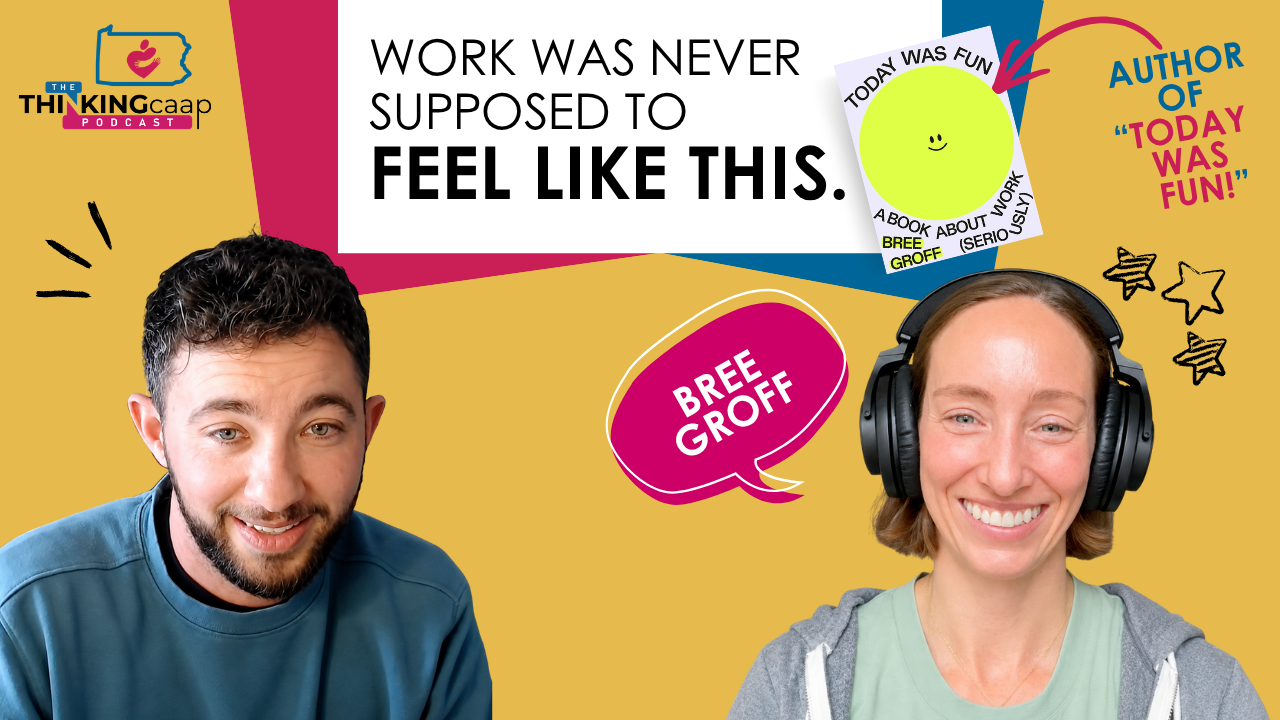
IMAGE DESCRIPTION: A yellow background. Heather Holloway is gesturing in a questioning face on the left, and Beck Moore is leaning in from the right with a smile. The headline is in a white box in the top center of the graphic, “In Membership Orgs… How do you keep everyone engaged?” There are small star and line callouts, with small excited text that reads, “Beck is our guest today!”
ThinkingCAAP Episode 41 Notes
[00:00:00] Welcome Back, Bree Groff
Beck welcomes Bree Groff back to Thinking CAAP. Bree is a returning guest, CAAP fall conference keynote speaker, and author of Today Was Fun.
[00:00:42] Why We Should Like Work
Bree explains that work does not have to be painful to be valuable. Mondays are not renewable, and people are paid for the value they create, not for how much they suffer while creating it.
[00:03:00] The User Manual Exercise
Beck shares that CAAP has adopted Bree’s user manual activity, a one-page guide that helps teammates understand how someone works, communicates, and prefers support.
[00:05:34] Understanding Creates Grace
Learning even a little about someone can create more empathy. What looks like resistance or disengagement may actually reflect different communication styles, boundaries, or processing needs.
[00:12:22] Talk to Think vs. Think to Talk
Some people process by talking. Others need time to think before speaking. Understanding that difference can prevent unnecessary tension at work and at home.
[00:14:42] Bringing More Humanity Into Work
Bree encourages teams to try being 10 to 20% more human than they think is normally safe. Fun and authenticity will look different in every workplace, but small choices can reduce the pressure to wear a “business mask.”
[00:19:42] Small Rituals Matter
Small rituals, jokes, and moments of playfulness can create meaningful cultural shifts. Leaders do not need a complicated engagement strategy. They can start with one small thing that feels genuinely fun or human.
[00:24:42] The Cost of Hyper-Professionalism
Bree argues that rigid professionalism often comes from insecurity rather than confidence. Strong ideas do not need to hide behind jargon, buzzwords, or a “business costume.”
[00:27:45] Personal and Intellectual Vulnerability
Personal vulnerability can be as simple as sharing a small real-life detail. Intellectual vulnerability means being honest about challenges, difficult decisions, and the realities facing the organization.
[00:32:55] Small Leadership Moments Leave a Mark
Beck shares a story about being brushed off by a CEO early in his career. The moment stayed with him, illustrating how even brief interactions with leaders can have an outsized impact.
[00:34:13] Fix What Is Wrong, Then Build What Is Delightful
Fixing culture problems gets an organization back to baseline. Leaders also need to build recognition, growth, camaraderie, fun, and visible signs of care.
[00:39:07] A Culture of Care
Beck and Bree share examples of the CAAP team showing thoughtful, personal support during difficult moments. Meaningful workplace care comes from knowing people well enough to respond like humans.
[00:42:40] Two Simple Actions for Leaders
Bree leaves leaders with two pieces of homework: share one small personal detail and offer specific gratitude.
A quick message telling someone exactly what they did well can stay with them for the rest of the day.
[00:45:09] Gratitude as a Habit
Beck reflects on thanking a former leader whose belief in him helped shape his career. Bree notes that people often need reminders that they are capable, valued, and making a difference.
[00:47:46] Closing
Beck thanks Bree for returning to Thinking CAAP. Listeners can connect with her through her website, Substack, book, and LinkedIn, and can send Community Action questions to info@thecaap.org with the subject line “Thinking CAAP.”
Transcript of Episode 41
00:00:00
What's up everybody? This is Beck Moore, the host of the Thinking CAAP podcast. And with me is someone I'm going to say is now a new fast friend, Bree Groff. Bree, what's up? How are you? I feel honored to be a new fast friend. And I am good.
00:00:15
Thank you. I'm going to say I have this dear friend, Lori, who when I first met her, I walked to her office. We were working together and I said, "Just so you know, we're going to be friends." and this is probably one of the most awkward way to make friends, but I've just really appreciated getting to know you. You're a former guest on the Thinking CAAP, but you also happen to be our keynote at our fall conference and so happy to have you back. Spend some more time together.
00:00:41
Thanks for having me back. Of course. So, I just want to remind everybody uh you know a little bit about who you are and what you do and what you recently did. So, if you're watching right and holding up your book, today was fun, which is a great read. It was a gift that we gave to all the folks who came to the conference and that was sort of the framework that you uh spoke to the group about and so if you can just remind everybody a little bit about the context of the book and what it's about.
00:01:06
It's amazing. I've read it a few times now. I am not ashamed to admit. Thanks. Okay. Well, I'm um for anyone who can't see me blushing just a little um a few times read is very high praise. And for anyone who has not read it, I hope you do. It's really about the existential case for why we should like work. There's lots of books out there that will make the business case.
00:01:34
Employee engagement drives performance and we need to grow our impact and scale our work and all of those things are very good and true. But what I think is most important is that we realize when we are in the thick of especially midlife in the thick of our work that one day we will run out of Mondays that Mondays are not a renewable resource that if we are only getting through 57th of each week we are not really honoring the very insultingly short time that we have on the planet. And so my solution to that is to reframe how we're thinking about work, not as something that is necessarily painful, and that's why you get paid because it's painful, but really as something that we do that just creates value for others, creates value in the world. And the pain is optional. You get paid for the value whether you're having fun or not. And so if we can reframe work as something to be enjoyed, we're starting from a much different place where we can think about how do we bring our humanity to our work, our creativity, how do we make sure it doesn't overrun our lives, and how can we create organizations where all of those things are true.
00:02:54
Yeah. Amen to that. I just Yes. It's something that I love to talk about. But it's something that the books that I really resonate with me from a business perspective, the podcasts I listen to, right, the people that I have in my personal life, all something that those folks all believe deeply. It's something that we talk a lot about at CAAP. I know many of our agencies talk about, but just cannot say enough good about this book and our conversations that we've had since I've gotten to know you a little bit.
00:03:26
Thank you. Thank you for putting it out there in the world because I think it's something that is deeply deeply needed. And as a matter of fact, I will call out that on uh our team at CAAP, we've done the user manual. Yay.
00:03:38
activity now lives in our SharePoint. So for those of you who don't know, Bree, you want to just speak to that a little bit. I know it's something we've talked about before, but Sure. Yeah. It is one of my favorite exercises that immediately makes your working relationships better. And here's how it goes.
00:03:55
You create a one-pager for each person in some sort of shared document like a Google doc. And on each person's page are a series of questions. They tend to fall into a few categories. So questions about like who is this person? So that the first question might be who are the people or animals most central in your life? There's questions about what you value, what you value on a team, what you what you like about your work. And then there's also questions about how do others quote unquote use you? So I call it a user manual almost like you're a blender. Um not to be dehumanizing but because I think it's funny. Uh but you know you look at the blender user manual like why guess at all the buttons? You just go to the quick start guide and be like here's how I use this. And so
00:04:40
similarly right so for a human it's just helpful to to hear from someone like when I'm stressed here's how you can help. Now, some people want you to come right up to them and say, "Oh, you look stressed. I'm so sorry. What can I do to help? Do you want to tell me about it? I can take something off your plate." And for other people, they're like, "Please go. Please go away, my cubicle, Room cube, whatever it is."
00:05:05
Yes. Right. And why should we guess the difference? You know, obviously, these are things that you can intuit it over time and working with somebody, but why why should we wait? And so, instead, can we answer these questions for ourselves and each other? and then as a team share our answers, learn from each other's answers. And it's a great way just to accelerate a team cohesion, understanding, humanity within the team. Oh, and for anybody listening, you can go to Breegroff.com/user-manuals and then there's a free template for you. And this is actually something I've been putting in my uh employee kind of workplace culture management coaching trainings that I've been doing. I have, you know, your book front and center, a couple different slides link in there.
00:05:54
So, just know that I'm shameless promoter for you. Yes. Thanks, Beck. You can give me some royalties later, of course. Yeah.
00:06:03
Um, yeah. The way that I liken this is, you know, ultimately it's a lot harder to not it's a lot harder to to not get along with somebody if you if you know them a little bit, right? It's easier to give grace if I just understand a little bit more. I usually use the example, right? Like if my neighbor doesn't take out their trash and I don't know my neighbor and I'm like, why are their trash cans always overflowing? And then I find out maybe my neighbor has, you know, an ability challenge where they can't literally they just can't get out their front door. But I didn't know that because I never took the time. And now suddenly I find myself taking my neighbor's garbage to the curb for them because I know they can't do it, right?
00:06:42
Like there's just simple things that I think that this creates and just getting to know people just a little bit. I think you talk about it in the book, right? working with somebody, you shouldn't find out five years in that, you know, they have a dog and how important that dog is to them or, you know, something that they're going through in their life life, right? Like we should try to create that space where people can just talk about the things, you know, the good things and the not so great things.
00:07:12
It creates cohesion. Oh, absolutely. Yeah. It's like the same idea of like it's really easy to like flick someone off and you're driving and you're like that jerk got into, you know, but you can imagine if someone magically dissolved your cars and you're just standing on the street next to someone, you'd probably say like, "Oh, hi. Excuse me." You know, instead of telling them they're number one when you're driving by.
00:07:40
I know. Um just anything to I think Yes. Um, and chapter two of the book is all about like how do we humanize the workplace such that we see each other as three-dimensional people who are just doing our best. Uh, it's good things can only come from it.
00:07:59
Yeah. I was just having a conversation with somebody not that long ago and we were talking about sort of right like when you talk to people about the best boss they've ever had and the worst boss they've ever had. And sadly when you ask that question the people have a lot more examples and immediately that person that you know was the worst boss we can see that person so much more clearly than the best boss. And so the other reason that I really love this exercise of the user manual is because I think it gets very can become very clear if you continue to work with people, right, and continue to get to know people about really what that past trauma is so that you don't it again because right like if you're a processor and I don't know that you're a processor
00:08:45
and I just see you shutting down every time we have a hard conversation, you know, I may assume things and or if somebody's trying to set a boundary with me and I don't understand right like the boundary they're trying to set it could potentially show up to a manager or a leader as insubordination but I don't think it's always insubordination I think it's trying somebody trying to set a boundary and they don't necessarily know how to set a clear boundary right and becomes complicated and so all of what you know that kind of context about that user manual I think to me very much allows for that from it sort of creates the framework for people to differently.
00:09:28
Yeah. Yeah. You know, there's so much leadership philosophy out there of, you know, be more of this or be more that, but really the best kind of leadership growth, I think, is can you take the time to learn about the people that you're leading? Because everyone's going to need something a little different.
00:09:46
You're right. Everyone's had different past traumas. I wrote this article um I think it was for Valentine's Day called like the five love languages of your manage. Um right like instead of Yes. Go ahead. Go ahead. No. No. Seriously. Love languages. If you haven't if you haven't read love languages there is very interesting context for how it's applicable in the workplace. Go on. I don't want to interrupt.
00:10:10
Yeah. Oh yeah. I mean maybe you leave the physical touch out of it just for HR purposes. Um, but I think I wrote about it specifically in terms of how do people want support and growth. Some people really love public praise. Other people find that totally cringey and makes them want to die and they want private praise. Some people want a lot of hands-on mentorship because that makes them feel cared for. Other people that feels suffocating and what they really want is like space and autonomy because that feels like trust.
00:10:44
And it's not to say that you as a leader need to be this sort of like, you know, hyper flexible everybody gets what everybody needs thing, but it's good to understand where people are coming from so that you can do your best to support them in the way that they need. Like that's part of the job of the leader is to understand what do people need from you.
00:11:06
A thousand%. I literally just last week did a training for managers and leaders and one of the things that I try to give some framework around is when it comes to being flexible sort of changing your approach as a leader which is so important even though it's difficult to do and I find myself still right like reverting sometimes to past ways that I would lead and manage but in the moments of really difficult times in particular right adapt for that person not for yourself as a leader or manager, that person adapting and asking somebody how they like to be communicated with or right like what do you need in those hard moments to me is the most pivotal time. So, and I tell people, right, like
00:11:53
you're not going to if you ask somebody like, "Do you would you rather an email? Would you rather a team's meet teams message? Would you rather a meeting in person or virtual to have a hard conversation or just like that kind of communication doesn't mean that every single time you're going to communicate, you're going to create the and individualize the communication, but in the hard conversation, right? If somebody needs to sort of write like reflect on something before you have the discussion, that's really important
00:12:20
It's really important. You just have to notice that like right even um even in my marriage. So I'm very much a verbal processor and my husband is not. So I'll be like and I was feeling this and then you know and he'll just sit there in silence for a few he's like a very smart person. So it's but he needs processing time and so I just have to learn to sit there and be patient.
00:12:45
Whereas my instinct is, well, why aren't you just like sputtering back at me the way same way I sputtered at you? And yeah, it used to be very frustrating earlier in our marriage and now I've learned like, you know, as they say, some people talk to think and some people think to talk and then sometimes those people marry each other.
00:13:07
Fair enough. The very first long road trip that my wife and I, my now wife and I, uh, went on, we were driving and it was a pretty long, it was like a 10, we're talking about like a 10-hour drive. So, we're talking about like, you know, a long drive and I'm just, you know, going on and rambling and had created, you know, a whole soundtrack for us to listen to, you know, very perfectly timed songs, the next thing to the next thing. That's just I'm a little bit of a planner when it comes to trips like that.
00:13:35
And at one point she just sort of leaned over and like put her hand on my hand and she was like, you know, you can just be quiet, right? And in past relationships or in past situations, like being quiet meant problems. And so I just I'm going to fill the silence with as much verbal whatever that I have to give. So I I feel that right like learning somebody's style and personal relationship is it's why love languages is so brilliant frankly.
00:14:01
So good. Yeah. Agreed. And also I do like that people find their ways to situations that use their strengths. Like you have a podcast and you're very good at chatting. So yes, but I am also very much an introverted extrovert. Like I still need down time. It makes me extremely tired to be with people all day long. But I also get energy from being with people, but it also makes me really tired. So like I can work a room like a boss, but then I like I've seen it. Thank you.
00:14:33
But then I need to like take a nap for a week or go do something that like just turns my brain off. Yeah. Yeah.
00:14:40
Yeah. Yeah. So, let's kind of dig into a couple other things here. So I want to kind of explore this idea a little bit and you touch on this in the book in terms of like the most, you know, tightly managed maybe corporate sort of experience to, you know, maybe a team like CAAP where we're all working remotely and then, you know, the team surprises me with like pajama meeting day, but they don't tell me and I have to go put on a turkey suit, which did happen, by the way. Uh you had a turkey suit.
00:15:17
I did have a turkey suit. Yeah. I went I had got got it for my wife's 5K for their turkey trot because if I'm going to be at a turkey trot on Thanksgiving morning, I might as well be dressed like a giant turkey. So they all had their pajamas on. I get on this meeting and I'm a little bit late and everybody's dressed in their pajamas and I was like, "Why didn't anybody tell me?" And they of course wanted to surprise me. So I went and put on a turkey costume and we had the rest of our meeting.
00:15:41
Best meeting ever. Yeah, it was. But right like there's a big wide spectrum from you know maybe the most sort of conservative attitude to the you know maybe CAAP team. Um and in instances where let's say that I'll use the example of my uh my uncle's business. He runs a landscaping uh company, snow removal company. They sell power tools, you know. So, a very different environment than what I'm working in right now. But to me, right, like and you touch on this, there's ways to do this regardless of the environment. And I think sometimes when you're talking about how to weave joy and fun into a workplace, people sort of write like, well, maybe at your place, but that's not going to work at mine. Yeah. So, can we talk about that a little bit and explore it a little bit?
00:16:41
Yeah. Um, you know, my usual go-to response is, well, I'll tell my response and then why it's my go-to response is try to be just 10 to 20% more human than you think is normally safe. So, this is not to say that if you work in finance, I recommend showing up in a turkey suit, right? Like, I mean, Um yeah, you know, like at best you'd be innovate, you like labeled the innovation person like or hope that you know, like, oh, that's so and so again. Um, right. So maybe in finance it's you're wearing kind of a fun sock that day.
00:17:25
The reason I think it's important is because no matter what industry you're in, human beings, like people want to feel like themselves. There's a cost to putting on a business mask every day. And frankly, some people have like they have to put on thicker masks than others depending on how far they are from like the normative business culture. So, frankly, if you're like a white dude in finance who likes sports, then you're you don't have to put on much of a business mask. But, you know, maybe if you're a woman of color who's doesn't want to be talking about football on Monday, then it's just like, oh, it's just a lot of performance to try and fit in.
00:18:10
And so, I just I'm always a fan of can we level set the culture, any culture, to be a little bit more inclusive of people just showing up as they are. So I try to model this in the way that like a lot of times I'll show up to meetings with wet hair because well I mean it is like a stand but it's also just convenient. Like a lot of times I'll exercise in the morning and then shower and then jump on a meeting.
00:18:37
And I try to model that. Look, I'm just as smart if my hair is wet or dry. And I don't want to sacrifice my exercise, my health, my sleep the night before for a blow dryer and, you know, putting on some makeup so that I look like what business thinks I should look like. Uh, I'd also point out too that like there are some industries that are highly respected that don't dress up. Like surgeons for example, right? Like surgeons wear scrubs because they're sanitary and they're comfortable, right? Like primarily because they're sanitary, right? They take them out of these little machines, they've been sanitized.
00:19:20
But you would never say like, "Oh, I want my surgeon wearing a suit." No, you want the surgeon wearing the thing that's going to enhance their job performance, right? Like you want them to be able to move and you want them to be clean. And so in any industry, it's like, well, what do you need to wear, you know? And and of course, like clothes is only are only one part of that. There's also the um like the rituals, like the pajama day ritual. And I think we all I try to hold on to the belief that everybody wants deep down to be a little bit more fun. It's just that some people have learned it's not safe to do so. And so to wrap back around what does it look like to exposure therapy ourselves into a little bit more fun? you know, like 10% 20% more playful.
00:20:12
Tell the joke at the top of the meeting that you saw on Instagram the other day, whatever it may be. Um, and then see if it inspires some people, too, because I think a lot of times it does. It's like, oh, that person is themselves like that that's magnetic and it's inspiring. And if you don't see that person in the room, my the question I always ask is, well, how can I be the person in the room for others?
00:20:37
Yeah, it's I think about uh when I was early on, one of my first jobs was I was a camp counselor. And you think about, okay, well, camp counselor is all fun all day, which sure, but it's also exhausting and you're think and you're, you know, which I love kids, but you know, when the 35th kid has asked within the hour, what are we having for lunch? should, you know, like I'm living in an episode of Groundhog Day. And so at one point we I used to do uh the song of the day over the walkie-talkie because even though we're all goofballs all day long, you also you don't have a moment to be yourself because you sort of got to put on this mask, right?
00:21:22
Because you've got to be on all day long for these kids and you have to be like this larger than life camp counselor to get them to go do high ropes, right? where they're climbing 50 ft up in a tree and you're trying to encourage them and you're on all day long and you get maybe two hours of a break and music to me is important and so you're also not really able to listen to music particularly your music depending on what your style is or isn't and so I would try to find a song that was you know appropriate for the five to 18year-old kids that we're counselors for and I would just do it's everybody's favorite time of day of the day time, right? And I would just put on a, you know, a song that was semi-popular at that point or maybe a throwback. And it was one of those moments that everybody sort of were like, if I didn't do song of the day, it was like something was wrong, right? Or there was an emergency.
00:22:18
But that humanizing moment for everybody was important. And it was something that was so dumb that I because like I think I was bored one day and I wanted to listen to music and I was just like okay walkie-talkie time.
00:22:33
Yeah. Well, what's so great about it? It was an expression of yourself of like what you thought would be fun and you know so often I think it's like the CHRO's and executive teams are like oh what structures do we need to put in place to increase employee engagement and you know it's like I just start with what you think would be fun. I don't it's like it could be any anything could be song of the day you know pajama meeting and so a lot of these things come out as like they're labeled as like silly or trite but I sort of take offense to all of those things like on behalf of all of those things because that's just somebody trying to take life a little bit easier and who couldn't use to take life a little bit easier and so it's worth experimenting. Even if it feels like, oh, this isn't deeply meaningful cultural change. Well, you know what? Sometimes a song of the day once a day is deeply meaningful change because it gives everybody that pressure release when you need it.
00:23:37
Well, so often, right, the really small thing and I tell people this anytime I present or train, you know, if you're sitting in that like this training that I did, right, it was seven hours. People are sitting in a room with me all day long. And so I start by telling people, look, I'm going to give you lots of tips and tricks. Just pick the one thing. Just pick the one thing that you're going to try because I guarantee that small incremental thing will create big change. And as you realize and add in the small thing, right? You're more likely to add another thing and another thing. You got to start somewhere, right? So you're not going to start with all the things. You won't be successful. So just pick the one thing. And I think that goes back to like it could just be an agenda. You ask people what they're looking forward to at work, what's, you know, what's getting them excited. Even just starting something that tiny, right, that starts to shift. Oh, we're going to not talk about just the ROI on this contract and what our KPIs are for this month and how people are feeling about right meeting their deadlines.
00:24:42
And I also I would think like I think I know a lot of times that hyper professionalism it doesn't come from a place of strength and intelligence and um you know care for the business. It comes from a place of insecurity. Like sometimes it's often actually in consulting the more junior consultants I see are the ones who are really throwing around those buzzwords, right? And I get it and there's no judgment there. But, you know, they're trying to demonstrate proficiency and especially in something that's like a client service, you know, like a consulting or maybe a finance, you're trying to be like, I'm smart.
00:25:23
Trust me, believe in me. But actually, it ends up doing the reverse, right? Like it ends up making like, do you actually know what you're saying? There's some research on this, too. When people overuse jargon, they end up reducing their perceived uh competence. Well, I think everybody also sorry, but everybody sort of glazes over like, "Oh, there goes Sally again talking about KPIs and smart goals and hanging fruit and how we're going to get the highest return on the mark bet like I haven't gotten. I don't I'm not paying attention anymore."
00:25:54
Yeah. And instead like the super smart person in the corner wearing some ripped jeans is like, "Have we thought about this?" And it's like the most it's like the thing everybody should have said five meetings ago but no one thought was appropriate to say. Um that's I think where all like that's the kind of confidence that we should be after the kind of confidence that we are feel comfortable to share our ideas that we have confidence in the value of our ideas and that they just aren't correlated with whether our pants have a pleat in them or not.
00:26:28
When I first started working there was an organization that shall remain nameless to protect the innocent and the not so innocent and I will never forget I got the employee handbook and it said hosiery required. Oh my god. And this wasn't that long ago to be clear but I read it and I was like what does that mean precisely? what I emailed my new manager who I hadn't met yet because I had been hired also from across the country virtually had never actually physically met the person and I emailed and I was like hey can you explain these points and I should have just known what I was getting myself into when I read that my gut was right I mean I did stay there though for 13 years and ended up leaving as a CEO and hopefully did a little
00:27:19
oh my god good, you know, as so I started right like Yeah. Yeah. and hopefully changed some of the culture a little bit for the good. But I will never forget reading that and it was just like, okay, this is going to be interesting.
00:27:32
Oh my god. You know what? I'd totally come with like panty hoes on my arms. Nailed it. Bare legs. But yeah. So let's if we can I want to I want to kind of dig into this a little bit more though because so a lot of times when I'm having conversations people particularly CEOs executive directors there's this conversation about sort of vulnerability that we end up inevitably getting into and this idea that you know I'm really not comfortable sort of like sharing too much about myself because to me usually because it's been weaponized against them at some point so there's this sort of fear but any thoughts around on that and or conversations you've had with folks when you've had these conversations where it's right like yeah, I want to do this, but I'm just not comfortable for whatever reason.
00:28:24
Yeah. Well, I think there's two different kinds of vulnerability. There's like a personal vulnerability and then there's like an intellectual vulnerability. So if we separate the two, the personal vulnerability, which it sounds like you're addressing um first is more about like I don't want to share the intimate details of my life and in order to be seen as human. And what I would say to that is there's such a spectrum, right? You can even start with I've got a dog. The dog's name is Jimmy. Jimmy's a bearded collie. You know, even these small things that to us it feels like, well, why would I share that? That's just not relevant to anybody. it. But it is right because Jimmy means a lot to you. Usually if someone asks to see a picture of your animal, you watch that person light up. They're you're like, "Oh, let me," you know, and then they're deep in their photos, right? So, it's a way of demonstrating a personal facet of your life, a form of or a part of your life that is driven by love and care and cuteness, which is, you know, often feels very different. And yet there's nothing that personal about it, right?
00:29:34
Like it's not that people have to disclose long past traumas, but there's like baby steps into that. And I will say the more that you can again sort of exposure therapy like I shared this thing and nothing bad happened the more you'll often find that actually made me endearing to people like people understood me better. You know, so often CEOs in particular, they sort of they're put on this pedestal where it's very easy to us them, the CEO, right?
00:30:12
Oh, the CEO just cares about numbers and profits and like of course they do. They're trying to keep the business afloat, right? That's their job. Yeah. But I think there's a way to endear employees to the CEO if a CEO can say like well one share some basic things about their life. It's just nice to know the CEO if it feels comfortable what city did you grow up in you know like do you have some siblings around? If it feels comfortable who do you live with you know which like maybe a little bit dicier for people but still nonetheless. Um do you have a favorite food? Do you have like a quirky thing about you? like a hidden talent, right? Or like, you know, I like dried mangoes on Tuesdays. You know, all of these things are endearing.
00:30:59
And I think it can really help too when you get this US them mentality because then it sort of opens the door to intellectual vulnerability, which is things like, let me tell you about the financial state of the business right now. Feeling brave enough to do that, not, oh, we're fine everybody, don't worry. And then whoops, we got layoffs later. But let me actually unpack what this looks like here. Like does everyone understand how we make money, where all of our money goes. Now you might understand when we're making cuts here, it's because I want to save this other thing. I had to make this hard call. And you may not agree with a hard call, but now you understand the stakes, right? And that's totally different organizational culture than what is the CEO doing? They cut this thing. They don't care. they're trying to line their pockets or whatnot. And so, in the very least, I think CEOs should and leaders should get on board with that sort of intellectual vulnerability.
00:32:00
And then if you can pair that with some personal, you know, just a little like I'm a human too. I put my pants one on one leg at a time kind of stuff, it just it goes a long way. And I would say it feels better. It feels better to be seen and known and not to be this Wizard of Oz. It's um you know, as they say, it can be lonely at the top. And sharing some of yourself is one way to allow people in.
00:32:28
Yeah, I agree wholeheartedly. I mean, I probably do this a little bit to a fault, but I think to me as somebody who doesn't trust people, you know, easily, it also creates it creates trust, you know, like it's I'm far more likely to ask a question of somebody who is a human than someone who is just always buttoned up all the time. I that former organization that I also just talked about I my very first all staff meeting I went and I had had a really remarkable CEO at a former organization. I talked about her on the Thinking CAAP before. Her name is Fran. Fran is an amazing human. Shout out to Fran. She's just a remarkable leader. And so I go to this new place. I've moved halfway across the country again. So I had moved out and then moved back, you know, but didn't know anybody at this organization.
00:33:28
And I walked up to the CEO and I was, you know, it's just really nice to meet you. I'm so excited about being here, you know, just excited to see what comes and, you know, thank you for thank you for the opportunity and she sort of like brushed me away and was like I don't have time to talk right now. Oh god. I know. Well, in that right like so I'm trying I'm also right like the low person on the on the org chart at this point. So and that moment I just very much has stuck with me for a long time. I think the other thing that I want to kind of talk about briefly and then I know we've got to sort of start to wrap up our time together unfortunately is this idea of a lot of times when you're starting the discussions with workplaces around we don't know what to do.
00:34:18
We know we have a little bit of a workplace culture issue, right? We've done the survey. We fixed all of these things and just people still, right? They're not happy. Feel like, you know, people are starting to burn out. We just don't really know what to do. And I try to explain to people all the time that, you know, starting at culture with just like fixing the problems is not it's not going to do anything, right? Because it's an expectation that you have some of the things that people are talking about in those surveys, you know? So, I don't know what your thoughts are about that, but I think it's to me it's one of the biggest missteps in trying to fix culture problems is just like, okay, we're going to start with the workplace culture survey.
00:34:58
I mean, it should do the survey to be clear, but yeah, there's also these other pieces. Well, yeah, there's definitely a can we fix what's wrong? Uh, which is a good thing to do. Um, you know, right strategy and there's also what can we make truly great and delightful strategy, right? Which honestly once you have some of those things in place, I think we've all had jobs or perhaps you an inkling of a kind of job where you had enough fun with the people that you were willing to kind of endure a lot of really unpleasant parts of the job or organization otherwise. And so sometimes it's what can we do to give somebody a little bit of delight? And this could look like a bunch of different things.
00:35:48
There's one way that I often advise leaders is just start with your own mindset. If you assume that not that work is hard and therefore we're going to endure it the best we can, but that work can be joyful and therefore we're going to try and squeeze some of the fun out of it. What does that look like? And maybe it's simply as a leader like what does fun look like for you? Can you laugh at your own jokes? Can you laugh at other people's jokes and take things a little bit easier? Then there's also like what are some of the things that you could do? Um there is a famous theory from I think the '70s called Herzberg's I'm going to butcher it maybe you know it herzogs Herzberg's somebody will correct me um theory of motivation which says there are hygiene factors in an organization and there are motivational factors. Hygiene factors are things like pay, cleanliness, and safety of the workplace. These are things that if they're bad, then fixing them gets you to average, to normal. But you can't make a workplace so clean that you're delighting people. You know, at some point you're like, the floors are clean, right? I can see my face. I can see my face.
00:37:05
Right. Yeah. Right. Um, so those things you want to take care of just in the way that usually if you're really being underpaid that feels like an assault on your value, but even at some jobs, even with great play, you're still like, "This is not worth it." So there's the hygiene factors, but the motivational factors are some of those things that make people shine and light up. Some of like the recognition, the mobility, and the growth, and the learning and camaraderie. And I'd say too, like a lot of leaders get overwhelmed by what program do we have to put in place to get some of these things? And I would say, can you start with a a simple daily delight that shows employees that you cared? Um, I live in New York and so we've got the new mayor, Mamdani, here, and he has a really interesting theory of change. A lot of which is like he's just started filling a lot of potholes. um you know things like one might argue like you can't make people so happy with lack of potholes but the idea is it was something tangible that you could feel like walking to work one day you're going to be like there was a pothole there yesterday and not today which is much different than putting together a five-year plan for like road reconstruction it's like no just go out there and fix the thing which also doesn't feel real right like it doesn't feel real yeah.
00:38:26
And so I think like in a workplace what are some of those things like you know it could be something like the pajama day meeting or it could be something really simple like um instead of your all hands you schedule it for an hour and a half instead you take 30 minutes and say hey for the next hour everybody please just go take a nap like go get yourself some ice cream like these little delights go a long way to showing just like in any relationship you know in a workplace relationship I see you I care about you and I just want to do something nice for you.
00:39:01
Yeah. Absolutely. We're going through some tough times right now in my house with my son and my team. I had to be off really suddenly a couple weeks ago to be out for about a week like completely, you know, some sort of surprise and off the cuff that we had to had to I had to be out and my lovely uh leadership team Erica and Georgia and Jen talked and my executive assistant Jen dropped off at my house just a basket of just like goodies like favorite things that I really like. um snacks that they noticed that I'm eating all the time and a Door Dash gift card because they knew that I probably was not taking care of myself and just probably needed to eat a good meal and it was just the kindest sweetest thing and it's that's I think an example you know like we try to do for each other all the time and be very thoughtful but what it has what you know these moments prove to me over and over again is just what we have tried to create and really intentionally continue to curate from a joy perspective and a comfort and care perspective when things are hard for each other. It just really changes the dynamic when you're having a hard day at work and knowing that you can talk to somebody is just it's different and it's just place.
00:40:25
I have to say for anyone listening also the CAAP team did this for me too. I had to share that my dog died a couple months back and I guess what I expected was any you know he's like oh I'm so sorry to hear that and then you carry on and then flowers and this beautiful like a stained glass wall hanging that said Charlie on it arrived and I it's hanging my daughter's room right now. It was just so just beyond what beyond what anyone would think of as like a cursory. We do this as society to be like, "Oh, I'm so sorry." It was like above and beyond caring. And the like the items themselves were of course lovely and what was behind them is like you and your team like took time to care. Like that's what we value. Like we value that the human effort that went into caring.
00:41:28
Yes. It's not performative, right? Like it it comes from a place of we are all working with humans every day and we're all tired. There's a lot of change that's happening in the world and we should make sure the folks that you know we're working with we want to make sure are taken care of. And if that's just a simple care and comfort thing like sending somebody their favorite candy on a hard day or right you're experiencing loss which all of our team has over the course of our time together in a lot of different instances and to us right like I tell people all the time like the death of a loved one is extremely hard. I put pets in that same category because they're part of our family. So I'm glad you got to experience that. I mean glad you got to experience the loss, but I'm glad you got to experience just a little bit of what we try to do for each other at CAAP.
00:42:21
Oh, it was so special. Yeah. Which makes you and you all so special. I mean, it's it's our team is a lovely group of people. Yeah.
00:42:33
So, on that note, anything else that you want to lift up? You know, I'll ask kind of the final question. If leaders listening, people who are aspiring to be managers, leaders in whatever way that shows up, whether it's on a board, in the community, right, or an organization, if they hear nothing else simple thing, right, to start doing today, which I know is a big question, but anything in particular other than listening to the Thinking CAAP and reading your book, of course. I mean, those are those are obvious. Um definitely yeah do those things.
00:43:11
Um two bits of homework for you is to offer something personal and then share some gratitude. This can be in whatever format. It could be in a team meeting or you just think of one person and DM them. Um the first I sometimes call a micro confession. So, even if you're writing an email, instead of saying like, "Hi, thanks for sending the report. I'll be in touch later." It's um, "Hi, my socks are drenched because it's raining today. I hope you're fairing better. Thanks for the report. I'll be in touch shortly. Bye." Right? It's like it just takes a half second to share something personal. That little micro confession. And that's a totally different vibe of an email, right? Like that's a human writing that AI did not soak its feet in the rain, right? So, one micro confession and then share one little bit of gratitude.
00:44:07
This continues to be just the highest I was going to say highest leverage. That sounds so jargony, but as high as leverage thing you could do, which is just shoot someone a text or a Slack, someone you work with to say, "Hey, you were so awesome at blank." Just tell them something they were good at. Everybody's got something they were good at. Just tell them. I guarantee you they're going to be thinking about it the rest of the day, right? Like they're probably gonna screenshot it and send it to someone, you know, a friend, put it in a little folder on their computer. They are going to be thinking about they're going to say, "That person out of the blue told me I was so good at, you know, public at speaking in our meetings or I was so good at organizing our project plan." Uh, you won't regret it. Takes two seconds and you're going to make their day. And then between those two things, it's showing a little gratitude and sharing a little bit of your humanity. It just those things get you if you do them repeatedly, those things get you most of the way there.
00:45:09
Yeah. Well, I was at a conference once and they had somebody from I think it was Harvard. God help me if it was Yale. Sorry Yale. Sorry, Harvard. But it was someone who had studied the science of happiness. That was her job. And one of the things that she pointed to, and I have my notes somewhere still because I've sort of reflected on this. One of the things that they said is one of the top 10 things that people do who are happier in general in life, they're they're show their gratitude for things, right? So even if it's just once a month, you sort of write like have a reminder in your calendar, gratitude day. It's a part of building a habit, right?
00:45:45
It is a part of changing your patterns of your behavior so that you start to do things more often like going back to the gym or right eating healthier or whatever but to practice gratitude on a weekly monthly basis if that becomes a habit I think it's I always try to be very thoughtful about that whenever I can it's not always come easily but I mentioned Fran you know for the first 20 years of my nonprofit experience after you know I worked with her I It's something that anytime I got a promotion, I called her, I sent her a text, and I just reminded her, right? Like, this is the influence you had in my life. And I just hope you know how much the things that you did for me really mattered because I wouldn't be here if it wasn't for you. Because she really showed me and her belief in me, which helped me to believe in myself. And she said, she's like, "I don't like I don't even necessarily always remember these moments, but I'm just so thankful that you have reminded me." Because at one point she told me, she reached out and she was like, "I just don't I know you don't know this, but I'm really struggling with what I'm going to do next." And you've reminded me about why this work is so important. And I'm so happy that that sort of moment came full circle for both of us, you know, that I was able to help her in some small way.
00:46:59
Yeah, we have to do that for each other. There's too much it's just too much imposter syndrome in the world that we all feel like you know we're talking about like what am I even doing? I don't know. I'm making it up as I go. No matter how senior you get people still feel this way and it's such a kindness to remind each other of the good things we do for each other that we are indeed smart and inspiring and making a difference for others.
00:47:27
It doesn't have to be that difficult, right? It can just be basic things. I think it's like have a thought, send a thought is my easiest way. Like I think something nice about someone and I'm tempted to let it go by and whatever, go make a coffee. I'm like, no, Bree, you have a thought, send a thought.
00:47:44
Yes. No, I think that that's very true. Well, I love spending time with you. Thank you for likewise joining me again on the Thinking CAAP. Appreciate you so much. if folks want to reach out, if they want to find you, bookstore near you, of course, but any shameless plugs that you want to do before we're officially wrapped.
00:48:02
Sure. Yeah. Uh, you can find my Substack. Um, best place to go first is my website, breegroff.com or breegroff.com. Uh, do sign up for my Substack, find the book, wherever books are sold. Uh, you find me on LinkedIn. Other than that, I'm trying a bit of a digital detox, but those places are pretty reliable.
00:48:26
Love it. All right. Well, thank you for joining. Thank you to our listeners, and we'll catch you again the next time when you put on your Thinking CAAP. CAAP out. Thank you.
00:48:39
Thank you for being a part of this episode of the Thinking CAAP. Check the show notes for resources and links to other episodes. And don't forget to subscribe and follow to be notified when new episodes are released. If you have any community action questions you'd like Beck or one of our local experts to answer in a future episode, please email your questions about community action to info@thecaap.org. Subject line Thinking CAAP.
If you have any Community Action questions you’d like Beck or one of our local experts to answer in a future episode, please email your questions about Community Action to info@thecaap.org — subject line: Thinking CAAP.