
Holding on to Hope with Brandi Fleming
In this episode of Thinking CAAP, Beck Moore and Heather Holloway welcome Brandi Fleming, Executive Director of Indiana County Community Action Program, for a conversation about leadership, service, responsibility, and what it means to keep holding hope for a community.
Brandi shares what has kept her rooted in Indiana County and how Community Action helps create pathways to stability and opportunity for individuals and families. She reflects on the increasingly complex challenges people are facing, from housing and food insecurity to employment, rising costs, and the many connected barriers that can make it difficult for families to move forward.
The conversation also explores Brandi’s journey from accounting and finance into Community Action leadership. She talks about the shift from CFO to executive director, the challenge of balancing strategy, outcomes, and dollars, and the leadership value she calls “strong kindness,” pairing compassion with accountability, boundaries, and strength.
Throughout the episode, Brandi offers an honest look at the weight and beauty of Community Action work. She shares what gives her hope, including programs that feed children and seniors, the power of helping someone take the next step toward stability, and the strength of a statewide network that continues to gather, collaborate, and push for change.
From client stories and leadership lessons to finding balance during heavy days, this episode is a reminder that Community Action is built by people who keep showing up, keep caring, and keep working toward a better future for the communities they call home.
Connect with Brandi Fleming on LinkedIn here: https://www.linkedin.com/in/brandi-fleming-a7866b359/
Follow Indiana County Community Action Program, Inc on facebook https://www.facebook.com/IccapofIndianapa or on their website here: https://iccap.net/
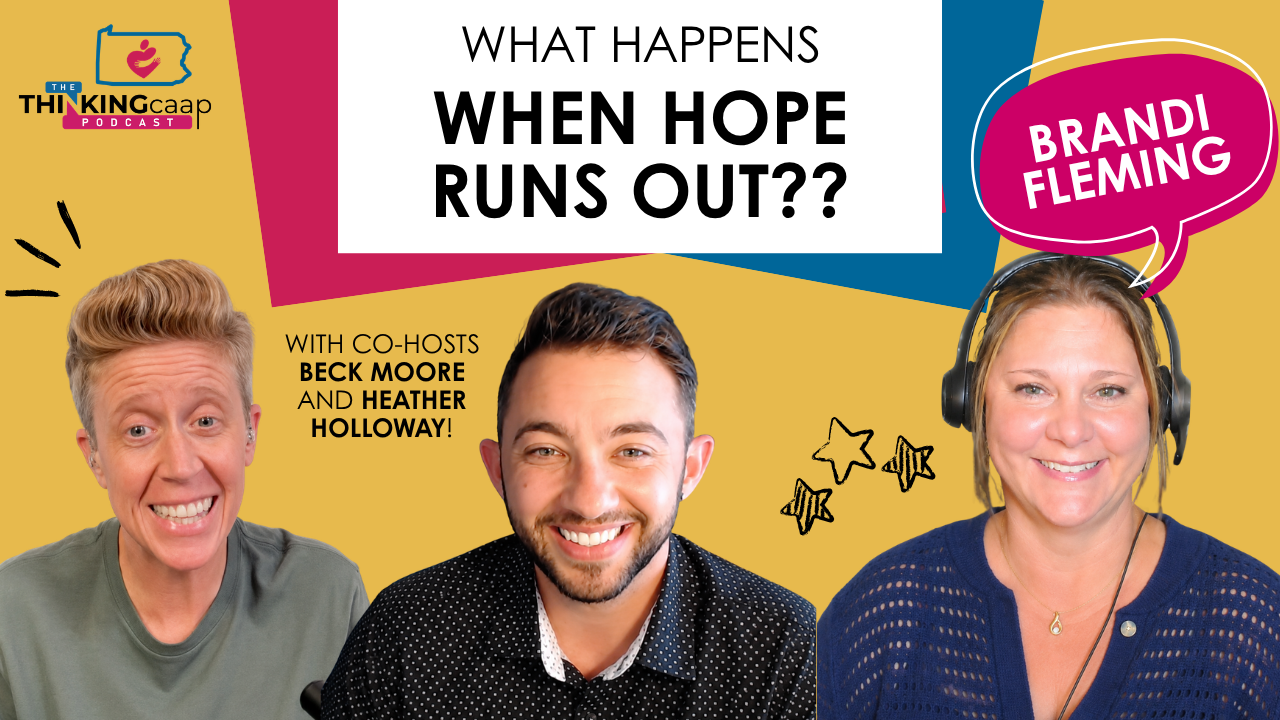
IMAGE DESCRIPTION: A yellow background. Heather Holloway is gesturing in a questioning face on the left, next to Beck Moore in a black shirt. On the right is Brandi Fleming. The headline is in a white box in the top center of the graphic: “What happens when hope runs out?” There are small star and line callouts.
Talking Points of Episode 42
[00:00:00] Opening Reflection
The episode opens with a reflection on the effort-filled moments that shape leadership, service, and Community Action work.
[00:00:12] Welcome to Thinking CAAP
Beck Moore welcomes listeners to Thinking CAAP with co-host Heather Holloway. Heather introduces the episode by asking what makes someone decide that the place they live is worth fighting for.
[00:01:04] Meet Brandi Fleming
Beck and Heather welcome Brandi Fleming, Executive Director of Indiana County Community Action Program. The conversation centers on leadership, service, responsibility, and holding on to hope on behalf of a community.
[00:01:55] Staying Rooted in Indiana County
Brandi reflects on being a lifelong resident of Indiana County, apart from a few years away. She shares that Indiana feels like a safety net, with small-town stability and access to larger cities nearby.
[00:03:49] What Community Action Means
Brandi shares that she wishes more people understood Community Action as a pathway to stability and opportunity. The work is about meeting people where they are, walking alongside them, and helping them access tools and resources to build a better future.
[00:05:13] Complex Challenges Facing Families
Brandi explains that the challenges facing families in Indiana County have become more complex than ever. Housing, employment, wages, food costs, and financial instability are often connected, meaning one form of assistance rarely solves the whole issue.
[00:06:50] Multiple Needs, Not One Need
Brandi describes how Indiana County Community Action Program uses a Community Needs Assessment to understand the full picture when someone reaches out for help. Many people know their immediate need, but the assessment helps identify connected barriers and possible supports.
[00:07:53] What Gives Brandi Hope
Brandi shares that hope comes from watching people shift from not seeing a future to reaching milestones, such as earning a GED, getting a better-paying job, saving money, and building stability. Those moments keep her coming back to the work.
[00:09:40] From Accounting to Community Action
Brandi reflects on her career path from accounting and auditing into Community Action. After starting a family, she wanted to do work that felt more meaningful and impactful.
[00:10:34] Growing From CFO to Executive Director
Brandi shares how her finance background helped her first enter Community Action as CFO. Beck notes that several former CFOs and number twos in the network have grown into executive leadership roles.
[00:12:24] Connecting Strategy, Outcomes, and Dollars
Brandi discusses the shift from focusing primarily on financials to balancing financial decisions with outcomes and impact. Beck notes that connecting strategy, action, and dollars is difficult but essential leadership work.
[00:13:38] Hard Leadership Decisions
Brandi shares that staffing has been one of the hardest leadership challenges. Burnout can make it difficult for people to keep seeing the work with fresh perspective, and sometimes leaders have to make hard decisions for the health of the organization and the people served.
[00:15:14] Strong Kindness
Brandi describes “strong kindness” as a value that guides her leadership. Kindness matters deeply, but it has to be paired with strength, accountability, and boundaries.
[00:17:31] Strengths and Challenges in Leadership
Brandi reflects that one of her greatest strengths is also one of her biggest challenges: being a situational thinker. She tries to give each situation its due course, while also recognizing the need for clear guardrails and consistency.
[00:19:37] Showing Up When Progress Feels Slow
When the work feels heavy or progress feels slow, Brandi comes back to the children and families served by her agency. Programs like Power Pack remind her that hundreds of children and seniors are being fed and supported, even when some challenges remain unresolved.
[00:22:16] Where the Desire to Help Comes From
Heather asks where Brandi’s passion for helping people began. Brandi reflects on always wanting to make people happy, pitch in, and see the impact of helping, beginning with small acts of support at home.
[00:24:01] Becoming a Doer and a Leader
Brandi shares that she always had leadership qualities, even before she expected to become an executive director. She describes herself as a doer and explains that doing big things became a natural extension of wanting to help.
[00:25:33] Michelle Faught’s Belief in Brandi
Beck and Brandi reflect on Michelle Faught, Brandi’s predecessor, who saw leadership potential in her. Brandi describes Michelle as faithful, deeply kind, and someone who believed wholeheartedly in what she said.
[00:27:03] Motherhood and Leadership
Brandi shares that motherhood has helped her become a better leader. The care, language, patience, and values involved in parenting have translated into how she leads and supports people in crisis.
[00:31:13] A Client Story That Stayed With Her
Brandi shares a powerful story about supporting a woman in crisis who had experienced domestic violence, human trafficking, addiction, and mental health struggles. Brandi stayed with her through calling crisis, going to the park, and eventually getting her to the emergency room for support.
[00:34:03] The Range of Community Action Leadership
Beck reflects on the wide range of roles executive directors play, from budget conversations in boardrooms to crisis support with clients. The work requires leaders to shift quickly between responsibilities with very little transition time.
[00:35:59] Advice for New Executive Directors
Brandi’s advice to a new executive director is to find the balance. She explains that leadership includes effort moments and heavier effort moments, and peace comes from learning when to keep giving and when to recharge.
[00:37:34] Finding Small Moments to Decompress
Brandi and Beck discuss the small, sometimes silly things that help break up heavy days, from tortilla challenge videos to strange Facebook Marketplace listings to team emoji conversations. These little moments can help people reset.
[00:39:18] What Surprised Brandi About Leadership
Brandi says one of the biggest surprises of becoming an executive director is how much people expect you to know. She reflects on the pressure to have answers and the importance of recognizing that it is okay to pause, look something up, and respond thoughtfully.
[00:41:58] Hope in the Community Action Network
Brandi shares that what gives her hope is the passion across the Community Action network. People know systems are broken, but they are still willing to gather, divide the work, collaborate, and keep making change.
[00:44:18] Leadership Inspiration
When asked about a leader or book influencing her leadership, Brandi shares that Beck has been one of her biggest inspirations. She points to his drive, humility, kindness, and genuine commitment to others.
[00:45:35] Closing Reflections
Beck thanks Brandi for her kind words and for the work she and her team are doing in Indiana County. He shares that other local nonprofits have praised Indiana County Community Action Program and encourages listeners to learn more, get connected, and support the organization.
[00:46:58] Podcast Outro
The standard Thinking CAAP outro reminds listeners to check the show notes, subscribe, follow, and send Community Action questions to info@thecaap.org with the subject line “Thinking CAAP.”
Transcript of Episode 42
Transcript of Episode 42
00:00:00
There is a life full of effort moments and effort moments.
What's up everybody and welcome to the Thinking CAAP. I'm Beck Moore, CEO of Community Action Association of Pennsylvania and joining me today is my sidekick, the CEO of Holloway Media Services, Heather Holloway. What's up, Heather?
00:00:25
Hey, everybody. So good to be here. Thanks, Beck. And I'm going to start today with a little bit of a simple question in terms of what makes someone decide that the place they live is worth fighting for. So not just living in, not just working in, but ultimately fighting for every day across Pennsylvania. You know, leaders are waking up and carrying the challenges of their communities with them, particularly those leaders that were within Community Action. You know, they're seeing families struggling to make ends meet, children who need opportunities, and of course the barriers that stand between where people are and where they hope to be. And despite all of those challenges, they keep showing up. And today's conversation is about and with one of those leaders.
00:01:04
So today we're joined by Brandi Fleming, executive director of Indiana County Community Action Program to talk about leadership, service, responsibility, and ultimately what it means to hold on to hope on behalf of a community. And so Brandi, welcome to the Thinking CAAP. We're so excited to have you. Thank you, Beck. It's a pleasure to be here.
00:01:22
Oh, this is going to be a good one. Well, no pressure, Brandi. No pressure. Yeah, I'll I'll try and get get it off my back. Just conversation among friends here.
00:01:33
Yeah, absolutely. Absolutely. Totally casual. I'm not being recorded or anything. Well, the real question will be is if you listen back to the episode, which I always encourage people to do. So, just we'll say that on, you know, up front before we get into the thick of it all. Please listen to yourself back. I promise you're going to be amazing. No doubt.
00:01:50
Yeah. We'll see. So, we were chatting a little bit before we got started around you being a lifelong resident of Indiana County, minus three years, had a little blip in a couple other places, but what what really has kept you rooted there? Anything in particular that you you can speak to or you want to you want to shout out?
00:02:10
I think that every single community has their barriers. They have they're good, they're bad, they're ugly. But the thing that keeps me in Indiana County and what always what brought me back actually is the fact that it's a safety net. Um, it's surrounded by a lot of different big cities as far as like Pittsburgh, a couple hours from Philadelphia. like we have those surrounding things that you can always enjoy and become a part of, but you can always go back to Indiana, which is lower crime, uh more opportunities for families to grow in safety as opposed to um being worried if your kid is on the street and they're going to be attacked by something or, you know, it just it just gave me a more sense of the community that I grew up in and I wanted to give that to my children as well.
00:03:03
Yeah. I will say as somebody who grew up uh, in uh a military family, a bit of an army brat, you know, we bebopped around the whole country. So, the longest I've ever lived anywhere is 7 years. And yeah, I went to, you know, a ridiculous number of elementary schools.
00:03:19
So, it kind of blows my mind to hear when somebody has been in one location for so long. I think it's really beautiful, but does not compute in my brain if I'm being completely honest. But I appreciate so much the sentiment now living in a place that I just really love and appreciate. You know, our kids walk to school. We're close enough to be able to walk to the local ice cream place. There's something. But we so I like to say we sort of have small town feel but with big opportunities all around us.
00:03:46
Absolutely. That's what Indiana is. Well, yeah. Oh, nice. So, you've been within Community Action now for how long?
00:03:54
Nine years. June 12th was nine years. Oh, congrats. Thank you. And so within Community Action, we've talked about this quite a bit on the Thinking CAAP on different episodes. When people hear Community Action, what do you wish they understood? I wish that when they heard the word Community Action that they really knew that we were about creating pathways to stability and opportunities, not necessarily just finishing actions for everyone, but we're trying to be the facilitators. Um it's about meeting people where they are. uh whether they need to have assistance with housing or employment, financial stability, we walk alongside them to provide the tools that we have, the resources that we have access to so that they can create a better future for themselves.
00:04:44
It's not this handout that people think all the time, the stigma that's wrapped around Community Action. It's about us wanting people to do better, finding the best version of themselves, thriving in the community, and making it a best the best place that we can all live. Yeah. Absolutely. I've heard people say it's not a hand out, it's a hand up. Exactly. Exactly.
00:05:08
I love that. A hand up. It's It's a hand reaching out so that you can get up. You know, we're in 2026 here, Brandi. I imagine that today's challenges were different than last year's challenges that were different than two years ago. So, currently in Indiana County, what are what are families facing?
00:05:28
Wow, that's a complex issue. Honestly, back maybe 2 years ago, 7 years, 10 years, 15, whatever demographic and time period you want to look at, they had their different challenges that they were overseeing. But the complexity of the issues that our families and individuals are seeing are, I think, the largest that I've ever witnessed. It's not just, okay, so we're having trouble finding a house because there's not a lot of affordable housing.
00:05:57
It's like, okay, well, there's not a lot of affordable housing, so I also don't have a living wage employment, and the grocery prices are also increasing, so I can't provide food on the table. And so it's this conglomeration of different issues all into this one that even by giving them one level of assistance, it's really not fixing the problem as a whole.
00:06:22
Yeah. Well, we talk about a lot that right when somebody comes to a community action agency maybe for food specifically, chances are if people are having trouble putting food on the table that there's other things that they also need. And so I guess a followup to that that I want to kind of explore a little bit is just that particular idea, right? So when you all have somebody coming to to have reach out or need a resource, are you finding it's one need? Are you finding it's multiple needs?00:06:50
It's multiple needs across the board. Uh we have individuals that will call in. That's why when we have a cold call or a walk-in, we do a community needs assessment with them right off the jump so we can see where they're at because most people walking in the door, they know what their immediate and emergent need is, but they don't understand what other needs they have until we kind of put it into a package and a perspective for them to just sink their teeth into and like, "Wow, I didn't even realize that if I maybe got some help with the housing assistance that I can't afford, I could do that by getting the food assistance over here that you have to provide. So it gives my budget a little bit of breathing room. Um so that's kind of where we are.
00:07:34
We do the community needs assessment, see what all barriers they have, what services we can provide, and then we reach out to all the community partners that we have in our back pocket to try and see collectively what we can do to fix that big issue. Yeah. Well, to the flip side then, right, in terms of the the concern, but what about the hope when you're looking at the county, when you're looking at maybe the people you're serving, right, the work that you and your partners are doing, what gives you the most hope?
00:08:06
The thing that I can witness um that really makes me keep coming back because as we all know, Community Action is not an easy profession. Um, it's dealing with crisis and devastation and sadness, but there is that other side that we get to hold on to. The hope seeing somebody make the shift to I didn't see myself getting a GED and now we've provided them a service and a resource that they can get a GED, they're getting a better paying job, now they're able to save in their savings account and then they can get a car and then, you know, it just that snowball effect. Excuse me. That snowball effect that seems to be a possibility is that that's what gets to me every single time.
00:08:54
It's you know Megan I think Sharie says this a couple other board members I've heard say this other member agencies right it's not everybody deserves to dream. Community Action gives people the opportunity to actually realize those dreams and maybe dream for the first time in their frankly in some in sometimes people's entire lives, right? Which I think is one of the most beautiful and hopeful things that our agencies collectively create.
00:09:18
I love that I love that we're talking about hope so much because you know as you're doing this work Brandi I assume that you're also being influenced and I'm just so curious about you know being in for nine years doing this work uh you know how how is that how has that affected you and h how does that uh affect your world view?
00:09:40
So my path didn't start out with Community Action. It began with accounting and auditing and doing, you know, the most practical thing that I could think of when I was a teenager that would always make me money because I knew I wanted a family and had to support them. So, I never found passion in auditing or accounting. I can tell you that right now.
00:10:01
It is the really sexy part of everything that we do. Oh, yeah. So, I was I was doing that and I was enjoying it as much as you can enjoy that type of work. But then I when I started a family, I was thinking to myself, "Oh my gosh, I need to do something that's more meaningful, that's more impactful, because my kids are going to look at me one day and they're going to be like, "Okay, is she just a bean counter or is she going to help people grow beans?" You know what I mean? And I just I just want to do something that means a little bit more. So throughout my journey, it was the CFO position first and that I felt like my accounting abilities could relate to that profession and then I could still be doing something to help and make sure that the agency was running and profitable in whatever capacity that we could be to continue the service. And then as I got the opportunity to do more in leadership.
00:10:56
It's hard. It's opened my eyes to the real possibility that sometimes I want things more for people than they want for themselves. And that's not necessarily even their choice that they don't want it for themselves. They just can't see it. They can't see the picture. They think that you're lying to them because it's just so much hope has been lost in their life to that point that they're just like another rock in the in the road in front of me that I can't overcome. So it's I just want to make sure to kind of make a a a statement about what you shared there about being an accountant. There's a few of you that have grown in your roles within the existing leadership of our network. So you,
00:11:43
Michelle Steiner, Teresa Sweeney, all former CFOs who are now serving executive director CEO roles. And I just think and there's a number of number TWS who have grown into the number one roles as well, kind of on a different side of the number two spectrum, right? So I think about Michelle Abbott, right? Um, uh, Trena from Blueprints, but there's a number of you that have really just grown in your experiences and I just love to see the growth of leadership within the organization. I think it's a beautiful thing when that happens. So shout out to you. Um because not every CFO can make the jump from CFO to executive director. It's it's a different set of you know skills in a lot of ways.
00:12:24
Yeah, it is. I um I'm thankful that I have been able to make that shift. I wasn't quite sure at first uh the barriers that the leadership role witnesses it's it's a lot because I'm always in the background thinking obviously of the financial aspect and okay what's the bottom line how does this affect us because that's what I did for you know six years prior but when I'm looking at okay yes not only the financials but what is the outcome results that we're looking for and how to we how do we match that with the financials And it's tricky. I see you do it all the time back when we're having our meetings and the finance committee. I'm like, "Yep, I feel you. This is rough."
00:13:09
Yeah. Yeah. But yeah, connecting strategy to action and back to the dollars is is tricky business, particularly people who are very number-minded, right? So, yeah, and we're gonna we're going to dig into that a little bit more in a in a second. But if we reflect on kind of the leadership decisions now being, you know, what I call, you know, the chief banana in charge, what what's been some of the hardest leadership decisions that you've had to make since you've stepped into your role? I think you've been in that spot now for two years. Is that right?
00:13:38
Yes. Two years in May. Um, I think I think the people the people that keep me here are also the people there. there's another sector of people that make it really difficult to do good work and that's a hard pill to swallow because my mind I'm logical I'm practical by nature and I just don't understand why people need to be hateful um and why you would want to put that negativity on something that is so positive and can be so positive. So, I think a struggle that I've had is um staffing. Staffing's been difficult because some people have been in this realm for a really long time. And you can get burned out as we've talked about at all of our different CAAP functions, it's a real thing.
And when people don't realize that they're in the burnout stage and they're putting that on clients or they're not able to see outside the box anymore and they're just kind of getting in that same mindset that the stigma around Community Action is, it's really hard to try and bring them out of it or tell them it's time to go. like you you need to you need to move on because the good work that you think you're doing it's not there anymore because you can't see it from a different perspective.
00:14:59
Yeah. Yeah. Stepping this I mean people right people is the big it's the biggest thing. It's the engine that keeps it going and it's what you need and and and they say it's hard to find good people and sometimes that's the truth. I'm curious Brandi with you is there a value or a set of values that guides your leadership? I would imagine where you started as a leader and where you are now little bit different. So I'm just curious is are there any values that guide your leadership?
00:15:27
I'm going to say that strong kindness is probably kindness. Yes. Um I thought originally that kindness was the key to opening all doors. Um because that just makes sense to me. But you have to balance that with strength and you have to balance that as a leader to express that okay I am willing to give you any kind of support out there and we're going to make the strategy together and move mountains as long as you're willing to do it with me and if you want to buck the system then I'm going to have to understand that my kindness will only go so far. You can't take advantage of that because then that's just negating the process. So, I think that that strength that you have to put behind the kindness is not always an easy task because I don't like to be mean.
00:16:22
Sure. And I don't necessarily think that it's being mean, but sometimes it really does come off that way when I just go into mom mode is what I classify as. I'm like, "No, we're not doing it that way."
00:16:33
Holding people accountable feels like you've got to be the heavy, right? It's the you've got to provide accountability. You've got to provide consequences. And that's perceived as I think more often than not it is perceived as being mean which I think what people forget sometimes is right like you are you're the chief banana in charge you're held accountable to the things that go well and don't don't don't go well and so you're also trying to protect the organization you're trying to mitigate risk right and that means making sure that people are doing what they're supposed to be doing and with I think you know as somebody who observes people and has gotten to know you a little bit. I think you have always struck me as someone who is approachable, thoughtful, and I have to imagine that your team feels similarly.
00:17:24
Fingers crossed. I mean, I've not heard otherwise for for what it's worth. Well, that's all good. Brandi's team, if you're listening right right now, show a little love. Show a little.
00:17:35
Yes, please. And and you know what? They do. They really do. Um, I have a really good group of people that are coming up underneath me right now. We've uh we've got a good plan. Um, but speaking back to the other the other point that I was going to make is that um I've realized as of late that my biggest strength is also my biggest weakness. My biggest strength is that I'm a situational thinker. I always give every situation its due course and I don't try and box it up into one particular thing. Um, however, in a leadership role such as this, it is really difficult to not find people that feel like you're discriminating against them because, well, this person, you gave this person this or this person it we need to keep it linear. We need to keep it straight.
00:18:23
And I'm like, but I understand that, but it doesn't always work that way. Like, there's a lot of gray in between that black and white. And so that's something that I've been challenged with recently that I have to really start working on and to overcome.
00:18:39
Yeah. Well, I mean, and I think it's okay to operate within gray as long as that's explained to people about here's here's what the black and white is, right? But here is the here is the area that's gray and we have to evaluate the specifics of any situation. And so I I I feel that I think as long as you've established the guard rails of what what is important from an equity perspective that you're never going to going to vary from, right? I that's I think that that's okay. I mean, it ultimately depends on, you know, the devil's in the details with that, but yeah, that would be my two cents.
00:19:13
I'll take them. Well, being a former CEO, sorry, I had to. I had to. So one one other question kind of along these same lines though about kind of just leadership and you know some of the the challenges etc. But what is really important to you or how do you continue to show up maybe when progress is feeling slow. When I think about, first of all, it always goes back to the kids for me. Uh because my kids are my heart. And so when I think about one of our programs with food insecurity and childhood food insecurity, our power pack program, that's the first one that I always look to when I'm having a rough day. I'm like, "Okay, but there are 800 students that were going home on Friday, didn't have any food over the weekend because they're not because their families were always negligent, just because there's too much month at the end of the money and they don't have anything more than eggs or something." So, I'll be like, "Okay, well, at least we were able to do that. I am secure in that. I know the bags went out and I know that they got them and 800 hungry bellies otherwise if it weren't for us are fed. And you know then I start going down the line and trying to think of all the different positives. You know 600 seniors and just rocking out those numbers making sure that I can collectively get that that picture in my head. Okay. So, yeah, maybe five people are really struggling and we are not helping them enough. And I don't know how we can, but those other ones, they're going to keep me going and they're going to keep me thinking that there's there's another route.
We have to find another route to help those ones that we're we're struggling with right now.
00:21:06
Yeah. No, I I feel that in my soul. One of the things I tell people in leadership and management coaching training is you got to think about what is your energy sucking thing and what is your energy giving thing in your work and how do you try to spend or balance your day so that you can get through the energy sucking things. Right? So you start with the really like energy giving then maybe you go into the energy sucking and then you go back to the energy giving. And if there are particular programs or things that really do get you fired up, even just once a month being able to spend time with that group of people or seeing that program can be so valuable to trying to, you know, stabilize and I think make sure I hate the saying, but make sure your cup is filled, right?
00:21:52
Like it's it is so so incredibly important. Yeah, it sounds like like your why, Brandi, of course, is helping people. And I'm curious, where does that come from? Where does that superhero power originate from? Did your parents give this to you? Did you did Indiana County, you know, are you a production of your environment? Like why why why human services? Why why are you helping people?
00:22:16
Um, it's always been a passion. It's been an underlying passion that I didn't really realized was something that I just had innately in me. I was always a pleaser when I was young. I wanted to make people laugh. I wanted to make them happy. Um, I thought I was going to be the next Jim Carrey, but that ship has sailed, unfortunately.
00:22:37
Oh, no. No. You can have a second act, my friend. Talent show at the next CAAP conference. Oh, yes. Stand up. You hear?
00:22:49
Yeah. So, I mean, I was if if something needed to be done or my mom my mom would need help with something, like I was always the first person to pitch in and I didn't know why. And it was because at the end of the day, I was like, "Okay, I can see the result. I can see the impact." It wasn't something that I was just like reaching up and I could feel that like okay so I wash these dishes for somebody and it saved their back from having to stand and do it and you know so it started at home with helping my mom and doing chores and things like that and then um I got with my husband when I was very young and I they just thought that I was the greatest thing because I was willing to help and I was just like but isn't that what people do?
00:23:34
Um, so then I was just, you know, known as that person and it just seems to be something that followed me that I didn't really capitalize on until recently. It's like this is really a strength of mine and I get a lot of good feelings and positive vibes out of it. And in this crazy life, you need as many positive vibes as you can get. Yes. Hallelujah. Amen to that. So, you touched on this a little bit in terms of your transition from finance into the executive director role and kind of some of the why. Did you ever sort of imagine that you'd be sitting in an executive director role?
00:24:12
Yes. Um I did I didn't think it was going to be this soon. Um but I've always had the leadership quality that has been whether I wanted it or not, it's been put onto me. It's like every every time you get into a job, you're like, "Oh, you're going to be a manager now." And you're like, "I just got here."
00:24:33
Yeah. It's like, "Oh, okay." But I mean, I think that you get you get rewarded for wanting to do all the things. Sometimes people will take advantage of it, but sometimes you get to see the other side of the reward and be like, "Yes, because I know I'm a doer." And if I'm a doer, then why not do big things as opposed to just like small little things? And so I did know eventually some way I was going to be in leadership, but I didn't know where that was going to be. And when I took the CFO position, I honestly thought that this was going to be like the lifelong thing that I was going to do, the finance, and just keep on keeping on with that.
And then um my executive director knew and she saw something in me and she said, "I don't want you to say anything, but when I retire, I really want to know if you would want to take this on." And I was like, "Yeah, sure." I remember one of my first conversations with her telling me I have a really rockstar smart CFO and that just how she really asserted just how much she believed in you then for what it's worth. I mean I she was adore her. She was just such a kind soul. I was sad to see when she retired but really excited to see you step into the position.
00:25:54
Absolutely. She was one of the most faithful people I've ever met. And I tell anybody that I know that she has there are some people that can um I don't know, they just exude it from them. And you knew that what she was saying, she believed wholeheartedly. Regardless of what it was, she believed it and she just helped you move in that direction. And it was really it was wonderful to be under her. And um so I was thankful to take this role and see where it brings us. I want to do great things here. And I think that our Community Action in our county needs to grow unless there's no there's no lack of need. So if we can be, you know, the catalyst to making things better.
00:26:39
And before we get going, can we say her name? Because we kept saying she and her. Who is this? Miss Michelle Faught. I will shout it from the rooftop. She is a wonderful lady. Oh, if if you were going to say it, I was going to say it, too. Okay, hear us, Michelle.
00:26:54
Yeah, I'm gonna send I'm gonna send her a a text message like, "Listen, shout out." Shout out. I mean, Brandi, how has this changed you as a person? How has this leadership role changed you as a person? Are are you carrying this into other, you know, home life? I would like to say that it's been the reverse that I that I have carried this into my home like like leading people from here would make me a better leader at home or whatever. But I think it's honestly the reverse. Um when I became a mom, I didn't always know that I wanted children. Um, and so when I started that family and realized what a treasure it was to be the mom and to be that important in somebody else's life, it just translated to here.
And so I see the things that I do that are helpful and the way that we run the household and try and instill the great values in our children, it easily relates to what you can do for people that are in crisis.
00:28:00
And so I think that my being a mother has helped me be a better leader. Honestly, I think I think to that end, right, like there's something that unconditional love when you experience it through the lens of a kiddo is very different. And it I think you're right. It does it does translate differently into helping people in a way that you know I'm not saying that you love all your clients in the same way you love your kids but there is this piece of you that you give up right to take care of others and people feel that when they when it feels really authentic but I used to say go ahead I was just going to say you can relate to them a lot better sometimes um when you're in a leadership role and especially in a higher position people will take what you're saying as like you're you're dictating or you're being condescending or it's it's wrapped around this negativity and it's just like when you're a mom and you have to know how you word something to a child to make it seem not that big, not that heavy. Um I think that it can be that same way. So you give the same vibe when you're you're talking to another adult because you've already witnessed how well that works in a situation that's a little bit tricky.
00:29:16
Yeah. And I just want to make sure to say right as somebody who is a nontraditional parent so right found my parenthood through non-traditional means I want to say that it doesn't I think my this perspective is not because of somebody who's had children of their own biologically but as somebody who has found themselves in a parent parental role and parents come in lots and lots of different forms. So if you're listening you're like well that's some crap just want to make sure to acknowledge that right? Like we all have influences over, you know, little folks in our life in different ways. That, you know, doesn't mean you're any less of a a parental figure than somebody who has had their own children biologically.
00:29:50
Absolutely. I'd go in my direction. You know, I'm a caretaker for my mom and my my aging mom. So, you know, I'm just caretaking for an older an older person. So, but you still use kind, gentle language. Oh, at least I do now. You know, I'm learning. my mother-in-law. Uh, and if she hears this, she's going to be like, "Brandi." Um, but my mother-in-law lives with us.
00:30:15
She, um, came about seven, eight years ago now. And having two mothers and different capacities, you know, mother to grandmother and grandchildren and your son and the whole shebang. It makes for an interesting household. And I would like to say that I am always using gentle language. Probably not what she would say. Um because sometimes you get like a little Yeah. You know, we got to get stuff done. You know what I'm saying? Like Yeah.
00:30:45
We all have really perfect versions of ourselves and then not so great versions of ourselves. Not always our best selves. Let's just let's just say that out loud. We can all accept a little bit of salt. Yeah. Oh, exactly. And I mean, Jess used to work here, she's one of my uh best friends, and she adopted both of her children. And it's it's no different when you decide to take somebody else on as your person in whatever capacity. Um it changes you innately. And take us there, Brandi. Take us there. You've you've been working in this in this in this field for a bit now. Is there any client story that stays with you that has just touched your heart? I would say the one that gets me um the most it was I was in a CFO role still at that time and there was a woman downstairs and she was in a bad way. Um she had domestic violence, human trafficking in her background and she was um struggling with mental health as well and she was a former addict and like you name it, she had checked all of the boxes for having a really really rough time and she came into the office and one of our liaison was working with her to try and get her into crisis because she was definitely in crisis in that moment and she was struggling um a a lot that day. And so everybody had gone and our previous worker called up and she said, "I don't know what to do here.
00:32:18
Like, I need somebody down here to help." And I was like, "Okay." So, I went down and we had a conversation. We called crisis together. Um, and I ended up taking her, she wanted to go, she would agreed after a lot of talking with me. She agreed to go to the emergency room because she really needed to get a support bed um for another rehab facility or something. She just needed it. And she wasn't going to go at first. Then we talked her through that. And on our way taking her there, she said, you know, I'm going to be in the emergency room and they're not going to let me have a cigarette and they're not going to let me have this. and she was just listing off all the things and she was starting to backtrack like I don't want to be in that situation anymore. I don't know if I want you to drop me off there. I said, "Well, what how about this?
00:33:00
How about we go to the choice that's right up the road, we'll get a pack of cigarettes. We'll get you a pop, whatever else you need, and then we'll go over to the park and we'll sit and we'll have a little bit of conversation. You can have those things and then we can go to the emergency room." And so this took I mean altogether probably I didn't get home that night from the emergency room until 1:00 in the morning. And the good news is that she benefited from it. She got a bed. It was 3 days later but she got a bed and she was able to go through the rehab process again. And um the last I had heard she had moved out of county and she had found housing in another county. Uh I have lost track of that situation but at that moment I was like okay there's a reason that I'm willing to stay here nine hours past my day. Uh so I I need to be here and this is what this is why it matters. Wow.
00:34:03
I think what you're and what you're speaking to is something that I I just want to call attention to that is within Community Action regardless of how small or how large an organization is that our executive directors the roles that they play can can range so dramatically from right being in a boardroom talking about a budget to working with a client in the capacity that you just talked about and it's it is both I think the beautiful part of what our agencies and our particular executive leadership does, our frontline staff does, but it also carries right this additional weight of having to jump from one thing to the next thing to the next thing.
And some days there is no you know a lot of times when you transition from thing to thing there's there's a little bit of a grace period which you sort of like allow your yourself to okay I'm going to get ready for this thing now that I have to go and do but so often in our work I feel like
that's not what ends up happening. It's like your desk phone rings or you get pinged on whatever thing that you work on on the computer and it's like you got to be downstairs right now. This person needs you. This is what's happening. And you're like you've got to go deescalate a situation suddenly. And so I think it's just it requires just a totally different type of of thinking that is uh it's it's a it's a lot. It's a lot to to carry.
00:35:24
It really is. I I feel that every single day walking in here. It's like, okay, I have a plan. I'm going to catch up with this. I'm going to do this. I'm going to do that. And then one phone call can change the entire trajectory. And I'm sitting there at the end of the day and it's already over time and I'm like, but I didn't get anything off my to-do list and it just rolls into the next day and some other crisis happens. It's really it does take a lot um to wear the hat.
00:35:53
Yeah, for sure. So to that end, as we kind of get to get to wrap up some of our questions here with you, if you could sit down with a new executive director tomorrow, what would you what would you tell them? Any any advice, thoughts, hopes?
00:36:12
Find the balance. Um, I wrote this and I will definitely not swear, but I wrote this on my passing CFO's picture frame that we gave her when she had to leave. And I truly believe it. There is a life full of effort moments and effort moments. And when you find the balance between the two of them, that's where your peace is going to be. And you cannot always give effort, effort, effort. There are sometimes where it's effort. I can't I cannot do this today. I got to go fill up my cup with maybe something alcoholic.
00:36:58
Um or just juice, whatever. But I just I need to I need to go and um find find an outlet, get um something that is the most ridiculous stupid thing that you can find out there. For me, it's tortilla challenge videos. Um they make me laugh so hard like tears streaming.
00:37:20
Um but find find those moments that you can just latch on to decompress. So, it's not going to take away the heavy, but it's going to help you recharge to get through every single day. That's always going to be heavy. Yeah. Rebalance. Rebalance. One of my favorite things to do right now is to scroll on Facebook Marketplace and look at the very weird things that people sell and what they're selling them for. It's amazing. And then I send them to my father-in-law who also thinks it's hilarious.
00:37:46
That sounds like a fun You're going to get a couple now, just so you know. Just I'm going to send you some of my my most favorites. Please do. Yeah. That that would be awesome because it's just that like making those little connections in the day, it just it breaks it up.
00:38:0
Yep. Yep. We had a team message earlier from one of our team members who said, "I just need something to break up the day. What's everybody's favorite or most used emoji?" And then everybody on the team just started sending random emojis and it was funny. It's just Okay, we have to answer that question.
00:38:15
Uh mine is like the side face. Oh, all the the Brandi, what about you? Well, I was told that I was not allowed to use the thumbs up anymore. Um, because that was very generic. So, I told him I was like, "Well, fine. If you don't like one finger, I'll give you another."
00:38:40
Well, now instead of just sending one thumbs up, you should just send like 10. Yeah. All of them. All of the thumbs. Yeah. Yeah. I'm going with the celebrate emoji. I just That's just me. The little party hat with the little fake hat.
00:38:52
That tracks for Heather. Yeah. Yeah. I'm the living emoji. Yeah. Am I just like I don't know. I love it.
00:39:02
Yeah. So, I'm just looking I'm looking at the last few questions here that we want to make sure to squeak out. Um, let's see. We've talked to you a little bit about hope. We talked about, you know, the story about why the work matters. What what surprised you the most when you became an executive director?
00:39:26
That's a good question. I think that the need to be so knowledgeable about everything. Um when you're a CFO, you're knowledgeable about numbers and people only go to you about numbers. Um when you're doing case management, it's about the counseling and case management. when it's, you know, you're siloed in a lot of different positions, but as executive director, people expect you to know everything about everything. And when you don't have the answer, it feels like you're less than, but then you put it into perspective and it's just like you can't possibly have every answer. Saying that I need to look back at that contract because I looked at 10 today is okay. Um, so I think that that was the most surprising thing to me is how much people expect you to just keep in your brain.
00:40:27
Yeah. Yeah. Yeah. I said to somebody recently, they asked me for a response on something. I said, "Well, you've had a long time to think about this. This is the first time I'm hearing it, so I need time to also reflect and try to think about what how how I want to react, what my reaction is. You know, I just don't know." And I think that's that's fair. It's okay to take a moment and breathe and recognize you may not be in the best headspace to answer the question and be thoughtful about what your response is. It's totally okay. As much as I like to think that I know everything, I also recognize that I don't always.
00:41:01
I know it's a hard it's a it's a hard concept to think that you don't know everything. But yeah, that's why we have hence my favorite emoji.
00:41:12
Uh if you're listening, you're not going to get that. So you got to watch this on YouTube. um anything in particular that you want to call out about just the the network and the nature of the power of our network and I think kind of leaving us with a moment of of hope and thoughtfulness about the future of Community Action on the whole. I know that you've been a regular at many of our our uh larger scale events like our I know you were just at the summit, you've been at conference a number of times and so I know you've gotten to know some of your counterparts and heard about some of their programs, but anything in particular about sort of the optimism that you see for the future of Community Action or something that gives you hope about the work that we do collectively.
00:41:58
I think that every time I go to any event or I talk about Community Action with on our on our bi-weekly meetings, it's the passion and the how do I say it? Everybody wants to make a difference.
00:42:21
Everybody's ready for change. Everybody knows that the system is broken and that there are still silos. But collectively, we are willing to gather together, which is not often seen in today's world. We are willing to gather together and say, "Okay, well, I'll take this part. I'll take this part and we'll reconvene and we're going to knock this out." And that's something that really makes the team value portion. Um, it's remarkable to see because so many people are individualized right now and they're focused on what's best for me or what's going to happen for me. And if we can as a group spread that community out through the actions that we're doing, um, I think that that that makes me happy and makes me hopeful and I love the group of people that we have together every single time.
It's fun and uh we do meaningful things while we're having fun. So that's always a treasure.
00:43:22
That's so so so so true. It's one of my it's one of the things I've missed recently because I've not gone to a lot of national events. But in the first two years of being here, it was something that really, you know, helped me better understand our work, but also just continued to drive me to work harder was the amount of time that I got to spend with so many of you and just be able to be with, you know, Community Action family and hear about the great things that you all are doing um in your local communities. And it's just it's a we are blessed to have an amazing group of organizations here in Pennsylvania that are just doing really remarkable things. To be clear, there are amazing community action agencies across the country, but the ones that I get to spend the most time with, of course, are my favorites here in Pennsylvania.
So, I'm just going to be a little biased to say PA is the best.
00:44:07
Can I just said, any last questions for Brandi that you want to make sure to ask? Oh my gosh. One last question, Brandi. Is there any uh leader or book that you've read or any inspiration uh that's that's uh influencing your leadership today?
00:44:29
Well, this is going to sound really corny and cheesy, so I'm going to preface it with that. But honestly, my biggest inspiration in my role since I took on has been Beck. Um I think that goosebumps.
00:44:46
He's just remarkable. um the drive that I see in him, it makes me want to do more. Um and just always being humble and kind like so I I honestly want to give props and shout out to Beck because he's always there for everyone and he it's not put on. So that's the kind of leader I want to be.
00:45:07
No, he totally makes me cry. It's true. Be is true, dude. It is. Yeah. Yeah, man.
00:45:14
Appreciate you so much. I don't even know what to say. My whole my whole stupid art. Oh, I think I needed to hear that. I didn't even know I needed to hear it. So, thank you for saying that. That's means so much.
00:45:27
I mean, every word. Thank you. I don't even I don't know if I'm going to be able to close this out now, Heather. I'm going to cry. Oh, well, I got you, brother. Listen, you've been listening to the Thinking CAAP podcast. I tried. I tried. I need to give it back to you.
00:45:40
Um, thank you, Brandi, for spending time with us. I really uh appreciate it. and not just because you said the very nice thing at the end that you said, but I really just do appreciate you so much. Um, I was just on a meeting the other day with a group of nonprofits and there were a number of folks from uh, Indiana County and I just want to make sure to give you a shout out because they just sang your praises and the agency's praises um, over and over again and just said and then there was somebody else on the call was like, I wish my local agency was like you all. I'm not going to tell you who that local agency was, but you know, they did they just said so many really great things about the work that you all are doing. So, thank you for the work that you and your team does. It matters.
I know that you're making a difference in your local community. So, thank you. If you want to learn more about Indiana uh County Community Action, um you can go to thecaap.org, go to um find an agency near you, look them up. You can email info@thecaap.org, but please please consider uh time, resources, whether that's uh you know, dollars or just simply spreading the word about the organization. Check them out. If you want to get connected to Brandi to learn more, we're happy to connect you. But thank you so much, Brandi, for spending time. Heather, always good to see you and hope everybody checks us out the next time on the Thinking CAAP.
00:46:54
Thank you both. Thank you for being a part of this episode of the Thinking CAAP. Check the show notes for resources and links to other episodes. And don't forget to subscribe and follow to be notified when new episodes are released. If you have any Community Action questions you'd like Beck or one of our local experts to answer in a future episode, please email your questions about Community Action to info@thecaap.org. Subject line Thinking CAAP.
If you have any Community Action questions you’d like Beck or one of our local experts to answer in a future episode, please email your questions about Community Action to info@thecaap.org — subject line: Thinking CAAP.