
When Success Stops Feeling Like Success: Breaking Free from Automatic Striving
In this episode of The ThinkingCAAP, Beck Moore welcomes Kara Hardin, founder of The Practice Lab, for a conversation about achievement, identity, burnout, and the patterns that shape how we lead.
Kara explores how the same strategies that help high achievers succeed can also lead them toward exhaustion, especially when they try to control themselves enough to control the world around them. Through stories about work, parenting, running, fishing, striving, and self-improvement, Beck and Kara unpack what it means to lead from purpose instead of protection.
This episode invites listeners to reconsider success, pay attention to what makes them feel alive, and remember that there is no single rulebook for a life well lived.
Connect with Kara Hardin on LinkedIn
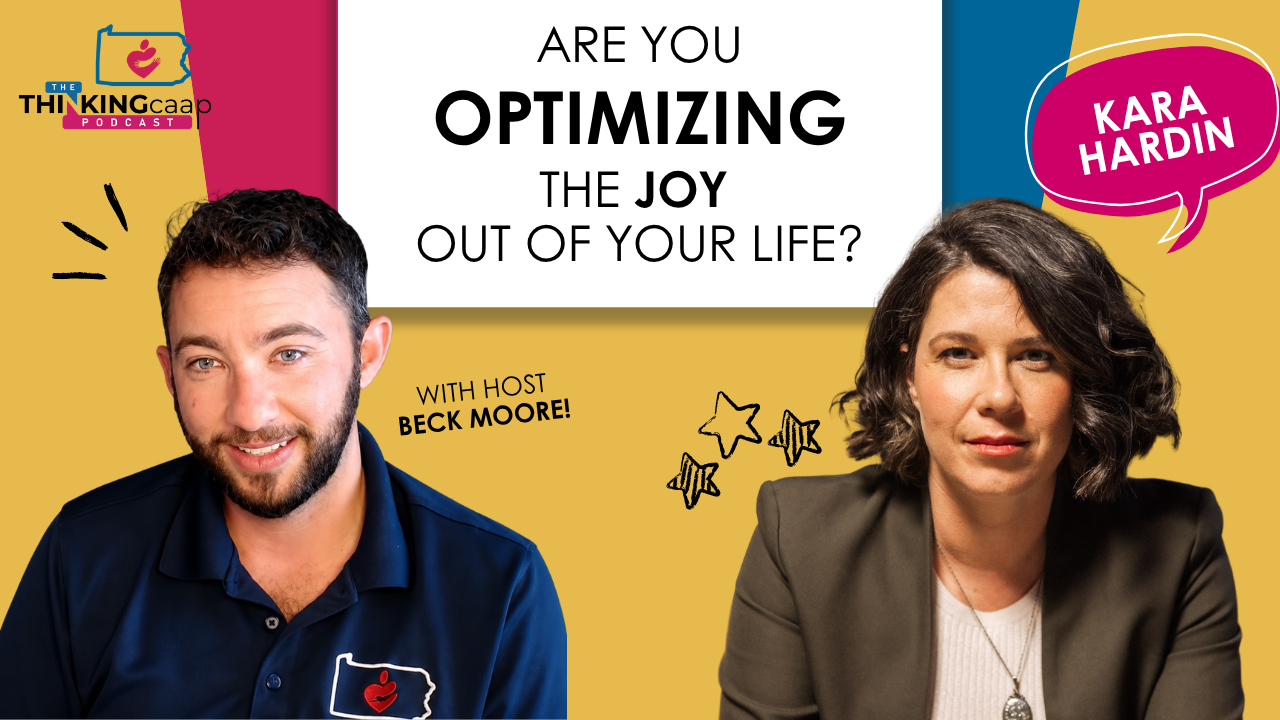
IMAGE DESCRIPTION: A yellow background. On the left is Beck Moore in a blue polo shirt and smiling while looking at the camera. On the right is Kara Hardin, with a thoughtful and intense look. The headline “Are you Optimizing the joy out of your life??” is on a white block at the top. There names, stars, and black highlight dots are scattered in the background.
Talking Points of Episode 43
[00:00:00] Welcome to Thinking CAAP
Beck Moore opens the episode by introducing Kara Hardin, founder of The Practice Lab.
He frames the conversation around achievement, burnout, leadership, and the possibility that the qualities that help people become successful leaders may also be quietly pushing them toward exhaustion.
[00:01:42] Kara Hardin’s Origin Story
Kara shares that she has spent the last decade asking what it means to have a healthy relationship with work.
She has explored that question as a lawyer, therapist, CEO, founder, and mental health educator.
[00:02:07] What It Means to Live Life Well
Kara explains that beneath her work around healthy relationships with work is a deeper question: what would it mean to live this life well?
Because work consumes so much time, energy, and attention, her inquiry naturally led her to examine how people relate to work, performance, and achievement.
[00:03:21] When Success Strategies Become Strain
Kara describes how the very ways people learn to succeed can become the things that make them unwell.
Beck connects that idea to human services and nonprofit leadership, where constant change and shifting expectations make the work especially complicated.
[00:04:44] Trying to Control the World by Controlling Yourself
Kara explains that many high achievers believe that if they can control themselves enough, they can control outcomes outside of themselves.
That may look like trying to write the perfect email, give the perfect presentation, or take the perfect path in order to secure a specific result.
[00:06:47] Scope of Control
Beck reflects on how much Kara’s description resonates with his own leadership experience.
He shares how CAAP talks about what is within the team’s control after major events, such as conferences.
He also reflects on how difficult it can be to release responsibility for the things no amount of preparation can fully prevent.
[00:09:00] Why Over-Control Makes Sense
Kara emphasizes that these patterns make sense because they are often reinforced over time.
Working hard, getting results, being right, and coming prepared can earn praise, opportunities, and success. Eventually, the same strategies can stop helping and start creating dread.
[00:10:49] The Balloon Arch Story
Kara shares a personal story from early in the pandemic, when she had a newborn, a medically vulnerable three-year-old, and a new business.
After seeing a large balloon arch for another child’s birthday, she felt like a bad mom.
Her instinctive response was to become better, more productive, and more disciplined.
[00:13:03] When “Be Better” Becomes the Only Tool
Kara explains that in that moment, the loudest internal message was not compassion, but self-improvement.
Instead of recognizing how much she was already carrying, her instinct was to push harder, optimize more, and prove herself.
[00:14:30] Beck’s Balloon Arch Moment
Beck shares his own version of a “balloon arch” moment, rooted in childhood responsibility, striving, and the belief that working harder was the way to get what he needed.
He reflects on a period when he was overworking, overtraining, and pushing his body past its limits.
[00:17:41] Running, Pushing, and Breaking Point
Beck tells the story of running a 10K, feeling far behind the other runners, and breaking down near the end.
He connects that moment to a larger pattern of pushing himself, ignoring his body, and placing work and achievement ahead of his own needs.
[00:20:15] You Make Sense
Kara returns to the idea that people make sense.
She explains that many people are taught, implicitly and explicitly, that if they do life “right,” they will feel happy, fulfilled, peaceful, and safe.
[00:21:53] All the Parts of You Belong
Kara explains that there are many different parts of each person, and all of those parts belong.
In adult life, people have to choose which parts they will satisfy and which parts they will soothe. No outside expert can make that decision for them.
[00:23:45] No Single Rulebook
Kara shares that there is no single right way to live a life well.
The work is not about following someone else’s playbook. The work is about paying attention to what makes you feel alive and finding the courage to follow that aliveness.
[00:24:46] What Is a Striver?
Beck asks Kara to explain what she means by “strivers.”
Kara describes a striver as someone who is constantly trying to be better and do more.
She connects striving to achievement, accomplishment, and relentless self-improvement.
[00:26:00] Defining Success for Yourself
Beck reflects on the realization that he has not always stopped to define success for himself.
Kara notes that many people never had to define it because the world offers its own version of success through status, wealth, influence, and achievement.
[00:27:12] Striving Toward a Life Well Lived
Kara explains that the language of striving helps move beyond labels like high achiever or high performer.
She suggests that what strivers may really be reaching for is a life well lived.
The challenge is knowing whether they are reaching for their own definition of that life or someone else’s.
[00:30:49] Congruence and the Inner Life
Kara introduces the idea of congruence, where the person someone is on the inside matches the person they are putting into the world.
Strivers may struggle when they are unaware of, or ignoring, their inner multidimensionality while moving toward what they have been taught will make them valuable.
[00:33:21] Fishing, Frustration, and Turning Joy Into Achievement
Beck shares that fishing has usually helped him turn his brain off.
Recently, he has found himself frustrated when he does not catch fish.
He recognizes that he has started applying a striving mindset to something that was supposed to be calming.
[00:35:50] It Was Never About Making Things Happen
Kara responds by reminding Beck that it was never about making things happen, it was about who he got to be while trying.
She notes that fishing is a powerful example because no one can fully control whether the fish show up.
[00:38:16] Endless Optionality and the Pressure to Get It Right
Kara talks about how modern life offers endless options for optimization, improvement, and customization.
With so many choices available, people can feel pressure to make the “right” choice in every area of life.
[00:40:53] Cultivating Good Enough
Kara explains that it takes deliberate effort to cultivate a sense of “good enough” in a world filled with pressure and endless options.
Choosing rest, simplicity, or enough does not mean someone does not care. It means they are choosing a life that reflects their values.
[00:42:12] Satisfaction, Hamilton, and What Comes Next
Beck reflects on the theme of satisfaction through the lens of Hamilton.
He shares that he has often wondered what would actually create satisfaction for him.
He notes that he has achieved past goals but has not yet set the next one, leaving him feeling somewhat rudderless.
[00:43:43] Satisfaction vs. Aliveness
Kara explains that satisfaction is not one-size-fits-all.
Different parts of a person may be satisfied by different things.
She often thinks less about satisfaction and more about aliveness, or the pursuits and choices that spark something meaningful inside.
[00:45:41] Following the Right Channel
Kara encourages listeners to think about which “channel” of themselves they are trying to develop.
Instead of only asking whether a goal is concrete or impressive, people can ask whether a decision nourishes the part of themselves they are curious to grow.
[00:46:18] Closing Reflection
Beck reflects on how deeply the conversation has landed for him and thanks Kara for joining the episode.
He closes by encouraging listeners to continue learning more about the Community Action Agencies serving every county in Pennsylvania.
Episode 43 Transcript
00:00:00
What's up, everybody? Welcome to the Thinking CAAP, where we explore the ideas shaping leadership, Community Action, and the human experience. I'm Beck Moore, CEO of Community Action Association of Pennsylvania. And on each episode, we take a step back from the day-to-day demands of our work to really ask the bigger questions that help us lead with greater purpose. And so today's conversation is one that I think will really resonate with anyone in leadership, especially those of us in human services. We often are celebrating resilience, hard work, and the willingness to carry more than our share on a regular basis. But what if the very qualities that helped us become successful leaders are also the ones quietly leading us toward burnout?
And so joining me today is Kara Hardin, the founder of The Practice Lab, a mental health educator, registered psychotherapist, and former corporate and securities lawyer who has spent the last decade working with high performers. Kara specializes in complex ways mental health shapes performance and how our internal patterns show up in our work and leadership. She holds a master's degree in counseling psychology from the University of St. Thomas and a Juris Doctor from the University of Toronto Faculty of Law. And at the heart of her work are two guiding values, learning and kindness, which are reflected really in everything she teaches. And so together today, we are exploring one central question.
If the strategies that helped us survive childhood are the same strategies driving our leadership today, how do we know whether we're leading from purpose or from protection? It's a conversation about achievement, identity, burnout, and ultimately what it means to grow into the kind of leader who succeeds without sacrificing themselves. And so whether you lead a nonprofit, a team, or simply find yourself constantly striving to do more, I think and hope actually I know you'll find something meaningful in today's conversation. So Kara, welcome to Thinking CAAP. I am so glad that you're here today.
00:01:42
It's so fun to be here. It's so fun to be here. Thanks for having me. My pleasure. Really. So let's start. One of my favorite questions to start with is just a little bit about your origin story. You know, your superpower story. So, attorney who went to a different side of work a little bit. How did you find the work? What drew you to it? Talk to us a little bit about kind of your origin story and your backstory if you will.
00:02:07
So, I have spent the last decade obsessed with the question, what does it mean to have a healthy relationship with work? As you've said, I've asked that question as a lawyer. I've asked it as a therapist. I've asked it as CEO and founder of a mental health education business. The thing is when I'm honest with myself, like when I'm really brave, I don't actually think that's the question. I think the question I've been trying to answer ever since I've been aware I was alive. I'm an existentialist human being is what would it take?
00:02:39
What would it mean for me to live this life well? And because work has become such a foundational aspect of how we spend our most precious resources, our time, energy, and attention. My inquiry, my work has led me there. And when I was a lawyer, it was a function of how do I do this? Like how do I bill 200 plus hours a month and still feel like myself? And as a therapist, I was responding to, well, how are other people navigating what it means to live life well? And eventually, I kept seeing the same things over and over and over and over again. Namely, that the very ways we learn how to succeed can become the things that make us most unwell. And that's how The Practice Lab got started. And that's how I ended up here with you today.
Thinking through all the things you just said, thinking through the complexity of what it means to be high achieving in a world that is ever asking more of us.
00:03:47
Yeah. Right. Well, and ever-changing, ever evolving. Yes. Particularly in human services, you know, nonprofit work is complicated. People don't give it enough credit for, you know, what it really is. And I think in the human services world, we talk a lot about how, you know, every time there's a political change, regardless of it's a county commissioner to a governor to, you know, a highest office in the United States, right, the presidency, right? Like every time there's a shift in administration changes a flavor or a change to how an organization has to adopt different policies. So it's really everchanging work on top of all of the evolution that happens just in general in the world.
00:04:32
So I was I was going to ask the question about do you think the billable hours really pushed on this ideas a concept for you which you kind of already answered that question. But there was something you just said there that I want that I want to pull up if you'll let me. And so things are ever changing, right? The people that I tend to work with, the people that gravitate to my work and my ideas, they are people that learned that if they could just control themselves enough, if they could be perfect enough, if they could get results, if they could not ruffle any feathers, if they could be right, if they if they were good enough that then they would have control over things outside of them, right?
So that can look something like if I just write the exact perfect email then I'm going to get that like this proposal will be accepted or if I do this presentation perfectly if I have the right words if I'm charismatic enough then I will be received well if I just take the exact right path then I will be promoted. They believe that if they can control themselves enough that they have control outside of them. And what that means in a world that is everchanging is they are constantly asking of themselves to be more and more disciplined, feeling like it is their lack of discipline that is the source of their strain and pressure and stress.
00:06:00
And so if the world, you know, in social services, in the world, in public service, it's constantly changing. The response isn't something that perhaps would be I use the word healthy very loosely, but something that perhaps would be healthy, which is okay, here's what I can control. here's what I can't control. This is really hard. I'm going to lean into this discomfort. What we see instead is, well, I feel overwhelmed because I'm not exercising. I feel overwhelmed because I need to set better boundaries and say no and I need to go on a juice cleanse and I need to meditate more and if only I was more mindful and learned how to give feedback properly. And that's not to say that there isn't accountability and room for growth in these things.
The challenge is they believe that they could navigate change by themselves being more controlling over who they are.
00:06:47
Does that make sense? No, it does. I'm quiet because it is something that resonated with I mean it resonates with me because I've experienced this and I've had to really do a lot of reflection on what is within the scope of my control. It is a question that I ask myself pretty regularly. I ask I remind our team pretty regularly because when we you know one of our biggest things that we do every year is a large conference and so we do a debriefing following that event and we've all been together for a week. We all work remotely as well. So the fact that we're all together for a week when 99.9% of the time we are sitting in our homes working and now you're thrown together and there's only so much prep.
There's only so much planning that can come into planning a large scale event like this and there are just certain things that are going to happen that are not within the scope of our control. doesn't make it a bad event. And so we spend time talking about, right? Like and I make sure to remind everybody, let's think about and reflect on if you could do what went well, what were things that you wanted, you know, could have done differently. But at the end of the day, we can't worry about the fact that the tech didn't work at the plenary, right? Like it that just we have to just go in knowing that there's going to be those things that happen.
00:08:06
And I think it's really hard to help people reflect on the scope of control and let go of some of that and it's so I'm quiet because I'm just like yes I mean a bazillion% over and I've gone the opposite which is that right like no I am going to box myself into this thing and try to write. I'm going to try to do this on top of this on top of this. And so because of all of the pressure and the other things that I was trying to control, I my health just was decimated and I was I was burning out on all kinds of other things, not just work, but all of it.
00:09:00
Yes. I mean, let's talk about how you make sense and how anyone who's listening that has the response of, you know, over-controlling themselves as if they can control the world around them better also makes sense. You see, the ways that we learn to find success, they work to a to a certain extent, right? Like there's a conditioned reinforcement. And when I say the ways we learn to find success, you work hard, you rest later, you get results, you be right, you come correct, whatever that means, right? We're also taught from a systemic place that success looks, walks, talks, and behaves a very particular way. Yes.
00:09:39
And what happens is actually as you were growing up, you do get external accolades. You get the grades. You get the jobs. You get people going, "Gosh, you're so amazing." And it works and it works and it works. And the more you do something, the more natural it feels to do. The more safe, secure, and connected you feel from something or the more positive reinforcement you're going to get, the more you're going to do it. The challenge is when you reach a moment where that skill is no longer helpful, where it's actually not possible to optimize yourself anymore.
not possible to make sure that the technology at the conference works because in that moment if you've only learned to succeed in those ways and if the story at the heart of it is I can only succeed in those ways then what happens is a paradox right your drive to do something starts to feel dreadful and in that dread the only thing you know how to do is drive harder so I can be even more practical it was the middle of the pandemic — actually, no, early in the pandemic and I had a 9-week old baby and a three-year-old son and he was medically compromised. He would get febrile seizures. My husband worked the type of job that I think a lot of our listeners work where there just aren't enough hours in the day and when you care a lot you want to give a lot. And I had a one-year-old mental health education business.
And so what that meant is like every day I woke up and in the words of Lynne Twist my first thought was I didn't get enough sleep. My next thought was, I don't have enough time. Before my feet even hit the floor, I felt inadequate. And there was this one day I was walking my dog. I was alone. And I saw this big balloon arch. You know those arches with like big and small? Yeah, those arches. And I kid you not, I came undone. There was a sign underneath it that said Lila turned four. And so they were like obviously celebrating Lila's birthday. And on March 16th of 2020, my son turned three.
00:11:44
and he and I share a birthday. And so for his birthday, I made him my favorite cake and I let him have a piece and I got him a stroller attachment. That was how I celebrated his birthday. So when I was confronted with this like grand gesture, I felt like a bad parent if I'm being honest. Thank you, patriarchy. I felt like a bad mom. And in that moment, I did what I see high achievers do again and again and again. I had a cry for all of three seconds and then I got up and I started looking up how to make balloon arches, I was going to make the best balloon arch that you had ever seen in your life.
00:12:24
I'm not laughing at you, Kara, for any of our listeners who are watching. This is it. This is it. I mean, it was it was comical. And not only was I going to make the best balloon arch, like become a professional balloon arch artist.
00:12:34
I'm going to start a side business where I'm going to make I'm going to make balloon arches because it's going to be the best damn balloon arch. It's going to be the It's not just a I'm going to make the best balloon art you've ever seen and I'm going to get my family on a sleep schedule and I'm going to meditate better and I'm going to exercise. I called my therapist and when you're a therapist and you call your therapist, they like talk to you. They're like, "This is it's a bat line." And I was like, "I don't need to talk about my childhood. I don't need to talk about what triggered this emergency call. What I know I need right now is to train for the marathon I've always wanted to run."
00:13:03
Right? And so in that moment, the skill that was loudest to me was, "Be better, Kara. You're a bad mom. Be better. Do better. Climb harder." As opposed to gosh, you're trying your best and it's hard going out there. And all the ways that you learned how to succeed, that's actually right now going to make your life much harder. You cannot control this feeling. You cannot help this feeling. And so if you're listening to me right now thinking to yourself, "Goodness, Kara, you should have been more gentle.
00:13:38
It was just a balloon arch. It didn't really matter. Of course, you love your kids." If you're thinking that, then I want you to think about your to-do list and all the items on your to-do list. And when was the last time you ever said to yourself, "Goodness, I've got a lot on my plate and it's just a memo or it's just a project or it's just a deadline and all I can do is keep putting myself into the way into the world in the ways that I am and trust that that's enough." This is the challenge is it works until it doesn't. Until you're on the curb, literally decimated, bawling about something.
00:14:20
Yeah. And then you need something else. And then you need something to loop out of the paradox and loop out of the narrative that you're in control over more than you are.
00:14:30
Yeah. My brain is exploding right now. I rarely have no words, but I just I it's so I am just having these flashbacks of all of these moments that I just the balloon arch I've got very many many many variations of the balloon arch experience and I'm just like wait tell us one what's one yeah I so I Oh goodness.
00:15:11
So, So, a couple things you need to know about me, Kara. I mean, I know that we've gotten to know each other a little bit in other calls that we've had, but I'm the oldest of five kids. Yeah.
00:15:19
And we didn't grow up with a lot. You know, my parents both worked very long hours, so I really took care of my brothers and sisters on a regular basis, right? like got him off the bus, walk home, we'd, you know, clean the house, would make dinner for everybody. My parents would come home, we'd eat together, and then I would go do my homework and rinse and repeat. And that was just the nature of what had to happen because we didn't have enough, right, for babysitter. And so even at the age of I think I was eight watching my four-year-old brother.
00:15:51
Oh. Which is as somebody who has an eight and nine-year-old now, I'm like, "Oh my god, leaving them home is not the choice that's happening." No. the 8-year-old, maybe nine-year-old, no.
00:16:02
Yeah. So, I grew up in a scenario where like you just you had to work hard and working harder meant you'd have the things that you needed and you just worked hard and hard and hard and hard and hard and that that was just it. So prior career I worked in a leadership organization and we'd gone through a lot of turnover and I was a COO at the time. I had been at that organization for probably 10 years at this point and I had grown from right like beginning of my career to sitting in the COO spot. So worked really hard, learned everything I could, asked all the questions, right, that I could to try to to do better at all the things to get the promotion and ultimately had very specific goals that, you know, I wanted to get to at any given point. Well, I knew that I also wasn't making healthy choices.
00:17:06
Like, you know, I was I just didn't feel good. I was starting to gain a lot of weight. I was like, I really need to go to the gym. I've never really been somebody who's worked out regularly, so I'm going to start working out. But it was also at that point culturally, right? Like you needed as a leadership team member, you need to be first in, first out. And so that meant getting up and I lived an hour and 20 minutes away from where I worked. So I was commuting an hour and 20 minutes one way. So that meant getting up to go to the gym by 4:00 a.m., would go and work out for an hour and a half, and then go hour and a half.
00:17:39
Yeah. Because I'm going to do it, right? Like you're going to do it. You better do it. Yeah.
00:17:46
And not only am I going to train for, you know, my first 5K, but I'm going to train for a half marathon and for a full marathon because before I turn 40, I'm going to run the marathon because Yeah.
00:17:58
Why wouldn't I? I can do this. I can do anything. Yes. Yes. And you know, I think everything that happened then over the course of the next few years and just how hard I was pushing, I had just complete and utter moments where my body just was like, "Nope, not doing this anymore."
00:18:22
Yeah. And I think I remember running a 10K. It was my first 10K. I'd done 5Ks up until then. And I'm not a good runner. Like anybody who like I do run. I am not a runner. I don't care that I've run multiple half marathons at this point.
00:18:37
I'm not a runner. So I'm running this 10K and it's a very hilly hilly spot and there's maybe only I don't know 50 people running this 10K and I am dead last. And when I say dead last, like I am significantly behind everybody else. And I can hear the vehicle that follows the runners. They're just like they are waiting for me to be done so that they can all go home. And there is just a point in this race. I think I was probably at mile like seven and I'm just like I don't know what mile I was at. I was at towards the end and I'm just like I just burst into tears and I was just like I can't do this. What the hell are you thinking?
00:19:29
And that just I think that run was one that I was like, "Okay, like something's got to change." Yes. And it was just a distinct moment where like I was pushing and pushing pushing. I ended up having to have a surgery that followed not too long after that experience because of something I kept putting off and couldn't get sort of like the medical attention that I needed because everything else was taking precedence over my body and feelings. So, I know it was a very long answer to the question about the balloon arch and what's one of my balloon arch moments, but like that was one of the moments where I'm just like so clearly can see like right the choice to go to work out, the choice to do this, the choice to do this, the choice Mhm.
It So I think again to like underscore and highlight all of my thinking centers around this idea that you make sense and we grow up being taught that if you do it right, if you do life right and that is never defined explicitly. It is implicitly through stories and models and systems and structures. Meaning is imbued upon what that is. you know, work hard, look a certain way, walk a certain way, talk a certain way, be a certain way. Then all of the parts of you inside will be harmonious. Like every part of you will be satisfied, right? I'll feel happy. I will feel happy.
00:20:55
You'll feel happy. Happiness, right? You will be happy. You will be fulfilled. You will you will it's more more than happy. You will be at peace. You will not stress like as if stress is a bad thing. And so we if you care about life, if you are someone who is oriented like me who wants to know well how do I live life well and if you have had developmental experiences that leave you especially vulnerable to the influence of what other people need, then you are more likely right to right, then you are more likely to strive in this way believing like if only I could do this right? If only I was good. If only I was able to contort myself enough. And that makes sense because that is what we are taught implicitly and explicitly.
Now the thing that no one told me that I wish someone had is the reality is there are many different parts of you and all of the parts of you belong. All of them belong. There isn't a part that's better or worse that's right or wrong. In fact, most often the parts of you that matter the most to you will conflict. So the part of me that is sick right now and wants to be lying in bed like my body conflicts with the part of me that loves talking to you and you know is curious about the part of me that wishes she exercised today. Like all of these parts conflict and the reality is that in life as an adult you have to choose which parts of you will you satisfy and which parts of you will you soothe and that's not a question Claude can answer. That is not a question your mother can answer.
That's not a question that you can put in consensus with all of your best friends.
00:22:48
There is only one you with your gifts, your disposition, your context, your resources, your limitations. There is only one way of making you feel alive and you are the only one that has access to it. Like you make sense and you don't need me, an expert, to tell you here are the five things you need to do to be mentally healthy. What you need is you, the expert, to pay attention to the parts of you that feel alive, regardless about what you were taught about how valuable they were.
and for you to find the fortitude and the courage to follow your aliveness and there is complexity there because like I'm a white probably upper middle class woman there are privileges where I can be like à la Gabby Bernstein the universe has your back and just be yourself and follow your aliveness and like that's not quite it what I am trying to express is something to the effect of if you want to know how to live your life well, there is no single rulebook. There is no single playbook and you cannot turn to anybody outside of you to give you those answers because there isn't a single right way. There isn't a single wrong way. There is just your way. And you are here to figure out what that is for you.
00:24:15
Yeah. And I can't imagine a more meaningful, exciting, terrifying thing. Yeah. I Have you been talking to my therapist? I feel like you've been talking to my therapist. What you're saying is just therapist convention.
00:24:31
Seriously, we all talk to each other, right? Like what what did Beck share? So, two things I'm going to just remark on and then I want to ask a couple questions to help. Well, before I before I share two stories, I want to ask the question. So, you've mentioned people as strivers.
00:24:51
You sort of Yes. made that comparison a moment ago when I was telling you about the working out story.
00:24:57
How can you explain what that really means and how someone how does someone understand and connect to the fact that they are a striver which I could probably list 50 people within our network right now that we work with on a regular basis that would fall into this category, but if you can just help our audience understand a little bit about what that means.
00:25:13
Yeah. So I think about a striver as someone who is constantly trying to be better and do more. And what that looks like is often achievement and accomplishment and relentless self-improvement. I try and be very values neutral and non-judgmental because I think at the heart of striving is a desire to live life well. You're a striver if you cherish life and want to get the most out of your life. That's how I think about it. Is that what you think when I say that or what do you think when I say strive?
00:25:56
I think it's someone who's always pushing themselves. Well, I mean, I think of myself. I think about somebody who's pushing themselves. I don't know what I'm pushing myself to. I mean, that's part of what I've been sort of thinking about as you're talking is I've not really ever taken the moment to define what is really success for me.
00:26:15
Oh, interesting. Well, you never had to. The world offers you so just achieve status, wealth, and influence back, right? Right. So, what does that mean? What does that mean? And what level of influence? Right? And so, I have a hard time saying no because, right, I and I have a hard time setting boundaries because of all kinds of different things. But I also think that that idea of you are somebody who is just trying to continue to do better than you've done before better perhaps than what you've had.
00:26:48
And you've not really defined that for yourself. And so you find yourself just in this constant sort of spiral of well I just got to do the next thing because that's what's going to make this better. That's what's going to make me better. That's what's going to make the team better. It's what's going to make the company better. It's what's going to make this project better. It's just it's literally striving for the next step, right? I mean, yeah. I mean, it's interesting. So, Shawn Achor, who's a happiness researcher, he used to run a class out of Harvard, like the fame h the famed happiness course.
00:27:21
Um, he's now started his own consultancy. He defines happiness as the joy you feel when reaching towards your potential. And I heard that on an this is going to date me, but a SuperSoul Sunday episode of Oprah Winfrey. And it over the years in my mind, it transformed into the joy you feel when striving towards your potential. And after a number of years working with who is typically called a high performer or a high achiever or a top 40 under 40 or a top 30 under 30 or someone who is at the peak of their game. I just thought that is so the idea of a high achiever, a high performer, that language is so imbued in the programming and conditioning of that leads to just automatically going for better and reaching for more.
And so the language of striving for me is really meant to help us get out of the system and ask the question that you're really asking like sure we want to be better.
00:28:29
Better about what? Yeah. And better in relate like it's really meant to sort of shake up inside of us. I am someone who's reaching. I'm someone who's reaching.
00:28:39
and the story I make up about you is if you're a striver, what you're reaching for is actually a life well-lived. Yeah.
00:28:46
But you may not know that. And what you also may not know are are you reaching towards your particular deliberately chosen life well-lived or are you automatically just reaching for what you learned would guarantee you or what promises you Yeah.
00:29:02
that your life will be worthy and well spent. Yeah. I think it's such an interesting thing, right? Because again, if you so if we go back to kind of the childhood piece, right, and we think about how that then influences if you didn't have a lot, if you didn't have or didn't see what felt like happiness, then what does that really mean for you?
00:29:38
And again, it goes back to this idea then of right like how have I really def how have I stopped to really think about what how does that really look right like okay you know you have the house you have the car you have the job great now what right well I'm going to continue to work harder to get acquire more is it the acquisition of things is it the acquisition of okay now I've have two kids do I need the third kid right what does that mean is it about what I give my kids. Is it about helping them understand how to do better? What does that mean? And it just becomes I feel like this again this kind of like spiral for me anyway, right? This spiral of and I think sometimes this dissatisfaction that I find in what I'm doing because I'm like, okay, well, what am I really working towards then?
How is again like the definition of success or happiness or whatever that is is a is a hard question for me to answer sometimes because because I don't I just don't I don't know that I've ever stopped to think about it long enough.
00:30:49
It so first of all I do think there are privileges associated with being able to stop and think. Oh yes a million%. Yes. Right. So there's there's I have a I have a cough now, so I see this.
00:31:02
That's okay. If you're listening and you want to sponsor the podcast, let us know. Yeah, please let please reach out reach out to Beck. I'll even do I'll even like guest cameo be like Ricola, I'll happy to do that again. Um so there again you have to be really careful in this space that there this is not good or bad.
00:31:23
Oh sure this is not right or wrong. Um I think also so Carl Rogers who's one of the leading thinkers in sort of person-centered therapy talks about this idea of congruence where the person you are on the inside matches the person you are in the world on the outside. And the way I sort of conceptualize striving is on one end of the spectrum, you either are unaware of your multi-dimensionality on the inside or you are simply aware and ignoring it and moving towards what you have been taught will make you valuable all the way. So there is a significant incongruence, right? a lack of congruence all the way to you have an awareness of your multi-dimensionality. You are picking which parts of you to satisfy and soothe.
And so there's an incredible congruence not because you're satisfying all of the parts of you, but but because you are deliberately aware and choosing to put into the world and to lead with intentionality.
00:32:36
Yeah. I think a lot of challenges that strivers struggle with has to do with this. How congruent can they be? How congruent can they be? And that importantly is not something that anyone else gives you ever. Yeah.
00:32:55
Like congruence is self-awareness, self-standing, and self-choice. And there are spaces where that is more and less possible. But it doesn't mean being accepted everywhere you go because you are not in control of that. Congruence is being aware of all of the different parts of you and being like, here's what I'm going to put forward.
00:33:15
This is what this is the thing that I'm going to lead with. Yeah. Even though all the parts of me belong and are valuable. Yeah. I'll give you a comparison that I've been has been kind of rolling around in my brain right now. So, I love to fish. That's something that and this isn't this example is not going to really you know resonate with everybody but I think it's such a simplistic way of looking at this in a lot of ways. I used to fish all the time with my dad. It was something that you know I don't know how he having taken two of my children fishing to my kid my two kids fishing. Um it is particularly when they were little is quite the experience and he used to take all of us fishing on his own. I don't know how he we didn't end up left in a creek somewhere frankly because we were a wild bunch.
But fishing is something that I've, you know, found again later in life um and have really enjoyed. I usually talk about it as some one of the rare things that turns my brain off because I'm just engaged in the activity, right? And I don't have to think. But this year in particular has been a hard fishing year.
00:34:22
And so I find myself becoming really frustrated because I'm not catching fish. And I'm like, well, if I'm not catching fish, then what's the point, right? Like I'm supposed to be catching fish. That is part of the excitement of doing the fishing.
00:34:35
Yes. And yet there are still those moments where like I was kayaking on I think it was Saturday and or Sunday and it's a bazillion degrees outside. you. We had this crazy heat wave. So, it's 100° outside and I'm kayaking and there's really nobody around and I happen to look up across the lily pads and there's this beautiful deer that's just kind of standing on the edge of the bank eating and it's by itself and I happen to have my phone and I take a picture and it doesn't really capture, you know, what's happening. It's like, "All right, Beck, put the phone away and just experience your day."
00:35:12
H and it was a really it was a beautiful day, but I left there feeling really frustrated and asking myself again, right? Like, well, what was the point of doing that? If I'm not going to catch anything, what was the point? Like, I should have chosen this other fishing spot. But I but this is one of those moments where right like I'm taking something that I love to do that is a calming thing that I started to do because it's calming and I've put on my striver hat and I'm ruining it.
00:35:45
Okay. So I'm so glad you told that story because a common reminder that I like to give is very simple. It was never about making things happen. It's always been about who you got to be as you tried.
00:36:07
Yeah. Like you can't make fish happen. And the I'm trying right. You can't make fish happen. But but our world would actually have us like the really if you're really in that like automatic striving part of you, it would say Kara, that's like the dumbest thing. Of course Beck could have. He could have picked a different spot. He could have had a different rod. He could have had a different bait, could have picked a different time of day. Look at all the things he could control. And what I respond is, there is no control outside of your own response, right?
00:36:39
And it was never about making any It's not about making fish happen, right? It's about the experience of being someone who's fishing and having all of that happen around you. And fishing is such a poignant example as a nonfisher person, fisher lady.
00:37:00
I think that's I accept that. Right. As a fisher lady, I do I have this image of like just being in a boat and just being like, well, there's Right. But but it's so it's so silly though because it's you know I said to my wife I was like I watched you know 35 YouTube videos last night. I have more tackle than any human ever needs. Like I need bills, right? I have every type of tackle you can imagine. I have I've got the apps to track the moon and the phases of the moon. Like seriously Kara it's ridiculous. I have tells me how much you care into this fishing space that it is becoming a not the thing I enjoy. It is becoming a task of catching the fish even though I'm not eating the fish to be clear because if you knew anything about where I lived, you wouldn't eat the fish that were here either.
00:37:56
But it's just it's catch and release, right? It's just the act of okay, this is something that's going to calm my brain. But what I'm realizing is it's not it's no longer the calming activity because if I'm not achieving anything in it then it's not worth the task and that is sort of the lie that I have told myself to a degree it but it's again you make sense it's what you have been taught and there's something of a momentum like since before co optimization and productivity and hyper efficiency See, it has exploded.
00:38:34
Yeah. Like it's everywhere. And I think a lot of it has to do with having at our fingertips endless optionality for betterment. Like there was um I like I could like I walk into any coffee shop, let's call it a Starbucks. also feel free to sponsor the pod Starbucks, right? And you walk in and it not only are you deciding if you want coffee or tea or a matcha or some sort of but like there's the size of beverage, the type, the toppers, the temperature, the individual customization. Like it's like a my order is like I want a matcha with coconut milk, no foam, no added sweetener, extra hot. Like I like it's like the most obnoxious thing, but we all do it. And with that comes a pressure to get it right because you had so many choices. You had so many options.
There is a relief of walking into a diner and there being we have calf or decaf and you're like, well, this isn't going to be so great. It's just going to be fine. And so in this world where at our fingertips is endless optionality, there is a pressure to get it right. And that get it right really pulls on our developmental vulnerabilities on if I was perfect enough then I would feel happy. If I could just get this right. And so it's not just been the development of easy access technology. It has been the momentum building pressure to self-actualize as a result as if if you just did it right you would be magically satisfied.
00:40:21
Self-actualization requires endless evolution. It's it's a target that's ever in front of you. It's Sisyphian. You don't arrive. You know, there's a book, I don't know who the author is, but Oliver Burkeman speaks about it, and he's written a number of books in this space, and he talks that the book is called Death: The End of Self-Improvement. And I just like that's the most brilliant title I've ever heard.
00:40:49
Yes. because that's what it is. And so it's it actually takes deliberate effort, deliberate effort to cultivate a sense of good enough in a world of endless optionality, in a world of endless pressure. And it doesn't mean you don't care. It doesn't mean that you're not trying. It simply means that you're looking at a balloon arch across the street and going, you know what, that option was available to me and I chose to sleep instead. And while that's really hard for some parts of me, it's the life that I'm going to lead.
00:41:22
And when I'm 80, God willing, 180, actually that's probably too long. Let's say like a 98ish. And looking back, I can look back and go, this was mine. Yeah. This was reflective of me, of my values, of my heart, of my spirit. And while I didn't get to do everything I wanted, I got to do most of what I cared about.
00:41:48
Yes. It's just, you know, are you a Hamilton fan? H Yeah. I mean, wait for it. Tell me more.
00:41:55
We have a whole podcast. I could just We could just have a whole conversation back and forth quoting Lin-Manuel Miranda is just I to spend time alone figuring out how he thinks and the collaborative process. Oh, it would be a dream come true.
00:42:09
Well, talk about a brilliant a brilliant mind. But there's, you know, the song in Hamilton about being satisfied and it's sort of like repeated over and over and over again. And I think from the moment that I first heard the soundtrack of Hamilton and having seen the show and having watched the show on Disney Plus, you know, and listened to the soundtrack over and over and over again, it was one of the only things that settled my my son for a long time in long car drives, even as a little little tiny guy. And so it's just that every time I hear that song though, I have thought about this idea of okay, well Beck, what's really going to create satisfaction for you?
00:42:52
Yeah. And I still I you know again I and I am somebody who am if I think back to you know 15 years ago, 10 years ago today this version of me compared to that version of me I do have far more clarity. I know that I've said I don't really have the answer to what really success means because I still don't quite because I find myself in this cycle of and I said this to somebody just the other day of you know I've been somebody who set three to five year goals. I've achieved those goals and I'm really proud of the fact that I've achieved those goals and I'm at this point in my life where I've not set the next goal and that's leaving me feeling very I don't know.
00:43:36
Mhm. I don't know the right word. A little bit rudderless. A little bit rudderless. I mean, so I think I think it's important to recognize two things. The first is different parts of you will be satisfied by different things.
00:43:49
Like satisfaction isn't a one-size-fits-all hat. And we have to be clear about that to ourselves and to other people. There are times, especially at work, especially when you're working in a space that gives you purpose and enjoyment um that you like your body will not be satisfied because you won't be exercising and you won't be eating in the ways that you want and you may not be sleeping, but your ambitious self professionally will be satisfied. So satisfaction isn't a one-size-fits-all thing. It also evolves and changes. And so for me, I often work with my clients and in my own life, I actually think less of satisfaction and more about aliveness.
00:44:33
Yeah. More about the things that sparkle magic inside of you. And so from the place of setting goals, I think less about what will leave me feeling full, what will leave me feeling sad and more about what will make me more alive, which things, which pursuits, which avenues will help me nourish the parts of me that I am curious to grow.
00:45:08
For me, the word aliveness is a is a window into that because I can feel it. You know, it's often the things I joke that I feel most alive when I'm at the edge of thrill and terror, like when I feel just vulnerable enough and just worried enough about am I going to be able to do it? Um, but that's going to be different for everyone listening, going to be different for you. And it's a little bit tricky because it means sometimes setting, you know, it's not best manifestation practices, goals that are more sensory or more emotion-based than they are specific and concrete.
00:45:46
It means being slightly more abstract in my thinking though, which anyone who's listening, you're the expert on you, like accept, reject, counter offer. You're honing into a frequency of yourself that you just want to grow. Like that is like, oh, this is the part of me. That's what I want more of in my life. And so when I'm making decisions, when I'm going through plans, I don't necessarily ask about that concrete thing. I check in and go, is that the right channel? Is that the channel that actually I'm trying to develop, or does that take me somewhere else?
00:46:18
Yeah. Again, I say — does that make sense? No, it does. I feel like my brain is just exploding a little bit with self-realization and trying to figure out how to, I don't know. I knew that this would be a discussion that would resonate with me with me personally for all kinds of different reasons, but I'm just having a moment. Thank you so much for joining us.
00:46:49
And for our listeners, if you want to become a part of Community Action, if you're looking for a job potentially, they are an important employer. If you're looking for a volunteer opportunity, a place to donate to, would highly encourage you, you can go to the CAAP website, thecaap.org, and you can look for one of our members. Thank you to our listeners for joining us at the Thinking CAAP. We look forward to you joining us on a future episode and continuing to learn more about the 42 organizations serving every single county across the state of Pennsylvania.
If you have any Community Action questions you’d like Beck or one of our local experts to answer in a future episode, please email your questions about Community Action to info@thecaap.org — subject line: Thinking CAAP.