

Building Healthier Leaders
Creating Cultures That Don't Reward Burnout
In this episode of Thinking CAAP, Beck Moore welcomes Kara Hardin for part 2 of a conversation about what happens after we recognize our patterns of striving, over-functioning, and self-protection.
Beck shares a deeply personal story from the beginning of COVID, reflecting on fear, identity, transition, and the terrifying but life-changing work of becoming more congruent with himself. Kara builds on that story by exploring the difference between automatic striving and deliberate striving, and how leaders can begin to notice the many parts of themselves that show up in moments of pressure.
Together, Beck and Kara discuss self-awareness, organizational culture, the limits of control, human services work, and the importance of creating space to pause, reflect, and gather better data about what we need. The conversation is honest, tender, and practical, inviting leaders to build healthier organizations without losing touch with their own humanity.
We hope you listen to and share this deeply human, supportive, and inspiring conversation with your circle, and find ways to support each other today.
Connect with Kara Hardin | LinkedIn
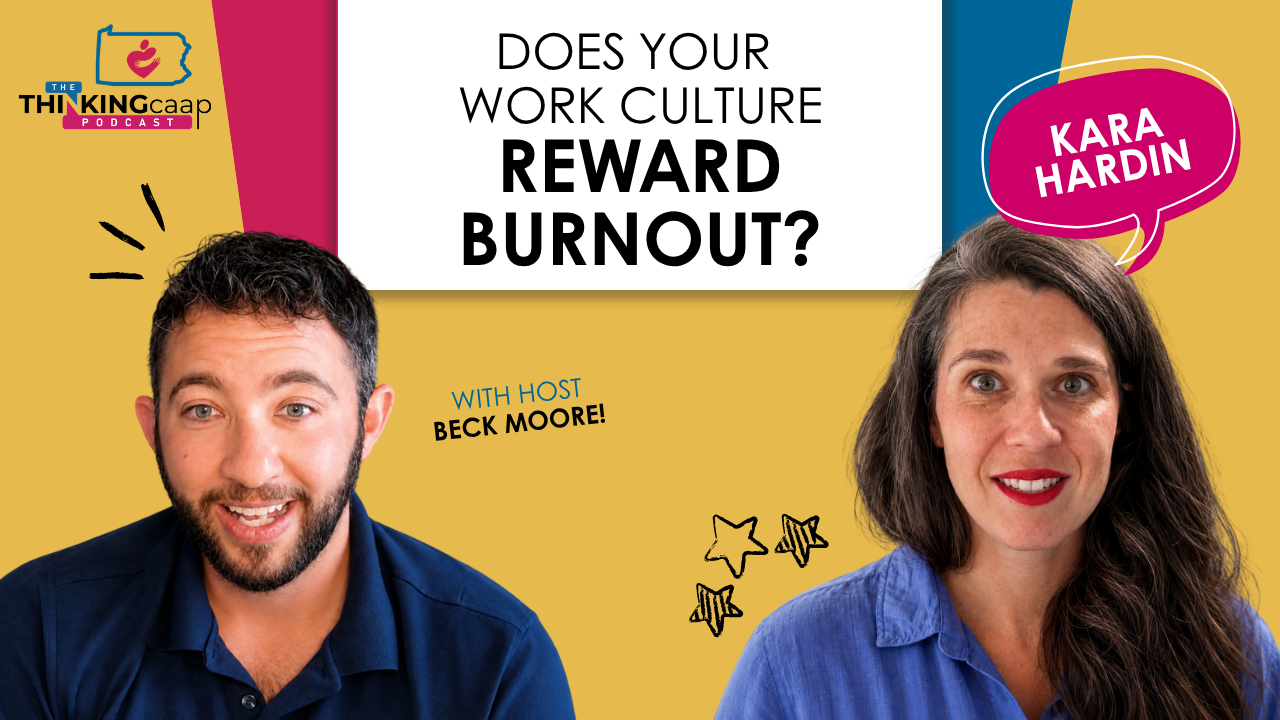
IMAGE DESCRIPTION: A yellow background. On the left is Beck Moore in a blue polo shirt and smiling while looking at the camera. On the right is Kara Hardin, with a thoughtful and open look. The headline “Does your Work Culture Reward Burnout?” is on a white block at the top. Their names, stars, and black highlight dots are scattered in the background.
Episode 44 Talking Points
[00:00:00–00:03:39] Recognition, Practice & Beck’s COVID Crossroads
Beck and Kara shift from recognizing unhealthy striving to leading teams and building healthier organizations through deeper self-understanding.
Beck recalls COVID forcing him to confront major questions about his relationship, parenting, work, identity, and transitioning from female to male.
[00:03:39–00:07:12] Congruence & Deliberate Striving
Beck shares that becoming more congruent with himself has made him a better leader by reducing the internal push-pull around how he shows up.
Kara explains that striving is neutral; the question is whether we are choosing it deliberately or acting from pressure, obligation, or fear.
[00:07:12–00:10:20] The Beliefs Behind How We Strive
Automatic striving is often fueled by beliefs like “I can’t fail,” “I can’t ask for help,” or “I’m not enough.”
Healthier striving grows from believing our actions matter, our work has meaning, and we have something valuable to contribute.
[00:10:20–00:13:04] What Comes Next & The “Part of Me” Practice
For high achievers eager to immediately “do” something, Kara reminds listeners that reflection and acknowledgement also count as action.
She introduces “part of me” as a way to notice competing feelings and needs without immediately trying to fix them.
[00:13:04–00:15:21] Gathering Data & Creating Awareness
The “part of me” practice helps people gather information about themselves and hold complexity without immediately changing their behavior.
Beck reflects on the power of simply naming what we are experiencing; small questions can create meaningful openings for awareness.
[00:15:21–00:18:22] Gentler Ambition & Organizational Culture
Kara encourages people to wrap ambition in care rather than rejecting it, creating a gentler relationship with growth and achievement.
Beck notes that organizational culture is shaped not only by what leaders say and do, but by what they ignore, tolerate, or leave unaddressed.
[00:18:22–00:20:14] Hiring, Similarity & Control
Leaders can unintentionally reinforce unhealthy striving by hiring people who operate just like they do instead of building teams with complementary strengths.
Kara says leaders need an accurate understanding of what they and their teams can and cannot control.
[00:20:14–00:23:42] Right-Sized Leadership & Human Services
Healthy leadership means taking reasonable action within your sphere of influence without tying outcomes, status, or performance to personal worth.
In human services, striving becomes complicated when workers deeply want better outcomes for people whose choices they cannot control.
[00:23:42–00:27:18] When the Work Gets Personal
Beck encourages human-services professionals to notice when someone else’s situation activates something unresolved in their own history.
Kara reminds listeners that caring deeply does not make us the expert on someone else’s life.
[00:27:18–00:30:45] Grace, Context & Assumptions
People often move toward what they have learned will keep them safe, even when those choices do not make sense to someone else.
Beck emphasizes that behavior we interpret as avoidance or failure may have context we cannot see.
[00:30:45–00:33:45] What’s Mine, What’s Yours & Disconnecting
Kara offers a leadership question for right-sizing responsibility: What is mine, what is yours, and what is happening between us?
Beck explains that meaningful work still requires intentionally creating conditions that allow him to disconnect.
[00:33:45–00:36:21] Creating Space & Managing Overwhelm
For Beck, disconnecting means turning off notifications, trusting his team, and making room for fishing, motorcycles, working out, and yard work.
Beck and Kara discuss how the desire to do everything can coexist with overwhelm that makes it difficult to do anything.
[00:36:21–00:39:03] The Pause & Multidimensionality
Kara explains that pausing helps the brain move out of task mode and into information-gathering, discovery, and reflection.
Having multiple sources of identity and aliveness creates resilience; when one part of life struggles, everything does not have to collapse.
[00:39:03–00:41:29] Self-Care & Hobbies That Give Something Back
Self-care is less about stereotypical wellness activities and more about understanding what you need and creating space for what makes you feel alive.
Beck finds life-giving hobbies in projects where he can see tangible progress, including restoring his home and building miniature houses.
[00:41:29–00:42:33] Exploration, Permission & Closing
Kara celebrates hobbies as places to explore, experiment, imagine, and even be bad at something without needing to optimize it.
She invites listeners interested in deliberate striving and living more purposefully to follow Making Sense on Substack.
Episode 44 Full Transcript
00:00:00
On a recent episode, Kara Hardin helped us understand why so many high achievers find themselves exhausted even while doing meaningful work, which is a question we ask ourselves pretty regularly on the Thinking CAAP. So today we're going to take that conversation one step further and talk about what happens after we recognize those patterns. How do we lead teams without recreating them? How do we build healthier organizations?
00:00:28
And how does ultimately understanding ourselves help to drive meaningful leadership? So, sit back, put on your Thinking CAAP. When COVID really, really hit Pennsylvania, um I was working in Delaware at the time and so I was driving about an hour, hour and a half back and I really loved a long commute for a long time. I don't know why. And I was living in the uh greater Philadelphia area, so had a pretty hairy commute also, right? Like driving back and forth that corridor on 95, sort of just like touching all of the traffic everywhere no matter which way you go.
00:01:08
And the county I was living in was the first county to go under quarantine. And I was driving home. I got the call from my wife at the time and um she shared, "Hey, you know, we're about to be under quarantine. I'm going to go to the store to get a bunch of things."
00:01:28
Yeah. And I was like, "What do you mean we're we just I don't Okay. And so I work until probably 7 o'clock at night, which was pretty typical of me at that point. um and started my drive home and I just remember having this complete and utter utter panic attack because I'm and I've talked about this at other times um and on other podcasts that I just remember thinking to myself like I'm about to be trapped in my house in a relationship that we had a lot of a lot of challenges. We had, you know, a son who had special needs that were trying to navigate all of his needs during, you know, very beginning of our learning journey, what that was going to mean.
00:02:17
And I was deeply unhappy with myself, with my career. And I just remember thinking to myself, right, like, I'm about to be trapped in my house and I'm not going to be able to escape. I'm going to be forced to look at myself every single day. And that was one of the most terrifying things that at the time you could have ever told me that you have no way to escape. And I just remember thinking, I'm just going to let go of the wheel because I can't do this.
00:02:44
I can't. I am terrified of what I'm going to find about the choices that I'm going to have to make. And I sort of I I just wasn't being honest with myself at the time about what would have made me happy. I think for a lot of fear of just what I was going to lose potentially, right? What it was going to mean. It was going to mean potentially, you know, completely demolishing the career that I had built because ultimately I was at this crossroads about whether or not I was going to transition from female to male. And I just I just I just I didn't I didn't know.
00:03:22
And I say all the time like I don't know what really got me through that drive.
But I'm thankful for whatever song I put on or whatever conversation with I had with with myself for that remainder of that hourlong drive because today right when I reflect on kind of you know you speak about the happiness and the congruency that is the part of me that I am so thankful that I took that kind of leap and made the next steps that followed to be the person that I am in front of in front of you because I've while yes I know that there are pieces of me that are continuing to chase this sort of striving mantra and do more and more and more and continue to achieve whether it's fishing or yes requiring something in my house or whatever it is the thing that is that I'm currently doing project-wise the relief that I feel and just the ability to operate in the world in a way that even something as simple as standing in the Starbucks line was so overwhelming for me because of the self-consciousness because of how I felt like I was being perceived in the world, how I perceived myself, the deep unhappiness that I had with myself.
I look at pictures and I can't even connect with the person of who I was because I was so deeply unhappy before.
00:04:59
And so I'm so I'm so thankful to have had that moment even though it was terrifying and I could have made a different choice at the time. But I am so thankful for taking the next steps to be this person. And that has also helped me to really think about right the congruency that you talk about and how I show up for other people and trying to help them create that space right and ultimately at the time I also knew that in order to be the parent that my son at the time I only had one kid then you know deserve to have in order to be able to be strong for them knew I knew that I had to be strong for myself first and I just wasn't and I wasn't being that so it just you know so much of what we're talking about just resonates me with me in so many different ways.
And what's what I find interesting, you know, now to wrap it back to our conversation is that as a leader because I don't have all of this, you know, sort of worry about how I'm showing up in the world in the same way. I know that I'm a better leader for my people and the people that I support at work now because it just that that pushpull in that same way that my ego got in the way previously, it's just not there anymore. Like I've sort of unburdened myself from so many of those pieces of how I was living. So, first thank you for putting uh between us and between listeners across this platform and lots of others the drive and your experience on the drive. I think every one of us has a part of us that gets to say I'm too tired. Um, and I also think like there are there are a couple of beliefs that have shown up again and again in people who are striving automatically.
And to be clear, striving itself again is neutral. The question is, are you doing it deliberately or are you doing it based on you feel like you should or ought to be? Are you doing it automatically? And when I see people striving automatically, they believe at the heart of their existence. It feels true. They have no choice. They cannot fail. They alone are responsible. They cannot ask for help.
00:07:24
They will not be helped. They believe on some level that they are not ex enough, not pretty enough, not smart enough, not thin enough, not symmetrical enough, not resourceful enough, not blank enough. There are beliefs as a result that if only they could be better then it's Sisyphean like if then if only they could be better or if only this external thing could happen because sometimes there are strivers that don't internalize the deficit they externalize it. Um, Lindsay Gibson talks about adult children of emotionally immature parents. And she says there's internalizers who take things on themselves and say the story is about them and there's externalizers that say, you know, they're the people that are constantly like, well, if only I could, if only they would see how smart I am. If only this hadn't happened. If only that person hadn't done this.
They're people who are constantly blaming others for their things. And so if at the heart of automatic striving are those beliefs, we can go to deliberate striving. And Shawn Achor actually, I have the book right here. Shawn Achor just wrote this book. He's the one who had the definition of happiness. And I have them here. I was actually working. I wonder if this will work. H Oh, but it's backwards for you. Is it right for you or is it backwards?
00:08:48
That's correct. You're good. So these are the beliefs that research shows predict greater success whatever that means to you and quote a better life like in a very headline-y way. So rather than orienting towards making things happen, do you as you move throughout the world believe that your behavior matters, feel gratitude not in a toxic positivity kind of way, but in an awareness of complexity kind of way. Do you know that you matter not only to yourself but also to other people? Do you feel like you have something of value to give? Do you know that you exist in community that you're not alone? And do you believe that your work is meaningful?
00:09:40
These are ideas that I see people who are deliberately striving embrace. In direct contrast to feelings of inadequacy, anxiety, over-control that show up like perfectionism, people pleasing and performing. And so when I think about your drive, what I hear is a part of you loudly saying, "You have no choice. this is it.
00:10:06
You have no choice and you have to continue in this way and this is who you learned you should be and had to be and that there was another part of you that was like maybe that's not true. Mhm.
00:10:20
Maybe that's not true. And so if someone's listening and they're like Kara Beck I I recognize myself in this work. I feel seen in this work. I have no idea. I have no idea. What's next? Like how to do I have no idea. Um the first thing is I just want to note that the impulse to do is strong.
00:10:43
And it turns out that reflection and acknowledgement and self-standing count as doing like it's not necessarily changing behavior, but there is there is space there. There are a couple of principles that you've heard me repeat again and again and again. You make sense. You are the expert. you need.
00:11:04
Another one is gather the data. And in order to gather the data, this tool I want to invite you to use is my favorite tool. It is three words and they are part of me. So when you find yourself looking at your to-dos, looking at your schedule, driving the car or waking up, when you're feeling that swell, that balloon arch, I have to be better. I've got to do more. I've got to dig deeper.
00:11:34
That fishing optimization instead of just jumping in. Give yourself the opportunity to say part of me. So, I'm going to do it for this moment with this podcast. I'll do it with me so we can see how it works. So, part of me right now feels so alive having these discussions to getting to talk about these ideas. Like I talk about following your aliveness and thank you for allowing me the opportunity to do that. to you Beck for creating this platform but also to anyone listening like this is so fun for me and it is because of you. So not only is there aliveness another part of me is grateful. Another part of me is curious. What are people thinking? What are they wondering? There's another part of me a younger part of me that's like do they like me? Will they like me? And then there's another part of me that's a bit more mature that says well I like you even if they don't like you.
There's another part of me that desperately wants to go lie down and put some sort of compress over my face. There's another part of me that's wondering how my eldest is doing. Another part for my youngest. There's another part that's thinking about my husband thinking about my, you know, my mom that's grieving my dad. Like there's all of these different parts. They all exist at the same time.
00:12:48
Part of me, part of me, part of me, part of me. And if you are wondering how to start simply doing that exercise, you can continue to make the same decision that feels biggest and most important. It can still be the one that should ought to. You can still optimize for fishing. But can you start to gather the data about who else exists inside of you? Just starting to become aware of who you are most comfortable satisfying and how that feels inside. That in and it of itself is something that you can do. And following that process again and again, inviting yourself to start playing around with curiosity just the way you did back with well, if not satisfaction, then what? Like if it's if there is no way to satisfy all of these different parts of me, then which one do I think I want to try satisfying today? And what data can I gather?
Essentially, it's the practice of consistently acknowledging your complexity and expanding your ability to hold that complexity without necessarily doing anything because automatic striving is the ever forward impulse to do more and be more.
00:14:08
And so in direct contrast to that, we build a muscle to simply stop trying to make things happen and to acknowledge and make space for who we are. A human having this really profound experience in all of its complexity. Yeah.
00:14:26
No, I love that. I think that it's such a I'm always looking for simple things that can create bigger change because to put in place the bigger thing is complex and right it's like it feels overwhelming and so just the simple task of asking that question I think is brilliant and gives you what I think an opportunity just to acknowledge right like things that words matter, right? Whether they're spoken or whether they're written down, the act of saying it or writing it helps you to connect with it.
00:15:14
Yes. There's also just again, you know, we we are constantly trying to we're constantly we're constantly swimming upstream in this optimization, productivity, like efficiency world. And so if you care and cherish the experience of being alive, you are immediately vulnerable to like do more. like you can sleep when you're dead, do more now. And so having some part of you grow and mature that says like simply like exploring and experimenting and not being attached to that gets to be enough. There is a gentleness that I'm inviting into your and everyone including my own life around it's not it's not a rejection of the impulse to be ambitious and to grow. It is a wrapping of that impulse in love and care so that as you try you are not fragile.
You are resilient and can keep going towards the things that matter most to you regardless of how anyone else perceives you, receives you, what they make up about you. When you can be gentle with yourself, it protects you from a world that ultimately is the opposite.
00:16:48
Yeah. I want to ask a question around kind of organizational pieces because I think this is important for us as you know we think about the Thinking CAAP and the people that we're really trying to create a path forward and think about how these conversations right are in in interwoven within the organizations that they work in so when you think about an organization's culture right and if we if we think for a moment that and I have a little bit of a question mark that I'm going to pose us for us all but one of the definitions about organizational culture is it's about what leaders say and do and how they what they communicate. And I you know my caveat to that is it's also by what leaders don't do or what they don't say or what slide under the rug or maybe don't address. So I think that's important to say out loud as well.
But and I feel like I know the answer to this question I'm about to pose but I'm going to ask anyway.
00:17:46
Can first can an organization's culture actually reinforce right this unhealthy striving and how so and then the third question to that is then how does it if the answer is yes how does it reflect to try to make that shift so that it doesn't continue to do that or how do you get out of the habit of doing it tell me first your instincts like I have thoughts but I'm so curious having having shared sort of my frame and reference like what do you think?
00:18:22
Yeah. So I think absolutely it can I think it depends on are you hiring people that are exactly like you and so if you're a striver and you only hire strivers and you're not thoughtful about strengths and how they match with you as a leader and how they match with each other I think it absolutely can because then now you have strivers who are pushing each other.
00:18:44
Yeah. and further reinforcing this as a necessary thing. Yeah. And then the undoing of it. I mean first you have to rec I mean personally you have to recognize something before you can make the change. So I mean that's where I go.
00:19:00
Yes. Yes. I think so that's exactly it and I would nuance it a little bit saying if you are striving automatically if you are someone who is reaching for externalized perhaps then internalized versions of what success looks walks talks and behaves like you are susceptible and vulnerable in any industry whether it's a billable target whether it is a prestige and statusbased industry whether It's an awards-based industry.
00:19:33
You know, I think about academia, like how published are you? Um what fellowship do you have in medicine? What journalistic awards do you have? Like if you are in an industry full of high achievers and there is a culture of you are valuable when you are externally recognized, then that internal vulnerability is going to be exacerbated. Like you're really it's a really tricky thing. Now, what what you want like at the heart of things is for leaders to have an accurate appraisal of what they can and cannot control. And an accurate appraisal of what their team members can and cannot control.
Because if automatic striving is believing we can over-control ourselves into pretzels of perfection, then deliberate striving is being like here are the things that are within our sphere of influence and here are the reasonable actions that we can take to affect those outcomes and everything is sort of deliberate and right-sized towards what's you know what people have capacity for with a healthy sense of this may or may not have happened and did we do what we good to affect the changes we wanted as opposed to this did or did not happen and it's all because we take personal responsibility and I want to be careful we have to you know it's a it's a real tricky throughline here like am I saying we affect no change in our lives like am I being really like people have no control and there's no accountability and moral relativism and all of these things what I am saying is you are in control of how you respond to this life and this world and the circumstances you find yourself in.
And those responses have definite and real impact and consequences on what happens outside of you. But that does not mean you are in control of them.
00:21:29
And a leader who has that relationship with outcomes and process and people is a leader that creates a growth environment where people are not defined by what they do where they can find their aliveness and grow and meaningfully have purpose and enjoyment at work. It is directly in contrast to leaders who themselves are tied in their worth to their job and their status and therefore over-control and micromanage and make the people in the organization around them fall prey to the same ideas and notions.
00:22:14
Yeah, I completely I agree completely with you. I think the caveat here is that it doesn't mean you can't have a culture of striving. I think that that's that's not the point they were trying to make. Right.
00:22:34
Correct. But there's unhealthy striving and then there's the healthy version. Yeah. And it's I think in human services it's a little it's a little complicated.
00:22:49
It's even a little bit more complicated to a degree because you're trying to help someone thrive. You're trying to help somebody to become economically mobile mobile in our work in Community Action. You're trying to help somebody, right, grow to become self-sufficient, you know, less than living paycheck to paycheck, you know, growing beyond that from a an economic perspective.
00:23:14
And that means that you're going to try your best to help support an individual or a family and they could make other choices, right, that maybe in the moment don't feel like the right choice that you're trying to help direct them to.
00:23:30
And then that can become really frustrating. And so then if you get into a cycle where that's continually happening, you become more and more frustrated. And I think the other part of that is also I will recognize that we also have a lot of individuals who have come from the conditions that they're trying to help people rise up out of.
00:23:50
And so you know and I ask myself this question with a lot of choices that I have made in my life right like am I doing this because I'm trying to save myself because I couldn't save myself then. Yeah. Yeah.
00:24:00
So, am I doing this and am I feeling this this dissatisfaction or this unhappiness because I know what it's going to feel like? I know what you could have had. I know what this could have felt like. And so, it becomes even more frustrating and retraumatizing in a way that you really have to reflect on, right?
00:24:19
Like why why am I feeling this much emotion about someone else's choice? And so then what I would encourage people to think about if you're working in Community Action then is how can how can I try to help someone understand all of the things but also recognize for myself that there are just things that are beyond our control. Right?
00:24:47
How can I make sure that I've done everything within the scope of my control to help somebody understand how this is going to look and feel if they do this versus this? Yeah.
00:24:57
Helping them feel comfortable to have the right, you know, things to help them make the choice, right? What does that environment look like from the from everything from the paperwork to the environment that I may, right? There's lots of things within that that you do have scope of control over that you can influence but ultimately can't make the choice for someone.
00:25:20
So Kelly McGonigal and I'm trying to remember which university she's with but I can't right now but she's sort of the leading researcher on all different forms of stress and she defines stress as stress is what happens when something you care about is at stake.
00:25:37
And what you describe is stressful. Sure. Working with people who bring up and reflect in you experiences that are deeply personal. There is a desire to help, to give, to contribute and holding the complexity of like you make sense, your response makes sense and also so do they. You know, if someone's behavior, choices, decisions don't make sense to you, it just means you're missing a piece of their context. And so, right next to that, we have to hold tightly on to the truth or what feels true to me at least that I am the expert that I need. You are the expert that you need but I am not the expert on you.
00:26:31
And that means that as you are navigating the world, what you can do is honor the expertise of other people. Like in our conversation today, I can tell you all about what I have seen over the last decade. I cannot make the assumption that it's valuable to you. I cannot make the assumption that you should use this tool or not use this tool. Like all I can do is help share what I know and then trust you to be the expert you need. I think what you describe though, what I make up is it is most painful when you see someone replicating a pattern of striving that is familiar and harmful. Not being aware or the person not having access to something else. And so as a therapist, what I often have to remind myself is people move as fast as they can, as best they know how towards whatever they learned would keep them safe. And that is different than what actually keeps them safe. And so with humility and with curiosity, we can keep asking questions, but it is it is really it is um insulting and degrading to try and take someone's dignity away by saying you know better.
00:27:53
Yeah. No, I think and that's hard. And it's just hard. No, I think and I think that's fair. And I think that again to the point about what could look like indecision could be reflective of something you just don't have context for.
00:28:10
Yes. I mean there are plenty of times that I have in the particularly in the last year that have been so overwhelmed that I just can't get to the decision. Right.
00:28:23
Yes. or I don't do the thing that leads to the decision because I just the thought of that choice becomes so overwhelming and it's complicated. And I think that's the other thing that I would just remind folks particularly in the human services work is that when someone's not making the call back, don't assume it's because they're just not calling you back. Right? It could als you don't know right what yes or why. So not jumping to the conclusion, right? Not assuming that you know or that to your point, you're not the expert on that individual or their family, right? So trying to figure out grace and not assuming it was we were just my wife and I were just watching uh the Brené Brown special on Netflix and the one there's we're about halfway through.
didn't finish it yet, but there's this point where she's talking about the idea of is this what's actually happening or is it what's the story I'm telling myself? And that's such a powerful tool that I just I'm finding myself saying it even since we watched it a couple times when my wife and I were talking about something.
00:29:43
We're doing a really labor-intensive project. And I usually say that there's a three tests to a relationship. And if you can survive those three things without like getting into a death match arguing, you know, spiral, it's a good relationship. One, taking a really long road trip in which you have to stop and get some type of snack and it's not just a like twohour drive. We're talking about a day long drive.
00:30:09
Yes. Number two, putting a piece of furniture together or moving a piece of furniture together. Yeah. Yeah.
00:30:18
And three, making a meal together. Yeah. And if you still enjoy if you still enjoy your relationship at the end of those three tasks, but those three tasks usually create the moment where like you're going to snip at somebody.
00:30:33
Yes. Right. You're gonna have the moment where you're like, "Why aren't you listening to me?" But you've not said anything yet. That's right. That's right. I mean, in any interaction, I like to ask myself, um, what's mine? What's yours? And what's between us?
00:30:48
Like, what's my stuff? what am I bringing? What are the stories that I'm telling myself? And then separate and apart from that is their stories and what they're bringing and the things that they're coming to the context with. And then all of that interacts. All of that interacts. And I think having accurate appraisal of those dimensions as a leader is the thing that helps you rightsize control is the thing that helps you understand how do you help someone with a story that they have or be with someone without having to take it home without having to carry it. Because all of this really does bring up the question, you can have a right-sized sense of control in your work and still it can be tragic and vicariously traumatizing and heart like just heartbreaking. It can still be those things.
And so aside from the how do you do the job practically knowing what's mine, what's yours, and what's between us, there's this other really important inquiry around and how do you take care of yourself as you do it? How do you invest in yourself? And so I'm curious, having done it now for as many years as you have, how do you do that?
00:32:14
How do I invest in myself? Mhm. and take care of yourself as you do this work that matters and also can be really heartbreaking. No, I think it's a great question and I you know at CAAP we don't do the direct client work so it's a little bit different and so I think it's the work of an association. We just did a podcast episode of this in terms of kind of the way that we do the work. It can be a little strange because we don't get to see the thing. We don't get to see the result of the thing that we've created. Yes.
00:32:46
As somebody who likes the tangible feel like I like to take things apart and put them back together the you know better than what the way that I found them. That is what you pass the furniture test. You pass but but it's Yes. Yes. me, my wife and I, my wife and I now today who, God bless her, the very first time we took a car trip together, she did have to put her hand on my leg and just say, you know, we don't have to talk, right?
00:33:15
It was such a mindaltering moment because that just was not that's never the experience that I've ever had. And being white in a relationship, I mean, there was something wrong. So I I think but I think to that end I think it's that's a really good reflection point for me to think about in terms of how do I show up differently? How do I take care of myself? How am I kind of thoughtful in relationships is I think the pause has been really important. I am trying to this year in particular get better about how do I really take time and disconnect and create and I have to then not only is it truly disconnecting and like turning my email notification off, turning my team's notification off. I have to create the environment in which I can disconnect because if I don't, I won't. like I know myself well enough at this point to just really trying to be thoughtful about that.
Um, and I'm not always as good about it as I should be, but you know, I trying to recognize the moments about, okay, Beck, you don't need to really pick up your phone and look at this email. It's okay if you don't look at the email, but we've created, you know, you've curated a team that is remarkably good at what they do. It's okay to let it go.
00:34:44
So, I think that's part of it. I also think just trying to really pick tasks and activities that do allow me the space to turn off my brain and reflect on how I'm feeling and not being scared of that is also important, you know. So, I said about fishing, you know, I also I've talked about this before on the podcast, like riding my motorcycle, working out, doing yard work, right?
Trying to figure out at this point in time right now, what do I need to give my brain the ability to just take a breath because as much as I love my ADHD and it is my superpower, when you're a striver and you have the ADHD, it can create a lot of anxiety driving need to strive strive strive strive strive and that's yes one of the things that I've reflected on in the last few years is and I don't think a lot of people realize this is that when you have ADHD and you have even just a little bit of anxiety those two things working together and in opposition of each other create a huge pit of Mhm.
00:36:07
Just overwhelming anxiety then which you do nothing even though you want to do everything. Yes, that can happen in the same at the same time.
00:36:18
At the exact same time. There's a couple things you said that I want to highlight and underscore. The first is giving yourself a pause. I remember when I was an associate um someone saying you just have to take a breath and I felt so frustrated because I was like you think a breath is going to solve the burnout that I'm feeling. I was like a breath.
00:36:36
Take a breath. The reality is the brain is going to operate in one of two modes. The first mode is getting things done. It's going to be task oriented. The other mode is information gathering and discovery. So as adults, our brain becomes more get things done and less discovery. As children it discovery is our main job. Like best of luck trying to get a toddler out of the house. Like we're like put your boots on, put your coat on, do this. And the toddler's like, "Oh my god, do you see that magical piece of dust? And did I tell you about this thing on my skin here? Isn't it the most and and so we are so we are automatically more comfortable in the getting things done as opposed to the data gathering the pause?" And so it's not just about resetting your nervous system and taking a breath, though that helps. It's about flexing a different muscle.
The same muscle that I refer to when I say acknowledging and reflecting. those are things you do. Gathering data is important and in order to do that you can't be doing all of the time like it's a different muscle. So the pause I think is really worth highlighting and underscoring. And the next thing was your multidimensionality.
00:37:49
Like you are you're fishing, you're a partner, you're a parent, you have you know you're exercising. You describe weightlifting like all of the things. If you imagine and Steve Magness talks about this, a chair with like one leg off to the side. If anything happens to that leg, which by the way it's barely balanced on, you're down and out. as opposed to if you have a chair with eight or nine legs. It allows you the um flexibility to fail at one thing without it being fatal, without it being challenging. And so giving yourself the opportunity to reflect as an act of kindness and gentleness as well as investing in your multidimensionality. And sometimes that looks like actually doing the things. Other times it looks like creating space inside to imagine doing the things like I would love to be a quilter.
00:38:47
Do I like do I at this stage in my life and my time and my thing am I doing that? No. No. But there is a part of me that sometimes her mind wanders that way and that's enough for now and that's okay for now. So when we think about taking care of ourselves, it's not like eye masks and baths and as Françoise Mathieu says like kale all the time. It's this right. She jokes about she jokes about like I think it's kale and pedicures or something. Um, it's really about this more complex process of allowing yourself to make sense, of owning your expertise around what you need and being willing to gather data to allow you to make space for all of the parts of you to belong and then to explore parts that you normally don't allow yourself to
00:39:48
Not because they're better or worse. But because they make you feel alive. Yeah. Here is I will this is be my my parting thought with respect to this topic is that one of the activities that I have really started to love and enjoy and have reflected quite a bit on why and we've I've talked about this on prior podcasts. I have a very old house and we are constantly in a state of construction to rehab and really breathe life into it in which it was created because it was built in the 1900s and bringing it back up to space. And what I love about those projects is that I can feel the task being done. I can see the results of the thing and I know that I need that. And so I also have have this little hobby of there's all these little houses and things that you can build.
It's literally like building almost like miniature dollhouses in a way, but it's like a coffee shop or a library or a greenhouse.
00:40:44
And it's a very time-consuming activity, but again, you can see the thing being built. You see the results of the effort and I've realized that I need that in order to feel like I've done the thing. And it's also activities that again to my point earlier turn my brain off. And so yeah, recognizing a hobby that matches with what you need can be life in a way that I cannot quite and it's not going to be building the house for everybody because that will be a frustrating task for a lot of people. But if you can figure out what it is that you need in a striving experience and match that in hobby. Oh, it's a beautiful thing.
00:41:29
Yeah. And that just takes that just takes experimentation, paying attention to the things that like because who would have thought miniature community building literally would be like quilting. Like who would who would have thought? And again, how am I how did I come up with that? Well, I remember I was a as a 13-year-old girl with my bat mitzvah money, I bought a sewing machine cuz I was going to be a quilter and I did it for and I remember watching Perry Mason and quilting and feeling alive. So, as a 42-year-old, I'm like, "Okay, well, I have two kids under 10 and I'm launching a business and I'm trying to write and I'm doing this and it's been this and this." So, like now isn't the time for that. But simply allowing that part of me to have space to imagine.
00:42:09
Yeah. Like that's for now that's enough. And then it will become more. So you can allow yourself multidimensionality in waiting, in holding, in exploration, in experimentation, in ways that you get to utterly fail at. Like how wonderful if you have a hobby that you suck at. Like way to just put yourself in all of these different ways into the world.
00:42:33
Yeah, absolutely. I feel like we could keep talking, but I know you have another call. I know that you need tea. I just want to say thank you for the discussion. Thank you to our listeners for hanging out and listening to me drone on about random things that have been popping into my mind. Is there anything that you want to share in terms of, you know, shameless plugs you want to make, ways in which people can find you? We'll make sure that the practice lab is, you know, in the show notes so people can find you. Is there anything else though that you want to really promote or share for people if they're curious about this discussion?
00:43:06
Yes. If you are interested in striving and deliberate striving and living life more on purpose, please, please, please sign up for making sense on Substack. It is a place where every week I share with you the latest ideas, the tools, the resources, the books, the podcasts that are making me feel most alive in the hopes that you will grow and learn with me your own aliveness. So that's making sense on Substack, please. And let me know that Beck sent you. Let me know that you found me here, please. Yes, that would be fantastic. Kara, we're definitely going to have to have you back because I feel like there's more that we need to talk about.
00:43:46
I don't even think we got to any of the questions. So, I think one or two, but I really appreciated this conversation. I know I'm going to be thinking about it for a while to come. So, thank you. Thank you. Thank you. It's been my pleasure.
00:44:00
The pleasure's been mine. Thank you for showing up the way that you do with such openhearted humble curiosity. It really it's it's a pleasure talking with you. Thank you for having me and thanks to anyone who put their head and their heart and their ears uh into the conversation with us.
00:44:18
I'm grateful for you too. Absolutely. Thank you everybody and we'll catch you again the next time on the Thinking CAAP. Thank you for being a part of this episode of the Thinking CAAP. Check the show notes for resources and links to other episodes. And don't forget to subscribe and follow to be notified when new episodes are released. If you have any Community Action questions you'd like Beck or one of our local experts to answer in a future episode, please email your questions about Community Action to info@thecaap.org. Subject line Thinking CAAP.
If you have any Community Action questions you’d like Beck or one of our local experts to answer in a future episode, please email your questions about Community Action to info@thecaap.org — subject line: Thinking CAAP.