
Beyond Burnout
What Mission-Driven Leaders Need to Thrive
In this episode of Thinking CAAP, Beck Moore and Heather Holloway welcome Rachel Barnard, founder and CEO of Creative Civility, for a conversation about burnout, resilience, and what it takes to build organizations where people can truly thrive.
Rachel challenges the idea that burnout is a personal failing, especially for people in human services and mission-driven work. Instead, she frames burnout as a signal that the work, the environment, and the systems may need closer attention. Together, Beck, Heather, and Rachel explore the emotional weight of service, the gap between what should be and what is, and the way fatigue can affect integrity, creativity, decision-making, and organizational culture.
The conversation also looks at capacity, asking for help, vicarious trauma, survivor syndrome, joy, self-care, and the importance of giving from a place of wholeness rather than depletion. Rachel shares how Creative Civility helps teams map their experience of burnout, reconnect with their humanity, and create joyful disruptions that make room for wellness, creativity, and possibility.
This episode is a reminder that healthy organizations begin with healthy people, and that thriving isn’t something we earn after the work is done. Thriving is the baseline we have to build into the way we lead, serve, and show up for the long haul.
Substack: https://rachelgbarnard.substack.com/
Linkedin: https://www.linkedin.com/in/rachel-g-barnard-49335751/
Website: https://www.rachel-g-barnard.com/
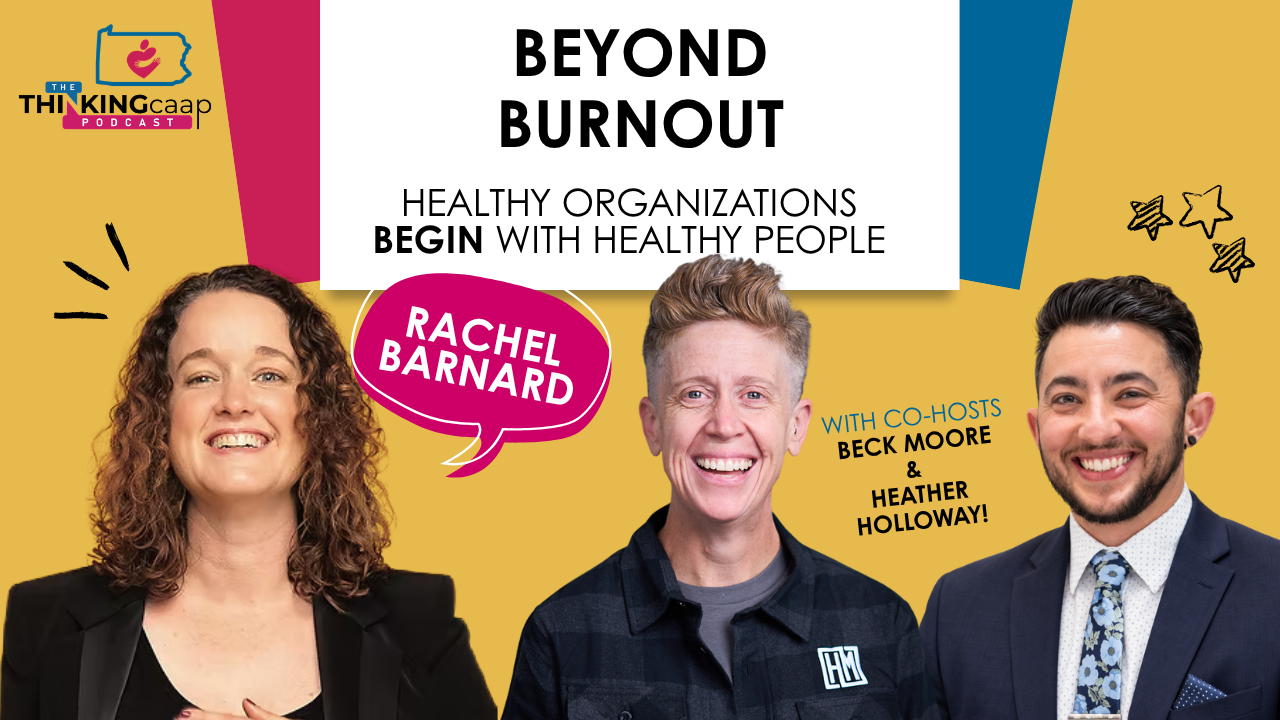
IMAGE DESCRIPTION: A yellow background. On the right is Beck Moore in a blue suit and white shirt, smiling while looking at the camera. next to him is Heather Holloway, also smiling and looking directly at the camera. On the right is Rachel Barnard with a bright smile and an upward gaze. The headline “Beyond Burnout” is bold on a white block at the top. Their names, stars, and black highlight dots are scattered in the background.
Episode 45 Talking Points
[00:00:01] Rethinking Resilience
Beck and Heather ask whether mission-driven workplaces need more resilience—or healthier expectations around what people can carry.
They introduce Rachel Barnard, founder and CEO of Creative Civility, to explore what helps people and organizations thrive.
[00:02:05] Burnout Is Not a Personal Failing
Rachel frames burnout as a signal about working conditions and unmet needs, rather than individual weakness.
Mission-driven workers carry the emotional weight of urgent human needs while navigating the gap between what systems promise and what they deliver.
[00:07:40] Agency, Timing, and Trusting the Work
Systems often struggle to accommodate people’s full complexity; apparent inaction does not necessarily mean someone does not want help.
Rachel shares how a young person’s progress became visible years later, reminding listeners that change belongs to the person receiving support.
[00:10:24] What Thriving Organizations Make Possible
Exhaustion can lead to consequential mistakes and leave little room for creativity, innovation, or delivering on the mission.
Thriving does not mean eliminating stress; it means preventing stress from compounding without relief.
[00:13:15] Replacing “Should” With “Could”
Rachel explains how “should” can reinforce shame, while “could” creates room for choice and possibility.
Beck shares CAAP’s approach to capacity: employees can name their limits, and leaders must be prepared to adjust the work.
[00:16:24] Protecting Capacity and Defining the Promise
Rachel describes mapping what gives energy, drains energy, and falls outside someone’s role to clarify responsibilities.
Drawing on Young New Yorkers, she explains why organizations must know what they can do well without taking responsibility for every connected need.
[00:19:13] Recognizing the Fatigue Cycle
Untended fatigue can feed mistakes, conflict, burnout, and reduced creativity.
Rachel encourages leaders to treat these warning signs as invitations to care for people and culture, rather than assign blame.
[00:22:29] When Working Harder Stops Working
Rachel, Heather, and Beck share personal experiences of pushing through exhaustion and overlooking physical warning signs.
They explore how achievement, childhood patterns, and self-sacrifice can make asking for help or taking time off difficult.
[00:29:43] Giving Without Proving Your Worth
Rachel challenges the belief that people are valuable only when giving everything they have.
Beck and Rachel share everyday ways to reconnect with joy and presence, from naming a favorite moment at dinner to noticing music on a walk.
[00:35:42] Sustainability Across a Career
Rachel discusses time in demanding roles, changing capacity, and the value of honest conversations about sustainability and possible transitions.
Beck explains how turnover and restructuring can leave a cultural burden that affects longtime staff and new employees alike.
[00:43:34] Culture and Joyful Disruption
Rachel describes culture as a shared agreement about what is possible; exhaustion and repeated change can narrow that sense of possibility.
She shares how creative courtroom exhibitions helped judges and prosecutors see young people more fully.
[00:46:29] The ME Manual: A Personalized Guide to Thrive
Rachel introduces Creative Civility’s process for mapping burnout, separating personal experiences from system realities, and identifying unmet needs.
Through reflection and play, participants build a personalized guide with practices and commitments that support their well-being.
[00:50:23] Levity, Connection, and Humanity
Beck shares the meaning behind his “Rule Number Six” tattoo: remembering not to take himself so seriously.
Rachel recalls young artists offering temporary tattoos and affirming words to court officials, creating an unexpected moment of connection.
[00:53:44] Finding Hope and Receiving Support
Rachel reflects on the kindness, joy, and wisdom she continues to find in people, even amid difficult circumstances.
She and Beck discuss restorative community connections and activities that offer something different from daily work.
[00:58:54] Willingly Give and Graciously Receive
Rachel reads “Receive,” a poem about welcoming rest, beauty, and nourishment so giving can come from abundance.
The episode closes with thriving as the baseline and a new question: “What kind of workplace am I helping to create?”
Episode 45 Full Transcript
00:00:00
Welcome to Thinking CAAP. Heather, first of all, I'm happy to see you.
00:00:16
Oh, thank you. I'm happy to be here.
I've been thinking a lot about this word resilience. It's been something that I know that I've written about recently in on LinkedIn, a few few articles. And one of the things that people tell those of us in human services is really that we need to be more resilient, right? We need to push harder. We need to stay positive. We need to keep showing up. But lately, I think one of the things I've been thinking about is is that really the right question. Have we been asking ourselves sort of the wrong question?
00:00:47
Yeah. Well, and I think as a culture, that's that's I actually I love that you're on resilience because, you know, speaking on stress and resilience myself, this one lands real deep. Uh because I think what we do here in this mission-driven work, my gosh, we pour our heart and soul into this work and then we're conditioned to celebrate that we poured everything out and we need to give more. That's kind of the culture. Yeah.
00:01:13
Yeah. But you know, caring deeply and doing the work uh and caring deeply and then carrying that two different things. Yeah. No, absolutely. And I think today's conversation really isn't about the burnout piece. sits around creating workplaces where people aren't just surviving, they're thriving really, right? Thriving is the word of the day because ultimately, and this is something that you and I both speak about on a regular basis, is that healthy organizations have to begin with healthy people, right? In order to serve our people well, we have to make sure that we're healthy and that we understand and are grounded in in all of the pieces of this. So, we're so excited today to welcome Rachel Barnard, the founder and CEO of Creative Civility. Rachel, welcome to Thinking CAAP.
00:01:56
Thank you for having me. I love everything that you just said. No notes. No notes. Well, I want some and I want to make sure to say thank you to Bree Groff who is a a friend of the Thinking CAAP, a friend of Community Action. She was our keynote at last year's conference. She's the one that introduced us. And so, thank you to to Bri for for doing that and being an amazing connector of people. So, Rachel, I'm going to jump into things here. So when people hear the word burnout, what do you feel like they usually get wrong in in that sort of description and that idea and philosophy?
00:02:34
I think one of the things that people experience when they're experiencing burnout might be that it's a personal failing that they used to have this capacity to do these things to do servant leadership to be of service and to give and you know help their clients meet their needs. um and go above and beyond and all of a sudden there's a really reduced capacity and they might think things like what is wrong with me or be self-punishing. So I think the first and most important thing is that it's not a personal failing. It's more a signal about the environment you're working in and what you might need to not just survive the work but like you said in your opening move to thriving.
00:03:24
Another thing is that it's just the amount of work you're doing. Um the amount of time you're spending. And I think we all know in human services, in social justice work, uh there's a different load to different parts of the work. Um and a lot of it is very human, a lot of it's urgent, and a lot of it's heartbreaking. Uh, and we're really trying to meet the world and meet people where they are and create a five-degree shift right through to a 180° shift. And the gap between what should be or our vision for a just world and what is can be really heartbreaking. And so all of those things are coming into play around burnout and vicarious trauma and experiences like that. that's very common and inevitable in the work because it's courageous-hearted work.
00:04:23
Sure. No, absolutely. And so just to kind of put a a finer point on this. So ask two questions really. One, do you think that mission-driven people, particularly those in in human services, do experience burnout differently is question one. And then sort of a followup to expand on a little bit. I think you've already touched on this to a degree, but why do you think that mission-driven people are experiencing this this burnout differently?
00:04:48
I think absolutely mission-driven people experience burnout differently. I think um a lot of it is it's because it's very common for people that lean towards their Heart Center uh rather than being structural or analytical to join mission-driven work. And uh then there is you know you're working in a team and every person has a different history, childhood um story that they're bringing to the work. And that diversity makes a lot of beautiful things possible, but the way that people are connecting to the work or the lens and the life experience they're bringing is different. And so it's going to open up different points of view and different values as well. uh which is hard to hold, can be hard to hold. It's very enriching, but it takes something. So just even working as a team can require a lot of our humanity. And then there is the work itself.
Um and uh I think one of the biggest differences is the cognitive dissonance in what should be and what is. Sometimes we're working in plainly ridiculous systems that are so absurdly harmful. Um, and it's obvious to the gap and then our work is often asked to bridge that gap. But no one human can actively make an oppressive system right and just for another person. And so those are some of the reasons why or some of the background context why we experience uh burnout so differently.
And it's it can go all sorts of places to you know a resigned anger um and you know being right about how wrong everything is um which doesn't often can be a helpful energy but doesn't often move the needle for the work we're actually trying to achieve right through to a self-loathing you if you internalize it and uh you know a profound heartbreak and self-loathing that's the kind I experienced when I was running Young New Yorkers, you know, just seeing how extraordinary the young people were and how the systems were so profoundly failing them and thinking that I could be the bridge and I couldn't.
00:07:40
Well, I couldn't. And I think to to your point there that the systems that we operate within in supporting people are not built often for the layers of who we are as people. And try as we might to re-engineer those systems, that new layer that suddenly, you know, arises complicates the system right away. And it's like, oh, we didn't think about this right in the build. And so it creates more frustration both for the people who are trying to be served, right, and trying to navigate the system and then the people who are trying to navigate the system on their behalf. And I was just talking to somebody about this on Tuesday in that I think the other thing that can be very frustrating that you sort of spoke to a little bit there is the idea that when we see people not taking action, it frustrates us because we want to help them succeed.
00:08:34
But what we have to stop and recognize is that inaction sometimes that we see on a participant's part right is not it does not we can't automatically assume that inaction means that they don't want action. It could just mean that they are so overwhelmed with the choices and being in the crisis that they don't have the capacity to make the choice. Right? Because we're so in it.
00:08:57
I understand that completely. I had a young person who um seemed to not be receiving or engaging in the work. This is possibly like 15 years ago now. Some uh his name was Sha in my first cohort. And um I just didn't see any evidence that he was moving the needle. And then 2 years later, um, I was on the train and this tall gangly kids is just like running towards me, Miss Rachel, Miss Rachel. and he's like, I paid for my train ticket, you know, and I'm thinking about my choices and I'm in this apprenticeship and you know, so I think sometimes it can feel like what we're doing is futile um and we don't have the partnership uh we need. But the truth is, it's not our agency. It's not our story. it's that young person or the client's story.
00:10:01
It's their life. It's their agency and uh sometimes years later there's a real difference created and you just I think it's a leap of faith that these things happen in mysterious ways. But that was one of the funniest moments of my subway life here in New York.
00:10:24
Yeah. Sometimes one one small little influence, right, can create really big change and you don't even realize it until you you know happen upon the big the big change. But your work really isn't about burnout though, right? It's about helping organizations thrive. And so if you can describe to us a little bit about, you know, what's the difference and really when did you realize that this was the work that you were meant to do? I think one of the big costs of burnout or compounding vicarious trauma is there can be a fatigue that leads to a lack of integrity.
00:10:58
And this that's the first thing um which can be really undermining to the mission that we all gathered to serve in the first place. So, for example, um in the criminal justice system, it's not uncommon for there to be mistakes in reporting whether a young person turned up or not um to a mandate and whether their case will now be dismissed and sealed, which means that an administrative error becomes potentially a criminal record for that young person.
00:11:31
And I think a lot of things happen like that more commonly that we than we like to acknowledge. That's really just a consequence of people being tired. So the first thing is is really looking honestly at what it takes to create an integrity-driven organization um and how important it is for justice that people inside that organization are thriving. The second thing that gets hit on an organizational level is creativity and really being able to innovate. If we're in survival mode as an organization uh or going from one urgent problem to the next, there just isn't the space individually or collectively to create novel solutions that could have an outsized impact. And uh an organization that is thriving is an organization that's creating a real difference in the world with integrity and with creativity and innovation.
Uh and that's only possible in my view when the individual members of that organization have the space to really thrive. That doesn't mean there's no stress. It just means that we're having an honest conversation about where we are at and where we're we're going to move to.
00:13:01
Yeah. Not all stress is bad. I mean, it helps us stay safe or keeps us alert, but just the compounding over time, never getting that relief valve, that's when we start to get into some trouble.
00:13:14
Absolutely. I want to go back. Rachel, you mentioned something earlier and I loved it because you used Now, now if you're listening at home, of course you're not seeing this, but if you're watching live or when if you're watching online, you know, when you said should, you put up the air quotes. I'm just so curious about the word should with you. What do we feel about that word should, especially in mission-driven, you know, agencies? So, I feel like that word should makes us carry maybe more than we need to.
00:13:41
Exactly. This is when we the word should is kind of a signal I think in language when we're blaming ourselves and moving into a shaming territory. The idea that there is a right way and that that right way is on our shoulders. Um so I think if we're using should a lot um there's a lot of self-judgment or judgment of others happening in the space and that's just one step away from shame and nobody operates well from a place of shame. Not in a long-term way anyway. Perhaps we go into striving and um hypervigilance which can get some short-term results but not in a sustained way for people or for a group of people that are Yeah. moving an organization forward.
00:14:37
Yeah. Yeah. I like to replace uh if I can I like to replace should with could. You could you could and then that gives agency. There's a choice there. There's there's hope. Yeah. It also gives access to a lot of creativity because we could do this but we you can hold different ideas all at once. You're not narrowing the complexity of something. You're creating an opening to hold more of it and to hold space for more things to be possible.
00:15:09
We have I think and somebody said this to me you know early when I got to CAAP around the idea of just because we can doesn't mean that we should and really evaluating right like when that actually happens and what's the decision tree and what are sort what's sort of your cornerstone about you know making the decision and not that we have that perfectly right at cap to be clear but I think the the other side of that for us culturally is that we've our workplace culture standards and sort of performance expectations are around. We recognize that it's okay for somebody to say, "I'm at capacity and that we're going to honor that and make sure that we're thoughtful about who else might take that project or maybe recognizing we just don't have capacity as an organization then, right?
And we're not going to take on that project." So, I think, you know, speaks to what we're talking about and gives, you know, a tangible tactical thing that you can put into place to do at your organization.
00:16:05
But right, you have to make sure you're prepared to actually honor in that statement and what's the what's the backup for it. Right? There's all these other pieces that fall into place in terms of the the managerial part of that, but it's something that we've really tried to be very thoughtful about in the way that we show up for each other as a as a team within the the association. It's really beautiful that people can say capacity in regards to themselves and where their capacity is at and that you have that in language inside your organization is a real testament to your leadership.
Um I think another way of approaching it from a different angle is um we sometimes do a mapping exercise in our workshops of um the diff all the different parts of our roles that give us energy or cost us more or outside our roles but we do them anyway or um you know maybe a client um throws is very activated I was about to say throws a tantrum that's leftover language from my mom that a a client might get activated and that isn't stuck in that moment that requires processing on your part to to let it go and be clear for the next person. Uh so understanding that and um then choosing what parts of the work that you do and you develop mastery around and then trusting that that's enough and allowing the your clients to have agency over their own lives or trusting them with their own lives.
So we create sometimes gardens, sculptures which seems very airy fairy and arty and and so on, but you develop a language and a a visual reminder as a community of workers of what your promise is and what is enough so that uh you have less leaks to your capacity. to be really proud of. For example, in my case, um, back when I was running Young New Yorkers, I could be really proud that we were helping young people not get criminal records and sometimes young people had issues with housing and food insecurity and mental health issues and we didn't have the capacity to solve all those issues. And it's even hard for me to say right now like no, we can't partner with you on that. Um, but as soon as I really understood what we did and allowed ourselves to do it really well, uh, that was so helpful in not leaking capac our capacity and energy um, and staying whole and energized.
00:19:12
Yeah. No, absolutely. And I I think it reflects right this the idea of strength-based leadership the idea of reflecting on what strengths are for an organization and the reality is it's a lot it's a lot easier and I don't I don't mean the word easier because the work that we do is hard but right like I think physically mentally for us to be successful to lean into our strengths as an organization as a group of people right it it allows us to focus on the things usually that we're we're better at that right we can be more effectual at which helps us feel more you know more successful and ultimately helps our participants, our clients, however you want to describe the people that we're working with, right? Be more successful as well.
So, I want to transition a little bit to kind of some of the the work that you you do and this this sort of cycle that you describe around fatigue and conflict, burnout, apathy.
00:19:59
If you can walk us through that a little bit and just kind of talk to us a little bit about where do most teams get stuck and what are the the warning signs that sort of leaders are are missing in this cycle? So now there's a couple questions in in one question, but I I am confident that you have all I love it.
00:20:19
Well, for the cycle, I think the first thing to remember is that it's normal and naturally occurring in our work and to understand that it's not a me problem or an us problem or a them problem. This is the fabric of the work that we do. Um it's it's the environment. Um, and if we don't tend to the vicarious trauma or the burnout, um, we can lose our capacity. Like we were just talking, we can become incredibly fatigued. Um, and the ways that we become fatigued are you often unique to us. So people around you will be having different reactions or different responses to essentially the same phenomenon. Uh and this leads for an organization often times to um mistakes being made that impact our mission and the work that we're here to do and to lose creativity.
00:21:25
Um and then that's disappointing to everybody involved. that creates a small heartbreak that leads into the fatigue and so it becomes a vicious cycle. Um, and so I think one way that's great for leaders to look at it is to notice if there are mistakes happening because often time leaders want really great results for their organization. They want to see the world changing under their leadership. um it's what drives them and to see mistakes being made or um people not having the energy to discuss ideas or approaches um as a signal to tend to the culture and to look after their people and to start meeting their people where they are just like they would meet clients or the world where it is to create change that way. It's like an invitation.
00:22:25
Yeah, Heather, I don't know how you feel about this. I It's something I've had to learn along the way. I'm not always great about asking for help. And so, I'll qualify myself as a high performer, or at least I strive to be a high performer. And for a long time in my career, it took me a really long time to ask for help. I don't know if that if you've felt that way, too. But I mean, yeah, I speak on it now. I damn near killed myself, right? Same. I I stress myself out so much. I overwhelm myself so much. Yeah.
00:22:55
Yeah. So, you know, I'm curious, Rachel, why you think and frankly, you know, I think that a lot of the people who we get the opportunity to work with at at CAAP are also high performers. But from your perspective and your experience, you know, why do you feel like that high performers are waiting so long to to ask for help? Well, I know for myself um that often the refrain that would go on for me in my head to offer you a window into that um was, "Oh, I'll just need to work harder. I just can work harder." I can remember looking at a series of problems one young person was having and going, "Okay, I just need to be stronger.
I need to almost become like a wrought-iron lady that can hold hold all of this and can move these kids through that and I can do that and through my whole life when I've worked harder I've gotten better results I've solved problems um the striving has been a wonderful powerful thing and then when you're in social justice work and you're on the ground doing the work and being with people a different kind of fatigue sets in and I personally didn't have the capacity to hold more and more and more and my mind was determined to to work harder and harder but eventually my physical body broke down. Um I Michael.
00:24:37
Yeah, I'm interested how it showed up for you two. For me, it was I got Bell's pausy and then six months later as a young woman had shingles and um I really had to take a a break. But I remember when I got Bell's palsy, I was like, "Oh, well, I'll rest it in a couple of months." because I was working on a big funding deadline that and and the thing is it did end up doubling our budget and also what kind of state was I in that I really thought I couldn't rest and I really prioritized deadlines and the organization over my own well-being.
00:25:20
It's interesting to look back. I I think it's the same. Go ahead, Heather. I mean, you can I know you've shared before, but go ahead and share, please. Well, I was just just going to say I think that's what we do. Uh our strivers, high, you know, u high achievers, we want to do good in the world. We want to we want to push this thing forward positively, right? And in order to do that, it takes energy. So, for me, it was all caught in my chest. So, I had I had chest pain and to the point where I thought I had a one-way ticket to a heart attack. So, had I did the EKG, did the whole thing, but we you know, everything on paper is fine. Uh, so you know, there were there were points where, you know, I walked walked out the door. I didn't know if I'd be coming back back.
00:26:00
Yeah. I mean, I talked about this before on a couple different episodes. You two years ago, I broke my arm and my ACL and had to have two major surgeries in the same year.
uh you know and you'd think that I would have learned from prior mistakes but if I rewind back to like 201 12 13 I think somewhere around there I was having major stomach problems for a long long time I kept putting them off kept putting them off and eventually ended up having to have a major surgery because of the amount of pain that I was in and you know similar stories with even team members at CAAP that you know were in former organizations and felt the same way and I think this is the nature of the conversation I was just having on another episode with with Cara Harden around this idea about right and it so resonates with me is that when I was a little kid you know the oldest of five kids I'm the was the person who right helped take take care of all the things because my parents both were blue-collar worked you know wild hours and so to ask for help was a sign of weakness right and so and we just sort of built with this idea if I work harder it's going to give me more I'm going to be happier I'm going to achieve the thing and so sacrificing yourself well That was just that was just the way it was, right?
And so now today it's as somebody who likes fixing things, likes to help people. Well, I don't want to let this person down, right? They've asked me, they they've shared their vulnerability. So for me to say no, right? I can't do that. That's not I'm just not I'm just not built that way
00:27:31
But what and I said this to you, Rachel, before we started this this afternoon, right? that that conversation and this conversation it's just sort of it's so interesting, right? It's sort of like rebuilding my way of thinking a little bit on this topic because I think we at CAAP are always constantly striving to elevate, right, and make better. But we I you know trying to make sure that we're honoring that capacity statement that I already made. And ultimately early this earlier this year I started going to uh we have a partnership with an organization called the Heart Center and it's this idea of sort of energy healing right and being really thoughtful about what we're putting in the world and how we're taking care of ourselves which is all part of what we're talking about today.
But um the person who I was working with privately said you know Beck I know that everything you do you lead with heart.
00:28:27
She's like I don't have to know you for more than 10 minutes to know that. And what that means is if you're not taking care of yourself, right, you're just pouring out. And it's the whole idea of, right, like you can't pour out of an empty cup, which I hate that saying so much because I've heard it so many times now, but it's not it's not not true, right? I do believe it deeply, but she told me in that session, she's like, "You're energy is completely depleted and I can't be your energy dealer, right? Like you've got to find ways of finding that energy." And so I am thankful to say, you know, I did actually use all my vacation this year, which is the first time I have ever in my entire 20 plus years of working actually used all my vacation.
00:29:13
That's something to celebrate. I mean, seriously. Seriously. Well, I'm Australian originally, so I've always been good at using my vacation. I preach it all the time, Rachel. I preach it all the time. But it doesn't mean I actually have been able to do it. There's some kind there's that that guilt factor in there for sure.
00:29:31
Yes, absolutely. And that worthiness coming from being able to provide for others but providing it that support alone um that self-sacrifice. I think there's a wonderful kind of Möbius strip in the the reality of all of this because I think in other parts of culture perhaps not in human services but um more in the social media culture. I'm sorry. I hope you don't hear all those semi-trailers going.
00:30:04
It's totally okay. Don't worry about it. My dogs bark. You've got trailers going by. Yeah, I got traffic. um is that uh let me just find myself again. Uh yeah, there is a wonderful Möbius strip in all of this because in other areas of culture like social media for example, um often what they're missing is the true joy in giving to others and being of service. and that um one of the ways to truly heal anxiety and depression is to ask how we can be useful to other people. And so that's a common or becoming more of a common understanding that's it's a blind spot of our broader culture. But in social justice and social service worlds, um we know that joy and also uh we know our value sometimes through giving um to the point of running empty to use that metaphor that is so clichéd but also annoyingly true. And and so there's these two things operating at once.
Like do I want to now become a corporate person who is earning zillions of dollars to then go and buy a yacht or something? I can't even think of a scenario very quickly because no that to me is a hollow existence. To me there's not joy and substance. But do I also want to live my life for myself and to experience great joy and ease and to give from that place of great joy and ease um and my own happiness? Yes.
00:32:03
Because I've seen what is available so effortlessly when I am coming from that place. And yeah, it's a bit of a blind spot in the larger culture um that we're only happy when we're receiving. But then in our micro part of the world um the blind spot is the opposite that we're only valuable when we're giving everything that we have and that others around us are better for it. Um yeah
00:32:36
Yeah. It's we do this activity. I think I've talked about it before on Thinking CAAP that we go around the table at night when we all eat eat dinner together when we can all be together in the same space and we ask the kids and ourselves right what was your favorite part of your day and it's you know the idea that eventually right like it becomes a part of your psychology to look for the moment of joy and that you're excited to share the moment of joy with your family and on the days where I sort of draw a blank I'm like oh okay that's makes me feel sad but then My response usually in that moment is it's right now, right? Because I'm having this moment with my family. And so I I feel like there is there it it's all about I think finding balance and recognizing that even in the hardest moments there is a piece of joy to find to sort of resonate on and remember about.
And the more that you think through that, right, the more that you you journal about it, whatever it is that helps you to kind of keep grounded in that space, the more likely are you are to identify it on an ongoing basis.
00:33:44
Absolutely. I love what you just said so much because that will be different for each of us, how we register our well-being by being able to register how present we are in our lives. So for example, what a gift that dinner is that you can even register that I have no favorite part of my day. I haven't it's not coming quickly for me. So you have that register that perhaps you weren't present or you're in overwhelm.
00:34:14
And for me it's like going for morning walks. Like how many things did I see on my morning walk today? Was I in my head or was I present with the world? And you want a phone? Yeah. Right.
00:34:30
Exactly. And I remember one of the most remarkable things that happened to me 6 months after I stepped down from my executive director role was that I was uh sitting um by the beach with my friends and music was playing and all of a sudden I was moving my body to the music and I was like I think I haven't heard music for 5 years because even when I'd go to a concert I'd be in my head solving organizational problems and understanding who I was going to talk to and uh what agreement we could come to easily and how that would help something else and rather than being present to music. So for me it's walking and music it sounds like for you it's like how in your phone you are kind of Yeah. Well, I I teach people to check get off their phone. Like I own a so here's here's check this out. I own a social media marketing agency and I'm taking people to get off of social media.
Like because I mean it's just we got to get there. We must stop and smell the roses. It's so sweet. It's so sweet.
00:35:42
I love that because it's both. It's always both. Both and yes and. Yeah. I um I'm so curious in your line of work and and it's particularly mission-driven work. Does burnout have an age? Like if you're a newbie to this work, like are you not allowed to be burnt out?
00:36:01
Oh, that's so such an interesting question. I love that question. Well, for a lot of us, I think Heather, you're probably about to say this, right? Like if you've been in it for a while, you sort of end up feeling like, well, you know, you're not allowed to feel burnout. You just started, bro.
00:36:16
Like, get it together. Toughen up, right? Yeah. Toughen up, buttercup. I didn't I didn't uh I didn't have my breakdown and breakthrough until I was in uh my early 40s. But I know I had to have been overwhelmed in my life before.
00:36:33
I think there are so many different things to this question and this idea that are true at the same time. Um, for example, um, if you're working inside a system that is futile, um, for example, I would say the criminal justice system often times, um, where there is a churn of young people and you do have that helplessness. You're not seeing the results, but still your role is so important because you're meeting the system where it is, reality where it is, young people where they are, and it's really important work. Um I do think over time that time is a major factor for burnout. Um if not age um time and I think it's really helpful in some of those roles to put a time limit on it. I really admire organizations that consider hightouch work like that as having you know a two or three year time limit um and being open at that at the beginning of the role.
Um, the other thing that I love for I I loved it for myself was starting to think about a plan B and an exit plan. um and having fun with that and having an idea for something that might be possible for outside the work because I don't know how it's been like for you but when you know this is a young person's criminal record on the line um they're so extraordinary they're so young and all of these obstacles are in the way for them to be what they were born to be magnificent Um, and there's just doesn't seem to be this reception in the system or in the world at large for how wonderful these young people are. Often they're imagined as monsters, as criminals. Um, and so this grave injustice and the way that it impacts young people for me, the stakes were really high. And I was so determined and that what that's what made me so good at the job, you know, I was so unstoppable.
Um, and sorry, I just got so wrapped up in how unstoppable I was and how magnificent those years of my life were that I forgot what the larger point of burnout was.
00:39:08
No, girl. That's the real joy of the work is how how inspiring the people, how wonderful the depth of human experience that this is all why we do it, why it it does fill our cups until it doesn't until the personal costs become too high. And I Oh, I remembered what you asked, Heather. Okay, great. Let's return to the point. So um so you know so over time our ability to give and be unstoppable which is often required to even just hit the baseline of our role does reduce and then I do think I don't know what your aging experience has been like but for me I do have less energy now that I'm in my 40s late 40s god and I don't know I don't know how I got to middle the middle middle 40. But here I am.
00:40:03
We're here now. Wrinkler and grayer by the day. I love it. I'm in. Yeah. And I I also for me personally um I don't know if we want to talk about hormones. This is not something I'm a girl. Let's get What's your routine? I got supplements. We'll talk all day. We can talk hormones. For me you you know my capacity for caring I think is reduced as my estrogen has reduced you know so I do this is very casual um look we are we have real conversations that's that's not coming from my professional authority that's just coming from my personal experience um but I think and I think it's a wonderful time of life to be able to turn more easily to your own joy and your own pleasure and to give from a place of excess. Um, I think it's really abundant and I'm personally kind of quietly excited about the ways my leadership shows up now and I want that for everyone.
you know, I I think it's possible and I want that for everyone to have a life that they adore, that's meaningful, um that's got problems that are worthy of their life and then allows them to give from that place rather than from a place of needing to prove their value or um deficit even. So, I do want to talk a little bit about your your leadership journey, but I want to just stay here for just a second. And I know try as she might, Heather, you know, tries to keep me on script, but I'm gonna I'm gonna go I'm going to move around a little bit.
I think that one of the things that I've observed in organizations where I've been for a long time and that have gone through a lot of change and kind of to go back to this idea of right like can you have burnout earlier on in your career than what I think we we sometimes think is possible is that you have this phenomenon called uh survivor syndrome that which is a wild phenomenon. There's really this idea, right, like when you've had lots of turnover, when you've had lots of restructures, the people who are left have this burden of, well, I'm I'm left and I'm the one who got chosen and all of this change has happened. And what I've seen occur over and over again is that somehow that survivor syndrome filters over into this burnout that even new employees feel.
00:42:39
And it is the wildest thing. And so you have to I think there is this there is this moment of recognition when you start to feel that happening that you feel like you're just in this consistent conversation about people being burnt out. You've got to sort of stop and evaluate, right? Like is survivor syndrome sort of sort of what's starting to play out here, right? And how do we try to unravel why that's happening and put pieces in place to help offset that?
00:43:03
Because even when the newer people, right, who are brand brand new, like within their first year and sometimes within their first year in the workforce on top of it, that sometimes is infiltrating to create that as a result. And I think it's a it's a strange thing. Um, but the soon fascinating as soon as I read about it, I and I was working in an organization at the time that I was like, "Oh my god, yes, this is happening right now." And it it was so clear to me once I once I read about it and sort of started to better understand what it was.
00:43:34
I think what you're speaking to there beyond that beautiful insight about survivors guilt um once an organization has gone through a lot of change is just how powerful culture is. Oh absolutely.
00:43:50
Because it's not just an agreement on how to behave and treat each other. It's an agreement for what is possible. And if you've been through that much change, the what is possible is so reduced. It's so capped. You're just trying to keep your head above water. You're incredibly fatigued. Any idea that comes reads as a change, which just is like so exhausting rather than a possibility. Um, it's also why looking at a team's culture is so exciting because there are tangible things that we can do to create a culture that's full of integrity and creativity, that is human- centered, that's playful. Um, and a lot of my practice is on purpose very joyful, very sparkly, almost silly because it's a way of joyfully disrupting that status quo.
It's why my burnout workshops involve these like metallic me manuals that and that we create games and I'll have balloons and it's a tactic that was really effective in courts. We would sometimes create elaborate exhibitions inside the courtrooms, places of fatigue, no possibility, endless criminal records, um poverty, uh activated people, shut down people, just a grim place. And then we would install the kids exhibitions and make them as sparkly and as immersive as possible because it disrupted the court actors.
00:45:31
it joyfully disrupted them so they could actually meet the kids instead of bringing their preconceived notions. And I think that's that way that the culture of less possibility of survival that you're speaking to is also the reason that it's so exciting and why I get to have so much fun making things fun, you know, because a just world depends on it. to us having something to joyfully wake us up to our own power and our own wellness and our own possibility to thrive.
00:46:13
Yeah, absolutely. Where can you can you take us there, Rachel? I mean, so we're we're we're at Creative Civility now. We were at the the Young New Yorkers before. So, take us into your work and how you're going into organizations and bringing that fun.
00:46:29
I love fun. I think it's so important um because we need to hold the seriousness of being human together with the joy of it. Um and so I work on a number of levels. My favorite thing to do is do a full arc. So to work with people on their wellness, but also to bring a new project into existence. Um but the very basic thing I offer is called the MI manual and we gather as a group um or as a cohort. Uh the bigger the group the better in this case because it's it's a joyful experience and we map our experience of burnout um as a onetoone exercise literally drawing on paper. And through that mapping exercise, we're able to identify what is our own personal reaction. Um, how does it connect to our previous experiences, our childhood, and what belongs to the systems we're working to, and what is definitely not us to tend to, what is just the reality of the work as it is.
00:47:47
Um and so that really helps us not shed responsibility have or shed personal agency not fall into uh sense of helplessness. But it also means we don't internalize oppression as our fault or I should be stronger, I should be tougher, I should just work harder, which every single person on this podcast has been there based on what I've heard. Yeah. And go on.
00:48:18
No, no, please go ahead. And so from there, we then enter the fun part. Usually the room is in a pretty deep place at that point. You know, you know when you hold space for a room and it's very still and somber and we're somewhere deeper collectively even though it's private. So, it's very sill still. And I have hundreds of cards laid out on the floor. They're all different shades of yellow and they're cards that list the normal human needs um that we have. And I just ask people to silently step up and walk around the room and see in the ways that they're being personally activated, what needs are missing that if they were present, it would make a huge difference to their well-being and the their ability to do the work with joy and without self-sacrifice.
00:49:10
And so that's when it starts to get fun and people start collecting their cards and then we play a game. So everybody gets a literal MI manual. Um I'm constantly designing it. There's over 150 cards and they get a one in a different category and then they play a game with each other where they swap different beliefs or activities um practices, habits um in different areas of life that they can commit to or take on or create a personal shift to themselves. So they literally leave with their personalized user guide to thrive, the MI manual. And it's an artifact designed to be like if you put it in your handbag or on your desk, it's designed to be so different from everything else you have. It's monochromatic. It's metallic.
Um, and then the cards inside are very, very colorful because it's designed to be a joyful disruption to wake us up to our own humanity and our own playfulness, our own sense of possibility. um and to really honor and love ourselves um as the baseline for doing incredible work.
00:50:23
That's amazing. You have cards and I have a tattoo and it says it's a smiley face that my mom wrote and it says rule number six and if you ever read the book The Art of Possibility, the art I love that book. Yeah. Rule number six is don't take yourself so seriously. So I walk around with that in my heart at all times to try to, you know, chill out and take a kinder approach. I love that because levity in all our work is so important.
00:50:51
It what it's what keeps everything alive, you know? So, I love that. Yeah. Yeah. I have a a tattoo on my forearm that says, "Okay." Haha. It's this like snarky thing that I used to apparently used to say as a little kid that I didn't know that I said. And when I asked, I have two aunts that I love and adore deeply who have are awesome listeners to Thinking CAAP.
00:51:18
Give them shout outs on a regular basis. My aunt Susie and my aunt Becky. And uh they I asked them for saying that was sort of around our relationship that I wanted to get tattooed. And at the time I didn't tell them that I was getting the tattoo. So I've got, you know, a word over here for my aunt Beck and then I've got my okay haha over here for my aunt Susie. But the okay haha is sort of like this tongue-in-cheek like Yeah. Okay. Haha. like I'm going to get to it when I get to it kind of moment. But it is that kind of levity, right? It reminds me of them. It reminds me of the story. And it's I think Heather, you and I have talked about this before, but you know, tattoos for me are very much like remembering moments in time and trying to honor those moments whether they've been good, bad, or otherwise.
And so that okay, haha is a is a definitely a and the other word is precious on the other arm, but they're definitely grounding on either side of me because you've got to have a balance other. So, if you don't have a tattoo on the other side for it, you better get Oh, brother, let me tell you. I got I got my dragonfly. I got, you know, we we can talk we can go down that tattoo lane later. What do you have, Rachel?
00:52:17
Well, I love that it's like precious and okay. Haha. Because it's like our insignificance is the significance. Like, it is what's precious. The levity, you know. Y tattoos. I can barely get my eyebrows waxed. Pain is not my thing. But uh once I had a group of young people sentenced to our program, more than half of them were aspiring tattoo artists.
00:52:43
And for that courtroom exhibition, we turned it into a tattoo parlor. And they tattooed using eyeliner, um visionary words on the judges and the prosecutors. And everybody loved it. And there's something about the added element of touch. So they went through a game and at the end they showed the kids they'd sentenced to our program a document they'd created and then the kids would offer them a word of affirmation that they saw in the judges. So you know inspiring or hardworking or whatever they saw. It was really beautiful. So I think the relationship I think I'm familiar with the art of tattoo even though I'm never going to get one because I am a coward. Damn.
00:53:27
Well, I mean, I'm terrified of needles, but I still am covered. Pretty good and covered. But, uh, they definitely hurt. There is no denying that. It, you know, I think I heard someone say, "Well, a kitten didn't lick it on." That's for sure.
00:53:40
That's for sure. That is for sure. So, a couple more questions as we kind of kind of wrap up our time together. Um, I want to make sure to be thoughtful about kind of, you know, thinking about moments of hope and you've talked about some of them in some of the work, even what you've described just then with like the tattoo parlor experience that you were you created in the courtroom, which would love to see. Can there be an episode of Law and Order SVU where that happens? Like I would that would be so restorative culture, right? Seriously, like Rachel, if you can make that happen or just, you know, here's an idea.
00:54:12
Sure. I'll put it on my list. Let's manifest that. Yeah, normalize it really. So, as we think about kind of hope and what you see organizations getting getting right, what are what are the things that that come to mind as you look to the future and are, you know, you're still working in this space where you're trying to help people, right, and disconnect and connect. What's what what would you tell people to sort of right like that are feeling completely exhausted?
00:54:44
Well, I can just share what's I'm noticing for myself and in case that's helpful for other people is that when I'm in rooms with people, they are just the most extraordinary people and I receive the most incredible wisdom all the time. Just listening to people and hearing their stories, I receive so much beauty and joy and wisdom. And with everything that is true right now, um the restructuring, the backlashes, the blatant and gross dehumanization of so many groups of people in ways that are not lip service, but affecting people's lives in violent ways. All of that is true. And it's also true that people are beautiful and kind and joyous and wise.
And I think it is really important for us to all engage in those parts of our collective experience as much as fighting against things certain things because in pouring our energy there in seeing that intending that we believe in the people around us. we can believe in humanity and from that place we can take action um that's beautiful and true and honoring of who we really are. Um I love people. I just people are amazing.
00:56:20
Everybody was born to be magnificent and having a curiosity around that is been one of the most enriching parts of my life. I love that. I love that. Yeah. Yeah. I don't know. I have no notes on that one either. That was really sweet. I I I We can get there. We can get there. We can do better. We can just tend, you know, I sometimes um volunteer for the local newspaper and deliver the newspaper.
00:56:54
It's still Wait, I'm sorry. You said what's a newspaper? The sunset. I'm just kidding. you know, just even just doing something for your local community like delivering the newspaper as a volunteer, something small that where you get to meet people you don't normally meet and remember how amazing people are. Um, just to yeah, fill your cup to use Beck's favorite metaphor slashcliché slash infinite universal truth.
00:57:28
You know, at some point I probably will get a cup tattoo if I'm being perfectly honest. Oh, no. We are going We're getting twinsies. I'm in. Seriously. I mean, it's I feel like it's a necessity at this point because the number of people who have said it to me in the last four years, I'm like, "Yeah, okay. I hear you, universe. I got it. I got it." Yeah. I I think it's when I when I think about our agencies, you know, I feel like I've got some of our our folks sitting in the back of my brain right now being like, you know, right, but I work in this space. But what I would say is don't go and spend time doing the thing that you already are getting paid to do, right? Like mix it up. Go to, you know, something that is aligned, sure, but right to try to find something that is sort of right. Yes.
aligned but different to to mix it up I think is also important because it I don't want anybody to hear that and think like oh good this is another chore that I need to do for my wellness right that's not what it's intended to be good good catch it should feel like you're receiving you know I actually wrote a poem about this should I read it and you can cut it if you don't like it Um, it's like about the differentiation. I just have to uh Is this terrible if I just find it?
00:58:52
No, no, go for it. Exactly to this. I think as you're trying to find it, I'll give you an example to to give you some time to to find it. Is that one of our agencies uh many of our agencies are are Head Start providers. And you know, one of our EDs, I I think it was Michelle Abbott who said it is that sometimes she just goes to her Head Start classrooms to be with the kids because it grounds her. It gives her energy and it's within the work that she does, but it's just it's with a bunch of like little three-year-olds, right? and just finding joy with a bunch of little three-year-olds who are just really excited to see her and do something fun is very different than, you know, sitting in a meeting talking about the P&L or going to, you know, a county meeting where you've got to talk about funding again, right?
Like, it's just getting to play with a group of three-year-olds for a little bit and just play tag. I mean, if you're like me, be careful so you don't tw tear your ACL, but right, like go do the thing. Okay, this is called receive.
00:59:58
I want to give but only ever as a cup overflowing. Which means I want to receive, receive, receive. I want to drink in the beauty of the world's rivers and streams. Until I am the waterfall, until I am the estuary, until I am the thunderstorm full of cracked light and blessings, I want to protect, but only ever as the lioness lying languid in the long grass. The folds of my belly spilled out along the ridge of the hill, forming incidental haven for the young to play and become. Which means I want to rest, rest, rest until I wake up into my own pleasures like a water buffalo sinks down into the mud, swatting away purported productivities with her tail. In fact, I want to receive, receive, receive all of my pleasures. Like the mud receives all of the water buffalo, squishing and squashing loudly in my own delectations.
01:00:53
I want to be the mud. I want to give, but only ever as a cup overflowing, which means I want to receive, receive, receive. Wow. Wow. Wow. Oh my gosh. Thank you for sharing that with us. That's so good, Rachel. Thank you so much. I some some um intentions that I set, you know, we started this out by setting intentions. So, so thank you so much for inviting us to do that. Uh but something that I said as I was trying to exit the overgive game was I want to um willingly give and graciously receive. Willingly give, graciously receive. And so I I try to live that way. Uh both and Beautiful.
01:01:41
Thank you for that poem. That was amazing. I I think that really is a beautiful conclusion. Yeah. I think it I think that is the cherry on top cherry on top. It's you know I think one thing that's staying with me in this throughout this entire conversation is that thriving isn't something that we work we earn after the work is done.
01:02:02
It's the baseline. It's Yes. Yes. is it's it's something that we need to build into. It's the baseline. So, I think that that message is something, Beck, that this audience needs to hear.
01:02:14
Yeah, I absolutely thriving is the baseline. Yeah. No, I absolutely agree. And I think, you know, for everyone listening today, maybe the question isn't around how much more can I carry. Maybe it's what kind of workplace am I helping to create? And when I say workplace, I also mean workplace in in terms of not just your colleagues, but also the people that you're serving and the environment that they walk into because ultimately our communities need healthy leaders and our teams need healthy cultures. And so and the people ultimately, right, that we've already kind of talked about, they the people that we're serving deserve organizations where the people are doing the work are able to keep showing up for the long haul, right? So Rachel, I just want to make sure to say thank you for helping us think differently today.
01:02:58
Thank you for sharing about your work and some of the things that you've done. Thank you for our listeners for joining us for another episode of the Thinking Cap. I'm fairly certain that this was not the last time that you'll hear from from Rachel. Um hopefully we'll be having her join us at an upcoming conference in the fall. And if today's conversation encouraged you, it challenged you, made you think a little bit differently, we'd love for you to share it with someone who could use it. And we'll see you the next time on the Thinking CAAP.
01:03:26
Thank you for being a part of this episode of Thinking CAAP. Check the show notes for resources and links to other episodes. And don't forget to subscribe and follow to be notified when new episodes are released. If you have any Community Action questions you'd like Beck, Amanda, or one of our local experts to answer in a future episode, please email your questions about Community Action to info@thecaap.org. Subject line Thinking CAAP.
If you have any Community Action questions you’d like Beck or one of our local experts to answer in a future episode, please email your questions about Community Action to info@thecaap.org — subject line: Thinking CAAP.