CAAP Trainings Help Organizations Build Skills They Can Actually Use
NOTE: This is the first in an ongoing series of articles where we will go more in depth into the behind-the-scenes of CAAP, explain concepts common in the industry (but uncommon elsewhere), and discuss lesser-known aspects of CAAP’s work in Pennsylvania. Think of it as a CAAP 101 series where we can share what CAAP does and why.
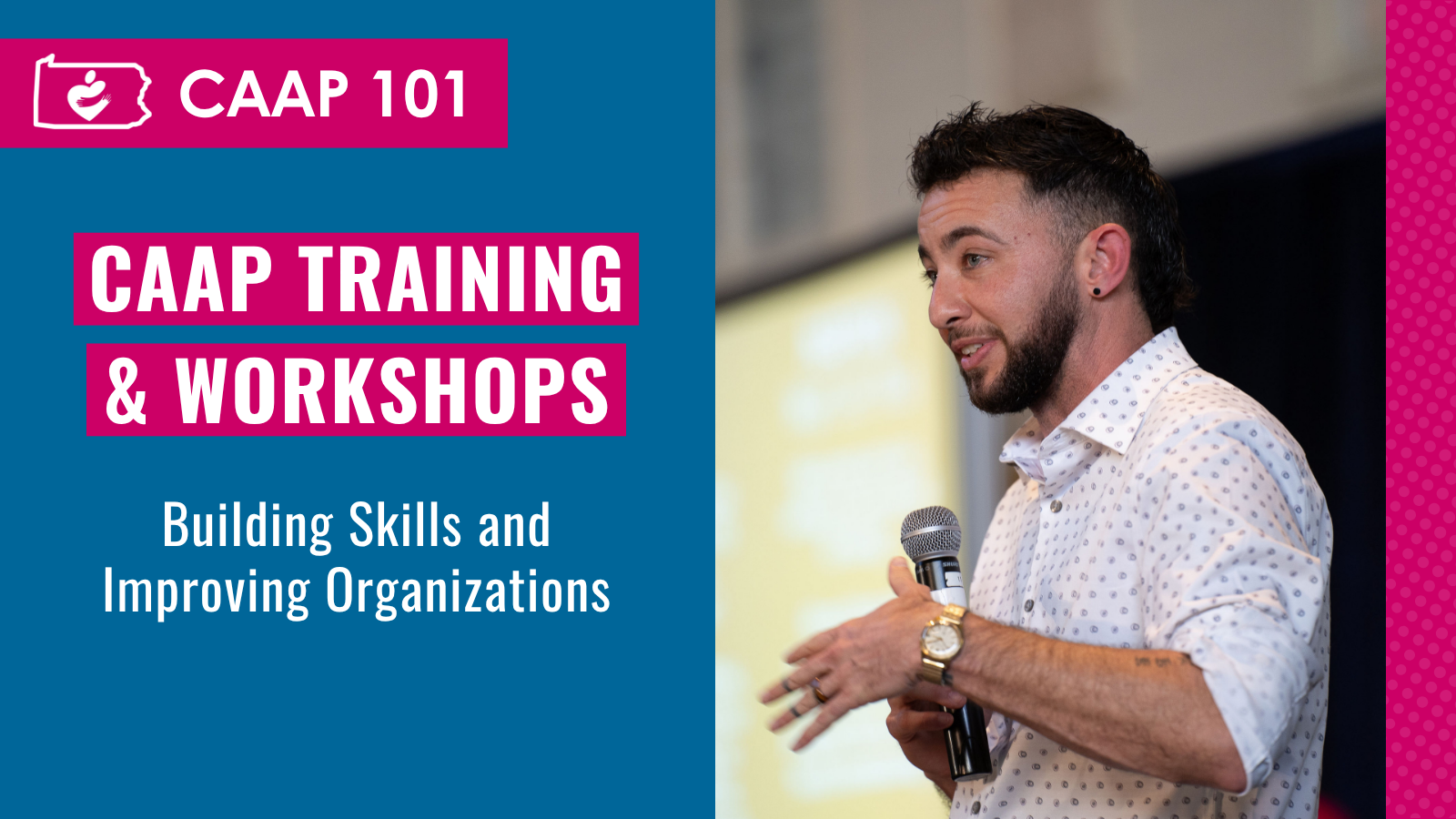
Image Description: A white headline reads “CAAP TRAINING & WORKSHOPS” on a blue and magenta background. Below that is a subheadline that reads “Building Skills and Improving Organizations. At the top is a small flag that says “CAAP 101” and on the right is a photo of CEO Beck Moore holding a microphone and speaking to a group.
Community Action work is complex.
Staff and leaders are often working across several needs at once: housing, food access, energy, transportation, health, employment, family stability, compliance, funding, partnerships, and more. The work is personal, practical, urgent, and deeply connected to the realities of each local community.
Good intentions are great and all, but it takes more than that to build better communities.
It takes strong systems and clear communication. It takes teams that know how to work through hard conversations, improve processes, and serve people with both skill and care.
That is where the Community Action Association of Pennsylvania’s training work comes in.
CAAP helps strengthen Community Action Agencies and other nonprofit organizations by offering practical, field-informed training in several different ways. Some training happens online through CAAPLearn, while others happen through expert-led webinars, cohort calls, and deep dive sessions. CAAP also offers customized trainings for a specific agency, association, nonprofit, or group of professionals facing a real organizational challenge.
The format may change, but the goal stays the same: help people learn something useful, apply it to their work, and leave better prepared to serve their communities.

Image Description: A textured cream background reads “CAAP Trainings help people learn, apply it, and leave better prepared.”
What Training Does CAAP Offer?
CAAP’s training support is not limited to one format or one topic.
Through CAAPLearn, members can access online training and professional development resources designed for Community Action professionals. This gives teams a flexible way to keep learning, build shared knowledge, and support staff development over time. We’ll be sure to post a deeper dive into the breadth of CAAPLearn benefits soon.
CAAP also offers webinars, technology demos, cohort calls, and deep dive sessions that give professionals a chance to learn from experts and from each other. Offered on a rotating basis, these sessions help professionals stay informed, ask questions, share best practices, and connect with peers across the network. Being a CAAP member gives you access to these cohort calls; from the executive level to the frontline staff, there is something for everyone!
For organizations facing a specific workplace culture, training, or system challenge, CAAP provides customized training and facilitation. These sessions can be built around an organization’s goals, audience, challenges, and setting.
That flexibility is meaningful, because, like in any organization, there are layers. From front line staff, to middle management, to executive level leadership, and board members - each of those different individuals have varying levels of knowledge, tenure, and experience. Then we consider the overall work, the range of programs, and the complexities of compliance within those programs - and what we find is that one-size-fits-all professional development, and technical assistance - simply doesn’t work.
A training that works well for one group may not fit another.
For example:
A rural weatherization program may need help improving workflow, strengthening communication between partners, or understanding how new guidance affects daily operations.
Meanwhile, a leadership team working on workplace culture may need space to talk honestly about trust, accountability, burnout, or how people experience leadership inside the organization.
Or maybe a nonprofit board is looking for a clearer understanding of governance, strategy, and its role in supporting the agency’s mission. Frontline staff may need practical tools they can use right away with clients, coworkers, and community partners.
A state association may be focused on broad network challenges, shared training needs, and statewide trends, while a local agency may be trying to solve a specific issue affecting one program, one team, or one community.
All of these scenarios offer challenges that are unique to their specific audience. CAAP’s strength is in understanding those differences and designing training sessions that help people leave with tools, language, and next steps they can actually use.

Image Description: A textured blue background with white text reads, “It’s obvious that Mel genuinely loves what she does. Her enthusiasm is contagious, and it shows in every interaction.” ~ Weatherization Training Attendee
Professional Development Designed for Real Organizational Challenges
Good training shouldn’t feel disconnected from the work people do every day.
It should help them think more clearly about the challenges in front of them. It should give them language, tools, and next steps they can use. It should also create space for people to talk honestly about what is working, what is difficult, and what needs to change.
In Community Action, agencies are navigating complicated programs, compliance demands, funding requirements, community partnerships, staff capacity, and the real needs of families and individuals. Teams are often asked to move quickly, solve problems, and adapt to changing conditions.
Training has to respect that reality and also meet those demands.
CAAP’s approach is practical and people-centered. Sessions are built to be engaging, useful, and grounded in the field. They are not simply lectures where information moves in one direction. The strongest trainings create conversation, invite participation, and help people connect the material to their own work.
That is where skilled facilitation makes a difference.

Image Description: Mel Luckenbaugh stands next to Destiny Murrell, both women are smiling at the camera. On the right is magenta and dark blue text that reads, “CAAP’s approach to training and workshops is practical and people-centered.”
Customized Training for Community Action and Nonprofit Teams
A recent training in Oklahoma offers a helpful example of what customized CAAP training can look like.
CAAP’s Mel Luckenbaugh traveled to Oklahoma to facilitate several sessions for weatherization professionals and partners. Rather than offering a generic presentation, the sessions were built around the realities of weatherization work, including partnerships, invisible disabilities, workplace support, and process improvement.
One general session focused on guiding principles and how strong partnerships help deliver successful weatherization programs. Weatherization agencies, state office partners, and training center partners came together to explore the behaviors and shared values that support stronger outcomes for residents.
The session included real-time participation, group activities, and honest discussion about what it takes to work well across roles and organizations.
Another breakout session focused on invisible disabilities in the workplace. Using Spoon Theory — a simple way to explain how people with chronic illness, disability, or limited energy may have to budget their capacity each day — participants explored how invisible disabilities can affect colleagues, employees, and clients.
The session used weatherization-related examples to make the topic practical for the people in the room. This helped participants think beyond theory and consider how invisible disabilities may show up in workplace communication, client interactions, scheduling, expectations, and daily service delivery.
A third session introduced process mapping as a tool for improving how work gets done. Participants mapped workflows, looked for bottlenecks, and identified steps that may be causing delays, confusion, or extra work for staff and partners.
The hands-on format gave attendees a practical way to see where a process is breaking down and where small changes could lead to better results.
That is what strong customized training should do. It should make the topic clear, connect it to the audience’s daily work, and give people a way to keep using what they learned after the session ends.
Participants did not leave with theory alone. They left with language, tools, shared understanding, and practical next steps they could bring back to their teams.

Image Desctiprion: A mangenta textured background has white text that reads, “Absolute excellence from beginning to end. As the training progressed and got deeper with emotion and reflection, it made you feel more invested.” ~Training Attendee
Why the Facilitator Matters
Strong training is not only about knowing the material.
It is also about reading the room.
A good facilitator knows when to step in and when to let the conversation breathe. They know how to keep people engaged without controlling every moment. They can adjust in real time, listen carefully, and help a group move toward a useful outcome.
That is exactly what participants noticed in Mel’s Oklahoma sessions.
Amanda Ewing, Executive Director, shared, “Mel, you did a fantastic job today facilitating our session. I felt like you were spot on with determining when to sit back and let the conversation happen organically and when to step in and help move things along.”
Jessica Izquierdo, Director of Programs, added that Mel has “exceptional active listening skills” and is able to facilitate discussions effectively even when the topic is highly specific. She also noted that Mel’s personality helped put attendees at ease, creating a space that was both welcoming and productive.
Training works best when people feel comfortable enough to participate. They need to feel heard. They need to trust that the person leading the room understands the purpose of the session and respects the people in it.
Mel brought that kind of care and skill to the Oklahoma sessions, and the feedback made it clear that participants felt it.

Image Description: A textured blue background with white text reads, “Employees sent me several emails appreciating the training and saying it was one of the best they have attended.” ~Programs Director & Attendee
Training That Builds Stronger Teams
CAAP’s training work also extends beyond technical topics.
Beck Moore, CAAP’s CEO, continues to lead sessions and speak with organizations on workplace culture, leadership, belonging, poverty, and the human side of organizational life. His work has reached Community Action audiences, nonprofit leaders, youth leadership programs, housing and rehabilitation teams, and even corporate and government organizations like NASA.
Feedback from Beck’s trainings points to the same larger theme: strong facilitation is about connection, trust, and practical learning.
After one workplace culture session, a participant described the experience as “honest, authentic, engaging, and deeply human.” Another called Beck “confident, experienced, captivating.” In a Community Action presentation, one attendee shared that Beck helped them view poverty through a different lens, while another said he explained barriers related to economic hardship in a way that felt realistic and relatable.
That is what strong training can do.
It can help people see familiar work in a new way. It can help teams build shared language. It can give leaders tools they can bring back into everyday decisions, meetings, programs, and partnerships.

Image Description: A textured cream background with blue and magenta text that reads: Beck gave some realistic and practical ways to ensure everyone in the workplace is included.” On the right is a backlit photo of Beck Moore speaking at a podium.
Weatherization Training and Technical Assistance That Meets the Moment
Weatherization work is a strong example of why practical training and technical assistance are so valuable.
No one delivers a successful weatherization program alone. It takes coordination among agencies, state offices, training centers, contractors, staff, and community partners. Success also requires clear processes, shared expectations, strong communication, and a real understanding of the people being served.
When training is tailored to that complex setting, it gives teams room to work through the real challenges in front of them. They can examine where a process is getting stuck, strengthen communication with partners, and talk honestly about what helps or hinders the work. It also creates space to name the shared principles, behaviors, and expectations that lead to stronger service.
That is the difference between training that checks a box and training that helps people improve how work actually happens.

Image Description: The training CAAP offers helps people improve their real workplaces and systems.
CAAP Does More Than Deliver Presentations
Have you ever had a training and felt like it was more about presentation than actual learning? If so, than that likely missed the mark.
Training is a tool for strengthening organizations.
CAAP helps agencies and nonprofits build knowledge, strengthen teams, improve systems, and serve communities more effectively. The format may vary, but the purpose stays the same: give people practical support they can take back to their teams, programs, and communities.
The purpose is always bigger than the session itself.
After a CAAP training session, people should leave with tools they can actually implement.
For instance:
A workflow they can map with their team to find bottlenecks.
A question they can use to get to the root of a recurring problem.
Shared language for talking about trust, accessibility, accountability, or customer service.
A clearer understanding of how their role connects to the work of other teams and partners.
Community Action professionals are doing work that affects people’s lives every day. They deserve professional development that respects the complexity of that work and helps them keep getting better at it.
That is what CAAP training is designed to do.

Image Description: A textured blue background with white text reads, Did you know? CAAP offers training and technical support to member agencies.
Explore CAAP Training Resources
Whether your organization is looking for online training, expert-led webinars, workplace culture support, weatherization training and technical assistance, process improvement, or a customized session designed around your team’s needs, CAAP can help.
Explore CAAP’s training resources or contact CAAP (info@thecaap.com) to start a conversation about a training designed for your organization.
Strong organizations don’t just happen by accident: they are built through learning, practice, trust, and the people willing to keep growing together.

Image Description: The huggy heart in magenta is on the left, with magenta and blue text on the right reads, “Expert-led. Community building. CAAP trainings are here to help your organization reach the next level.”