Helping Tropical Storm Debby Survivors Find a Path Home
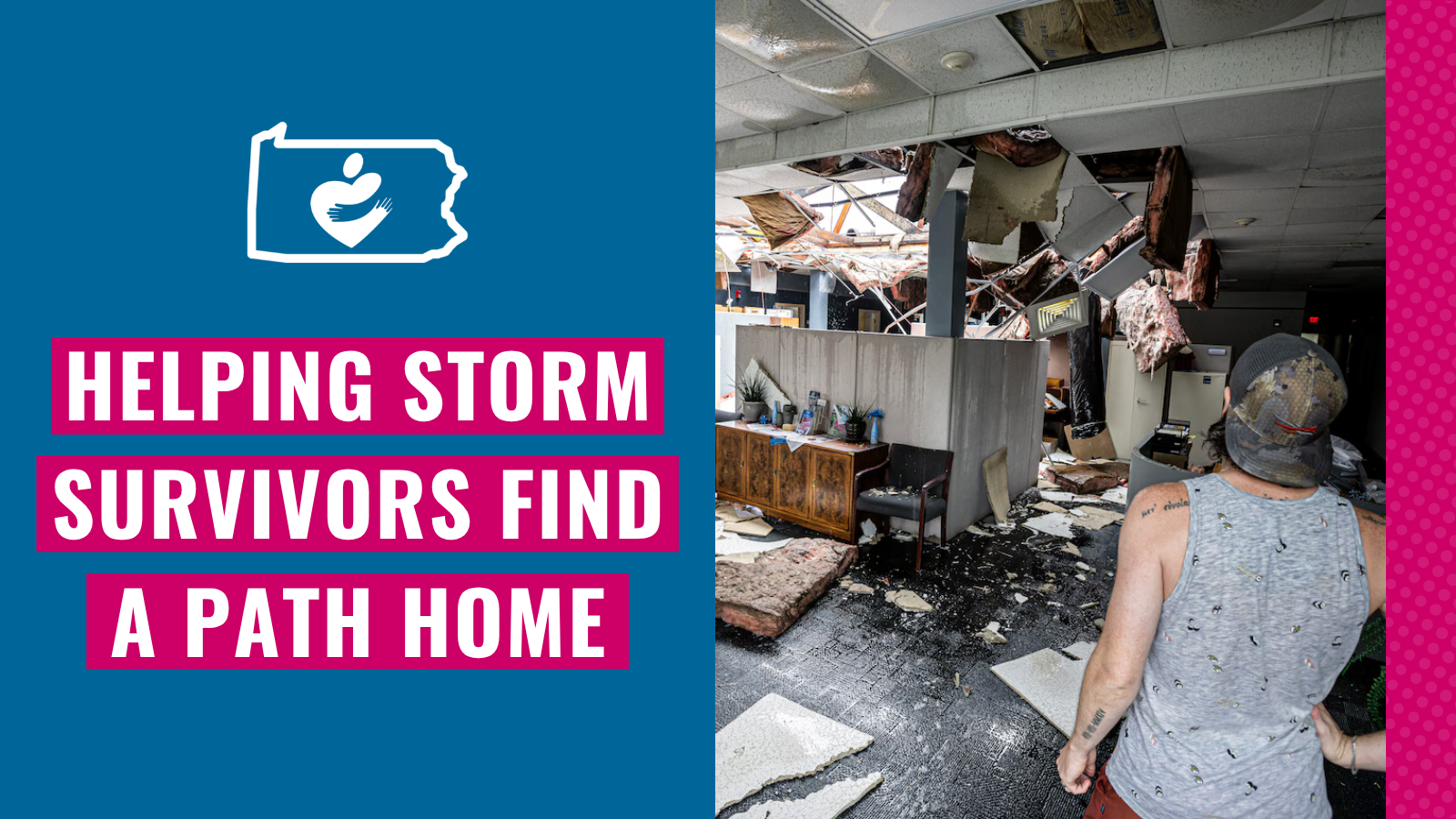
Image Description: A white headline reads “Helping Storm Survivors Find a Path Home” on a blue and magenta background. On the right is a photo of a storm survivor staring at the wreckage of a home.
When Tropical Storm Debby damaged homes across parts of Pennsylvania on August 9th 2024, many families were left facing more than repairs alone.
They were facing paperwork, appeals, contractor questions, financial stress, and the long emotional process of figuring out what came next.
Recovery after a disaster isn’t instant. It happens step by step, often with the help of someone who can listen, organize, explain options, and walk alongside a family until the path forward becomes clearer.
That was the purpose of Pennsylvania’s Disaster Case Management Program (DCMP) effort.
Funded by a Federal Emergency Management Agency (FEMA) grant awarded to the Pennsylvania Department of Human Services and subcontracted to the Community Action Association of Pennsylvania (CAAP) as the administrator, DCMP brought together a strong network of partners to support families in impacted counties. CAAP partnered with PA 2-1-1, Develop Tioga, Northern Tier Community Action Corporation, and Lycoming-Clinton Counties Commission for Community Action (STEP), Inc. to provide day-to-day support for survivors in Tioga, Potter, Lycoming, and Union Counties.
From mid-2025 through June 2026, DCMP case managers helped households sort through paperwork, identify unmet needs, pursue FEMA appeals, and connect with local resources. Their work was practical, patient, and deeply personal.
Over the 12-month program, DCMP partners supported 408 households and made nearly 3,100 unique contacts. They assessed needs, made referrals, helped with FEMA appeals, and, in many cases, became the steady encouragement families needed to keep going through a difficult recovery process.

Image Description: A textured cream background highlights some of the statistics from the article, reading “DCMP Partners supported 408 households, with over an 85% successful closure rate.”
Of the households that stayed engaged with case managers through formal case closure, 85% were closed successfully. Another 9% were still active as they moved into local, long-term supports. Only 6% were closed without their needs being fully met.
Those numbers tell part of the story.
The people behind them tell the rest.
In one Tioga County case, a survivor expected only limited FEMA assistance. With support from DCMP, he was able to complete a successful appeal and received twice the amount he originally expected. That award helped him repair both his foundation and hot water heater.
In another case, a retired survivor living on a fixed income had used retirement savings to make a storm-damaged home livable again. After a secondary appeal, the survivor received the maximum FEMA reimbursement, helping restore some of the savings used during the recovery process.
These stories show what disaster case management can make possible.
Careful documentation.
Local knowledge.
Strong partnerships.
One-on-one support when families need it most.
CAAP is grateful to the partners, case managers, and community organizations who helped Tropical Storm Debby survivors move from uncertainty toward safety and stability.
Disaster recovery takes time. But with the right support, families do not have to navigate it alone.

Image Description: A textured blue background with white text reads, “Recovery doesn’t end when the storm passes. DCMP was there for families when they needed it most.