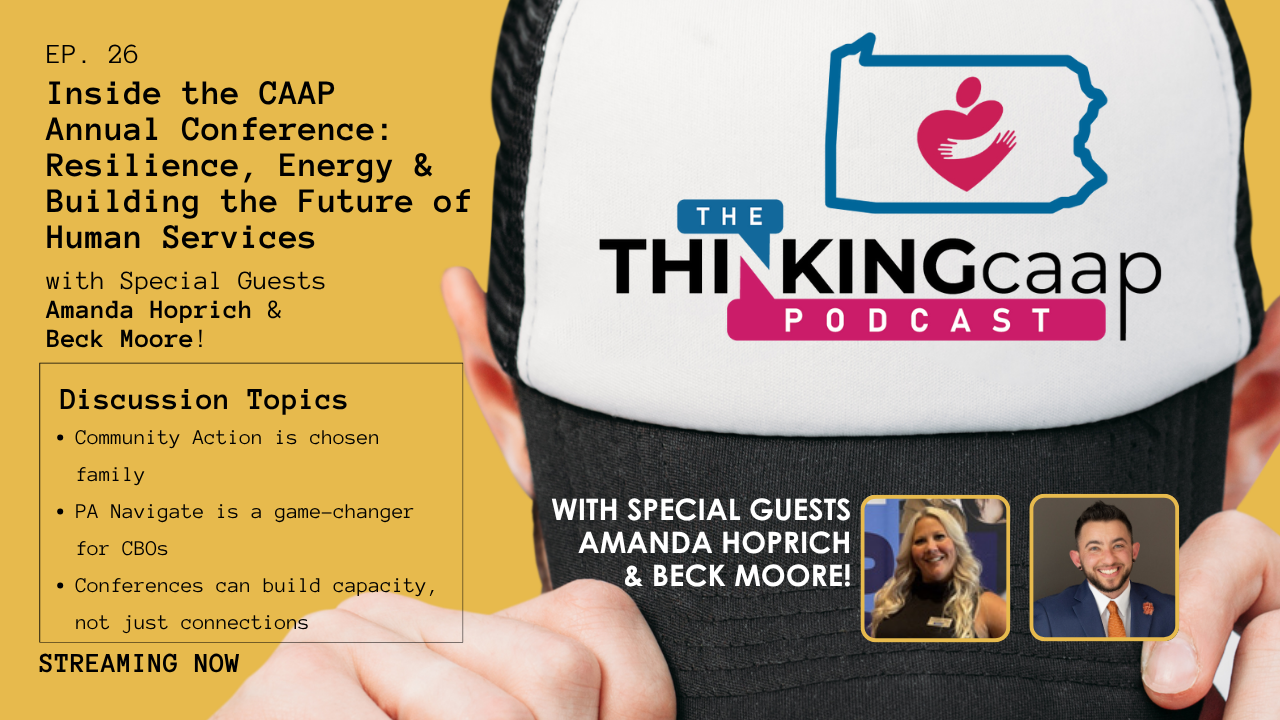
Inside the CAAP Annual Conference: Resilience, Energy & Building the Future of Human Services
What happens when you bring together hundreds of mission-driven professionals, leaders, and changemakers in one room?
In this special episode of ThinkingCAAP, host Beck Moore and previous co-host Amanda Hoprich, now with WIPFLI, reunite to reflect on the highlights, heart, and hard truths of the CAAP Annual Conference from keynote moments to behind-the-scenes planning to the emotional impact of the Community Action Awards and 50th anniversary celebration.
They cover:
✅ The evolution of CAAP’s award ceremony and what it means to be seen
✅ The power of Pennsylvania voices leading from within the network
✅ How pre-conference infrastructure tracks are reshaping nonprofit readiness
✅ Why workplace culture (and a little bit of fun) matters more than ever
Whether you’re in the Community Action Network, a human services leader, or simply curious how systems get stronger from the inside out, this episode is a powerful window into what’s possible when we lead with purpose, reflect with honesty, and celebrate with intention.
Thinking CAAP Episode 26 Highlights
[00:00:00] Welcome to Thinking CAAP
Beck opens the episode and introduces returning guest Amanda Hoprich.
Amanda shares excitement about being back with the CAAP network in Lancaster.
[00:00:34] Pre-Conference Kickoff at Eden Resort
Sessions include HR, Fundraising, New Manager Boot Camps, plus the Executive Leadership meeting.
Energy is already high as agencies arrive from across Pennsylvania.
[00:01:12] CAAPy Hour Tradition Continues
Halloween-themed karaoke brings connection, joy, and levity to the week.
[00:01:38] A Year of Growth & Resilience
Amanda reflects on how agencies delivered progress despite a difficult year.
Specialized learning tracks met the real needs of Community Action professionals.
[00:03:51] Planning Through the State Budget Impasse
CAAP prepared virtual access options and equity-focused attendance support.
Advocacy continued at the Capitol throughout conference week.
[00:05:46] Why the Conference Couldn’t Be Canceled
Despite uncertainty, CAAP protected space for connection and learning.
Scholarships and flat rates kept attendance strong statewide.
[00:07:35] What Is PA Navigate?
A statewide closed-loop referral platform connecting healthcare providers and CBOs.
CAAP leads community engagement and onboarding through panavigatehelp.org.
[00:10:34] Rising Community Need
Budget delays and federal uncertainty increase demand for food, housing, and benefits.
PA Navigate surfaces resource gaps and strengthens referral networks.
[00:13:06] CAAP Store & Scholarship Support
Conference merch like “Holy CAAP” and “This Is My Thinking CAAP Face” funds future attendance.
[00:14:26] Conference Energy Lifts the Room
Attendees reported feeling lighter, seen, and supported throughout the week.
Content reflected real agency challenges: proof leadership listens.
[00:17:20] A Chosen Family in Community Action
Shared mission, collaboration, and lived experience create belonging in PA’s network.
[00:19:55] CAAP Awards Ceremony
A polished, emotional celebration during CAAP’s 50th anniversary year.
Families surprised honorees adding depth and meaning.
[00:24:42] Celebrating Partners & Community Champions
New award categories honored board members and organizations like Geisinger for food access efforts.
[00:28:54] Team Checkout & Reflection
CAAP staff collectively felt momentum rising throughout the event.
Feedback reinforced that session topics met urgent, real-world needs.
[00:31:54] PA-First Presenter Model
Attendees prefer sessions led by Pennsylvania practitioners—people solving problems locally.
The 2025 schedule showcased the strongest version yet.
[00:41:56] Storytelling That Matters
Video vignettes added heart, context, and human impact to the awards experience.
[00:48:00] Keynote: Brie Groff
Play, workplace culture, and joy resonated deeply during a heavy year.
Her book and earlier episode remain audience favorites.
[00:55:04] Strengthening Nonprofit Infrastructure
Pre-conference training helps agencies address HR, leadership, and fundraising gaps statewide.
[00:58:55] Looking Ahead to CAAP Conference 2026
Location still in the works—Eden Resort and Harrisburg remain top considerations.
[01:05:07] Continuous Improvement
Beck hints at updating CAAP’s introductory video to reflect the network’s evolution.
Closes with gratitude and an invitation for ideas, speakers, and feedback.
Episode 26 Transcript
00:00:00
What's up, everybody? Welcome to the Thinking CAAP. This is Beck Moore, CEO of Community Action Association of Pennsylvania. And with me is my previous fearless co-host, slash sometimes co-host, the darling of Pennsylvania, Amanda Hoprich, live and in person. Really excited to have you, Amanda.
00:00:17
Very excited to be here. I am thrilled to be back together with the CAAP team, representing Wipfli as Growth Marketing Manager for nonprofit, government, education now. However, it just feels fantastic to be in Lancaster, back with my pe—
00:00:34
We are currently at Eden Resort and Suites on pre-conference day. So yesterday we had our CBO convening. We had new executive director meeting for a lot of our new executive directors. And today is sort of like the official, official kickoff to the conference with our pre-conference session. So today we have a whole mix of different things. We have an HR boot camp, we have a fundraising boot camp, we have a new manager boot camp. And then of course we have our Executive Leadership AI annual meeting for CAAP. So a very big day. And then of course, let's not forget everyone's favorite part of conference, which is our CAAPy Hour.
00:01:12
CAAPy Hour.
00:01:15
This year though, if you didn't come and join us, I'm sorry to say you would not have taken place in Halloween karaoke, which we're super excited. Costumes are, I'm hopeful for. I know my team, our team is showing up hard with the costumes, so hopefully we get some other takers with the costumes. But excited about tonight. Got a bunch of people coming in and excited to kick off our week officially today.
00:01:38
I have to say, Beck, coming in the first year as a guest and not part of the team presenting, I was just absolutely floored at what a fabulous job the team has done. And I keep saying it. I feel like all the dreams have come true over the last three years. We had all these goals to bring these specialized tracks to the community action agencies across the commonwealth. And you all did it, and you did it in a very tough year. So just want to give you all kudos for all the learnings that are coming to everyone joining in Lancaster and just congratulations.
00:02:21
Thank you for that. You were part of the secret sauce. I mean, I think it’s— I was toasting with the team last night at our dinner, and normally we have a team dinner at the end of conference week, but this year we mixed it up. Everybody mostly got in at the early part of the week, so we were able to have dinner together last night. So it was great to just spend some time with the team and then with the board later last night. But I said to them, I was like, you know, this team has grown so much. This event has grown so much. But you were, you were a part of that. So kudos to you also because you were a part of the secret sauce to get us to this point. So it’s— the team is following, right, the layout that we've continued to just increase what this event has looked like. We've— like every year, hopefully this is the feedback we get again this year. But every year we get the feedback. Amanda, I'm sure you remember, like I don't know how you all do it, but every year just gets a little bit better. So hopefully we continue on that trend.
00:03:16
And on that note, I was just absolutely, you know, filled with gratitude and appreciation in seeing all of the community-based organizations, or CBOs, that joined at the CBO convening yesterday. That portion of the CAAP conference, and it— it as a standalone brought to you by Find Help this year, was just a fantastic outpouring of organizations who are leveraging PA Navigate, coming together for resources. And I believe some folks joined virtually. Right.
00:03:51
Yeah. So to your point earlier about, right, you know, all the preparation in a hard year and getting up to the conference. As we were getting closer and closer— and Erika and I, shout out to Erika because she's like, you know, I just talked in my leadership program about people that come to event organizers like a week before an event with a big idea and I was sort of laughing about it, and then literally, right, I do exactly what she was talking about with a couple big ideas. But I think to your point about it being a hard year, we were sort of reflecting on just the challenge of travel and what that was going to mean. We're still in a state budget impasse right now at the time of the start of the conference. And so we wanted to make sure that people had equity in being able to still attend. And we like doing an in-person meeting once a year for our CBOs. But we ended up having— I think it was 60 people in the room and then about 50 online. A really great group of panelists from CBOs to healthcare. So we had somebody from Jefferson Health, somebody from one of the MCOs in the state on a panel, but really great conversation. I ended up getting there a little bit late because we were testifying at the Capitol about CSBG and then quick run down to Lancaster and then jumped in the CBO convening. But it was a great— I think it was a great day. All of the feedback we heard was really fantastic and a lot of really excellent learning. So, yeah, thank you to Find Help. Thank you in particular to the community engagement team who took on that work and really just did an excellent job. I didn't even— I didn't need to be in the room. It speaks to the strength of our team. And then I think for today, the other thing that we've pivoted a little bit to do is to have also virtual participation in our executive leadership meeting, which we don't typically do, but because again, of just, you know, the state of Community Action right now and nonprofits in general, we just felt like we needed to be able to offer another option. And I think the other thing here that I will say is we— about six months ago we started to talk about this conference and whether or not we still wanted to host it. And I think that the one thing that, you know, I just kept going back to was this event we know is really what I think gives people a moment of being together. And I hate the phrase “refilling cup,” but right— like, okay, that's the phrase I'm going to use. But it does— it really— like you don't feel as alone. You're all in it together. You can talk about the struggles, you can talk about the really good things. We have so many great sessions this year with highlighting some really amazing programs from our local agencies. But ultimately we decided not to cancel even though we were worried about attendance being down. I'm happy to say attendance isn't down. That was also in part largely due to the Department of Community and Economic Development, who gave us some scholarship dollars so that our agencies didn't have to foot the bill for conference. We were able to keep conference rates flat again, which is also really fantastic in a world where inflation is real. Right. And prices are much higher than they were last year with conference planning. But I think we've been thoughtful about some of the pivots that we had to make and excited to see it all— it all happen.
00:06:59
Well, you can see it in the excitement of all of the CAAP members that are here and all that made the trip to Lancaster. So appreciate that you all continue to create the time and space for folks to come together. But I wanted to circle back around to you. If I am a member of a community-based organization and I want to know a little bit more about what's going on with PA Navigate, get in touch with the community engagement manager— how would I do that and how would that benefit my organization in becoming a part of what this looks like?
00:07:35
Yeah, so it's interesting, we have not really had a long conversation on the Thinking CAAP about PA Navigate yet, which yesterday I kept thinking to myself, we need to do an episode specifically to this project. But PA Navigate specifically is the closed-loop referral platform that DHS sponsored, I think about a year and a half ago now, if I'm not mistaken— two years ago maybe. And ultimately, it really creates intentional relationship opportunities between healthcare and CBOs. Provides a space for people to search for resources if they need them, ultimately so that healthcare can send a referral to a CBO who can provide a support or a resource that somebody needs. Right. So if somebody's going through the questions in their doctor's office about food and not having access to food, that doctor's office can then provide a referral to a CBO who is the food provider in their particular network. And so CAAP is the community engagement partner on that project, which is why we host the CBO convening yesterday. And we also host a website called PANavigate Help. And so that website is very specifically for CBOs to learn more about what PA Navigate is, get connected to one of our community engagement managers. We have some really great team members: Kat, Matt, Christina, Keisha, Christy— shout out to all of that amazing team. And yeah, they'll— right, they'll talk you through the platform. Ultimately, from a benefit perspective, I think part of what I heard DHS, Department of Human Services here in Pennsylvania, talk about is that their intention is to use this platform to understand who’s searching for what, how do we find deep, culturally appropriate solutions to challenges within specific populations in rural and urban Pennsylvania. And then at the same time, how do we look at where we're not able to serve people because there isn't a resource? And so how do they redirect funds ultimately? And so this platform gives healthcare, you know, a very different perspective. It gives DHS a different perspective. And ultimately, you know, the intention is to make sure that people that need help get— get help.
00:09:45
Aren't you so glad you gave me carte blanche to ask you any questions? See— dedicated podcast episode. I read your mind.
00:09:52
It's true.
00:09:53
And I just love this project. Being with CAAP at the very beginning of, you know, becoming the community engagement team wrapped around this. Because like you said, ultimately where CAAP and the community engagement team comes in is— learning new platforms are hard. It's hard to integrate into your current processes. Especially, you know, you are out there working in the community. And really the team then, and the panavigatehelp.org site, is that connector that wraps the circle and resources around organizations to help them leverage this platform and ultimately reach more members in their community in a more effective way.
00:10:34
Yeah. And it's— we have a, you know, as CAAP, right, we have a network of agencies who collectively have partnerships with over 10,000 local nonprofits, businesses, school districts. It's an impact measure that we have to be able to show and report on on a yearly basis. And so we felt like when the community engagement opportunity came up, you know, who better than us to serve in this space? We have those relationships. Right. And if we don't, we know people who will find a way for us to have those relationships. So it's been a really great project. It's been an interesting project because there's just, you know, it's a marriage of technology and health and that means complicated systems and integration and interoperability and words that I'm not going to begin to try to explain in our quick snapshot of this. But it's— it's a great project. It's going to do— it's doing a lot of good. It's going to continue to do a lot of good. We know that, you know, some of the things that we're going to talk about today, Amanda, are SNAP benefits and those payments not going to individuals in our communities because of the state budget impasse compounded by the federal shutdown. And so we know that need is going to continue to increase and it’s going to be— it’s going to be really tough over these course of these next few days, weeks, months, depending on how long the shutdown continues. Hopefully by the time this airs, you know, that weight has been lifted a little bit. But yeah, PA Navigate is— it’s there to serve a community. And ultimately, you know, if you don’t— if you haven’t seen it, if you haven’t checked it out, please do so. You can also just go to panavigate.org, which is the official platform. Right. Where you can search, check out to see if your organization is there, and at the very least reach out to talk to us about how you can claim your program listing so that we can start lifting you up as one of those trusted organizations that can provide support to our communities.
00:12:33
Well, thanks so much for that snapshot for our CBO listeners. But let's turn back a little bit to conference. We're getting ready, geared up— the CAAP store, I'm telling you, if you're on your way, if you're here, you're going to be very impressed at some of the swag. And we're continuing— one of the things I've heard so much with the folks. So getting back to the CAAP conference, and one of the things that I can't wait to get my hands on is some of the CAAP swag.
00:13:06
So.
00:13:09
New T-shirts supporting the Thinking CAAP. If I was unable to join in person, how can I grab my CAAP swag?
00:13:17
Yeah. So thanks to Jen, our fearless Executive Administrative Assistant, whose title does not match all the things that she does. She helped to launch the CAAP store. So you can go to thecaap.org — and in the right-hand corner, I believe, is a little store link. You can check that out. All of our swag that we have available at the CAAP store at conference will be available there. Whatever we don't sell out of, of course. We've got some new fun Thinking CAAP T-shirts. My personal favorite is “Holy CAAP, that's good” as the logo. We do love a good pun here at CAAP. Love a good play. Or the “This is my Thinking CAAP face.” Also a good tee. So check it out. We've got some things that we brought back again. But every dollar that we make in that store helps to support the work that we do at our conference. It helps us to provide scholarships. So just know if you're buying something, you're helping to support a Community Action professional in the state of Pennsylvania to come back to conference next year.
00:14:20
And getting the word out there in Community Action every time you wear the T-shirt telling the story.
00:14:26
That's right. The other thing that we're excited about for conference is Erika got some service dogs to come to registration. And so I'm excited to see that happen tomorrow. It's just kind of one of those nice— I'm just thinking about the registration area where our CAAP store is set up, which is why that popped into my head. But trying to think of some ways to just give people a little bit of Zen. And we know that when you hang out with puppies, kittens, you pet a dog, right— it does something to the human psyche sort of immediately. It is a calming thing. And so we brought the service dogs. Erika really did— not me, to be clear. And excited to see that happen tomorrow. So if you're allergic to dogs, I hope that you didn't hang out in the registration too long.
00:15:10
I can't wait to check them out. And you had mentioned earlier in talking about the CAAP store. But another dream that came true is the ability to have some scholarships available for folks to attend the conference. And so with this being the first year, can you talk a little bit about if I'm interested, if I'm new to community action, what kind of things should I be looking for in these opportunities coming up for conference next year? If it's something I think would help benefit me in my role?
00:15:39
Yeah, it's a great question. And I think, you know, our conference is open to any nonprofit and honestly, anybody who wants to come. It's—yes, our membership and community action agencies is first and foremost in our planning and our thinking. But so much of what we talk about at conference is really human service, you know, broader human services conversations as well. And a lot of the best practices that we feature, conversations that we have are replicable.
Replicable.
Replicable.
Replicatable.
Replicatable—what? Whatever the word is, insert word here.
But you can use it for any human service provider, right? It's able to be rinse and repeat in another place. We always try to bring and strive to bring the best of the ideas that we are seeing to conference to lift those up so that other agencies can learn and grow from them. So if you're another CBO out there, nonprofit human service provider, come check us out.
We start kind of ramping up registration for conferences—we hold it every October, usually anywhere from mid to late October. Start ramping up registration usually by about mid-summer. If you go to our website, it's usually front and center. We're shameless promoters. Check us out on LinkedIn, connect with us, you're going to see all of the posts encouraging people to come.
We—this year, thanks again to DCED—they provided some scholarships. So we had up on our website, right, “apply for a scholarship,” tried to just ask some basic questions. We really try to think about trust-based philanthropy when we're exercising an activity where we're giving dollars to our agencies. So we try to make it really simple. We know their jobs are already hard. We're not trying to overcomplicate things and ultimately just asked like, why do you want to come to conference? How are you going to take your learning back to your agency?
And then we had a team here who went through all of those scholarships and luckily we were able to give out—I think almost close to almost every single person who applied—we were able to give a scholarship to. And so we received about $28,000 from DCED to do that. We also got a scholarship from Penn State Health. We used dollars that we made on our CAAP store last year at our last two events. And so that ended up being over 40 people that got scholarships. I think the official number is 42, but don't quote me on that.
00:17:50
Just like the number of agencies in Pennsylvania. I love that.
00:17:54
I didn't even think about that. My mind just blew. But we were able to do hotel rooms. We were able to do travel stipends. We were able to do the cost of the conference.
And I think the other thing that we don't really talk about a lot—and I know you know this because you were working here—but we get just under about a million dollars from DCED to do all of the training and technical assistance work that we do specific to community action. All of the other dollars, all the other revenue sources that we receive—we actually subsidize another million dollars of training and technical assistance to our network.
And so we intentionally try to keep our costs really low for conference because we don't want cost to be a reason why somebody can't attend. So, you know, for this year, I think our early bird price again was $250. We try to encourage early registration—that helps us plan and also gives folks a little bit of a discount. And even if you're not a community action agency, you can still receive an early bird discount.
But ultimately, every single dollar that we make, we try to invest back into all the work that we do. That's one of the things that I think people just don't necessarily understand.
00:19:01
Yeah. And on a recent episode with you and Ashley and I, we were chatting about—it is always a challenge to find dollars for professional development for your teams. This is just such an incredible scholarship available for folks serving their communities. Have a great week with professional development, incredible learnings, timely pieces to help navigate some of the circumstances surrounding funding uncertainty with the new development boot camp happening this year. And just kudos to you and the team for making that accessibility and filling that gap in the state of Pennsylvania.
00:19:43
Thank you.
I think the thing that I love the most about this year's conference and what we've really tried to focus on over the course of this last year—and I'm sure you'll appreciate this, Amanda—we were getting ready for conference and one of the sessions that we do is our plenary session on Thursday. And in that session, we try to sort of unveil: here are the things that we've done this past year. Here are the things that are coming for the future year.
And I was talking to Megan Shreve, our board chair, and I was like, you know, Megan, I was trying to think about what to include in the plenary, and I just don't really feel like there's not a lot I can point to. And then she gave some suggestions—really thoughtful suggestions, as Megan always does.
And then we were sitting with Georgia, our Chief Strategy Officer, and Erika Carpin, our Director of Operations. We were sitting, talking about the Impact Report and going through this document with a fine-tooth comb because it's very long this year because we've done so much—even though in the prep for the plenary I was like, “I don't really think we've done a lot,” but so much of what we've invested in for conference and over the course of this last year is just building block pieces to try to think about our organizations who are doing really great things, but they don't have some of the critical infrastructure to continue to grow.
Like a fund development staff person, right? They might be somebody who does grant work and reapplies for different contracts every year, applies for new contracts and new grants, but ultimately they're not a fundraising professional necessarily. And so how do we create building-block pieces?
So, like—we did a case for support template that's really plug-and-play for our agencies. We've done more press and talking points than I can even remember at this point. But so much of pre-conference, right, is some of those building block pieces that we know are really critical infrastructure. And so to your point earlier, right—being able to do that throughout this year and showcase those things later this week and ensure that there's even more of it happening at pre-conference this year.
I'm excited. I mean, I think it's what will continue to grow our collective network and create more innovation, create stronger opportunities for our local communities, create more resources so that our agencies can serve more people. Ultimately, it's about trying to get people help. And we're hopeful that even if it's just a little bit of what we're doing helping to aid in that—you know, that's what makes this job really fantastic.
00:22:12
Very well said. And check out CAAP's social media for some insiders on the CAAP store and Halloween karaoke.
00:22:21
And I just want to also recognize, Amanda, before you go—something very important that I want to make sure to say. I appreciate that you made the time to get a fresh lash fill.
00:22:28
Oh, always. Always.
00:22:32
And I'm so excited to spend some time with you this week, my friend. It's always good to have you back in Pennsylvania. You're missed. Always.
00:22:38
Well, thank you so much. Tune in to hear all about conference—all the backstage access—via the Thinking CAAP.
00:22:45
All right, everybody, so before we jump into the second part of this episode, a quick note for our listeners. The first part of this podcast you just heard was recorded during our pre-conference at our 2025 CAAP conference.
In part two of this episode, you're—Amanda and I reconnect after the conference, because despite good intentions, unfortunately we didn't get a chance to record as much as we wanted to while we were there. And so in this particular second part, we're going to be reflecting on what we saw, what we felt, and really I think what stood out the most during a week that hopefully none of us will forget. From the resilience of our network, to the award ceremony, to one really amazing keynote—this conversation really, I think, brings the full picture together of what we experienced over the course of that week.
And so let's pick things back up with Amanda and I post-conference.
What's up, everybody? Welcome to the Thinking CAAP. I'm Beck Moore, CEO of Community Action Association of Pennsylvania. And with me, Pennsylvania's darling, former COO of CAAP, now fancy-title-insert-here at Wipfli, Amanda Hoprich. What's up, Amanda?
00:23:46
Oh, I love how I have now coined Pennsylvania's darling.
00:23:50
I can't. I can't escape it. I can't. It's stuck. Every time I see you, that's all—
00:23:54
—I can think of.
00:23:55
So I love it. Happy to be here today. Excited to kind of recap getting to have spent some time together recently.
00:24:05
Yeah, absolutely. So going to acknowledge best laid plans—we talked about, I think this is pretty typical Amanda and Beck fashion, to be clear.
00:24:14
I would say. I would absolutely say.
00:24:16
We talked about having time at conference week, which was the end of October, and doing a short recording every day to kind of talk about what we were excited for, the reflections of the day. And we got to day one of pre-conference and recorded that morning fairly early in the day.
00:24:40
We did great. We did great. We did. We did really good.
00:24:44
And then that was it.
00:24:45
And that was it. So here we are.
00:24:49
So here we are post-conference.
00:24:50
Post-conference. But we got this.
00:24:53
It's true. So want to spend a little—so now let's kind of set the stage for everybody. We're post-conference. We have officially gotten to a state budget in Pennsylvania. Thank goodness. I'm very happy about that. Thank all of the things, whatever you want to thank—thank it. Very thankful we're out of the federal shutdown.
And so, you know, I'm not going to say normalcy, I'm just saying the next evolution of this life of working in a nonprofit and trying to figure things out. So we're in the next evolution and we're reflecting back on conference week and so wanted to spend a little time together kind of talking through that, because I think you're in an interesting perspective of—I'm coming up on my four-year anniversary at CAAP. You started with me here at CAAP really early on in my journey and you were a critical part of creating the infrastructure and you got to see so many things come to fruition. And now you came back to Pennsylvania during conference, right, to sort of just be a part. We were happy to have you.
00:25:55
An outsider. Yeah, I mean, outsider—
00:25:58
Yeah. I mean you're still—you did our social media takeover. So like, you're still, you're still in it.
00:26:04
To be clear, still on the team. Designated on the team from afar.
00:26:12
Chosen CAAP family is what I will say. How about that?
00:26:14
Perfect. I love that.
00:26:16
So you're running like sort of parallel to us in a lot of different ways. Really connected with the community action network on the whole still. And so now you're sort of reflecting on all of the things that we saw and did together that week and got to see, you know, how CAAP has continued to grow after your departure—because to be clear: of our success before you left. Just want to say that out loud because I know you're gonna give some self-deprecating something and I just won't have it today.
00:26:47
All right. All right, well, checkbox done.
00:26:50
Where do you want to jump? Where do you want to jump into this?
00:26:53
I think I'm happy to just jump right in. So I think one of the things that was a privilege to me is—since my time leaving CAAP till coming back for the conference in October—I've had the opportunity to see a number of other conferences, right, from the perspective of being a sponsor, from being the perspective of just like Wipfli being involved.
And I always compare it to the CAAP conference and I don't know if I'll ever be able to not do that. But I think that it was just so invigorating, rejuvenating to be a part of an event where you all just do such a great job uplifting the network. And this year, being that it was a state budget impasse and during the longest federal government shutdown, what I think really resonated with me is the resilience of the network.
And that although there was an unmistakable dark cloud that everyone knew was carrying around—and every right to at this point, every American was carrying it around—but especially the impact in Pennsylvania on this network—but was so resilient and willing to continue to share what they're seeing, what they're doing, how they're being successful.
And it's never about, you know, what you need to be doing. It's about, how can I help lift you up? And I think—I don't remember who said it—but oh, it was Dawn from Lehigh Valley of, you know, the ultimate mission is giving folks a hand up. And you know, this conference has always been that moment for everyone to come together and fill up your cup and have that opportunity to feel it. And everyone really needed to feel it this year. And it really resonated in the energy that it was resilient and powerful.
00:28:54
Yeah, we do an exercise, as you know, at the end of any large-scale event that we host to sort of do a checkout because we've all spent a lot of time together. We've invested a lot of energy in that—particularly for conference, a lot of energy. It's literally almost a whole year of planning, right, for all of the things that people see and feel.
And so sort of like—you've been running this high of like doing all of these things and then it's like, okay, we've all just packed up and we're all about to drive home. And for some people, like Georgia, it's, you know, a six-hour drive. For me it's maybe, you know, 30 minutes down the road. For somebody else, maybe it's an hour, two hours. But we're all sort of like collectively sighing this collective sigh of relief. Okay, it's over. And we're taking a moment and we're just kind of recognizing like, what's the checkout? What were your thoughts? Scale of 1 to 5? Sometimes we'll do, right, like a word or a phrase. We'll talk about highlights and we'll just sort of like do a quick, how's everybody feeling about what you just experienced?
And what so many people said in that team checkout was that they could literally—from like the people who started the week with us on Monday, which was like pre-pre-conference. Then there was pre-conference on day two and then there was like conference—full conference started really for us on day three. Second day of conference is day four after a really long day of an award ceremony and learning and all of these things.
And so, like, I know I didn't go to bed until, I don't know, like 3 a.m. on Wednesday night.
00:30:23
Whoops.
00:30:24
Right. I got to see my friends. I wanted to spend time with them.
00:30:27
Oh, well.
00:30:29
And so we're finishing up conference with everybody. And what people said overwhelmingly was that they could literally feel people's spirits lifting throughout the week. It's like they could feel people sort of come alive and be excited. And that—that moment—I just… that's what makes this all worth doing. Right? Like that type of event that takes so much time and energy and resources, by the way, because it's not a cheap event to run because we also like to treat people really well.
That was… was really great.
There was also a moment in the closing, and I think you had left at this point, so I don't even think I've had the chance to say this to you, that there was an individual who spoke up to say that the one thing that she loved so much about conference was that what she was struggling with—what she was experiencing, you know, at her agency in terms of, you know, confusion or clarification she needed about like, “Why?” of something—that all of the content were those things.
And so it felt really nice to know that leadership at CAAP, leadership at local agencies—like, however that happened—all was reflected in the conference. And she's like, “And that tells me that our leaders are listening.”
And that also—I know that… that… right… I know my whole… my heart was so filled at that moment.
00:31:54
Well, I think—I mean, 100%—you know, I said this on stage at the conference that usually, especially in just attending these events, sometimes your energy level wanes a little bit. And I feel like all week, my energy—every day—I was more excited for the next day.
And that, you know, you don't realize what you need until it's gone. And I was… you know, being in that room with that network, I just don't think you'll ever find a better group of people, in my humble opinion.
But I think that it's very purposeful. And one of the things that you all—you know, we… we were very intentional about three, four, five years ago—what was our first CAAP conference year? It's a blur now. But—is really ensuring that a lot of those presenters are from the network. That the pain points are real. That they have really felt it. That they really understand.
You know, to that point—attendees feeling like people are listening. Well, it's also like that camaraderie that people have walked through it and you're walking through it together. And I think that you can never—you know—we all try to put the networking events together and, you know, it's never those forced networking moments. It's those moments where someone else is expressing those shared pain points that everything sort of really comes alive and you realize you're not walking on that journey alone.
00:33:20
Yeah. Well, I'm—right, it's… And I said this also at the close after, in my kind of comments after Hattie McCarter did our closing—shout out to Hattie, who is a dear friend of mine and is a guest on an upcoming episode. And by the time this airs, she'll probably already have done her episode—but she did a closing for us, and then I kind of wrapped us up with a couple last-minute thoughts.
And one of the things I said on stage was like, chosen—this idea of chosen family. Like, community action—we are a chosen family. We are people—for those people who are not familiar with chosen family, right? It's this idea of you have the people who you are, you know, born into family with—you can't pick your family—but you can pick your friends. And guess what? You can pick your chosen family.
And so they're the people that you're choosing to spend time with. They're the people who give you that energy that you need. They refill your cup—whatever the phrase is. And so it really is chosen family, right? Like, there is something special about our network in Pennsylvania in particular that I just love and adore.
And so I acknowledge, you know—they're the “why” of why I get up in the morning and do all the things that I do. And I know that our team feels very similarly. There's just something really spectacular about that group of people. This group.
00:34:33
I couldn't agree more. Couldn't agree more.
00:34:37
The other thing—I want to go back to what you said there about the folks who were presenting at this year's conference.
So early on, when I first got here, it was one of the things that was told to me—that the CAAP conference is one of the things that when I asked people “What should we start, stop, and keep doing as a network, as an association?” Conference was one of the things, “Yeah, you should keep doing it.” But there was always the “but.”
The “but” was:
We already travel to a lot of conferences.
And the national conferences are great—you know, to be clear, I'm not criticizing those.
But a lot of times what would happen at CAAP is that we would just take the national speakers and ask them to come and speak at our conference. And so it felt like a duplication for a lot of folks who were traveling regularly.
And so they said to me overwhelmingly:
“We don't just want—we want some big names, right? We want some big speakers—but we don't just want the same folks that we've already heard.
We want to—
We know—”
00:35:34
Right.
00:35:35
“—that there are solutions within our network, and we want to hear from each other. And so let's make sure that we've thought about Pennsylvania first and grow from each other before we simply start trying to find new ideas.”
And I think you can see that year over year in our content. But particularly this year—I know we had more Pennsylvania speakers than—
00:35:55
It was amazing to look through on the app because, to be frank, I never carry paper. And just like knowing those names and knowing those agencies was super exciting. And it also just creates—then you—when you're hearing about something, you're hearing about a pain point that maybe you've experienced or you're going through change, transformation—something you anticipate you may need to lean on—then you organically have this opportunity to know someone who's walked through it, who can tell you what not to do, what they found success with, and, you know, create an even more lasting impact when you bring it back to your community.
It's amazing. I love that that has been something that we walked into so intentionally, and now the CAAP team is carrying it on. And from the CBO convening, where it was just that pre—pre, pre conference—but really hearing some of the success stories that the PA Navigate team has seen all the way through to, you know, the very last sessions on Thursday.
00:36:58
Yeah, yeah, for sure. And the awards ceremony—I want to take a moment to reflect on the award ceremony, because this was an idea that I think…
00:37:07
I think that we—
00:37:09
—I think we created this child together, this brainchild.
00:37:11
We did.
00:37:13
So this is—this is the birth of our child. But let's reflect for a second. And it was also like CAAP's 50th anniversary. So—and I was doing a little bit of a recording a little while ago that I'm sure, you know, will air at some point about sort of the reflection on the 50th and where we've been and where we're going and all the things.
But most times that you have a big anniversary like that, you have like a year—you have two years—you have three years of planning because it's a big deal. We didn't even realize it was going to be the 50th anniversary until like six months into planning this year's conference, I think, because we were going through some details about the organization.
We were going through the process of selling our office, and so we started to go through like our articles of incorporation and all of these things. And I remember saying—Erika, I was like, “It's our 50th anniversary. Like—we gotta—we gotta—we gotta do something about—like this is a big deal. We gotta do something.”
00:38:12
Right?
00:38:13
And so I love that this event—this awards event—has kind of grown. And then the 50th has become really, I think, what… now, there are some tweaks that we're gonna—we can talk about, to be clear, because I will recognize that we're not perfect. I don't want anybody listening right now to be like, “Oh, you know, Beck thinks he's the best.”
I think we're good. I think we still have room for improvement.
But this event was—it used to be Self-Sufficiency Awards. So at our conference we would have the participants of some of our agencies who were being recognized because of the economic mobility, self-sufficiency, you know, challenges that they had met. And it was a really, I think, touching event.
There was also an interesting partnership at one point where we were partnered with another nonprofit-serving organization, and so it was a cool way, I think, at that point to also teach people about what community action was doing.
But the first year of our conference—so this December it'll be four years that I've been here—so it was October 2022, I think, and we were in Harrisburg at the Sheraton.
00:39:19
Yes.
00:39:20
And we had said—we had tried to do that awards. And it was also the first conference since COVID.
00:39:34
Yep.
00:39:34
So there had been like a two-year hiatus of the conference overall. None of the team who were here had ever seen our conference.
00:39:37
Never done a conference.
00:39:37
Not community action. We've all run a lot of events, but never run like a full conference. So we're also like, “Okay, well, hold on to your butts, everybody. We're going to do this.”
So we said, “No, thank you.” A lot. We did—we said, “Okay, we're not going to do—we're not going to do the awards.” So we put it on pause. We kicked it down the road a little bit. We tried another iteration of it. It still didn't work.
And so we were talking about really—well, what is the core of our association? What are we supposed to be doing? It's really to support the professionals of community action. And this is not a field in human services that gets recognized very often. It's a very thankless job for them.
And so—what if we do an award ceremony at conference to recognize the employees of our agencies?
And so this idea has just—this is the third iteration of this.
00:40:28
Yes.
00:40:29
And every year it's gotten a little bit bigger and a little bit fancier.
00:40:35
100%. I remember though—it was like Georgia's first year when we were like, “We're gonna do an award ceremony—have not defined any of the awards. Day two. Can you do that?”
It was like six weeks before.
00:40:50
Gone. Yep.
00:40:52
“We're making this happen.”
And we did. And being on the stage at the Eden in Lancaster, you know, came full circle because that's where we hosted our first ones. And we had no idea that, you know, you should have walk-up music. We just stood there. You could hear a fork drop on the floor with the spotlight as attendees are walking up.
And again, learned a lot.
But this year was absolutely incredible. I think that not only the additional awards—this year just really made sense in being able to honor all the hard work. Because to your point, it's a very thankless job that doesn't necessarily get recognition. And there were just people being surprised by their families being there. And so many folks not realizing it was a secret until they saw that program. They didn't even know they were getting an award when they walked in.
And the 50th—I mean, you would never have known it wasn’t… it was, you know, a scramble because it looked incredible. There’s a wonderful birthday cake for CAAP.
00:41:56
Which the team surprised me because I didn't even know about the cake.
00:41:59
And I just think hearing those stories and hearing especially some of the folks that are not necessarily even in client-serving roles—that probably sometimes feels even more thankless, right? They don't necessarily even get to feel that direct mission impact.
Seeing their smiles and rewarding all of their hard work—best yet. I mean, I don't know how you're going to top it next year.
00:42:25
Yeah, I think—so for some context for people who weren't there—we have a number of different categories about like Impactful Educator and Community Action Excellence and Poverty Advocate of the Year. And those are really intended to be employees for any level of employee.
And this year we decided to add a board role or a partner role of an award—so Community Captain. So we had a lot of former board chairs, current board chairs…
And then the award—it's escaping me right now. Oh God. What is it? This is going to annoy the heck out of me.
But it was an award—go ahead.
00:43:08
I was going to say the CBU app, I think, kicked me out. So I’ll have to look on the website. Go ahead.
00:43:15
Ultimately, an award that helps to recognize a partner—a sponsor—
00:43:20
Right?
00:43:20
—like somebody who's growing community action and uplifting in a larger way. And so this year we honored Geisinger, who has helped a number of agencies to launch fresh food markets and their mobile fresh food markets in their local communities. They've invested dollars in a number of food programs across different parts of the state.
And so shout out to Geisinger because I think—really a great example of where someone should be receiving an award, you know, on behalf of our network.
So we added those two, which was really great. And so the crowd looked amazing. I think I'll never forget—Dave Young, the very first year. He comes in in jeans and a hoodie and I'm in a three-piece suit and he's like, “Beck, you didn't tell me I had to dress up.”
But like—the room looked beautiful, the people looked beautiful. It was just—
00:44:13
The food was great.
00:44:15
The food was great. Yeah, it was just such a nice night. Now I will recognize for anyone who was listening in there, the awards were. The videos were a little long. It was our first time doing the award vignette videos, which we knew would be like that little bit of personal touch. And I really, I loved it. But yeah, I recognize it was a little long. And as somebody who had to stand on the stage the whole time in the spotlight and felt like I was gonna keel over at one point. Yeah, it was a long time to stand up there.
00:44:42
It is long and it gets hot under that spotlight. But I absolutely, if I get a vote, I would say yes. Move forward with the vignettes. They were so good. They were long. But I think that those are the kinks who get worked out. Such a beautiful addition. I also, shout out to Rochelle and Jen — CAAP board members — for guest hosting. They were absolutely gold. They are just for them. You know, as board members, I don't think that everyone necessarily—well, I'm gonna say not even. I think the CAAP board doesn't get recognition as often as they deserve as well. And it was so fun to see them in the element and for them actually be able to honor a handful of their own staff members. Yes, I vote, I vote for the— as the former co-host, I love the way the torch was passed and hope that they sign on to do it again.
00:45:40
Well, and they've got this whole, like, kind of like Tina Fey, Amy Poehler vibe going on. And if you don't know, I mean, Rochelle Abbott has been a former guest of ours, as Jen Wintermeyer, on the podcast. And for those of you who may not remember this about Rochelle, she's a planner. And so if you know anything about Amy Poehler as Leslie Knope in Parks and Rec, she's a planner. Right. And so it kind of — it just — it tracks and it just. I love that they told a little bit of their origin story of, like, how they met and grew, kind of grew in Community Action. I loved that on the stage as well. It was like a — yeah, again, it was like another full circle moment at that, at that point. Yeah, I don't know. It was just, it was a special. It was a special night and it was, it was a long day for people who were traveling in on Wednesday and then going and learning and then going to awards. But again, it's, it's such a great event. I just, I love being able to recognize and helping the teams at our agencies feel special. So if you're listening and you haven't nominated somebody before, we had about, I want to say about 40, 40% of our agencies ended up being recognized in those awards, but that leaves 60% not being recognized. And so if you have a really phenomenal team member at your agency that you want to recognize, email us, please. You don't have to wait till the nomination form opens. Just email us at info@thecaap.org if you're an affiliate member. Right. We give some room for those. If you're working in a human services role and you're partnering with a Community Action agency. Right. Like, just let us know because we want to make sure to see how we can continue to grow this awards event and make sure that people get recognized for the great work that they're doing in local communities, because it is pretty — it is pretty stinking phenomenal.
00:47:30
And I'm still looking for that other award name. I'll find it before the end of this episode. But can we pause and just, you know, we talked about the heavy burden that everyone had been carrying with all the budget implications and the CAAP team — just an amazing job, treating everyone like absolute gold. But what I left most excited for is the keynote. We didn't even get to the keynote. Yes. Yet.
00:48:00
I know, I know. Shout out to Brie Groff. She just knocked it out of the park. Author, workplace culture sort of consultant. Just wrote a book Today Was Fun: A Book About Work. Seriously, look her up. She's got a great presence on LinkedIn. If you're looking for a speaker on your — for your next event and you touch on workplace culture in any way, shape or form, she was just so good. We, you know, we were thinking about who we could have as a keynote this year. And if we rewind to last year, we had an amazing speaker, Dr. Leah Bel — she's in California. I had the great pleasure of meeting her at a health equity summit here in Pennsylvania last year and she came to talk about sundown towns. And if you don't know what a sundown town is, do yourself a favor and Google it. Look it up. Take time to understand a little bit about impact in the state where you are listening right now. But it's a heavy topic. And so as we were thinking about — and again, she did such a good job. But as we were thinking about this year and sort of the burden and feeling and all of the things that people were experiencing, we're like, we need something to uplift this group. What's the right thing? And Brie far and above just, I mean, I'm literally playing with her happy face pin right now that I got in my swag box from her and that we put in some of our swag stuff on the tables. But like, she's just really good discussion about how to infuse really, in some really simple ways, fun at work.
00:49:41
What great timing though, when sometimes, you know, work is going to be heavy. You know, work — especially in Community Action, especially in a lot of nonprofit roles — but like work is, is, was really heavy at that time. And I think it was just such an incredible message. She made it so fun. We. Everyone knows those — which I, I don't — I should have had mine on my desk — those word play that you made in elementary school. It was — I — there was like a beautiful picture of me smiling with it and Erika, who didn't know she was in the picture next to me, but was this great, great juxtaposition of like playing with one of those things because it really just, you know, it's. We forget play a lot of times. And I feel like that was so infused in the message that, you know, why, why not bring play into the workplace? And this, to your point, you're with your chosen family in your chosen, you know, line of mission impact. And sometimes that's still — it's still going to be heavy. And you know, that message was just so incredible.
00:50:45
Yeah. Yeah, it was. And it's a great read. I'm not a big — I mean, I love books. Clearly I'm surrounded by books in my office for those who are watching — but not a big business book person. I'll listen to a lot of books if it's business specific, that will keep my attention. But a lot of times books that are written through that lens or in that vein, they just don't capture my attention in the way they're written. And Brie far and above does a really great job in her book about capturing people's attention. We did an episode, sort of a sneak peek about her. So if you haven't listened to that episode, go back. She talks a lot about some of the things that she ended up speaking about at conference and a couple other handful of other things. But yeah, check out that episode. She's — she's fantastic. Can't say enough good about her. I have this really interesting idea that I'm playing around with her about and like, trying to think about how to kind of do something that I'm hopeful that one day I'll be able to talk about on the podcast. I'm not there yet, but it's in my—
00:51:44
Can we even have a preview?
00:51:47
I know I've got to keep it in my pocket. I'm going to keep it in my pocket.
00:51:51
I'm not ready.
00:51:53
Fair enough.
00:51:54
Stay tuned. Stay tuned.
00:51:55
Fair enough. So before we—
00:51:57
Yeah, so before we wrap up here, do you have — do you have a question?
00:51:59
Go ahead.
00:52:00
No, no, I — well, I do, but I want to save it, so go ahead.
00:52:05
Well, my question for you is just like, what — was there anything else that you want to point to that you were just like, yes, this, and if not then — and—
00:52:15
Or—
00:52:15
My other question is when you think about the future of CAAP, so you were such a core part of creating the future infrastructure pieces, right, in which now allow us to do all of the things. What do you see being the next iteration, the next chapter in the next 50 for CAAP?
00:52:36
Well, to answer the first part of your question, selfishly, what really wowed me is just — just being able to spend time with my former team and with, you know, especially the whole CAAP team, but especially with you, with Erika, with the board members. It was so fun. You know, selfishly, I — like I said before — is I didn't realize I needed that. You know, being in a new town, in a new state, in a new role, at a new company. I needed that time, you know, at home, and that, you know, that network will forever be my home. So I know that isn't necessarily part of the conference, which — but for me, selfishly, that was what I think was the best part. But I think the details, and you can always see the details that you all — like, and I'm, I am picky about those. But from the conference app, it looked amazing. I had no issues knowing where anything was, the signage on site to be able to way-find where I needed to be. Very easy. And I know they're not the sexiest, most glamorous parts of a conference, but those are the nuts and bolts that break a conference. Right? Like they are the things when you — when people don't know where they're going or they don't know what time things are or, you know, things are not easy to navigate, whether that's in the app, on site — and the CAAP team just, every year, it gets better and better. Better attention to details, better learnings. So I think that that was great. And I think when I think about the next 50 years, I mean, I think you all are going to take over the world. But seeing just the programming of this conference continue to grow, of, you know, it being — like you said, it was just two days and then we added, you know, pre-conference with the award ceremony and then adding the CBO convening as part of the pre-pre conference and having, you know, I remember that first year our pre-conference was, you know, just, just executive leadership session and, and a few folks that came in for small poverty simulation training. And now pre-conference had how many tracks this year? There was HR track, there was new executive leadership track, there was executive leadership meeting. I mean, it was fundraising, fund manager, HR—
00:55:04
Yeah, it was a whole mix of things. And really, at the end of the day, the pre-conference piece is about how do we build critical infrastructure and flex the muscle of critical infrastructure that makes or breaks an agency. And, you know, I don't think that a lot of people quite understand that many nonprofits — it does and it does — sometimes it doesn't matter how large or small. It doesn't mean they're not incredibly nimble or incredibly data-driven or they don't have infrastructure in terms of those pieces. But a lot of times, you know, they're forgoing an HR person because they don't have the money to pay for that because of the way that grants are created. Right. And so there are executive directors who are also HR, who are also all of these other roles. And so for those folks who either don't have the role and have somebody that's doing that job function, they need that. They need to learn. And so how do we create that capacity-building piece? And that's really become what is secret part of pre-conference for us.
00:56:03
It was like all the dreams came true. I kept seeing that all week too. We would — we would sit and talk about, wouldn't it be great if we could add, you know, these deep-dive tracks and — done. Checkmark, done. Wouldn't it be great if we could add, you know, these amazing keynotes. Checkmark, done. These amazing presentations from the network. Checkmark, done. So where I see CAAP going is just continuing not only that impact in lifting up, you know, not only that impact in PA in the Community Action Network, continuing to lift up that network to national recognition and opportunities to really share the amazing things going on in Pennsylvania. But I also see you all continuing to grow that impact even to other nonprofits across Pennsylvania, as we're seeing with the CBO convening with, you know, the way that the team continues to understand that it takes a village and Community Action is, is the core of that in so many ways. But how to make it easy to create those partnerships across the state, have the greater impact, and have the opportunities for everyone to rise and thrive.
00:57:18
Yeah, no, I appreciate that. I said at the plenary session that I really would love to see us become a training technical assistance provider for all human services providers in the state. That's, that's a dream that I would love to be able to, to see and recognize because I think it's such a, it's, it's such a complicated and layered field and there is so much opportunity for people to grow and learn and yet — but it also has to be done in a way that is very thoughtful about the experience that those individuals are having as professionals.
00:58:03
I love that.
00:58:05
So we're about done here. I want to just recognize that the reason we're doing this episode is that we don't always do a good job of reflecting on what we've accomplished. And this is sort of like our end-of-year, start-of-year for our conference. And so when we were talking about episodes, it made a lot of sense to kind of take this moment to reflect on the daily while we were there, to be clear. But since we didn't do that, we're doing it now, but happy to do it and happy for it to be you and I because, you know, we — again, full-circle moment — you know, we, we started in all of this together and happy to still have you be a part of the journey in, in some ways. So. Yeah. Any other, any other questions you have for me as we kind of, kind of wrap up this episode.
00:58:55
Yes. So do we get a sneak peek? Where do you think CAAP conference for 2026 — what — where are some of the top, top contending areas of the state?
00:59:06
You know, if you were at conference, I said that we were going to try to get to Penn State. I thought, I thought we were going to get to State College next year. And I don't think that the timing of it is going to work out, so I don't know yet.
00:59:17
We're—
00:59:17
The size of our conference makes it a little challenging to find the right location. So we're exploring. We're talking about at least moving it for next year and then maybe going back to the Eden since it feels like a little bit of a perfect location people really love. I mean, shout out to the Eden Resort and Suites. They are just a fantastic venue to work with in Lancaster County if you're, if you're not aware of them. And the service teams are so great. The, the way that they take care of us as a conference and take care of our team is just really phenomenal. So I'd love for us to go back to the Eden, but recognize that it's not the greatest location travel-wise. So I don't know yet.
01:00:01
It might be Harrisburg, three hours, but—
01:00:04
Yeah, you know, it might be Harrisburg.
01:00:06
Yeah, I'm used to it.
01:00:08
Yeah. I don't know. So we're — we're working on it. We just had a planning meeting a little while ago and having some discussion, so I'm not sure. I know that that's a terrible answer.
01:00:15
But as long as I get an invitation, I'm game for wherever it is.
01:00:19
Come on now.
01:00:20
You know you will. Yeah.
01:00:22
I mean, you did such a good job on our social media takeover. We're all busy running around and we needed somebody to help do the kind of like the quick moments that we know that are going to matter to people and, you know, you already know us, so. Of course, nothing else.
01:00:36
So much fun doing it and happy to take it on anytime it's needed.
01:00:41
Perfect. Any other questions for me at all?
01:00:46
I don't think so. I mean, what myths are you busting in Community Action lately?
01:00:52
Oh, what myths am I busting in Community Action lately? I feel like it's the same myths, just different audiences on the regular. Right. I just want to reiterate something that I have said so many times. So the other thing that, that happened the week of conference is that every three years, the state — at least in Pennsylvania — has a hearing and the hearing is really to talk through Community Services Block Grant, the funding that all of our agencies and Community Action receive throughout the country and in the state here. And so in Pennsylvania, there's a hearing with the Local Government Committee of the state. Yes, if you didn't know, that's a committee. It is. And so the Department of Community and Economic Development invited some of our agencies and myself to come and testify to talk about the great work of what our agencies do. And so that request for me came in pretty, pretty late. So literally, like the week before conference, I'm going to be going and testifying now, the week of conference on the Monday that I'm supposed to be in CBO convening. So in typical—
01:02:00
It could be two places at once, though, right?
01:02:02
I mean, always trying to pulled it off. At some point I will figure that out completely. And so I go to the Capitol and I go and testify and then back to the CBO convening to facilitate a panel discussion before, you know, I finally get to collapse and eat something for the day. But I think the one thing that is — it was a really interesting experience, one of those things where, like, I find myself often in this job doing things that I never, first of all, didn't know existed and/or never thought I would do once I knew that they existed. Then it's just kind of these weird, surreal moments because as I've said on the podcast before, I just, you know, I never thought I was going to be anything. Just like, you know, some weird dude from the South that now finds himself in this job. And so I'm in this room and kind of looking around, and if you've never been in the Pennsylvania Capitol, do yourself a favor. It's beautiful. And we're talking to all of these different reps and everything, and. And I think the one thing that really stuck out at me is just some of the questions even about the perspective of what Community Action does — is that we work with homeless individuals. We work with people who are unhoused. We work with people who are experiencing deep, deep, deep, deep poverty. And yes, that is true. But the majority of the participants in our programs across the state, they're working, and they still can't make ends meet. And they're not just working one job, they're working two jobs, and they can't make a livable wage. They're still reliant on food programs. They're still reliant on LIHEAP because their wage just isn't enough. And that myth just continues to be a frustration point, I think, for Community Action on the large. And so it's something that I know you and I created together — the video that we use to talk about Community Action. And so we're at this point now where I think it's time to do another iteration of that video because I have, you know, two years later since that was cut, I have deeper perspective, I have the words to be able to speak about this a little bit differently. And I just — I listen to that video now and I'm like, we need to say this differently because I just still don't think people are getting it. And I feel like it's going to be one of those things that we're continually myth-busting.
01:04:19
Well, I love that you have the tenacity to continue to myth-bust on it because 100%. And even though I'm adjacent to Community Action and it's something I continue passionately advocate for and love to educate, sometimes unsolicited. And so exciting to your growth of possibly a new video. I can't wait to see it.
01:04:40
I really — I think it's the introduction, but, you know, well, I'll probably call you to be a phone-a-friend to think about how to storyboard.
01:04:46
I would love that. I would love that.
01:04:48
The people who are in the video are amazing, right? But then there's the guy who starts the video — that's me. And, you know, it's fine. I think it's fine. It was very reflective of Beck circa 2020, late 2023. And so, you know, it's time for the next. The next evolution.
01:05:05
I love that. I can't wait.
01:05:07
So in the spirit of, in the spirit of Community Action and always trying to continually improve, that's what we're going to do. We're going to continually improve. Improve. And so with that, Amanda, thank you as always, for hanging out with me for a little bit. Thank you for being at our conference.
01:05:21
Wouldn't miss it for the world, and—
01:05:23
For being Pennsylvania's darling.
01:05:24
Oh, well, thank you for having me. Can't wait for the next episode. I'm — I'm always on standby whenever needed.
01:05:31
Cool.
01:05:31
Awesome. Thank you, everybody, for listening. As a reminder, if you have ideas about what we should be doing at our conference — a great speaker that you want to see or somebody you want to bring back, something that you didn't — fill out the survey, shame on you. But that's okay. Send us your ideas anyway. You can send those to info@thecaap.org. Let us know what you're thinking. And thank you for spending a little bit time with us and putting on your Thinking CAAP.
01:06:04
Thank you.
01:06:04
Thank you for being a part of this episode of the Thinking CAAP. Check the show notes for resources and links to other episodes, and don't forget to subscribe and follow to be notified—
01:06:13
When new episodes are released.
01:06:16
If you have any Community Action questions you'd like Beck or one of our local experts to answer in a future episode, please email your questions about Community Action to info@thecaap.org.
If you have any Community Action questions you’d like Beck or one of our local experts to answer in a future episode, please email your questions about Community Action to info@thecaap.org — subject line: Thinking CAAP.