In this special episode of Thinking CAAP, Beck Moore welcomes some of the youngest voices in the CAAP family for a conversation about what matters most to them, what they wish adults understood, and how they see the world around them.
Noble, Caroline, Joseph, Kit, Jules, Joss, and Tally are the children of current CAAP staff, and they share their thoughts on family, friendship, and happiness. Their answers range from thoughtful reflections on trust, emotions, and treating others with kindness to lighter conversations about Minecraft, Hamilton, cats, and candy.
The kids also tackle a question that might make their parents a little nervous: What do you think your mom or dad actually does for work? Their answers offer a fresh and sometimes hilarious perspective on relationship-building, connecting people with resources, and helping communities become stronger.
Through their honesty, humor, and curiosity, these young guests remind us that even the simplest questions can lead to meaningful conversations. It's a heartwarming episode about listening to the next generation, appreciating what matters, and remembering that there's always something we can learn from one another.
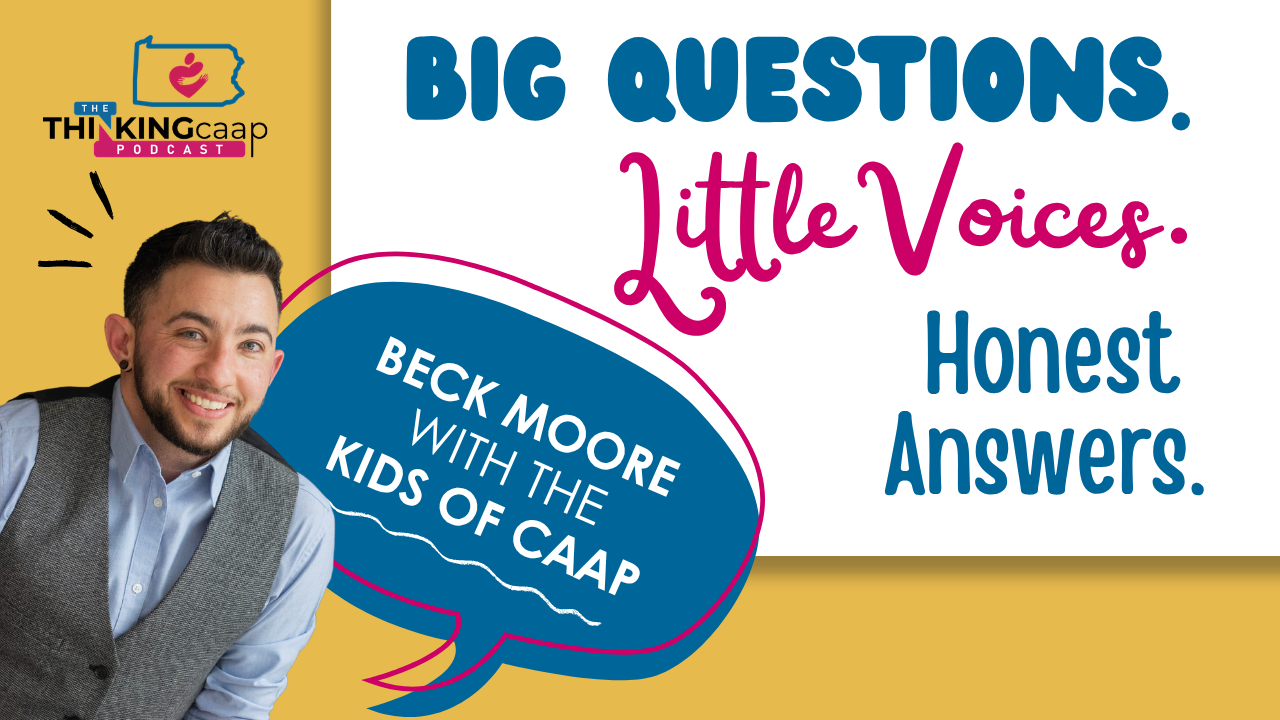
Image Description: Host Beck Moore smiles against a golden-yellow background. Bold blue and magenta lettering reads “Big Questions. Little Voices. Honest Answers.” A blue speech bubble highlights “Beck Moore with the Kids of CAAP,” with the podcast logo in the upper-left corner.
Thinking CAAP Episode 49 Talking Points
[00:00:04] A Special Episode Featuring the Kids of CAAP
Beck introduces a different kind of Thinking CAAP episode, featuring children connected to the CAAP family.
He explains that the conversation will explore how kids see the world, what's important to them, and what they think their parents do for work.
Beck invites the kids to share their perspectives in their own words.
[00:00:32] Meet the Young Guests
Noble, Caroline, Joseph, Kit, Jules, Joss, and Tally introduce themselves.
The kids share details about their ages, grade levels, interests, and activities.
Their introductions include marching band, plans to study pre-med at Penn State, a love of Hamilton, and a favorite color of purple.
[00:01:26] What Makes Kids Happy?
Beck asks what makes the children feel really happy.
Answers include spending time with family and playing Minecraft.
The conversation begins to reveal the importance of relationships, shared experiences, and simply enjoying life.
[00:01:38] Family, Relationships, and Community
The older kids reflect on the importance of gathering people around shared interests and building relationships.
Family, friendships, teachers, and community are identified as meaningful parts of their lives.
Several guests emphasize staying connected, learning from experiences, and continuing to grow as individuals.
[00:02:40] What Makes Someone a Good Friend?
Beck asks the kids what they believe makes someone a good friend.
They identify trust, keeping promises, showing kindness, and respecting one another.
Simple actions, such as helping someone who falls down or listening when someone needs support, are highlighted as important qualities of friendship.
[00:03:20] What Kids Wish Adults Understood
Beck asks what the children wish grown-ups understood about being a kid.
One child explains how being compared to other children can make someone feel inadequate or as though they've disappointed their parents.
Another shares that adults don't always understand the complexity of children's emotions, including the possibility of feeling sad and okay at the same time.
[00:04:06] Appreciating the Little Things
The older guests encourage adults to recognize and appreciate small victories.
They reflect on the importance of being present and fully enjoying meaningful moments.
Another child reminds adults that growing up doesn't mean they have to forget how to have fun or approach life with a playful perspective.
[00:05:19] If You Were in Charge of the World
Beck asks what the kids would do if they could run the world for one day.
One child says they would try to make everyone happy and provide people with the things they need.
Other responses take a lighter turn, including buying lots of cats, seeing Hamilton with friends, and eating candy all day.
[00:06:18] The Best Parts of Being a Kid
The kids reflect on the freedom to learn, explore, and experience new things while growing up.
They recognize that adults carry additional responsibilities, including bills, taxes, and taking care of a household.
One guest points out that childhood also offers opportunities to develop independence and learn to think for yourself.
[00:07:14] What Do Your Parents Actually Do?
Beck introduces the question of what the children think their parents do for work.
The older guests describe the importance of building relationships, supporting organizations, and helping communities across Pennsylvania.
Their answers reveal an understanding of how communication and collaboration contribute to their parents' professional responsibilities.
[00:08:02] The Challenges of Relationship-Building
The kids reflect on the work involved in communicating with people, leading meetings, fundraising, and connecting with government officials.
One guest expresses admiration for how naturally a parent handles conversations that would feel intimidating to them.
The discussion offers a thoughtful perspective on skills adults sometimes take for granted in their daily work.
[00:08:48] Helping People Find the Resources They Need
Another child explains that their mother works with websites that help people find assistance.
The discussion reflects an understanding that some families don't have everything they need and that technology can connect them with available resources.
The children also consider how important it is for those resources to be accessible to everyone.
[00:09:28] Making Communities Stronger
One child describes their father's work as a city planner and the responsibility of helping a city become stronger.
The conversation explores the challenge of deciding which improvements are most important for a community.
The child's answer connects community planning with the needs of the people who live there.
[00:10:45] Technology, Training, and Workplace Fun
The children continue describing their parents' responsibilities, including teaching others how to use websites that connect people with assistance.
One child remembers the fun of seeing everyone use filters during a video call.
They also recognize that teaching people unfamiliar technology can be a challenging part of the job.
[00:11:35] Understanding Work That Helps Others
The younger guests offer their own explanations of their parents' work.
One describes helping people who don't have water or electricity.
Another describes a parent who builds things throughout the day, showing how children understand work through the activities they see and hear about.
[00:12:01] The Little Details of a Job
A child explains that building things requires following directions and sometimes working with small, difficult screws.
Another describes the enjoyment their mother gets from communicating with people.
The conversation shows how even young children recognize the effort, patience, and connection involved in everyday work.
[00:12:34] Final Advice From the Next Generation
Beck asks whether the kids have anything else they'd like to share with listeners.
One encourages people to appreciate the little things, stay motivated, and not let challenges hold them back.
Another shares a desire to pursue a future career helping people around the world, even without knowing exactly what that career will be.
[00:13:02] Closing Reflections and Thanks
The episode ends with a playful exchange about being identical twins.
Beck thanks the young guests and listeners for being part of this special conversation.
The children help close the episode by thanking everyone for listening.
[00:13:15] Podcast Outro
The standard Thinking CAAP outro invites listeners to explore the show notes and follow the podcast for future episodes.
Listeners are encouraged to submit Community Action questions to info@thecaap.org with the subject line "Thinking CAAP."
Transcript of Episode 49
00:00:04
What's up, everybody? I'm Beck Moore, CEO of the Community Action Association of Pennsylvania, and welcome to Thinking CAAP. Today we are on a very special episode. I have very special guests, some of the kids of CAAP, that I've invited to talk a little bit about how they see the world, what's important to them, and some interesting questions that we're going to ask about what their parents do to see what they have to say.
So, without further ado, I'm going to introduce my guests with me today. I have my kiddo. Do you want to introduce yourself?
00:00:32
Noble.
Noble. And Noble, how old are you?
Eight.
And you're in what grade?
Third.
Third grade.
My name is Caroline. I'm 15. I'm in 10th grade, and a fun fact about me is I play clarinet in marching band.
Yeah, my name is Joseph. I'm a senior at Parkland High School. Caroline kind of stole my band fun fact, but another one is I'm going to Penn State next year for pre-med.
00:01:01
Hi, my name is Kit. I'm nine years old, and my favorite color is purple.
My name is Jules, and I'm seven. I'm in second grade, and I'm holding Oreo.
Hi, my name is Joss. I'm 11 years old. I'm in sixth grade, and I really like Hamilton.
Hi, I'm Tally, and I live in Pennsylvania.
Seven.
00:01:26
Let's start with an easy question. What's something that makes you both feel really, really happy?
Mine is just my whole family.
Your whole family. I love that.
Playing Minecraft.
That tracks. That tracks. What's something that's really, really important to you?
00:01:38
I think my favorite thing is getting a big group of people together, all with something that you all have in common, and getting to do it together.
I'd say, for me, it's probably relationships that I form with people, whether that's through family or friends or teachers or anything like that. Just building relationships and kind of building community around myself.
00:02:04
I think one of the most important things for me is my family and staying connected with them. And another is using what I learn and my experiences to help me become a better person.
I'd agree with Caroline about family. I feel like that's always at the top of the list for me, but also staying driven and staying motivated in everything that I do to put out my best effort.
Probably my family, because they're really nice to me and they care for me, and also probably my friends, because I like spending time with them and making jokes and having fun.
00:02:40
Like my toys, like my headbands, my lip balm.
What do you think makes you a good friend?
Someone that you can trust, and if you say, like, "Can you keep this promise?" they don't tell it to anybody else. And they care for you, but in a way that, like, if you tell them to do something, but in a nice way, I think they should still do that thing and not get upset about it and think that you're bossing them around.
If someone falls down, they can help them up.
Maybe listening to them.
00:03:20
What's something that you wish grown-ups understood about kids?
Kids don't like being compared to other kids, because it makes kids feel like they're doing something wrong. Because, like, if you're not that good at math, but someone else is good at math, and your parents are like, "Why can't you be more like them?" you'll feel like you've done something wrong and that you're making them sad.
00:03:55
Like my feelings. They don't understand my feelings. My parents don't feel my feelings. Sometimes you can be half sad; sometimes you could be half okay.
00:04:06
I would say that something I want to teach adults is the appreciation of the little things and taking the small victories that you have in life and really appreciating them. Because you never know when things start to go wrong or the challenges that you face. Just appreciating those small victories in what you do in your life, I think, is really valuable.
00:04:35
I feel like one thing is kind of enjoying, like he said, the little moments, but really living out the moment and being in the specific moment to fully enjoy it.
Maybe teaching them that being a kid is good, and when you're grown up, you don't have to forget about being a kid. You can still think about fun things rather than just all this stress on you when you have to pay a bunch of stuff. You can still think about doing everything that's kind of stressful in a fun way.
00:05:19
If you were in charge of the world for one day, what would you do?
Honestly, I would probably make everybody happy. Well, try to make everybody happy and think about what everyone in the world needs and try to give them what they need. Some people that are in charge of the world, like the president, have a lot of stuff to think about, but I would think about people that don't have everything that they need and try to give it to them.
00:05:59
I would buy a lot of cats. And I would also buy some tickets to go see Hamilton for me and my friends, the ones that like Hamilton. Not all of them do.
I would eat candy all day. Kit Kats and peanut butter cups.
00:06:18
What do you guys think is the best part about being a kid?
I think one of the best things about being a kid is getting to really learn from the experiences and all the little things people will teach you. They actually kind of treat you in a different way, like you might not know it, so that you can understand more of it, and there's less responsibility for it.
00:06:39
Probably staying young. As a grown-up, you probably have to think about a lot of stuff, like taxes and bills and how to take care of your family and your house. I like being a kid because you're not just spoiled and you don't have to think about anything. You still have to think about some stuff, and you have to sometimes take charge of your own thinking instead of just letting other people do it for you.
00:07:14
What do you think that your mom and dad do for work?
Yeah, so this is an interesting question. Caroline and I, on the way home from school, were talking about this because we knew we had this podcast, and we were like, "We really got to figure it out." But I would say, well, my first answer was he takes action in the community around Pennsylvania. But I feel like he does more building relationships, and he uses a lot of the relationships that he's made throughout his career to help out around the state and help the other organizations that are a part of CAAP to help them succeed.
00:08:02
There's, like, kind of along with the relationships, communicating and getting the word out about things, maybe.
I feel like, to me, if I were to do his job, the hardest part would be getting on the phone and talking to people that you don't know, or you're trying to get a favor out of. But I don't know, he does it so well, like second nature. Or leading a meeting, or trying to fundraise for people and get the word out with government officials and stuff. It's like it's no problem to him, but I feel like I'd be really concerned about trying to pull some strings like that.
00:08:48
I would say they both have, well, they're not easy jobs, but they're not, like, very hard. I would say they both have good jobs. I think my mom talks to you and all of her coworkers about how to use websites for people that don't have everything they need. And those people can go on the websites and find places that they can go to get the stuff that they need.
00:09:28
And I would say for my dad, well, he just started a new job, so I don't know a lot about it. But I'm pretty sure, since he works at City Hall, he's a city planner. I'm pretty sure he thinks about ways for the city to be better and make it stronger for the whole city.
00:09:52
Probably for my mom, making sure that the stuff that you guys do is perfect for anybody, and perfect for everyone rather than just for some people, like making sure that everybody is able to use those websites and stuff. And then for my dad, probably, because when you think about it, there's probably a lot of things that my dad could make the city better. But I think the hardest part is picking the most important things that should be good for the city, rather than just making a playground. Thinking about how the city could grow stronger and be better for people to have an environment in.
00:10:45
My mom uses a website to... She teaches people how to use a website that gets them stuff that they need.
He used to be a librarian.
Yeah, I think he's a... I don't know.
00:11:06
I think the most fun part for my mom's job was when everyone put on those filters for the one video call. And the hardest part might be teaching the people how to use it, especially if they don't do stuff like this that often.
00:11:35
Well, my mom and dad, like, people don't have water or electricity, and they're the people that bring those things to other people.
Dad just builds all day. He builds.
00:12:01
It's just that you have to follow the directions, and sometimes you have to put little screws in that are really hard.
Mama's job, her fun part is that she gets to communicate with people, and she communicates with you sometimes. Communicate means like you're talking. It's kind of like the same as, "Oh, I'm talking."
00:12:34
Is there anything else that you want to share with the listeners of Thinking CAAP today?
Really appreciating the little things in life, and not getting too set back by a challenge, and just staying motivated in what you want to do.
I have a lot of things that I would want to do, but I don't know a specific job. I want to do a job that helps people all around the world. If they need help, I want to help them.
00:13:02
We're identical twins.
You're just a smaller, shorter version of me. To all of our listeners, thank you for joining this extra special episode of Thinking CAAP. Thanks, everybody, for listening. Have a great day.
Thanks for listening to Thinking CAAP.
00:13:15
Thank you for being a part of this episode of Thinking CAAP. Check the show notes for resources and links to other episodes. And don't forget to subscribe and follow to be notified when new episodes are released. If you have any Community Action questions you'd like Beck, Amanda, or one of our local experts to answer in a future episode, please email your questions about Community Action to info@thecaap.org. Subject line: Thinking CAAP.
If you have any Community Action questions you’d like Beck or one of our local experts to answer in a future episode, please email your questions about Community Action to info@thecaap.org — subject line: Thinking CAAP.