Health Beyond Healthcare
The Power of Community Partnerships
In this episode of Thinking CAAP, Beck Moore welcomes Dr. Craig Butler, Chief Medical Officer for PA Health and Wellness, for a conversation about long-term services and supports, health-related social needs, and the role community partnerships can play in helping people access the care and resources they need.
PA Health and Wellness supports individuals who qualify for long-term services and supports, including many people who need help maintaining independence in their homes and communities. Dr. Butler explains services such as personal assistance, non-medical transportation, home-delivered meals, employment assistance, personal emergency response systems, and other supports that help people stay safe, healthy, and connected outside of a traditional medical setting.
Beck and Dr. Butler also discuss the larger connection between healthcare, social drivers of health, and Community Action. From housing instability and transportation barriers to food access and care coordination, they unpack why a person’s overall health is often shaped by factors far beyond medical care alone.
The episode also highlights the growing partnership opportunity between PA Health and Wellness and Community Action Agencies across Pennsylvania. Dr. Butler emphasizes the value of hyperlocal knowledge, trusted community relationships, and local outreach, while Beck reflects on how Community Action’s Community Needs Assessments, compliance structure, and deep community expertise make the network a strong partner for health plans seeking to better serve people across the Commonwealth.
Together, the conversation points toward a shared opportunity: aligning healthcare resources with trusted community-based organizations so that people can better understand, access, and use the benefits available to them.
For more from PA Health and Wellness:
Email: phwcommunityoutreach@pahealthwellness.com
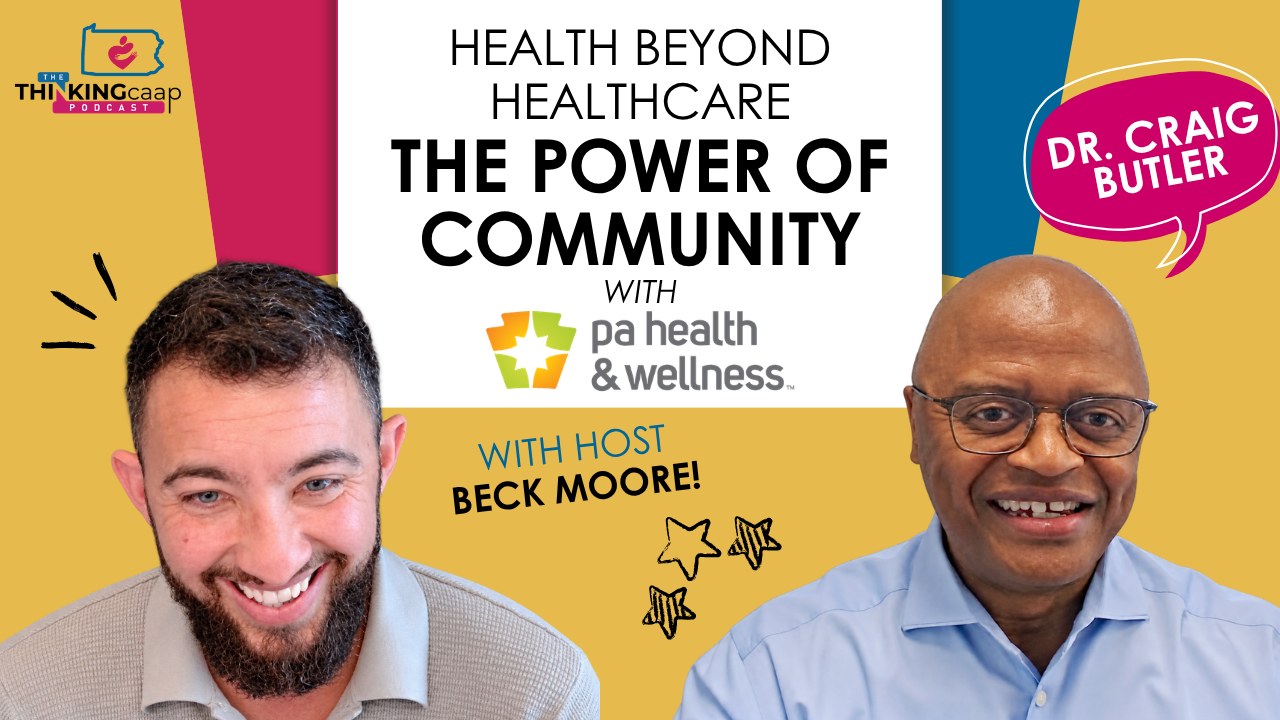
Image Description: Thinking CAAP podcast graphic featuring “Health Beyond Healthcare: The Power of Community” with PA Health & Wellness. Smiling host Beck Moore appears on the left, and guest Dr. Craig Butler, wearing glasses and a light blue shirt, appears on the right. The gold background includes magenta and blue accents, hand-drawn stars, and the Thinking CAAP and PA Health & Wellness logos.
Episode 47 Talking Points
[00:00:00] Opening and Introduction to PA Health and Wellness
Beck Moore introduces Dr. Craig Butler, Chief Medical Officer for PA Health and Wellness, and invites him to explain his role and the organization’s work.
PA Health and Wellness is one of three entities contracted in Pennsylvania to manage Medicaid long-term services and supports, addressing needs such as transportation, food, and housing.
[00:02:54] Healthcare Language and CAAP’s Partnership
Beck acknowledges the complexity of healthcare terms, including social determinants of health, Medicare, and Medicaid, and encourages listeners to reach out with questions.
He thanks PA Health and Wellness for supporting CAAP’s conference and western Pennsylvania projects, including work helping families access diapers and other connected needs.
[00:04:21] Dr. Butler’s Background and Who the Organization Serves
After 30 years as an orthopedic surgeon, Dr. Butler moved into managed care to help people at scale. He has been with PA Health and Wellness for nearly five years.
Participants must qualify for long-term services and supports, often through income criteria and physical limitations that make independent living difficult.
[00:07:24] Services That Support Independence
Personal assistance services help participants with daily activities. Other supports include transportation, home-delivered meals, employment assistance, and personal emergency response systems.
Beck connects these services to Community Action’s understanding of how zip code, family support, and social conditions affect people’s ability to live healthier, more independent lives.
[00:10:40] Drivers of Health and Comprehensive Care
Dr. Butler explains that non-medical factors strongly influence health. Terms vary, but social determinants, drivers of health, and health-related social needs all point to conditions beyond medical care.
PA Health and Wellness addresses these needs alongside medical care to support a more comprehensive, holistic approach to a person’s health.
[00:12:20] Housing and Transportation as Health Barriers
Beck describes someone who needs follow-up care for high cholesterol but is worried about eviction or homelessness. Missing an appointment does not mean they do not care about their health.
Dr. Butler identifies transportation as another major barrier and explains that PA Health and Wellness can help address gaps in drivers of health.
[00:14:37] Hyperlocal Partnerships and Shared Strategy
Part of Centene, PA Health and Wellness takes a hyperlocal approach to improving community health. Dr. Butler says strong partners like CAAP and its member agencies are essential.
Rather than developing strategies separately and finding partners afterward, he wants health plans and community organizations to understand each other’s priorities and build strategies together.
[00:17:55] Mission Alignment, Resources, and Local Knowledge
Beck explains that Community Action and PA Health and Wellness often serve the same people, creating clear mission alignment and opportunities for stronger partnerships.
Dr. Butler describes a partnership where the health plan brings resources and Community Action brings local knowledge, helping tailor support to the different needs of Pennsylvania communities.
[00:19:41] Reaching Members and Connecting Them With Benefits
Many members assigned through the state are difficult to contact and may not use benefits they need. Dr. Butler sees Community Action as a bridge between those resources and participants.
Beck shares that even with a care manager for his son, returning calls can be difficult. Both speakers recognize that unanswered outreach can reflect overwhelming circumstances or reluctance to answer health plan calls.
[00:22:44] Community Action as a Trusted Bridge
Community Action Agencies may already be meeting with the people PA Health and Wellness is trying to reach and understand how best to connect with them.
Those trusted relationships can help participants learn about unused benefits that support health, stability, and self-sufficiency.
[00:24:27] Starting a Partnership and Learning From Local Outreach
Many PA Health and Wellness participants are older adults, and some are homebound. Dr. Butler wants to learn how agencies reach them, what is working, and where gaps remain.
Local strategies, including door-to-door outreach, may offer partnership opportunities. PA Health and Wellness may help fund efforts aligned with shared goals, combining its capabilities with community expertise.
[00:29:13] Community Needs Assessments and Conference Connections
Beck explains that Community Action Agencies complete Community Needs Assessments every three years, adapting their approach to local needs and building expertise through data and compliance requirements.
PA Health and Wellness will be represented at CAAP’s conference, including an executive leadership session to discuss partnership opportunities and areas of alignment.
[00:31:31] Urban League Partnership and Investment in Community Health
Dr. Butler shares that PA Health and Wellness has funded a free clinic with the Urban League of Greater Philadelphia, expected to open in early 2027 and provide primary care for uninsured people.
A community partner grant program will allow the Urban League to distribute funding to organizations addressing drivers of health, drawing on its local relationships to identify partners.
[00:34:17] Connecting Partners and Directing Resources
Beck encourages conference attendees to connect with PA Health and Wellness. CAAP will highlight connection points and continue sharing opportunities for human services providers.
Dr. Butler says directing resources toward people who need them most continues to excite him. This work often addresses underutilization, helping people access support they are not receiving.
[00:35:55] Shared Commitment to Communities
Dr. Butler describes PA Health and Wellness staff as passionate and dedicated, explaining that he has come to see their work as a commitment rather than simply a job.
Beck reflects on Community Action as a family whose care for communities creates meaningful overlap with PA Health and Wellness’s work.
[00:36:56] Closing and Contact Information
Beck thanks Dr. Butler and shares contact information for PA Health and Wellness. Organizations seeking an introduction can also reach CAAP at info@thecaap.org.
The Thinking CAAP outro encourages listeners to check the show notes, subscribe, follow, and submit Community Action questions for future episodes.
Episode 47 Full Transcript
00:00:09
What's up everybody? I'm Beck Moore, CEO of Community Action Association of Pennsylvania and your host of the Thinking CAAP podcast. And today's episode is about PA Health and Wellness, an organization, company, business that you may not know too much about. Maybe you do. But with me today is Dr. Craig Butler. Uh, and I'm gonna let Craig Dr. Butler talk a little bit about himself and share a little bit about who he is, what he does, and then we'll get into our questions for today. So, Dr. Butler, if you can just tell us a little bit about yourself. Welcome to Thinking CAAP. Happy to have you.
00:00:40
Right. Well, thanks for having me back. Um, PA Health and Wellness is not a widely known name, and if you give me a little time, I'll kind of weave what PA Health and Wellness is into who I am. So, my my official title is the chief medical officer for PA Health and Wellness. PA Health and Wellness is itself uh one of the three entities in the state of Pennsylvania that has has a contract to manage long-term services and supports. And without getting into too much extraneous detail, uh long-term service support is a part of Medicaid, but it's the part that basically looks to provide a lot of um meet people's needs outside of the health care environment, mainly addressing areas which are commonly more known as drivers of health these day, transportation, food, housing, things of that nature.
00:01:35
Um, in addition to the physical health Medicaid plans which are in the state as well. We do not have that contract. We basically have solely a contract for the long-term services and supportss. Now, PHW is part of a bigger entity uh known as Centene um which focuses on government sponsored healthcare solely and that includes Medicare Advantage um Medicaid and the marketplace or um products which are um uh commonly known with you know the subsidies and for people that you know uh require some help qualifying for assistance. And so we have a focus on government sponsored plans. We have products in the market with different names that are all tied together. I happen to be this chief medical officer for all of them, but in this context, we're going to just limit it to the uh to the Medicaid uh line of business, and that is long-term services and supports.
So hopefully that's not too confusing for anyone, but I get it. we've done ourselves no favor because all of those other products have different names that don't map to PA Health and Wellness, but we're in the process of remediating that. And uh so stay tuned. We may not be PA Health and Wellness in very long. So well, and look, we we we get I mean we a lot of our former episodes, if you're a regular listener, you remember our very sec our second episode, I think, where we had Karen Vanzant, who was a a great partner of ours in the healthcare space.
00:03:06
We spent a little bit of time talking about social determinants of health, social social drivers of health, uh, health-related social needs. We've had recent episodes about PA navigate and the work that we're doing in that space. But the the difference between Medicare and Medicaid, right? Like we've spent a lot of time trying to educate, you know, the folks that we support as a membership based organization about what's the difference because look, the world of healthcare, if nothing else, it's complicated.
00:03:31
So appreciate if people are are are uh listening and they're wondering, you know, what's the nuance here? What's the nuance there? Reach out. We're happy to happy to talk about it offline. But I want to make sure to say thank you to P Health and Wellness because you all are a sponsor of ours, a supporter of ours.
00:03:47
uh you're you're working with us to uh help uh sponsor our conference as well as some projects that we're working on in the western part of the state uh with helping to get people services that they come through the doors in the immediate for uh need around diaper and getting those types of of of uh items for their families. But then we know that that one need is so much more complex and you all are helping support that work. So I just want to make sure to say thank you on the front end. So, uh, how long how long have you been with PA Health and Wellness? What's your sort of day-to-day look like there?
00:04:21
Yeah, I've been I've been with PA Health and Wellness will be five years in November. And I I didn't mention by background, I'm actually an orthopedic surgeon, which is a strange uh combination to be a CMO of a Medicaid plan with that background. But after practicing for 30 years, I kind of changed horses and and and went uh into managed care. And you know, as a surgeon, you kind of get to help one person at a time, if you will. And in this role now, you kind of get to help people at scale. And it's a lot more challenging, for sure, and a lot more rewarding. And so I really, you know, come to this with a um at a point in my my career where I'm looking, you know, to give more than to gain. And this is a perfect position for me in my current station and and tenure in my work career.
00:05:17
Yeah. Know, I love that. And so when you reflect on the people who the PA health and wellness side of things or focused on today really serve, can you tell us a little bit about sort of who those who those clients are, who that population is that you're you're really serving and uh what does that kind of like work really look like in terms of those long-term supports. If you can give some examples of what that really means for people. So, um, first of all, the people we serve have to qualify for the program. And just like Medicaid, uh, the long-term services and supportss has a state funded component and a federal funded funded component and a lot of state level variations. So, you're hearing LTSS from Pennsylvania and it doesn't necessarily translate to even LTSS in New Jersey. Sure. Because they're they're all the same.
But our our um our goal and and our purpose that we're contracts do is to to serve those who qualify. Now the things that we cover in general are not medical.
00:06:20
There's a small portion of our population where we do do the manage the physical health and those are the people that become newly eligible for Medicaid and at the same time become eligible for LTSS. Uh but many of the uh folks that we have um have Medicare as their primary physical health providers as opposed to having us as those but and we call those duals and dual eligible have Medicaid and Medicare and we have a population of non-duals which is if we have 80,000 members maybe 4,000 400 or non-duals where we have physical health accountability but our role to qualify first of all you usually have to have not only income uh meet the income criteria, but for LTSS, you have to have usually some physical limitation that is challenging for you to continue on in the community living independently.
And so we basically manage those wraparound services that allow people to maintain their independence and to remain in the community. things that you know the most uh expensive bucket of state investment is in what we call personal assistance services. People really need someone to come into their home and assist with things we call activities of daily living or instrumental activities of daily living on a regular basis. For instance, someone might need someone some help for two or three hours a day. We would basically in one model basically figure out who that person was, arrange for those services and what those specific services they needed help with, activities they needed help with.
00:08:02
And um that that's one big bucket. Those are personal assistance services. There's also transportation. There's a lot of non-medical transportation that's covered as a benefit w with our with our plan. Um and again what the waiver services there's a list of I want to say 50 at the federal level the states can kind of figure out which ones they want to fund and offer and then that comes down to us and basically that list changes every year depending on funding and we basically try and uh again manage the utilization of those services. Transportation non-medical transportation is a big one. Um there's a food uh component. We do a lot of home-delivered meals for people that can't can't uh cook. We can do uh employment assistance there. There's just a whole myriad of of services. Uh even providing uh personal emergency response system PERS devices. We manage that.
We also manage that utilization of a lot of things that are are aren't covered by normal physical health insurance covered. um things like you know you mentioned um ex you know diapers and like especially adult diapers there's limits on those and we can go beyond the limits to make sure they have what they need um there there's just a myriad of things and I could go on forever trying to list them but if you think conceptually of those things that are kind of required to maintain health and to maintain independence we have a wide um charter to cover those and they're not all delineated saying, you know, we can cover this list of 30 things. We have some discretion to cover things that aren't on the list if it meets those criteria being what we call medically necessary. That includes uh maintaining your independence and living independently in the community.
00:09:54
Yeah. So, let's dig into that a little bit more. And I think we've spent we spend and spend spent a lot of time within Community Action talking a lot about how you know zip code, genetic code all impact your health. And when I say zip code, I also mean the family support system you have around you. And a lot of the things you're talking about, right, are impacted by, you know, how we how we are able to live longer, healthier, happier lives are all impacted by those things that that you're talking about right now. as we've discussed, you know, plenty of times before on Thinking CAAP, but when you look across Pennsylvania right now and those people that you're you're serving, what are some of the biggest needs and challenges that you're really seeing within the the folks families that you're you're serving on a regular basis?
00:10:38
Anything in particular you really want to highlight? Yeah. Well, I I think the viewpoint that I've seen and I think the view is pretty accurate of what's represented in in Pennsylvania is not unique to Pennsylvania.
And you know we there's a lot of language around the non-medical things that impact health outcomes right and that's gone through this evolution of language you know the determinants of health social determinants of health drivers of health health related social needs there there's a lot of language around there that gets confed but but if people understand that your overall health is more determined by things other than medical care right that's when you kind of get your focus on what we tend to focus on those non-medical drivers of health and that's what that language is trying to capture there you can get real geeky about the terminology but I try not to but I've gone to lots of healthcare conferences and so I end up just rattling off all the different phrases because depending on who you ask depend which phrase they use and and you know conceptually I look at our contract with the state is to administer the utilization of drivers of Well, and if you think conceptually that's different than the other physical health which is to manage the health care and medical care, right?
00:11:56
We we do have a that as part of it and you'd obviously like to think they're integrated but current structure not so much. But um but uh the idea is that we can not only know about the medical needs but we can supplement them with those drivers of health to comprehensively and holistically address the health outcome the health of the individual.
00:12:20
Yeah. One of the examples that I talk about from time to time is about right if somebody is has a um let's say you know they go to the doctor for the health screening and they find out they have you know high cholesterol. Well, there's follow-up visits that then have to happen, right? But if if you have someone who is walking through the the doors of their their uh you know, doctor, you know, provider and they're uh worried about housing insecurity, they're potentially about to be evicted, they have they're unhoused already, the likelihood that they're going to f do the follow-up visit is impacted by all sorts of other factors. And they're what, 50% less likely to attend a follow-up visit. Well, that doesn't mean they don't care about their health, right? But they've got other immediate needs that have to be met.
And depending on where you live, depending on what your family dynamics are, right? All of those different things are impacted by so much more. So then if I don't go to the follow-up visit as somebody who has high cholesterol that is very managed at this point, right? If that doesn't get taken care of, that's going to directly impact how long I'm going to live, right?
all these other factors and ultimately you know my reliance on and if we kind of sum this up in a really simplistic way if I'm reliant on an emergency room right I'm not going to a primary care provider right that potentially increases health care costs right there's all kinds of other factors that end up playing out so that person's ability to get to that follow-up visit is really really important for so many different reasons yeah and that's that's a transportation issue you know that's not met medical care even though it's adjacent to medical care and probably a barrier to medical care. But, you know, where can we plug in and make sure they have that transportation to get to the doctors non-emergent and and may some cases we it may even be non-medical, but we have the ability given this charter from the state to address those those deficiencies in in those drivers of health.
So, it's very well positioned uh value proposition if you will. So, are there any particular priorities that you really want to identify or lift up or sort of speak to at where you all are are really focused on right now that you want to make sure that our listeners know about?
anything in particular that you want to make sure to so so you know first of all I didn't spend a lot of time on our um parent organization which is Centene but one of our missional statements is to improve the health of the community one person at a time and the approach has been very local in fact we call it hyperlocal and that's why we don't have the name Centene because we wanted a name that kind of fit in the community spoke to local local focus and that's where the nexus I think between um PA Health and Wellness and and CAAP really shines and why we're willing to um partner with invest in um what what we're trying to do because if you have a hyperlocal approach you cannot be effective doing what we do without great community partners. Absolutely.
00:15:33
And so we understand that. I think you'll see that we put our money where our mouth is in terms of the resources we're willing to bring to bear to facilitate those partnership. But we are absolutely looking for partners like CAAP and all those member whether it's 40 42 members that are that are part of the U CAAP that we would love to have a have a dialogue with about how we can partner strategically. I think the challenges on both sides is that we're never at each other's table when the strategy's been developed. You know, you're not kidding. That is, you know, that's a really good that's a really really good point.
00:16:13
Yeah. And and so we kind of developed the strategy and then you kind of go try and find somebody that fits your strategy that they didn't inform which which you know is not uncommon but to me if you all know and we're going to give you some contact information if I if I may to outreach if you're an organization out there that is interested in partnering and the good thing is we have a statewide contract. The bad thing is we don't know everything about all the communities that are out there, all the organizations that are constituent members of CAAP. We don't know exactly what they do, exactly what their priorities or how we can partner with them to help them be more effective and to help us grow and be effective as well.
So, and and you know to be clear and honest and straightforward, we are a business and our business is is um is successful when we grow and to the extent we get out there and sponsor, we'd like to think and we we know we can deliver on the quality side because we're the highest rated um Medicaid plan in the state. Okay? There's not a better quality product out there. I can by the numbers, not my subjective judgment. Okay. And so we we know and you pair that with our want and willingness to partner. I think that's just a a very favorable outcome not just for the the U members of your organization but ultimately for the members in the community that actually need need the help. And uh so I I think again it's really exciting opportunity. I'm hoping this is kind of the beginning of something that's much bigger and long lasting. Absolutely.
00:17:55
And um so you know that that's what I I think PA Health and Wellness can offer and and is willing, you know, like I said, we're willing to stand behind our our offer here and and basically meet with just about anybody who has a has a calling to serve uh the communities and and figure out what what the best next steps for partnering are.
00:18:16
Well, and I think as we look to see I mean we we try to seek out partnerships and opportunities where we know that there's mission alignment, right? And that's where we feel like PA Health and Wellness is very very well poised and mission aligned and and part of the reason why we've continued conversations with you all. And so I think let's talk a little bit about the partnership piece because again we've spent a lot of time educating our member agencies and having conversations and them educating us about what has been working, what's not been working, where they where they want to grow, you know, in terms of those relationships.
And so right the people that we are serving at Community Action are oftentimes the same people that you're serving with PA Health and Wellness and so if you can talk a little bit you to everybody about what does a really a strong partnership look like between a health plan and a community based organization like a Community Action Agency.
00:19:06
Okay. So, so a lot of times it's us bringing the resources and the community action member bringing the knowhow, especially on a local level because again, we span the whole state, but I guarantee you the northeast corner of the state is very different than the southwest corner.
00:19:25
Oh, yeah. and and you know, we we know that, but we don't necessarily fully know the nuances and and are informed enough to be successful in in reaching out, especially to uh folks that happen to be in those local that are also members of our plan. We have a tremendous number of members that are assigned to us from the state that we can't even contact. We can't get them on the phone that we can't get we can't say hello. And these are people with benefits that they hopefully know about, but they're not using and probably need.
00:20:02
I mean, to qualify from the for the program, your need level has to be pretty high. But you not only have to be qualified, you have to understand how to take advantage of those benefits and use those benefit because we want them to use them. I mean, that's what we're planning to do, but when we can't contact them, we can't really help them understand that. So, my my question is maybe some well positioned uh Community Action uh partner can help us do that.
00:20:32
they understand how to they might have even the boots on the ground to do local outreach, go knock on doors and things like that to help us uh help the u participants understand that they have benefits that they can use and understand and do because it's it's amazing how um how little sometimes the participant knows about their benefits and you know they they know their need they have a lot of needs. they just don't know what the program can how the program can address the needs or how to go about um taking advantage of those benefits. And so we're we're here to educate them. And again, I I do believe that members of CAAP are well positioned to help kind of bridge that last mile, if you will, connecting us with our health plan resources and and the distributor of their benefits to the beneficiaries.
And that's to me just a tremendous opportunity and again that's across the entire Commonwealth.
00:21:32
Yeah, absolutely. I mean I use the I'll use the example of you know my son has special needs and so we have an assigned care manager that pretty consistently calls me. I never get a chance to call them back. I know that there are other benefits that I could be utilizing but here I am continuing to not make the phone call back. It's not because I don't want to. It's just because life be lifing and sometimes it's hard.
00:21:56
Yeah. And and if you had this list of uh the entities that people don't answer the phone for when they do their their call screening, uh health plans are at the top of that list. uh because I I can tell you our unable to reach rates are are are significant and and you know we we try three or four times but after that you know we the assumption you leave a message that they don't get you back that they don't they don't want to talk to you and that that's kind of sad you know because again it's usually to their benefit and it's in the terms of taking advantage of their benefits that we're calling about and um that's that's um that's a whole another issue in some ways, but I do think um Community Action partners could help facilitate that.
00:22:44
So I think if we reflect on right that you know the the somebody leaves the the message the client or the participant of a Community Action program. I think part of what our agencies do a great job about is trying to think about the methodology of how to reach somebody. And it could be that the same person that you're trying to contact is also a participant at a Community Action agency, right? And so to be able to look to see, okay, am I already meeting with this person, am I not? And trying to be, you know, thoughtful about could be somebody's working third shift, they can't pick up the phone or, you know, all kinds of different things or it's just a matter of, and I will say this, you know, somebody who is regularly overwhelmed in life that I just forget to make the return phone call, right?
And so I think that partnership opportunity where a Community Action Agency can look at here are the benefits that you're not taking advantage of and here is what it means if you take advantage of it. It really creates a great opportunity to potentially help somebody have the right resources to really thrive, become economically mobile, self-sufficient, right? And or just have access to things that are directly impacting their health on the day-to-day. And so I mean I think it's a a great opportunity that we pretty consistently encourage our organizations to think about who are the right partners and also partially the reason why we want to continue to partner with you so that we can help make those introductions really and try to sh up those relationships.
And so if we have an agency leader an executive who's listening today and thinking about we want to help build a stronger relationship between our organization and PA Health and Wellness where should they start? What does that look like?
00:24:20
And I I have the email address that you shared that I will make sure to to repeat. But what does what does that look like? What should that first reach out look like for um PA Health and Wellness? The majority of the members are participants. Our older u folks usually Medicare age, okay? Meaning over 65. And part of our challenge even realizing that many of them are homebound and and We I think there's an assumption that there's a lower technology or digital adoption in that age group. So some of the things like texting or uh emailing and all those things may not actually meet their needs in terms of their favored mode of communication. But when we pair that with phone calls, emails, text messaging, we still have a big big gap in terms of our ability to get there.
So part of me in thinking about um the Community Action partners is to you know kind of help us learn how to be more effective in reaching their constituency you know because I'm sure there's a huge overlap and you know what what are you doing how how how is it working what you know are you having to go around knock on doors you know if that's the case can we can we help fund some of that you know um we obviously what some of our our um goals uh served in that effort, but I don't think they're, you know, so outstanding or um separate from goals that a lot of the Community Action partners would have either. So, that that would be a really uh good thing, but also helping us identify those local or hyperlocal needs in that area. We we you know, we'd love to think we know how it is over there.
00:26:16
Okay. you know, we don't we we really do need to solicit the intelligence and knowledge of the local players on a consistent systematic basis in my mind to be most most effective. And so just the ability to to share that knowledge or willingness to share that knowledge with us would be very good. And again, we're we're we understand that we've probably done all we can as outsiders, if you will. And so we know that any future growth, improvement, or or uh betterment of our product on behalf of those individuals that are part of it is going to be facilitated by community level engagement, community level partnerships. So we can mesh our capabilities with the local knowledge and expertise to be effective. And so my my message is like let us know what what you're doing.
Let us know what your needs are and and let's figure out what the common ground is where we can partner uh and grow together because I think we all want to be effective. And um I think that at this stage for us as a managed care organization for long-term services and supportss, that's the next level. That's what it's going to take for us to grow because, you know, we've out there, you know, you have a choice of three three uh managed care organizations. If you're have a LTSS benefit, we're one of three and we're we're pretty steady partner and really, you know, especially for our size, we're the smaller of the three.
00:27:56
Uh, I I think but you know, if you know anything about managed care in Pennsylvania, Pennsylvania has a reputation for people regardless of their experience sticking with their brand, if you will. Okay? And, you know, if I've had, you know, Blue Cross Blue Shield for this and that, I'm going to stick with that, you know, because I know the system, right? And, you know, you make this case, well, they're all bad, so it doesn't matter how it goes around. I know we're the new new person on the block. We're the most recent new entry into managed care in the state of Pennsylvania, now eight years young, if you will. But they're just not a lot of turnover. And that's that's part of what explains our our challenges with people not knowing about us. We haven't been around for decades. And uh but we we're we're here to stay.
And um and I I think our track record, if you look at the details, shows us we're committed. shows that we have a a uh a uh a good a good product to offer and and more importantly I think especially in the years that I've been here shows that we're really good with community part as a community partner and um so we're we're looking for that we've prioritized that as an area for growing and focus and really think that that that mesh with a cap is is a good one and we app we certainly appreciate it and we feel like as organizations. I know we've talked about this before in Thinking CAAP, but you know, our agencies, any Community Action Agency across the country, frankly, right? We're required to do community needs assessments every three years
And so that means that our approach to that local community has to has to evolve based off of the local needs, which is a very different uh, you know, approach compared to sort of a traditional nonprofit. doesn't mean that there aren't really deep cultural support solutions being created with other nonprofits but Community Action in particular very well poised to understand provide data back because of the compliance regulations that we have to follow you know based around the funding that the collective uh network of organizations receives from the federal government.
00:30:01
Okay. So I think one of the things that we try to educate, you know, not necessarily uh on this call today, I know it's not necessarily the purpose, but you know, as people listen and as we're out in the community, it's one of the things that we try to help people understand is that yes, there are overburdened nonprofits, CBOS, however you want to describe it, and you know, varying levels of ability and nuance and understanding, but Community Action in particular, right? because of the way that we are managed, because of the way that we have to follow compliance regulations around all of the programs that our organizations uh manage, there's so much knowledge and expertise that is there.
And that's part of the reason that in frankly we we wanted to make sure to partner with some of the right partners again because we know about where we can see so clearly, right, where there's crossover and opportunity and where you all come into play. And so, we're excited. We're having you at our conference this year. You're going to some of your uh leadership is going to be at our executive leadership session on Tuesday to talk a little bit about you know this partnership where there can be opportunity. And so one of my last questions for you as we sort of wrap up a little bit is is there something in particular that's happening with PA Health and Wellness or across Pennsylvania generally that really kind of gives you reason to be excited about where this work is headed?
something that you know makes you get get up and go to work every day that you're excited about that you wanna want to highlight or anything that gives you pause too Dr. Butler, if you No, no. I have a lot of lot of uh uh things that I'm excited about, but I'm going to share one particularly with you. Um PHW has, you know, partnered with the Urban League of Greater Philadelphia, and in full disclosure, I'm actually serve on the board, but um they're in we've kind of funded a couple things with them. one is a actually a a uh a free clinic that's going to come online in early uh 2027 where they're going to basically be a home for u people who lack insurance completely lack insurance to get primary care.
00:32:11
That's one thing. But another program we funded again through the uh Urban League of Greater Philadelphia is it's a community partner grant program where we've g given a sizable sum that'll allow them to uh dispense between 25 and $50,000 to community partners who are doing the drivers of health work. We kind of base acknowledge Philly is a great big area. we don't know enough about of it about it to really you know judiciously decide which community partner deserve the funding. So we've asked the Urban League to kind of be our intermediary and use their network of partners to find u uh partners that they can they they can shell out grants to to um help again address those drivers of health.
And so that's something I'm really excited about because again you know the sum is not not trivial and um you know the idea that we can give up to 10 grants between 25 and $50,000 kind of gives you a sense of the scale of the investment and again actively opening uh their advertising for uh community partners there. I'm sure uh talking to people that are in their network of collaborators already, but that's an example of what we can do and bring uh from PHW. And again, that's not funding that we are dispensing directly to these community partners, but we're leveraging the uh relationships and networks that um um what we view as a credible u not forprofit has within the community already.
And so that that's something that that's really exciting and um I'm sure if you went to the Urban League of Greater Philadelphia website, you can find out how to engage that if your community partner out there looking for that. But we can we can also do business more directly too, especially since we're only covering the southeast corner of the state. Uh there's there's opportunity across the the greater Commonwealth as well.
00:34:17
Absolutely. So if you're I love that news. I think that that's fantastic. And so if you're an organization that's coming to our conference at the end of October then want to just encourage people write seek out. We will make sure that you are highlighted at the conference so people know who to who approach but that is one of the things that we are really hopeful is to because not only community not only Community Actions come to our conference we have other human services providers too and so we'll continue to try to you know lift up where there's opportunity and showcase how people can get connected to you. Is there anything else you want to share with uh with our our listeners today that you want to make sure to highlight or or speak to before we wrap up?
00:34:54
No, you know, I just again I I mentioned earlier that um I'm kind of a strange bird having worked as an orthopedic surgeon for 28 years before I decided to cross the street and put on a put on a regular regular dress outside the operating room. But the the thing that still to this day excites me about the work that we do is this opportunity to really direct your energy, your and all your resources toward the people that need it the most. And and that's, you know, I I've worked on the commercial side of managed care as well. You know, a little more profit driven trying to drive down utilization because we as a nation probably do overutilize a lot of health care. Um but that's not the case here. uh most of the time we're talking about underutilization and getting people what they truly need.
Um and so so that that whole proposition excites me and the idea to be able to grow with partners is is equally stimulating. I can tell you on behalf of our entire health plan that that's where we're focused. We have some of the most f passionate and dedicated uh people to really serving the communities that we we work in. And um you know I I you know when I joined I you know I assumed it was just a job for everybody and it's not. It's really a commitment. It's it's a passion and I think that will show as you as we reach out to partner with some of the agencies that are in your organization.
00:36:25
I appreciate that so much. I mean that's part of the reason why I feel like I've found a home at Community Action in a lot of ways. And I was told and I've said this before on the podcast. I was told early on that this you know Community Action is like a family and you know we all everybody deeply cares about each other and I was like well right we'll see right but it really has shown up that way and so similarly right that's that is the group of community action professionals you know they you're not going to find a group of people who care more deeply than about their community so I appreciate the overlap in the way that you know we collectively look at look at this opportunity and the the work well Dr. Dr. Butler, I just want to say thank you again for for joining us, for sharing a little bit about, you know, what the organization does, what PA Health and Wellness does.
Have an email address for folks if they want to reach out to speak, learn more. PHWcommunityOutreach@pahealthwellness.com. We'll make sure that's in the show notes also so that if people want to connect and or if you're coming to the conference, seek out, right? We'll make sure that we make some introductions. If you hear the episode, you want the introduction, reach out to us at info@thecaap.org. And just want to thank everybody for putting on their Thinking caps for a little while today and listening to the conversation between Dr. Butler and I. Dr. Butler, thank you again. We appreciate you and we'll we'll talk soon.
00:37:40
Thank you.
Appreciate you having me.
Absolutely. Thank you for being a part of this episode of the Thinking CAAP. Check the show notes for resources and links to other episodes. And don't forget to subscribe and follow to be notified when new episodes are released. If you have any Community Action questions you'd like Beck, Amanda, or one of our local experts to answer in a future episode, please email your questions about Community Action to info@thecaap.org. Subject line Thinking CAAP.
If you have any Community Action questions you’d like Beck or one of our local experts to answer in a future episode, please email your questions about Community Action to info@thecaap.org — subject line: Thinking CAAP.