
Master Your Vibe
Building Meaningful Connections that Last
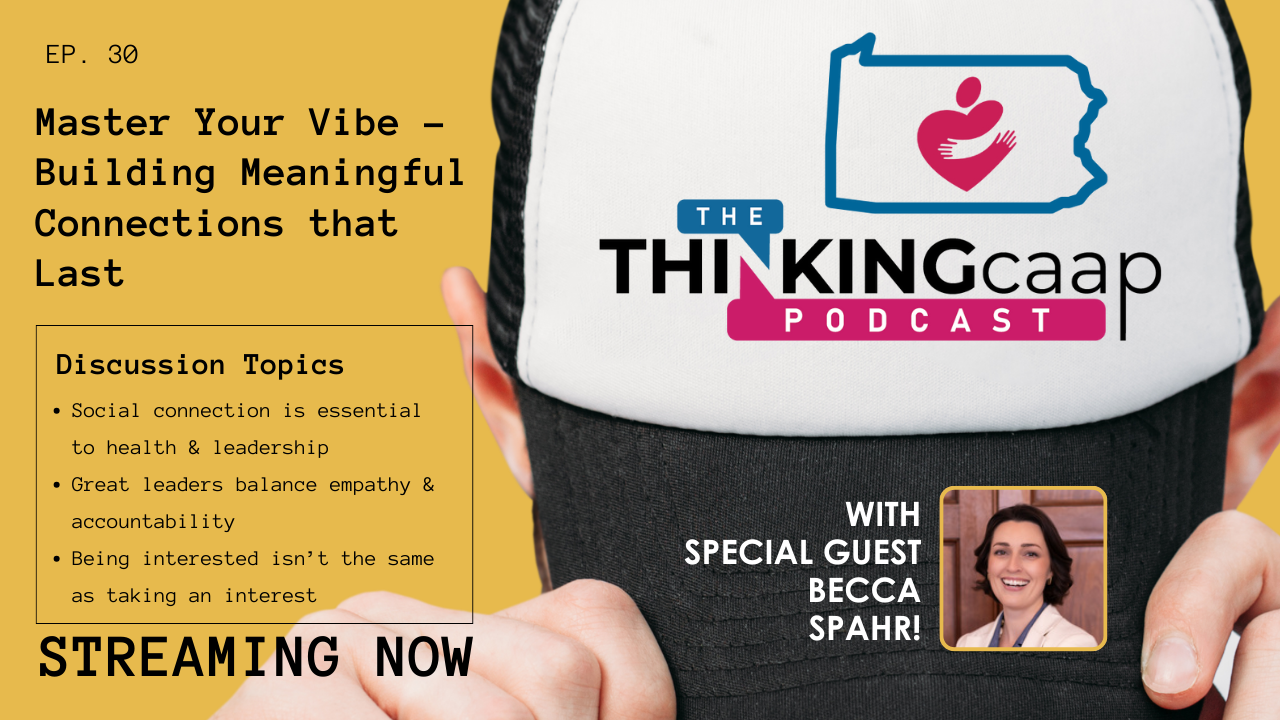
In this episode of Thinking CAAP, Beck Moore and Heather Holloway are joined by relational health expert and former U.S. Marine Becca Spahr for a powerful conversation about social connection—and why it may be one of the most overlooked drivers of individual, organizational, and community wellbeing.
Together, they explore social health as the “third pillar” alongside physical and mental health, drawing from research, lived experience, and real-world leadership lessons. From the science behind belonging and psychological safety to the impact of social capital in community action and workplaces, this episode unpacks why connection isn’t a “nice to have”—it’s foundational.
Becca shares insights from her 20-year Marine Corps career, lessons from Blue Zones around the world, and practical guidance for leaders who want to build trust, reduce burnout, and create environments where people feel safe, valued, and motivated to show up fully. The conversation also tackles leadership styles, accountability, authenticity, and what happens when leaders are promoted without support or training.
Whether you’re leading a team, serving your community, or simply rethinking how relationships shape outcomes, this episode offers a grounding perspective and practical takeaways for building stronger, healthier connections where they matter most.
To connect with Becca Spahr, visit her site: https://www.beccaspahr.com/
Thinking CAAP Episode 30 Highlights
[0:00] – Introduction to Social Connection and Guest Becca Spahr
Hosts Beck Moore and Heather Holloway introduce Becca Spahr, a relational health expert and former US Marine.
They discuss the importance of social connection and meaningful relationships in enriching personal and community life.
[2:00] – The Emerging Importance of Social Health in Overall Wellbeing
Becca explains social health as the third pillar of wellbeing, alongside physical and mental health.
She highlights a Harvard study showing social connection as the top indicator of overall health throughout 80 years of research.
[4:00] – Social Capital’s Role in Community Support and Success
Beck connects social health to community action.
He emphasizes how family structure and social networks impact individuals’ ability to thrive.
He includes access to resources beyond traditional family, including chosen and community support.
[5:00] – Lessons from Blue Zones: Longevity and Social Connectedness
Heather and Becca discuss blue zones, areas known for longevity.
They highlight how strong multi-generational social bonds and community support contribute significantly to better health and quality of life.
[11:00] – Authenticity and Belonging in Workplaces and Communities
Becca highlights the importance of creating environments where people can authentically belong and be valued.
She references Maslow’s hierarchy of needs.
She explains how social belonging is a fundamental human requirement for thriving.
[13:04] – Understanding Maslow’s Hierarchy in Personal and Professional Contexts
They emphasize how fulfilling basic needs enables progression to higher levels, including self-actualization.
They explore how this applies both personally and professionally.
They advocate for creating supportive workplace environments where employees feel valued and belong.
[15:21] – Balancing Leadership Styles: From “Too Nice” to Authoritative
The conversation explores the spectrum of leadership styles, from overly friendly to authoritarian “Darth Vader” leaders.
They highlight how effective leadership balances warmth and accountability.
They emphasize avoiding toxic work environments and reducing burnout caused by fear-driven performance.
[17:52] – Psychological Safety and Belonging as Key Workplace Needs
Beck Moore and Becca Spahr emphasize psychological safety as the most desired workplace trait.
They discuss the importance of creating inclusive cultures where employees feel they belong beyond superficial identity labels.
They address common leadership oversights in fostering genuine connection.
[19:19] – Challenges of Unprepared Leaders and the Importance of Leadership Training
The hosts discuss how many new leaders are promoted without training.
They observe how these leaders often default to ineffective or toxic behaviors.
They stress the value of intentional leadership development and self-awareness.
They advocate for breaking negative cycles and enhancing leadership effectiveness.
[22:22] – Marine Corps Experience Shaping Leadership Philosophy
Becca Spahr shares how her 20-year Marine Corps career shaped her understanding of leadership, people, and cultural diversity.
She highlights that meeting people’s need for love and belonging makes leaders.
[26:46] – Transitioning Military Leadership to Civilian Communication
Becca Spahr discusses her role managing manpower and personnel in the Marine Corps.
She emphasizes the impact of leadership on people’s lives.
She reflects on the importance of maintaining lasting relationships beyond military service.
[28:05] – Learning Leadership Styles: From Kindness to Assertiveness
Becca reflects on her leadership evolution.
She shares her experience balancing between being nurturing and adopting a more assertive, “Darth Vader” style.
She highlights the challenge of inspiring confidence while staying authentic in high-pressure military environments.
[32:09] – High-Stakes Event Planning and Leadership Lessons from the President
Becca shares a pivotal moment escorting the President.
She realized that effective leadership combines kindness and competence.
The experience inspired her to lead with warmth rather than harshness to achieve success and respect.
[35:23] – The Complexity of Kindness and Accountability in Leadership
The hosts explore the phrase “Don’t mistake my kindness for weakness.”
They debate its implications.
They stress the need for leaders to balance authentic kindness with firm accountability.
They discourage resorting to defensiveness or aggression.
[39:05] – Engaging Others Authentically to Inspire Leadership
Becca offers practical advice on leadership.
She emphasizes that to elicit positive responses, leaders must genuinely show interest in others.
She draws on deep social and evolutionary cues that foster connection and trust in both personal and professional settings.
[40:31] – Breaking the Touch Barrier and Non-Verbal Connection Cues
Becca Spahr explains how physical touch, eye contact, and non-verbal back channeling signals like nodding and thoughtful gestures create connection.
She describes how these cues signal interest.
She identifies them as essential in networking, customer service, and relationship-building contexts.
[42:05] – The Power of Open-Ended Questions in Building Relationships
The conversation highlights the importance of asking open-ended questions.
They emphasize following up thoughtfully to deepen conversations beyond small talk.
They explain how this triggers positive brain chemistry and fosters meaningful connections.
They note it encourages ongoing engagement and trust.
[44:41] – Sandler Sales Technique and Listening for Pain Points
Becca Spahr discusses the Sandler sales method focused on uncovering customer pain rather than just selling features.
She emphasizes listening and relationship-building.
She frames these as key leadership and sales skills for addressing real needs effectively.
[47:56] – Connecting with Becca Spahr and Leadership Through Social Connection
Becca shares her contact info.
She describes her evolving work with leadership and veteran populations.
She emphasizes social connection as a foundational skill for leaders.
She expresses openness to speaking engagements and workshops.
[50:54] – Cultivating Curiosity and Taking a Genuine Interest in People
Becca advises leaders to practice curiosity.
She encourages taking a sincere interest in their people’s stories and goals.
She explains how this fosters deeper relationships.
She recommends offering support and resources that promote long-term growth and belonging within teams and communities.
[53:20] – Building Trust and Loyalty Through Genuine Interest
Beck Moore and Becca Spahr discuss how showing genuine interest in others fosters trust.
They explain how this strengthens loyalty.
They observe that it leads to more motivated and engaged individuals.
They emphasize how it encourages people to support and contribute positively in their environments.
[53:41] – The Power of Signaling Care and Engagement
The conversation emphasizes how taking an active interest signals care and support.
They explain how this enhances relationships and teamwork.
Beck highlights the importance of this approach in creating a collaborative and motivated community.
[53:54] – Growing Opportunities and Sponsorship for Thinking CAAP
Beck Moore shares excitement about potential sponsorships for the Thinking CAAP podcast.
He invites listeners and sponsors to connect.
He illustrates growth and outreach possibilities for the show.
[54:15] – Closing Remarks and Gratitude
Beck Moore and Becca Spahr thank listeners for their participation.
They encourage them to continue engaging with the podcast.
Beck also wishes everyone a Happy New Year.
He emphasizes ongoing community involvement.
[54:36] – How to Engage with Thinking CAAP and Future Episodes
Listeners are guided on how to access show notes.
They are encouraged to subscribe.
They are invited to submit Community Action questions to Beck Moore and local experts.
This promotes active listener engagement and future content development.
Episode 29 Transcript
00:00:00
What's up, everybody? This is Beck Moore, CEO of Community Action Association of Pennsylvania, and your host at The Thinking CAAP. And with me, of course, my fearless co-host. We had a couple of episodes without her, but we're happy to have her back. Heather Holloway from Holloway Media Services. What's up, my friend? Oh, my gosh, Beck, listen, it'll never happen again. I will make sure that I am attached to this microphone. But, hey, it's great to be here.
00:00:20
2026 New Year, New us. Oh, my gosh. And for the first episode of 2026, I just want to say, Becky, Susie, I see you. I love you. Thank you so much for listening to the Thinking CAAP.
00:00:32
Shout out to some good friends of the Thinking CAAP and some close folks to my heart. So thank you, Heather, for that. I know they appreciate it. So with us today is a great guest. We are here to talk about meaningful connections and really why those things matter.
00:00:48
And so I'm going to let Heather are far better at the intros than I am. So, Heather, if you can introduce our next guest, that would be fantastic. You got it. Let me get into the studio mode. Here we go.
00:00:57
In 3, 2, 1.
Becca Spahr is a dynamic speaker and relational health expert who's passionate about helping people build meaningful connections that enrich their lives. With 20 years of experience as a US Marine, thank you for your service. Becca understands the power of genuine connection to build trust and teamwork even in the toughest situations. She now helps audiences master habits that create meaningful, authentic relationships.
00:01:23
Becca, thank you so much for coming on the show today. I'm so excited and super pumped up to be with you guys today. Yeah, we're excited to have you, and I think talking about something that Heather and I love to talk about kind of in the context of the things that we're most passionate about. So excited for this to be sort of our first recording of the new year, for sure. So we wanted to start with kind of talking a little bit about social connection, right.
00:01:46
Why it matters. And this is something that you speak about regularly. I know that you have keynotes that you do about this topic, so let's start there. Just help us kind of frame today's discussion with why this matters, what people are looking for. And I'll be quiet and let you answer the question.
00:02:03
Well, we as humans are constantly evolving. And I feel like I think of it as, like, we have. We've got a pretty good handle on our physical health, what it means to be physically healthy. You know, you. You try to eat right, you try to Move your body, you try to get enough sleep.
00:02:19
Most people can handle that. And then. Most, most. I'm trying. I'm still trying.
00:02:25
Well, we're at least giving it a good shot, I hope. Yeah. And then our mental health came on the scene, like 50 years ago. People started talking about this and like, oh, this is really a thing. Like we've got to manage our stress.
00:02:37
We've got to process the things that happen to us in healthy ways so that we can live our best lives. And that's good. And thankfully, a lot of people are prioritizing that and. And putting work and effort and money into taking care of their mental health. Well, probably somewhere between 10 and 20 years ago, somebody started thinking, there's a little bit more to it than this.
00:03:04
What about the aspect of our health that entails the people who are around us and how we interact with those people, how we draw support from other people? Because. Because humans are social animals. And so that pillar, that third pillar of our overall health is known as social health. And it's the way that we connect with the people around us within the communities and organizations that we're in.
00:03:30
And it is. I love to share this detail because it sounds so official. Harvard did a study that lasted 80 years. So they followed the same set of people for 80 years. I know, that's bonkers.
00:03:41
And they found that the number one indicator of a person's overall health was how connected they were with other human beings. It just blows my mind. Well, I think this is kind of paramount to something we talk about in community action. And I think it's relevant to this discussion around clients that come to one of our agencies looking for support. And there's sort of this, you know, the intake process and evaluation of what are the resources that surround somebody.
00:04:08
And that includes social capital. It could mean, right, like family structure. And if you have kids, who's there to help support. If you just quickly to run to the grocery store and your kiddo's sick, you don't want to take your kid out or you need a ride somewhere cause your car breaks down. You know that structure and resource in terms of community, not just blood relatives and family, but chosen family, larger family structure and dynamic.
00:04:31
It impacts somebody's ability to be successful in those ways. And I think is really relevant to what I think you're talking about. Heather, you were going to say something? Yeah. Well, this is so interesting.
00:04:41
The fact that, okay, Harvard did a study for 80 years. We've been talking about this for 50 years. 20 years ago, we start to do a different, you know, dance and have a different conversation. Meanwhile, you have countries like, Let me see, there are countries like Greece and Costa Rica and other places where they have these blue zones. Have you heard of the blue zones?
00:05:04
Yeah, there's a great documentary about it. Tell me about it. One of my favorites. Yeah, I think it's actually a series. Okay.
00:05:11
Yeah. Where they, they follow. They identified these blue zones, which are basically people where. Places in the world where, where humans enjoy the best longevity. And then the, I don't know his name, but the, the, the, the documentary filmmaker went to all of these places and he, he observed the way people lived and he conducted interviews.
00:05:33
And to say, like, how are you guys doing this? Because I'm missing something. We're missing something here in the US Maybe. So some of the green of the, the blue zones are like in Greece, in Okinawa, Japan, where I actually lived for, for four years.
00:05:48
There were a couple in the Mediterranean actually. So. And then I think one might have been also some somewhere else, kind of like equatorial. They're all in warm areas, so you're getting the warmth, a lot of sunshine. They're in areas where people draw their diets from very much from the Earth where we're eating a lot of like fish and vegetables, whole food type of diets.
00:06:10
But another thing that was a thread throughout, and Heather, you're nodding your head because you already know what's coming, was that social piece where they have these intact and robust family units. They have towns where people support each other. They have a lot of multi-generational relationships. So we're not only sticking to our like, our like decade of birth when we have friends, but we have friends who are younger than us and older than us. And there's something to it that where people have the setups like this, it actually does improve your quality of life, your overall physical health, your overall mental health.
00:06:52
And that is that, you know, that connection that we're talking about. Yeah, yeah. And I'm wondering, you know, how do we bring a blue zone into our. Can we do a community community, or do we start with our home first or do we start at the agencies? Are the agencies blue zones?
00:07:08
You know, how can that happen? Can that happen? Yeah, fantastic question. And I. This is probably what keeps me up the most, is like, how do we do it?
00:07:16
How do we do it? Yeah, yeah, yeah. How do we replicate. Right. Like this is happening other places.
00:07:21
So let's bring it here. So a lot of it is really cultural and you know, America has a pretty individual mentality when it comes to our culture, we look out for ourselves and our family. There isn't as much of a sense of doing things for the greater good, not like in other countries. And I'll tell you a little anecdote about that. I've lived in Japan twice in my life, once as a child, once as an adult.
00:07:51
And there it's a very community-focused mindset that they have. And the expectation also culturally and in a lot of places in Japan, they don't have trash cans in their public parks and public spaces or if they do, they're very small because everyone is expected to take their trash with them when they leave. And everyone knows that and everyone does that and they, you know, they bring a little bag and they just put their stuff in it and take it with them when they leave. Because you're cleaning up for the next person. You're not your mess for somebody else.
00:08:26
That. For so many reasons. Yes, but that's just, that's not the way that we do it here. No. Somebody else's problem.
00:08:34
Somebody's getting paid to do this. And you know, I mean there's. All right, yeah, we're making jobs or there's some. Something else behind it, maybe. But that idea that there is something greater than me that is more important than me on a greater scale I think exists in a lot of other countries.
00:08:53
And you don't see that as much in the United States. Yeah, my. One of my brother-in-laws is about to move to. He's in the service, he's about to be stationed in Japan and they're about to move and he's, you know, only lived in very small towns. It'll be interesting to see how his experience evolves.
00:09:12
I'm so curious to hear what his reaction is to it. But I think to your point about just kind of a side note for a second, it's interesting human social experiment to sort of be at a park with a, with a kid and to see trash in a park and to see who steps over and who picks it up because it's just, you know, if it's just a lollipop wrapper, like what is it? But most people, most people don't. Don't do anything. Yeah, they just don't.
00:09:38
Or you're walking through a parking lot and there's a piece of trash, one. Of the things walking through a parking lot and there's a shopping cart in the middle of the parking space. Right? Yeah. Put it away.
00:09:48
Yeah. It's interesting. One of the first times that my now wife and I went shopping. We went to the grocery store and we had the cart. Raymond.
00:09:54
We'd go to go to the thing, do the thing, and then we come out and put the groceries in the car, and there's a. There's the cart thing right next to the car, and we're not that far away from the front. And I go to push the cart into the grocery store and she. I got back in the car and she's like, I do that. I said, what?
00:10:09
Put. Take the cart back. I was like, well, right. Because it's right. It's right there.
00:10:12
Like, what is it? What is it? Like, I don't. Why do I need to put it in the cart Return. I have legs.
00:10:16
I can walk. Right. It's not a big deal. But it's just. There's very interesting things about human dynamic that unless you're kind of an observer of people, you don't necessarily notice those things.
00:10:28
That's right. Yeah. And thinking about others too, I think, is the piece of it, you know, you're observing. But I mean, you know, for whatever reason, some people are more inwardly focused than others. There's a variety of reasons that that happens, and, you know, that's okay.
00:10:46
But when you think about, you know, if. If you. We get one life and if you want to, you know, depending on what your goals are to get out of it, it's what you put into it. And sometimes that means thinking outside of yourself and welcoming other people into your life in an intentional way that is going to enrich your life and enrich theirs too, hopefully. Yeah.
00:11:10
One of the things that Heather and I talk about pretty frequently in different ways, but parallel content is around really. How do people. Creating an environment and work where people can show up fully as themselves, fully, authentically. Right. Without fear of judgment and just.
00:11:25
Just be and thrive. And then that impacts client experience. Participant experience. Because if I'm anxious about showing up as myself in the workplace, how can I really show up as my best self then for the clients that I'm trying to serve? And so with respect to kind of the social connection piece, you know, what does that really mean for you?
00:11:46
What's. What's the showing up fully social connection kind of parallel here in the workplace versus in the general community? Well, you know, we're all humans here, and we all have needs. We all have very basic needs that are the same for everyone. And the I, in my talks, when I do workshops or give keynotes, I usually teach Maslow's hierarchy, which is a pretty, pretty basic one that if you've taken a psychology class, you've probably heard of it, but, you know, it's usually depicted as like a triangle.
00:12:24
And on the bottom, the bottom tier, like your most basic needs as a human. So, like, food, shelter, that kind of thing. Then we move up into needs, like feeling secure, having, you know, financial security, feeling like you're physically secure. And then we move into the social.
00:12:41
A lot of it comes from other people. So those are things like love and belonging. Feeling like you are a part of a group, you are a valued member of that group, you have a purpose within that group, is. Is a very. It doesn't sound like it, but it is a very basic human need to feel wanted.
00:13:04
And, and within this hierarchy of needs, kind of the very. I'm really watering this down here. But the. The very basic premise is that until you fulfill the needs in one of the lower tiers, you don't really move to the next tier. So you can't.
00:13:23
If you don't know where dinner is coming from, it's hard to feel secure. And if you don't have a secure place where your body is safe, you're not going to be able to go somewhere where you feel loved or that you belong because you're. You're too worried about just protecting yourself physically. And then at the very tippy top of this triangle is known as self-actualization, which is really just a fancy way of saying that you're living your best life.
00:13:49
And there is, I think of it as. There are kind of two hierarchies. There's a personal needs hierarchy, and then there is a professional needs hierarchy. And so on the professional side, what you're talking about, Beck, is how do organizations fulfill these needs for their employees or sometimes the people that they serve also, particularly in human services. And so creating an environment where people feel love and belonging is where you want to focus your efforts.
00:14:19
And what you're saying is, I mean, you guys do it beautifully. I'm on your social media all the time. Like, yes, these people get it. We're trying. I'm trying.
00:14:30
No, you don't try. You do. Yoda. Well, I appreciate you, but some days I'm like. Some of these are easier than others.
00:14:37
But. But, yeah, it's that idea that you're making people feel like, you know, you are a wanted member of the team. We want you here. You're. You bring something and we appreciate you and we want you here.
00:14:47
Yeah, you know, this is now 2026. Right? And. And this language, how we communicate with each other. How we include each other is paramount.
00:14:56
There's no going back. You know, I'm watching Chopped on the Food Network from, like 20 years ago, and the way that the contestants and the judges interact with each other, particularly the contestants to the judges, not very kind. And I'm like, that's old school. You know, I forgot how far we've come. We've come a long way, but there are still naysayers out there that said, no, too touchy-feely.
00:15:21
Ain't doing that. I need you to clock in, clock out. What do you say to those quote, unquote leaders? Yeah, I have a graphic in one of my presentations that always get some chuckles because it's like this continuum of where leaders fall out. And so on the left end is the too nice leader who's just won't really hold people accountable.
00:15:46
They want to be friends. And it's like, okay, you're nice, but I need you to be a leader. And that, Snow White, is what I use as my little graphic there. And then on the other end is that leader who's just a jerk. And they lead with fear.
00:16:01
They're aggressive in ways. Yeah. And then that one. This is where people laugh, is that I pop up Darth Vader. Think about the Darth Vader leaders who are like, I mean, okay, it works for a while.
00:16:16
Yeah, you can get stuff done, but at what cost? At what cost? You're losing your best people because they're not going to put up with that forever. Well, and fear doesn't equal. Fear doesn't equal respect.
00:16:27
Absolutely not. And, yeah, and then you end up with one of those really toxic work environments where nothing's really getting done. Everybody's at odds with each other. There's too much unfriendly competition. There's too much negativity.
00:16:43
And so what you want is kind of that sweet spot in the middle where. Where you can still be warm and personable and compassionate. Of course, those are all good things, but then you can also maintain that authority where people look to you for guidance, where they see you as the leader. So it's that kind of right in the middle where you want to be. Well, and I think the pace when you're leading is sort of the Darth Vader.
00:17:06
Right. I think the pace in which burnout happens. Now, burnout can happen for lots of reasons, to be clear, but I think the pace in which burnout can happen happens far more quickly in that instance as well, because you're operating from this mindset of sort of Anxiety driven performance. And I got to do this, I got to do this, I got to do this, I got to do this. And you tend to sort of like fizzle out fast, right?
00:17:26
Because if I don't do it, I'm going to fear retribution or whatever. And then that creates this whole snowball effect of other behaviors and starts to impact the employee's mental health as well. And you start to see that play out in really unfortunate ways. I want to go back to kind of this. And we talked about this a bit with Bree Groff Heather around psychological safety.
00:17:52
And we sort of joked around the fact that we've been talking about this forever as we've been saying, you know, on today's recording. But if you read anything again and again and again, right. Number one, most desired trait in the workplace is psychological safety. And I think when I sort of hold that up and then I think to myself, okay, everybody wants to feel, feel belonging. Everybody wants to feel, you know, like, I have my space.
00:18:18
And we think about, particularly in the United States, there is this desire to check a box, right. And sort of label ourselves. Right. Like, I'm a, I, I was a Marine. I'm, you know, I'm a vet.
00:18:30
I'm in this category. I'm in this category. I'm in this category. And yet, for whatever reason, then as leaders, we sort of forget that a little bit. And this is just my soapbox, to be clear.
00:18:43
It's not really a question. We sort of like, we forget this need and desire in how we create our workplace culture in our environments. And it's like, well, I don't under, you know, I don't understand what's happening in my organization. And they sort of. Sometimes people just forget about these desires and needs, even though internally most people are struggling with, right.
00:19:04
Like what box to check in some way, shape or form or where do I belong within all of these different communities? It's just an interesting thing that plays out in the human psyche, particularly again, again in the United States. And that's, you know, again, just my. My soapbox for the moment. No, that's a great observation.
00:19:19
And I think what happens a lot with people as they.
00:19:25
A lot of people get thrown into leadership because, like, oh, you know, he's been here the longest or she's the highest performer. And so then eventually, like, you just get promoted into this leadership role and not always with any kind of, like, training or mentorship with it. And so people don't, in like, an intentional way, take time to sit down and think what kind of leader do I want to be? How do I want to be for my team? How am I best going to serve the institution or the organization?
00:20:02
And, and then they just, they kind of flounder because they, they fall back to whatever is normal to them. So which is either what just kind of comes naturally to them personality wise or what they've seen other leaders do in the past. And that's one of the reasons that a, a toxic organization will just keep being toxic and more toxic. Well, and cycles repeat. Right?
00:20:27
Lots of failure before you find success in how you really operate. Heather, you know, I've talked about this for, but like, knowing yourself is really important before you become really, I think a really strong leader. Amen. Imposter syndrome. They have to overcome.
00:20:42
Yeah. I have probably said this on this podcast more times than I can count at this point, but we don't become leaders because we're good leaders. We become leaders because we're rock stars at our job and we're sort of like, okay. And as somebody who has found themselves in leadership positions since the ripe, you know, old age of 16 and almost every single job that I've ever had, I have made so many mistakes before I figured out the right things. And it's one of the reasons why at CAAP, we do leadership and management coaching and training for new managers.
00:21:09
Because I wish somebody had said, here is a great new manager training for you as a new manager, slash new leader. And by the way, making sure that included something to get to know myself and my hangups and my ego issues. Right. And like my past trauma to identify. So that if I'm having a trauma response and I'm not just perpetuating something on somebody for fear of.
00:21:34
Right. Like what they stepped in and didn't even know they stepped in it, it's, I think it's a million percent if that's a thing. You know, part of somebody's ability to be successful as a leader is, is having that type of formal initial training of just saying, like here are four things. If nothing else. I would have loved that training as an entrepreneur.
00:21:59
Yeah. Everything that I've. The person, you know, love and trust today was built through reading books on these subjects. On Maslow, on emotional intelligence, on ego, on not taking things personally. A great book, The Four Agreements.
00:22:14
Before you become a leader. Read the Four Agreements. It's very quick. You know, you're right. Training is, is, is paramount.
00:22:22
But talking about training, Becca, I want to go back to your time spent in the Marines. I mean, how did that inform this work today? Yeah, a lot of, you know, when I. When I first started this, which was like, about a little over a year ago, year and a half ago, I thought, you know, I. I feel like I connect with people. I've kind of.
00:22:46
I've gotten a lot of feedback over my career that I'm an authentic person and that I was understanding as a leader and, and those kinds of things. And I thought, well, maybe I can turn this in. Maybe I can share this with others and be helpful in some way. But it was. It was funny to me, and I got a few laughs when, you know, I would say, well, I'm a. I'm a Marine.
00:23:06
I'm a career Marine, and now I'm teaching people how to be likable.
00:23:12
I'm teaching how to be nice, you know, and make friends. Well, there's, There's. There's bias right around, like, what we perceive as what that looks like and feels like. So, yeah, of course. I mean.
00:23:22
Yeah, and, and that's okay. But, you know, I mean, I learned a lot about people. And like Beck was saying before, you know, you observe. There are some people who just, like, observe other humans. And I've always been like that.
00:23:36
So during my time in the Marine Corps, you know, I mean, you're working with thousands of people at a time, and they're from all different walks of life, all different backgrounds, you know, and. And going to different countries. I mean, I. I don't even know how many countries I went to, but you're. You're taking little bits and pieces from these different cultures and different backgrounds. And when I really, like, sat down to.
00:24:02
To kind of distill it all and reflect on it, I started seeing some little, like, commonalities popping out about how people are. And then, you know, I started reading more, like Heather was saying, and there's some great books out there about it. And what it really comes down to is that all people want to feel that love and belonging. And if you can be someone who can provide that to others, you are automatically a magnetic and attractive person, because people are going to come to you to feed that need for love and belonging. And now that's a lot of what I teach.
00:24:44
Well, there are three hotties on this call. Becca, when did you join the. The Corps? Wait, what? How old were you?
00:24:51
I was 21. Yeah, so I. I was an officer. I went through college, joined at 21, and then I. I retired at a little bit over 20 years. Wow. And when did you just.
00:25:04
When did you decide you wanted to go into the. The military. I'm. I'm curious about the origin story, if you will, as we like to say. Sure.
00:25:11
Right. My. My villain story.
00:25:16
Heroes have origin stories, too. Heroes have origin stories, too. Heather always likes to keep us on the positive eye. That's very good balance because, you know, I think villain story, too, to be clear. But yes, hero also.
00:25:26
Yes. I mean, heroes can fall in a toxic sludge and become really cool, too. Right? Yeah. Yeah.
00:25:31
I mean, it's even more like, what a dense character to have both a villain and a hero story. We haven't seen that one yet. All right, Marvel, if you're listening, you owe us the rights. You owe us the rights. Let's record it.
00:25:44
You heard it here first. I love it. I grew up in a military family, so that idea of service before self was always there.
00:25:58
And then my older brother joined the Marine Corps straight out of high school. He enlisted, and I went to his graduation from boot camp. And it's this huge parade deck which is just this open field, and the lines of Marines are marching, and there's the music and the flags and all this. And I'm like. I just got chills, and I'm like, I have to be part of this.
00:26:24
Like, this is the coolest thing. But I already had plans to go to go to college, so I thought, okay, well, I'll become an officer. I will lead these fine men and women who are walking across this parade deck. And that's what I did. So I. I was a human resources officer.
00:26:46
Would be like, the translation in, like, human being speak civilian.
00:26:55
But. But, yeah, but I dealt with, like, managing the manpower and then. And then all the, you know, making sure people get paid and they get awards and they. You know, the correspondence and that kind of thing. So not the sexiest job in the Marine Corps, but it was very well suited to my personality, and I did really enjoy that aspect of my job.
00:27:19
But, you know, it really does come down to the people. It's cliche, but it is. You know, it's the people you meet along the way. I'm still in touch with people that I, you know, that I just had one of my. One of my Marines, just a young woman who was enlisted and became an officer.
00:27:35
Just reached out to me the other day, and it's like, that feels pretty good that, like, someone would still want my advice, you know, or, like, care about what I thought, you know? So it's like. It was just that, like, moment of, like, I did something like, I impact. I truly impacted somebody's life and that, you know.
00:27:53
Oh, it just makes you feel warm and fuzzy. It's true. A warm and fuzzy Marine. Yeah, I love it. Listen, hero, villain, origin story, Here we go.
00:28:05
But, you know, I think unfortunately I did serve with leaders who were on the Darth Vader side of the spectrum. And it, you know, was hard for me, especially when I was very young, because you're trying to see, like, well, who do I want to be? How am I going to model myself? And. And I kind of went back and forth because I know, like, in my initial, some of my initial training, I was very like, mama bear.
00:28:40
I wanted to take care of people. Like, I wanted to make sure people had what they needed and share resources and all of that stuff. And we did this one exercise, it was like a peer evaluation exercise where your group. It was a group of like 12 people, and they gave you a list of adjectives. And some of them were positive adjectives, like, you know, brave or decisive or whatever.
00:29:07
And then some of them were not very kind adjectives. And then we had to go in and assign a word to each person within the group. And going in, I was like, I got this. People like me, you know, I, you know, like, I'm a hard worker. I share my trail mix.
00:29:23
Like, that's gonna be great. And. And then I got my little slip of paperback and it said that some of my peers, men who I had been training with day in and day out for months at this point, thought that I was passive and meek and weak. And I was like, what? So of course, like, I reflected on it and at first I was super, super PO'd.
00:29:54
Yeah. Because I think you can say. I'm going to say. We can say pissed. Yeah, we say pissed.
00:29:59
I would have been pissed. But then I'm like, okay, well, like, let's see, like where we. Where's the disconnect here? What's going on? And I realized that we.
00:30:10
That was not a. An evaluation to decide, like, who you would hang out with or who you would, like, invite to your wedding, you know, it was an evaluation to determine who would you follow into combat, who would you want to be your leader when the stuff hits the fan and I was playing by the wrong set of rules and I needed to be instilling confidence in my decision making abilities and in my assertiveness rather than just being everybody's friend. So then I swung the other way. Oh, I've been here, friend. I've been here.
00:30:48
Yes, here comes the hammer. You wanted it, you asked for it. You wanted it, now you're gonna get it. And I'm like, giddy up. Here we go.
00:30:57
Get ready. Ki. Yay. Yeah. Yeah.
00:31:01
So I put on my Darth Vader cape, and I did that for a little while with varying results.
00:31:08
To be. To be honest, I never, like, went full Darth Vader. I might have, like. I'll say like I might have. I mean, I think I said on a prior podcast before, my wife and I used to work together, and she did not like me.
00:31:21
Like, she hated my guts when we worked together. Now, by the time I left the organization that shall remain nameless, we got along great and we were very friendly. But there was a time there that no Darth Vader, I think, really did kind of show his ugly face, but not really, because he had a helmet on. Yeah, well, a lot of it is who you're around and, like. And like, how, you know, how much stress is there.
00:31:44
Like, we have good days and bad days, you know, I. Yeah, of course. But. But I'll. I'll share one story with you, and this is. This is kind of what, like, was that, like, shift?
00:31:56
Because I. Because I thought, you know, I'm like, okay, well, being nice didn't cut it. And so now I'm being a Marine, and I'm telling people exactly what I think all the time, regardless of what their feelings might be. And we're getting stuff done. When I was.
00:32:09
Let's see, I had probably been in the Marine Corps for around six years at this point, and I had this super awesome, glamorous job working in D.C. and I was, like, an event planner for, like, the very highest levels of. Of the Marine Corps. And we had an event where the President of the United States was there. And my job, part of my job was to escort him and his wife through the different steps of the evening, you know, so I'm like, I'm on a time schedule. I've got the whole plan and everything.
00:32:42
This has been coordinated for months with Secret Service, and we've got all the. Everything. High-pressure stakes is what I'm hearing. High pressure, yes. Now, after we're done recording, to be clear, I'm going to ask who this president was.
00:32:53
Was. But I'm not gonna ask now. Okay. All right. We don't disclose any secrets now.
00:32:58
Go ahead. Okay. Yeah. So. So these.
00:33:01
These people who are. Who are very powerful in whatever, whether it's like, corporate world or wherever, their schedules are, like, detailed down to the minute. It's. It's bonkers. So we're going through the day, everything's going well.
00:33:15
And we're standing in this, like, the foyer of this, like, beautiful mansion in D.C. and I realize we're, like, five minutes ahead of schedule. And I'm like, oh, crap, this is bad. I mean, better to be ahead than behind. But in my head, I'm like, I'm getting that hot panic that starts at your feet. Yeah, I need to go to the bathroom.
00:33:34
I'll be right back. I'm like, I am the only person in the world right now who is gonna deal with this. So I start to come up with some lame story about the chandeliers or something and the president standing in the corner. And before I can say something dumb, he just peels off and he starts walking around to every person in the room. There's probably like, 10 or 10 or 12 people in there, and he's just clapping people on the shoulders and shaking hands.
00:34:03
Hey, where you from? How long you been in the Marine Corps? Laughing, high-fiving. And I'm watching this happen, and I'm like, if the most powerful person in the entire world can be nice to people, can have a conversation, can be interested, can make other people feel good, why am I trying to be such a jerk all the time to get things done? He's got way more riding on it than I do.
00:34:33
And obviously something worked whether. Whether, you know, political affiliations aside, something is working here. And so that was kind of my, like, aha moment, where I'm like, no, I'm trying to fit myself into a mold where that is not natural to my personality, where I'm being demanding and kind of mean to get things done. But here's this example of someone who clearly knows how to get stuff done and he's being cool about it. I would hang out with him.
00:35:06
I don't know if he would have me, but I would hang out with him. I'm curious how you both react to this. This statement I'm about to make. So there's something that prior leaders would say to me, and I say it still sometimes because I do think it's. It's true to kind of what you're.
00:35:23
What you're talking about. Don't mistake my kindness for weakness.
00:35:29
And I think there's a spirit in that, of that that is a little gross that I don't like. But also, it just resonates so much with me sometimes because just because I'm kind and thoughtful and trying to create an authentic workplace doesn't mean I'm not gonna hold you accountable and hold Your nose to the grindstone when you're not getting something done.
00:35:48
I don't know. How do you all feel about that phrase? I'm just curious. It also makes me feel gross. Right.
00:35:55
There's something about it. I don't know what it is, but. I think that this idea that, like, you know, there's a lot of words here that, that. That we've kind of said and there's. And people think of them differently.
00:36:11
Like, I could say I want someone to be nice to me, but other people would say, well, no, because niceness is like you're a pushover or. Or you're. Or maybe you have an ulterior motive and you're only. You're being nice in an ingenuine way because you want something, you know, so there's a lot of room for interpretation on these terms like kindness and niceness and weakness and power and all that.
00:36:37
Which is why I tend to use. That's why I use the word likable a lot. Because if. Likable can be different depending on the scenario. Like what a likable friend is different than a likable boss because I don't really want my boss to have drinks with me and I'm not going to call my boss to watch my cat, but, you know, like, I want my boss to hold people accountable and make sure that we're getting stuff done, you know, so there.
00:37:03
So it's different depending on the circumstance. I would watch somebody's cat, to be clear. So would I. Absolutely. Can't happen.
00:37:12
No. Right. Yeah. For me, that statement, you know, there is an energy to that. It's almost like you're bristling and waiting for you to be able to say that when you could just be that.
00:37:21
So for me, I'm like, you can try to misunderstand my kindness, but you'll get the real deal if. If that needs to come out. So I don't know. I don't know. It was an okay saying at one time, and now I'm like, meh.
00:37:38
I guess it does have like, sort of a threatening quality to it. I guess that's what it comes down to. You don't need a bristle. Just be you, man. Well, and I think it's one of those phrases that it goes back to kind of the trauma response because of, you know, like what you talked about.
00:37:50
Becca. Right. Was somebody calling you meek and timid. And this idea, I remember in a. Was a relatively new director of a large project, and somebody commented that I would waffle on decision-making.
00:38:09
And I just remember being like, I asked for your opinion because I genuinely wanted to know. And. And I'm just not sure. And I think I was nervous about saying that I wasn't sure part. And so it just looked like I wasn't comfortable making decisions, and that wasn't the case.
00:38:26
But it. I think it. That I, Like, I reacted to it, right. And I think about. Then that's the statement then, right?
00:38:35
That ends up coming out when it's like, well, you know, don't question my authority, you son of a gun. And so it's sort of like this feeling that ends up being the trauma response to the statement. Yeah.
00:38:50
Go ahead, Heather. Yeah, well, I. So this is all amazing. So we got the origin story. We got the why this work is so important.
00:38:57
Now let's. Before we have to leave today on this episode, let's get into the how. So, Becca, how do you help us?
00:39:05
In what way can you lead us to the righteousness? There's so many ways in 10 minutes or less. Becca, we need you to outline this. Good. Because it.
00:39:13
There's a lot to it, you know, and it's personality dependent. It's situationally dependent. It's. What are your goals dependent, too. Like we talked about, there's a difference between, like, your personal relationships and your professional relationships.
00:39:26
So I'll say the most important nugget that I. That I try to give to people is that to get people to respond to you, you need to be interested in them. And this comes from, like, our most basic, like, evolutionary beginnings. And it's deep, deep, deep inside of our brains that we take, like, body language cues and verbal cues, even, like, pheromone-type cues to know whether someone is interested in us or not. So I think of it like, you know, back when maybe we were a little younger, and you went.
00:40:07
You went out to the club or something, and you said, saw somebody you thought was kind of cute, and you try to make eye contact. Depending on their reaction, you may or may not, like, pursue that. Right. If you get nothing at all, you're probably not gonna, like, say, all right, I'm gonna go try this. But if you get the chin lift, Prolonged eye contact.
00:40:31
Now, that's like, there's maybe a possibility here. I put my hand on your arm. Do you flinch or do you lean? We call that breaking the touch barrier. Yeah, yeah, yeah, yeah.
00:40:44
So that idea that we can. We can, like, signal to someone whether we're interested in them in a lot of different ways is helpful. So when you're trying to whatever it is, meet somebody you think is cute or land a job or I don't. Know, network or run a successful fundraising campaign. Sure.
00:41:11
Yeah. Oh, that's a great example. Oh yeah, yeah. Any kind of customer service really, you've got to indicate that you're interested in them. So how do we do that?
00:41:22
That is making people feel seen, making them feel acknowledged. And some of it is like non verbal. It's the like making good eye contact but not in a like, like a two way but, but, but making eye contact. There's something called back channeling which are those like noises and gestures you make when you're having a conversation. So you're like nodding your head or you're like raising your eyebrows?
00:41:47
Yes. The, the stroking your beard. This of the chin. This is a thoughtful thought. Very interesting.
00:41:55
I was curling my mustache. I'm going to need you to do that so I can live through you. Look, if I could grow this thing out, I would. But anyway, sorry. So yes.
00:42:05
So that back channeling is like you're indicating that to them during a conversation. Yes, I'm following what you're saying. I'm interested in what you're saying because I'm nodding and I'm saying or oh that's cool or whatever. And then when you can start asking thoughtful questions and showing that you're curious about them, that is where it really takes off because now people are like, oh, he cares about what I think she wants to know more about me or about what makes me tick or what I'm passionate about. So with the question asking, you want to be asking open ended questions.
00:42:41
So not the just yes or no questions, but ones where you'll get a little bit more of a response. You listen to the response, then you ask a follow on open ended question. And once you do that two or three times now you're in a conversation with somebody, it's, it's progressed beyond small talk. You are signaling to them that you're interested and that's actually firing the feel good chemicals, the dopamines and serotonins and it, it's the same pleasure centers of the brain as like chocolate. Yeah.
00:43:12
And, and like so many good things. So all the good things. All the good things somewhere. Right. So it, so it that, that's what makes people want to keep coming back.
00:43:21
Oh my God. I had such a great conversation with Heather. Oh, what'd you talk about? Oh, she was asking me about my origin story and whether I was a villain or a hero and this and that. And I felt so good because Heather was interested in me, and I think Heather's cool, and Heather thinks I'm cool.
00:43:37
I want to give all my money to Heather. It just like that. Awesome. It's funny how fast. No, but that's.
00:43:44
But that's it. I mean, even in marketing, so. I'm so sorry, Becky. Even in marketing, you have to. You have to date people.
00:43:49
You have to do the eye contact first before you touch them on the shoulder. It has to be eye contact first, you know, and then you get them through that. There's like a 12 step. I forget the book. It's amazing.
00:43:58
But, yeah, that's. That's. That's awesome. Becky, you're going to say something. Well, and I think it's.
00:44:02
I'm going to say something to what you just said. When we first met, you were. You were a host for a moderator for a panel. And I even felt that. And it's rare to feel that in moderator conversations, but I even felt that about you.
00:44:13
In that, that first time that you and I met, when I'm trying to speak to a group of people and you're simply asking questions. Right. There was something different about the way you leaned into the panelists, and there was something different about even our interactions when you were moderating that conversation. So as an aside, we'll say. I mean, I. I know I've said this before, but you do that very well.
00:44:33
Oh, thank you. There's a. I care. I care. I give an F. No, I know. I know you do.
00:44:41
We wouldn't work together if I didn't fit that. True. There's a sales technique called Sandler sales, and it's really a kind of core to what you're. You're talking about, Becca. And it's this idea that, like.
00:44:52
Right. Like there's all these different pieces of Sandler that, having gone through that training a number of times that they will talk about in the training, but one of the ideas is the pain funnel, and that people don't buy for features. They. They buy for pain. Right.
00:45:04
And so if I'm a salesman and I show up and throw up all the features and benefits of all of the things that I'm trying to sell, whether it's me, my organization, or a widget or a car or whatever. Right. More than likely somebody's going to find something wrong with the thing that I'm just showing up and throwing up. And so if I lean in, if I ask questions, I understand your pain and why you're buying. You're more likely to buy from me.
00:45:28
And because in particular, if I can do this in the right way, I can listen to what your pain is and then speak to the feature of the thing that I have that addresses your problem. And I think it's my turning point in my management and leadership abilities is so much hinged on Sandler because of the context that I thought about it in. Because it was not about really selling the thing, it was about the relationship-building part of it. And that became very paramount then to how I started to engage with people. And I think exactly what you're talking about, right, it's the listening.
00:46:01
It's the follow up of the question that's sort of the unboxing of why am I sitting here and having this conversation? You know, it's listening more than talking. Although on this I talk a lot more than I listen. But still I think it's. But that, that training I think is, can be really helpful for folks who are listening right now if it's something we're.
00:46:23
Right now we're in the process of designing leadership program for kind of the middle management, beginning managers of community action. We're going to be talking about it soon and describing kind of all of the pieces of it. It'll be an application process that people will take. But part of that leadership journey and that leadership training and sort of graduation certificate, whatever we end up calling it, is about learning about who we are as people. There'll be some Sandler pieces thrown in there for good measure because I think it, it is really core to becoming a good leader in a lot of different ways.
00:46:57
Heather, have you ever, have you ever heard of Sandler, Heather? Yeah, I have heard of Sandler training. There's a place in York actually that you can go. But I have not taken the training. Shout out to Greg Orth, who I know he and I met years ago.
00:47:10
He's a trainer there. We've had a couple team members of ours go through Sandler in New York, Erica and Jess, who's a consultant for us. But yeah, if anybody's interested in listening right now and wants to be connected, let us know. We're happy to connect you to Greg. Can be a little bit of a pricey training, but I will say it's absolutely worth it.
00:47:26
A million, million percent over.
00:47:30
I know we're coming up to our end here and I know there's more questions that we want to make sure to ask, but I want to give you a second, Becca, to just give kind of any shout-outs, you know, if people are listening and they want to get connected with you. They want to have you come to their event and speak or come and speak to a group of people. Not just an event, but maybe a group of team members or a group of leaders. How can people reach out to you? Of course they can email us at infoheCAAP.org, but any kind of spaces that you want people to find you in.
00:47:56
LinkedIn, website, etc. Thank you for giving me the opportunity to say that. Yep, I'm on LinkedIn, Becca Spahr and then also Beccaspahr.com would be my website where I've got some resources and a little bit more about what I do. I started off really focusing on leadership and now I'm funneling a little bit more into the social connection side of it, which includes leadership, definitely, because it's just people. And I'm now also starting on working more with a veteran population.
00:48:30
Veterans who are either just starting to transition from the military and are maybe a little bit lost in how they are finding their way in the civilian world and then also the older veterans. Because as you all know in your work, loneliness can be a really, really big problem for the elderly, for everyone really, but particularly the elderly. So working on that. But I love to talk about this stuff, as you can tell, and would be happy to connect with anybody who's interested in, you know, doing a workshop or a talk where I could bring some of this information to their organization or even on more of a one-on-one basis. Really, really excited to do that stuff.
00:49:17
Yeah. Well, and to our listeners from within Community Action Association, don't be, don't be surprised if you see Becca pop up at some other things. You know, we're in some discussions potentially about some other, some other work together. So don't be surprised if you hear her name again. Anything else, Heather, that you want to make sure to ask Becca?
00:49:34
That's on top of mind. I want to kind of just glance through my list of questions here and see if there's anything else that is top of mind for me. But want to give you the chance before. Yeah, I appreciate that. I think we, I think we covered it all.
00:49:43
I think we went through the gamut, you know, not being too soft, not being too hard, finding that, that nice little middle which you can help us with with keynotes or workshops or one on one. That's BeccaSpahr.com Two C’s two C’s in Becca. But no, I think, I think you shared it. It's wonderful work Will you have a book eventually? At some point?
00:50:06
Oh my gosh, I hope to. I hope to. And every few months I sit down and I'm like, okay, today we're gonna do it. But yeah, eventually. Eventually there's, you know, there's so much to this and it's like one of those, one of those subjects you can just think about forever.
00:50:24
And it, but it really does change people's lives to know that that connection is possible and that every single one of us is worthy of it and can do it. It is a skill that can be learned if you are willing to learn. Yes. So one last question, kind of to just wrap us up then. If there's one habit that you would suggest from a conversation perspective or relationship perspective to kind of strengthen relationships, at least within the workplace.
00:50:54
Let's look, let's look there first. What's, what should it be? Why? Any, any last thoughts about this topic? Oh, God, that's not a short answer.
00:51:03
I know, but we have a little bit of time. So like, I meant to be sort of longer answer, but not really. I know, but yeah, okay, 30 seconds or less. Go. I mean, I think it, you know, it sounds like overstated, but just being like curious and open to people.
00:51:18
Everybody's got something they're dealing with. Everybody's got their story, their origin story. And when, when you can be that, like, that factor that allows them to say it and to like, open up. Like, it is so powerful not in, in your life, but also in theirs. And so like, when it comes to leaders, I mean, just getting to know your people, what do you have going on in your life?
00:51:43
I think that in, in America we kind of have this idea of like, well, that's their business that, you know, it's none of my business. And like, okay, yes, of course you need to use some discretion. There's some things you're not going to come right out and say because you're going to have HR pounding down your door. But you know, you can, you can, you can ask questions and build rapport. And one of the things I teach is that there is a difference between being interested in someone and taking an interest in someone in someone where being interested is kind of that more surface level, oh, how's your weekend?
00:52:15
How's the dog? How are the kids? Like, I'm interested in the moment, taking an interest. This is where leaders can really make their money. And also when you have like customer service or like donors that you're trying to build long-term relationships with, taking an interest, is that Longer term, how, what, what does good look like to you?
00:52:36
What are your goals and how can I help you get there? And because that is a conversation that is going to take months or years and you know, saying, whatever you, you, you take a mentee to lunch or you've got a new employee or something, and, and you say, well, like, what, what are you trying to do? What are your goals? And then what can I do to help you get there? Can I make an instruction, an introduction?
00:52:59
Can I have you on my podcast? Can I, can I, I don't know, write a letter of recommendation or something like that? Is there some training that you need or want that we can, can help you get to? That's the taking an interest where you're investing in someone. So that feels really powerful to the person who's receiving because they're like again, that love and belonging.
00:53:20
Wow. Yeah. If they're this interested, they must want me around. They want good things for me. And it, that just, that strengthens the trust, that strengthens the loyalty.
00:53:31
You're gonna end up with that person wanting to help you, wanting to participate. So they're going to be harder workers, better workers.
00:53:41
So that, yeah, that being interested. But, but even one step further, taking an interest in someone to, to signal all those things. I love that. See, Heather, we found another T shirt nuance. Love it.
00:53:54
You're gonna have Marvel calling. Look, we look, I got a lot of hopeful, hopeful sponsorship on the, on the table for the Thinking CAAP. So if you're out there listening folks and you know a good sponsor or you're listening you like, I want to sponsor The Thinking CAAP. Feel free to reach out to info@theCAAP.org, we know a guy that'll get you set up with that. So, Becca, thank you for the closing thoughts.
00:54:15
Thank you for sticking around to our listeners. Thank you for joining and putting on your thinking CAAPs for a little while. And I'm sure you will not be the last we see of Becca. Heather, good to see you again as always. Thank you.
00:54:26
Happy New Year to my old friends and new friends and catch you the next time on Thinking CAAP.
Bye.
Thank you for being a part of this episode of the Thinking CAAP. Check the show notes for resources and links to other episodes and don't forget to subscribe and follow to be notified when new episodes are released. If you have any Community Action questions you'd like Beck or one of our local experts to answer in a future episode, please Please email your questions about community action to info@theCAAP.org, subject line ThinkingCAAP.
If you have any Community Action questions you’d like Beck or one of our local experts to answer in a future episode, please email your questions about Community Action to info@thecaap.org — subject line: Thinking CAAP.